

Biowaste collection in businesses: how it works, challenges, and alternatives
Managing bio-waste is no longer optional: all companies must now adopt an effective solution for sorting and recycling their organic waste. But in practical terms, how is collection organized? What are the benefits and challenges for your organization? And above all, how can you optimize your costs while remaining compliant with regulations?
In this article, Easy To Compost reveals:
- The advantages and disadvantages of different bio-waste collection solutions for businesses
- Concrete feedback from a company such as Decathlon and the reasons behind its choice
- Tips for reducing the cost of managing your bio-waste, whatever the size of your organization
- A personalized estimate of the cost of collection based on your volume of bio-waste
Discover how to turn this regulatory constraint into a real opportunity for your company, thanks to solutions that are adapted and accessible to all volumes.
What is bio-waste collection?
Biowaste collection refers to the separate collection of organic waste from our daily activities. This waste includes:
- Food waste: leftovers, fruit and vegetable peelings, stale bread, etc.
- Green biowaste: grass clippings, dead leaves, tree branches, wilted flowers.
- Other organic waste: coffee grounds, coffee filters, tea bags, etc.
- Unlike conventional household waste, which is incinerated or buried, bio-waste is intended to be recycled. In particular, it can be transformed into compost, a natural soil conditioner, or into biogas through methanization.
- The distinction between waste and bio-waste is fundamental. Separate management of bio-waste prevents contamination of recycling streams and optimizes their recovery.
How does organic waste collection work for a business?
The process of collecting bio-waste in companies generally involves several stages:
- Sorting at source: Employees or users sort their organic waste into specific bins (often brown or black garbage bags).
- Regular collection: A dedicated collection service regularly collects the full bins (frequency varies depending on the volume of waste produced: once a week, twice a week, etc.).
- Transport and treatment: The bio-waste is transported to a sorting center or a methanization platform for recovery.
- Waste recovery: Bio-waste is transformed into compost or biogas, contributing to the production of renewable energy and natural fertilizers for agriculture.
- The organization may vary depending on the region and local regulations. In some municipalities, collection is provided by the local authority, while in others it is outsourced to private companies. It is also possible to set up a separate collection system with several voluntary drop-off points on the company's premises.
Since the mid 2010's, regulations accross Europe have made it mandatory for establishments (restaurants, industrial companies, stores, etc.) to sort bio-waste. The implementation of an efficient system is therefore essential to comply with the legislation.
Advantages and disadvantages of collecting biowaste
Collecting bio-waste has several advantages:
- Positive environmental impact: Reduction in greenhouse gas emissions, improvement in soil quality thanks to compost, production of renewable energy (biogas).
- Resource recovery: Transformation of waste into useful raw materials for agriculture and industry.
- Social and environmental responsibility (CSR): Positive image among customers, partners, and employees.
- Circular economy: Reduction in the amount of waste sent for incineration or landfill.
However, it may have some disadvantages for some:
- Cost: Setting up a dedicated collection system can incur additional costs (purchase of bins, collection fees, etc.). Everything is relative because it is a requirement of the EU Waste Framework Directive, your time and energy to devote to your business rather than your core business.
- Logistics: Need to organize sorting at source and manage waste flows.
- Potential nuisances: Odors, gnats, rodents if the system is not properly maintained.
- Difficulties in estimating actual production volume: It can be difficult for small businesses to predict their collection needs. That's why at Easy To Compost we can calculate this estimate for you.
Alternatives and complementary solutions to collection
To overcome these drawbacks, there are alternatives or complementary solutions to bio-waste collection:
- On-site pre-composting: Installation of a collective composter to transform organic waste directly at the place of production. This is an ideal solution for reducing waste volumes and recovering resources locally.
- Anaerobic digesters: A system that transforms bio-waste into biogas through a fermentation process, suitable for companies that produce large volumes of organic waste.
- Compost & Collect Easy To Compost: Our innovative solution combines the advantages of on-site composting and outsourced collection. We install a smart composter that optimizes the composting process while minimizing nuisance and logistical constraints. A regular collection service ensures that mature compost is removed and bins are replaced if necessary.
Frequently asked questions about organic waste collection
What are the regulations regarding the collection of bio-waste for businesses?
The current law requires companies that produce organic waste to set up a sorting and recovery system, even if there is no on-site catering facility.
What types of waste can be collected?
All food waste (leftovers, peelings), green bio-waste (grass clippings, dead leaves), and certain other organic waste (coffee grounds, coffee filters).
How to choose the right collection service provider?
It is important to consider the frequency of collection, rates, environmental guarantees, and the service provider's certifications.
What is the most economical alternative for my organization?
The choice depends mainly on the volume of your bio-waste:
- For volumes exceeding 5 tons per year, outsourced collection is generally the most economical and practical solution. It allows you to benefit from logistics adapted to large quantities, while optimizing costs.
- For volumes of less than 5 tons per year, on-site composting, possibly supplemented by occasional collection of surplus, is often preferable. This option limits transportation costs and recycles your waste directly on site, provided you have the necessary space and can manage the process.
To put it simply: for more than 5 tons/year, opt for collection; for less, opt for on-site composting.
In practical terms, how does organic waste collection work?
The process is quite simple:
1. Bin and container:
Easy To Compost provides you with bins (usually 60L, 120L, or 240L) suited to your needs. In some cases, service providers provide several bins per site. These bins require approximately 1m² of floor space for proper handling. They are equipped with lids to limit odors and access by pests.
2. Waste sorting:
Your teams sort bio-waste into these specific bins. A clear and illustrated sorting guide can facilitate this process.
3. Collection:
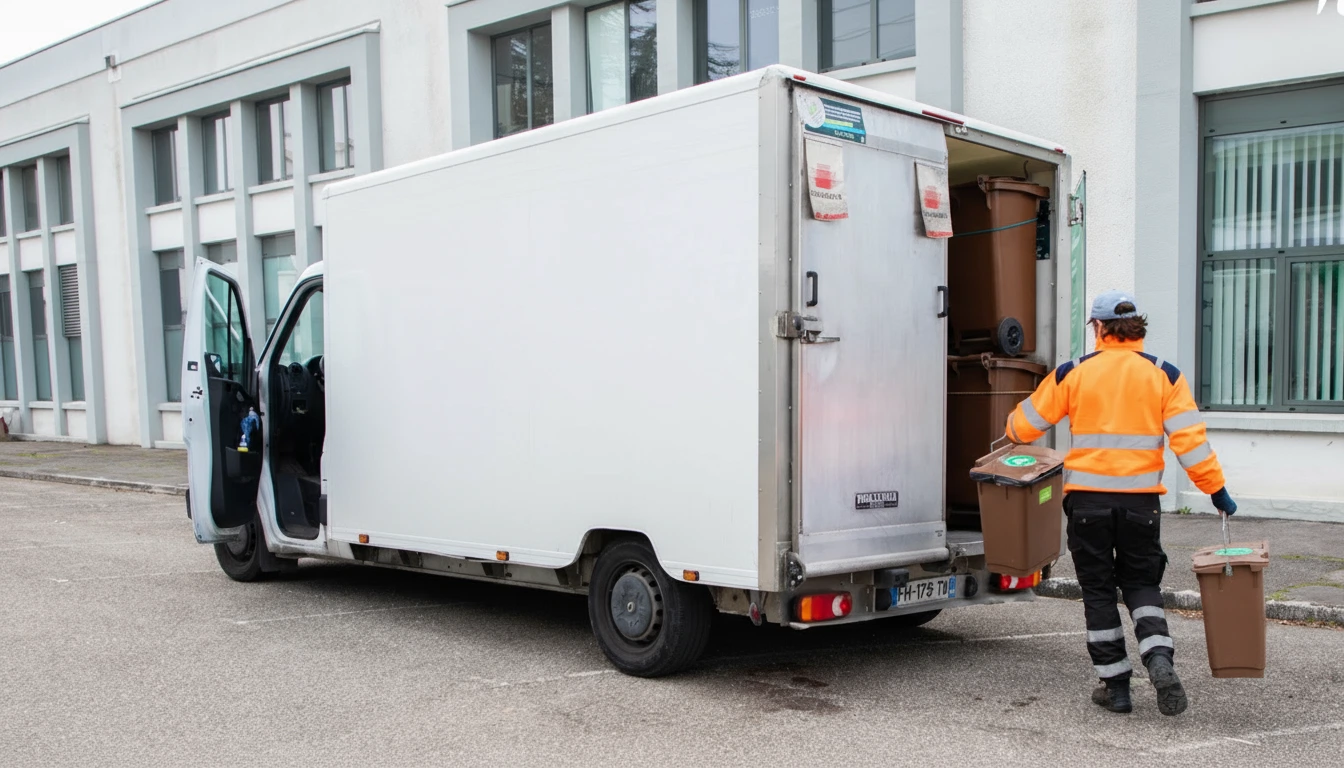
Our teams collect the full bins at the agreed frequency (weekly, fortnightly, etc.). Collection is usually carried out by a truck dedicated to bio-waste.
4. Organization:
Who empties the "bio-bin"? Internally, a designated person will be responsible for regularly emptying the small containers (bio-bins) into the main bin.
Where should I store the bins for collecting organic waste?
It is best to store bins indoors or sheltered from the weather, in a location that is easily accessible for collection and well ventilated to prevent odors. A dedicated, clean, and dry location is ideal. Keep them away from food preparation areas.
What solutions are there to limit nuisances (odors, gnats, etc.)?
Easy To Compost supports you by providing:
- Airtight, well-maintained bins
- Strict sorting guidelines
- Appropriate collection frequency to avoid prolonged waste storage.
- For on-site composting, we offer odor control solutions and advice on limiting pests.
Collection of bio-waste in large cities such as Paris and Lyon
Easy To Compost operates in several French cities, supporting businesses and local authorities in their organic waste management initiatives.
Paris: Faced with urban environmental challenges, Paris is stepping up its efforts in the area of bio-waste collection. Easy To Compost offers solutions tailored to Parisian establishments (restaurants, hotels, shops, etc.).
Lyon: Lyon is a city committed to ecological transition. We support Lyon-based companies in setting up efficient and sustainable systems for collecting their bio-waste.
Clermont-Ferrand: We offer solutions tailored to the specific characteristics of the Auvergne region, with a focus on local composting and the recovery of regional resources.
Strasbourg: The city is investing in the circular economy. Easy To Compost offers innovative solutions for Strasbourg-based companies concerned about their environmental impact.
Montpellier: We operate in Montpellier and the surrounding area, offering personalized services tailored to the needs of different types of businesses (hotels, restaurants, shops, etc.).
How to estimate the cost of collection
To give a concrete order of magnitude, the monthly cost of collecting biowaste depends mainly on two variables: the price per collection, linked to the volume of waste produced at each collection, and a variable portion indexed to the total weight collected. The calculation is based on an annual estimate (52 weeks), to which is added a treatment cost of €0.15 per kilo, all of which is then converted to a monthly equivalent.
The collection fee varies in stages depending on the source and whether the collection takes place indoors or outdoors, reflecting logistical, health, and operational constraints. This method provides a realistic estimate that is representative of market prices, while remaining simple enough to be used independently.
The calculation formula
(Cost per pass x 52 weeks + $0.15 x Weight in kilograms) / 12 months
Price per trip depending on the deposit:
Cost of passage for outside
between0 and 100 kilograms -> €25 per passage
between 100 and 200 kilograms -> €30 per passage
between 200 and 500 kilograms -> €35 per passage
between 500 and 1500 kilograms -> €40 per passage
between 1500 and 2250 kilograms -> €45 per trip
between 2,250 and 3,000 kg -> €50 per trip
Cost per trip for the interior
between0 and 120 kg -> €30 per trip
between 120 and 240 kg -> €35 per trip
between 240 and 360 kilos -> €40 per trip
between 360 and 540 kilos -> €45 per trip
between 540 and 720 kilos -> €50 per trip
Feel free to contact us for a free audit of your food waste and to find the solution that best suits your needs!