
How to make compost?
practical guide to get you started
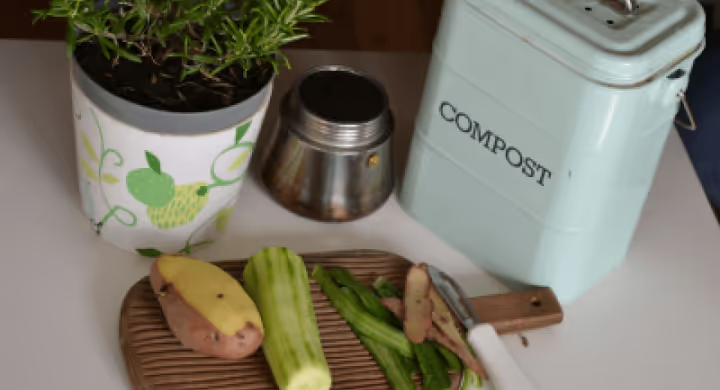
Turning food waste into a useful resource is possible, and often easier than you might think. Composting doesn't require a garden, special skills, or complex equipment, just a few basic principles to understand and a few easy mistakes to avoid.
In this guide, you will discover how composting really works, how to choose the right method for your situation, and how to make effective compost without odors or pests. Whether you live in a house, an apartment, or a business, you will find practical tips to help you get started.
What is compost?
Compost is the result of a natural process of organic matter decomposition in the presence of oxygen, moisture, and a variety of microorganisms. It produces a stable, humus-rich material that improves soil structure and fertility.
In other words, what we throw away (peelings, coffee grounds, plant debris, etc.) can be turned into useful organic fertilizer, provided we follow a few simple rules. This process is neither dirty, dangerous, nor complex. It is based on a biological balance between inputs, air, and water.
What are the different types of composting?
There are several methods of composting. They all have the same goal, but are adapted to different contexts in terms of space, volume, or frequency of use.
Aerobic composting (i.e., "in the presence of oxygen," the most common type)
Aerobic composting requires regular turning and allows for effective, odor-free decomposition with proper monitoring. This is the composting method used in traditional home composters, shared composters, and businesses. It can take different forms, depending on the equipment used:
- Static bin composting(standard in gardens)
- Rotating composter, which facilitates aeration through regular mixing. Handcrafted/DIY in private homes, this system is also used by Easy To Compost because of its simplicity and efficiency in models for businesses or communities.
- Electromechanical composter (plugged into the mains), which automates certain functions (aeration, temperature, mixing): this type of equipment is suitable for facilities that process larger volumes, with higher budgets and maintenance teams.
Vermicomposting
This method uses earthworms, which are naturally present in soil, with certain species known for their usefulness in composting (Eisenia fetida worms, in particular). It is particularly suitable for small volumes, indoors or on balconies. It generates very little odor and produces compost quickly, but is sensitive to temperature variations and errors in input.
The compost produced is highly concentrated, with a rich "juice" (called compost tea) that must be diluted for use as fertilizer. Ideal for apartments, small offices, or schools.
Bokashi (with anaerobic fermentation)
It is an oxygen-free process based on inoculation with microorganisms (EM).
The bokashi system is based on the fermentation of waste in a sealed bucket using specific microorganisms. This process is anaerobic (oxygen-free): it does not produce compost per se, but rather a pre-digested material, which must then be buried or added to traditional compost to complete its maturation.
It can be useful for small spaces or as a first stage of treatment, but does not work on its own in the long term.
It is a compact solution that is effective indoors, but requires an additional maturation stage.
Composting in piles or pits
- Rustic method: piles on the ground or in a cavity
- Requires space, not well suited to urban environments
- Slow but not very restrictive
- Suitable for gardens, farms, or rural areas with little traffic.
The choice of composter depends on several criteria: available space, amount of bio-waste produced, type of building (individual or collective), environment (urban or rural), and use (domestic or professional).
Garden composter → For individual homes with outdoor space
Advantages: robust, large capacity
Limitations: requires some maintenance
Rotating composter → For regular domestic use
Advantages: easy to mix, faster composting
Limitations: limited capacity
Electromechanical composter → For canteens, collective catering, businesses
Advantages: automated, fast, no nuisance
Limitations: high cost, requires power supply
Worm composter → For apartments, offices, indoors
Advantages: odorless, space-saving
Limitations: sensitive to temperature and humidity
Bokashi → For use in indoor kitchens
Advantages: compact, fast, very low maintenance
Limitations: the result must then be buried or composted
Shared composter → For condominiums or neighborhoods
Advantages: sharing, creating social ties
Limitations: requires good coordination between users
Some devices sold as "kitchen composters" are actually dehydrators. They heat bio-waste to a high temperature, dry it out, and then grind it. The result is a dry, inert residue with no biological activity.
In addition to the machine's high energy consumption, unlike mature compost, this residue: does not enrich the soil with living organic matter, is not a complete soil amendment, and often has to be buried or thrown away. These devices may be useful in certain situations (reducing volume in kitchens), but they do not produce compost. They are therefore no substitute for home composting or proper bio-waste management.
Aeration: compost needs oxygen
Home composting is an aerobic process, meaning that it requires oxygen to function properly. In the absence of air, other microorganisms, known as anaerobic microorganisms, take over... but their activity produces methane, fermentation odors, and slows down decomposition.
Good aeration allows:
- Bad odors to be avoided
- The transformation of materials to be activated
- The formation of juice or compacted areas to be avoided
In concrete terms, this means that you must:
- Stir your compost regularly (every 10 to 15 days)
- Avoid overloading it with very wet waste or thick layers (fresh grass, for example)
- Alternate brown and green layers to promote an aerated structure
