
The on-site composter for businesses and local authorities
On your own site, with no smell and no vermin. The ABC composter mixes and aerates the material on its own: two minutes on the crank a week, and your food waste is treated where it is produced.
- The composter on its own, from 79 € excl. VAT a month
- With collection and local spreading, from 89 € excl. VAT a month in France
They trust Easy To:




In figures
What that looks like, in practice
450 litres, two minutes on the crank. I checked. Peazy
Peazy
Peazy
Your setting
From the head office to the logistics hub
Seven settings, the same question in each: where does your food waste go? Find yours.
Not seeing your setting? We work with other sectors too: let’s talk.
Wherever your sites are
One team, however many sites you have
We work with you remotely and we ship right across Europe. A multi-site group deals with that same team, wherever its locations are, and arranges collection locally with the contractor of its choice. Click on a portrait to write to someone, on the badge to connect on LinkedIn.
The usual pattern
- A different supplier in every region
- One contract, one price and one notice period per site
- Collection frequencies that vary from one location to the next
- As many pieces of paperwork to gather as there are suppliers
For a group with twenty sites, that means twenty contacts, twenty invoices and no overall picture when the reporting comes round.
At Easy to Compost
One team
From the first assessment to the consolidated report
They organise the roll-out site by site They plan the delivery schedule for each of your locations They apply the same commercial terms and the same protocol everywhere They give you one single report covering all your sites
You arrange collection locally, with the waste contractor you choose. Keeping track of it is not something you hand off, though: one supplier, one contract, one set of figures.
- One teamShipping right across Europe: we can look after several of your sites at once, in more than one country.
- One single contractThe same price, the same sorting protocol and the same reporting across all your locations.
Case study
What happens once the composter has been delivered
How much does it cost?
Your quote: online right now, or on a call with the team
What you pay depends on your food waste volumes and on how often the composter is emptied. You can work it out without waiting for anyone: five questions online are enough. And if you would rather talk it through, someone from the team calls you back.
Get an online quote Five questions, a monthly figure, the PDF straight after. Nobody calls you unless you ask.or, over the phone
- A call back within 1 working hour, on weekdays
by someone on the team who knows your file, not by a call centre.
- A short phone assessment of a few minutes
volumes, meals served, the spot you have in mind.
- A tailored estimate within 24 h
based on your volumes, with a breakdown of what is included.
No commitmentQuote within 24 h
Get an estimate
The five questions we get asked before signing
You are already asking them. Each answer fits on one line.
‘Composting with no smells and no flies, is that really possible?’
The ABC composter came out of four years of research in mechanics and biology: continuous aeration by natural draught, mechanical mixing, the Easy to Compost bulking material recipe and a vessel rodents cannot get into.
‘Who handles collection, and how often?’
Composting on site cuts the number of collections. What leaves the site is mature compost, every 1 to 12 months depending on your volumes; its removal is arranged with the local operator of your choice, and we help you scope the brief. Your teams simply carry on sorting.
‘What can go in it?’
All food waste: peelings, plate scrapings, coffee grounds, eggshells, bread, spoiled fruit. No plastic, no packaging, no liquids. The full list and the signage come with it, to avoid sorting mistakes.
‘Will we be compliant with the food waste rules?’
Article 22 of the Waste Framework Directive (2008/98/EC) has required food waste to be either collected separately or recycled at source since 31 December 2023: those are the two routes the text provides. The United Kingdom sits outside the directive and runs four regimes: Simpler Recycling in England, the Waste (Scotland) Regulations 2012, Workplace Recycling in Wales and Northern Ireland’s own rules; Ireland is in the EU and applies the directive. The composter treats your food waste on the site that produces it and takes 65% of the mass out of the stream. What each regime asks of your own establishment is a matter for the law of your country. What applies where.
‘Where do you put the composter on a business site?’
Our models fit anywhere: a yard, a car park, a waste area, a terrace, a bin store, even indoors for small volumes. We advise on the siting, and there is nothing to build.
Our composters Organising local collection We also recycle your cigarette buttsAll the questions →
Configurator
Configure your composter, finish included
Five colours and the planter option, all at the same scale so you can compare them.
Our mission: to make composting simple for your teams.
We give food waste back to the soil. That is the whole idea.Peazy
Peazy
On-site treatment
From your kitchens to your own grounds, in four steps
The composter does not store your food waste: it composts it on the spot. Everything else follows from that.
- 01You sort
Caddies and posters in your spaces.
- 02It composts on the spot
No smell; the material loses 65% of its mass.
- 03You empty it when it is full
Every 1 to 12 months, depending on your volumes.
- 04Back to the soil
Mature compost, for your own beds and green spaces.
How often it has to be emptied
52 with a weekly collection
1 to 12 emptyings a year
Fewer lorries, less CO₂, lower disposal costs.
Where it goes

Composted on site, given back to the soil
What comes out of the composter is mature compost, and it is yours. Most sites use it on their own beds, borders and green spaces; where it has to leave, its removal is arranged with the local operator of your choice, and we help you scope the brief. Either way, the food waste goes back to the soil.
- Young compost. What comes out of the vessel goes onto your own grounds as it is. Handing it to a third party brings the fertilising-material rules into play, and the animal by-products rules where catering waste is involved.
- Where it goes. Your own green spaces, a community garden, or removal by a local operator you choose.
- Little left to move. The material loses around 65% of its mass while it composts, so what does leave is a fraction of what came in.
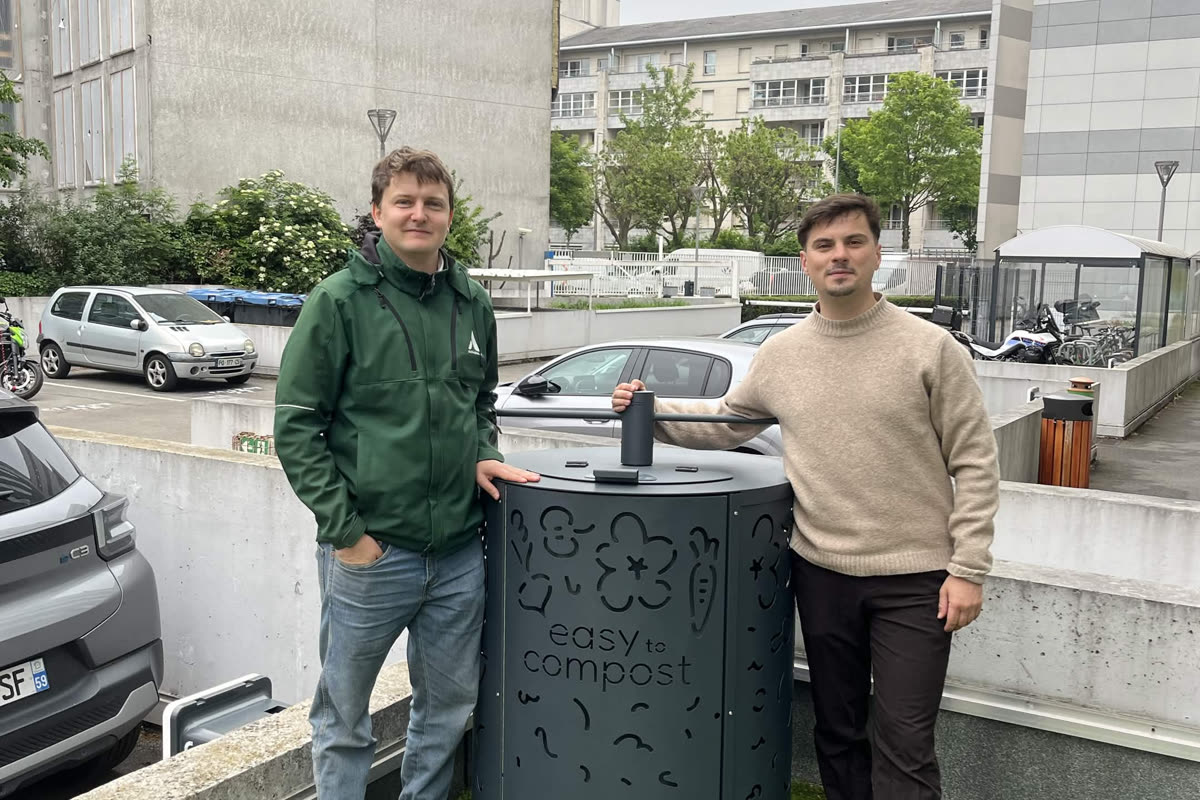
One lorry every three months instead of one a week. Works for me. Peazy
Peazy
PeazyA free remote assessment, a clear recommendation, a quote from our team
Thirty minutes on a video call is enough to go over the food waste separation duty that applies where you operate, size the right set-up for your volumes and estimate what you would save.
30 min video call · No commitment · Quote within 24 h
