On-site composting for non-food retail (Decathlon, Leroy Merlin, fashion, sport) and small food shops (under 2 t a year). No odour. Food waste recycled at source: one of the two routes Article 22 provides.
Your food waste bins take up space you do not have. Every square metre of back of house is sales floor you are not using.
Our answer. A compact, vertical composter. A smaller footprint than 4 bins of 240 L. It installs in a yard or a room away from the sales floor.
A customer glimpsing your back of house through an open door happens. A smell near the cheese or meat counter is noticed immediately. Your reviews feel it.
Our answer. continuously aerated by its aeration chimney, a closed steel vessel. No odour in store, even close to sensitive areas. It can go behind a partition or in an enclosed yard.
You have to trace it, prove it, recover it. Group directives (Decathlon, Leroy Merlin and others) call for reporting. And it eats your time in the back office.
Our answer. A log sheet supplied with the composter: date, weight and destination at each emptying. You keep the record, and we give you the emission factors and the method so your own team can calculate the saving.
A non-food retailer: the waste comes from the break room, not the shelves. The figures below come from our calculator, using the same method as your online quote.
416 kg of food waste a year
That is 416 kg a year, almost all of it produced in the break room.
Total79 € excl. VAT/month
48-month commitment. You keep the compost and use it on site.
Optional Removal of the mature compost, if you do not use it yourself: it is arranged with a local operator of your choice, and we help you scope the brief. As a French benchmark, a site like this one takes 2 collections a year, that is +20 € excl. VAT a month, bringing the total to 99 € excl. VAT a month.
Get figures for my own site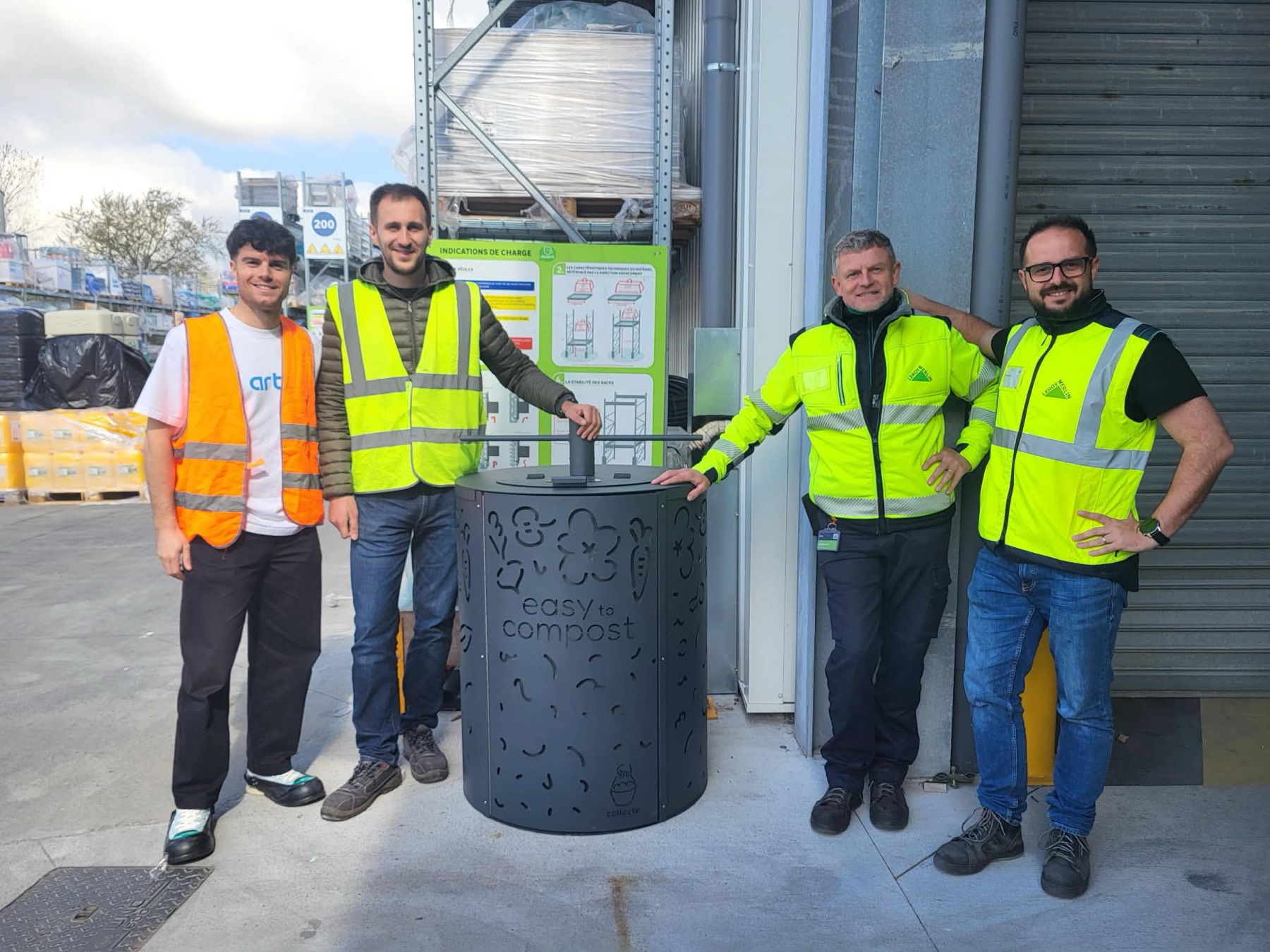
From accepting the quote to the first emptying: the location is agreed within 24 hours, delivery follows in 1 to 3 weeks.
The goods-in area or the loading bay, on the staff side. No impact on the sales floor, and less than one square metre.
Where the waste actually arises: coffee, lunches, fruit. One caddy per break area, sorting poster included.
One session at the start, visuals that stay up, and the material to bring new starters on board without calling us back.
Two removals a year in this case, arranged with a local operator. For a multi-store group, one operator can cover the whole network and the reporting stays consolidated by brand.
Emptying is optional. If you have a green space, a kitchen garden or planted beds, the compost stays with you.
The ABC composter delivered, the bulking material delivered, maintenance, remote training and the team awareness kit. You keep the compost and use it on site.
See this offerThe same, plus the mature compost taken away: 2 removals a year for this example, handled by a local operator you contract. Nothing piles up on your site.
See this offerIn France, collection is billed at 10 € excl. VAT a month per annual visit, from 1 to 12 collections a year depending on your actual volumes; elsewhere the removal of the mature compost is arranged with a local operator of your choice, and we help you scope the brief. Above 1,500 kg a year, a second composter is added.
Separating food waste at source applies to non-food retail too: the break room produces it. In food shops, unsold stock and fresh returns are added on top, often with far larger volumes. Exactly what applies to you depends on your jurisdiction.
Rules differ from one jurisdiction to the next, but the direction is the same everywhere: food waste has to be separated at source and recovered, either composted on site or collected separately. Check what applies where you operate.
The rules where you operateYes. The obligation covers the food waste you produce, not what you sell. A break room used by 120 people generates close to 600 kg a year, which has to be separated at source.
No. The composter goes on the stockroom or loading bay side, on less than one square metre. The caddies stay in the break room.
Donation comes before composting: anything still edible goes to a charity. The composter takes what can no longer be given away, damaged fruit and vegetables first.
Yes, with a single contract, the same price per site and consolidated reporting. That is the most common arrangement among retail chains.
We also recycle your cigarette buttsThe 36 questions in the FAQ →
A shopping centre combines both trades: see also hotels & resorts and industry & logistics.
 Peazy
PeazyThe quote is done online, price included, or over a call with our team.

Smoking areas, terraces, forecourts: Easy to Change collects and recycles the cigarette butts on your site, with the same method as your food waste. We install, we collect, we report.
