On-site composting of food waste for hotels, hotel restaurants, brasseries and resorts. No odour, no nuisance. Food waste recycled at source: one of the two routes Article 22 provides. Free assessment.
In high season your food waste volumes go through the roof. A fixed weekly collection costs you dearly in July and August, and far too much in November and February.
Our answer. The frequency follows your activity. From 1 to 12 emptyings a year, tailored to your seasons. The composter is emptied when the bins are full, not to a rigid schedule.
A bin store that smells, rodents spotted on the terrace, a star lost in the reviews. Waste management is also reputation management.
Our answer. The ABC composter in 2 mm steel, a closed vessel, continuously aerated by its aeration chimney. No odour, no pests. It can go inside the kitchen or outside, with a finish of your choosing.
You have to trace your food waste. A quality audit (hotel group, label, certification) asks for precise records. And there is no time to build them in-house.
Our answer. A log sheet supplied with the composter: date, weight and destination at each emptying. You keep the record, and we give you the emission factors and the method so your own team can calculate the saving.
30 breakfasts served on an average morning, 20 covers a day in the restaurant, open 6 days out of 7. The figures below come from our calculator, using the same method as your online quote.
578 kg of food waste a year
That is 578 kg a year: peelings, coffee grounds, bread, plate scrapings and trimmings.
Total79 € excl. VAT/month
48-month commitment. You keep the compost and use it on site.
Optional Removal of the mature compost, if you do not use it yourself: it is arranged with a local operator of your choice, and we help you scope the brief. As a French benchmark, a site like this one takes 3 collections a year, that is +30 € excl. VAT a month, bringing the total to 109 € excl. VAT a month.
Get figures for my own site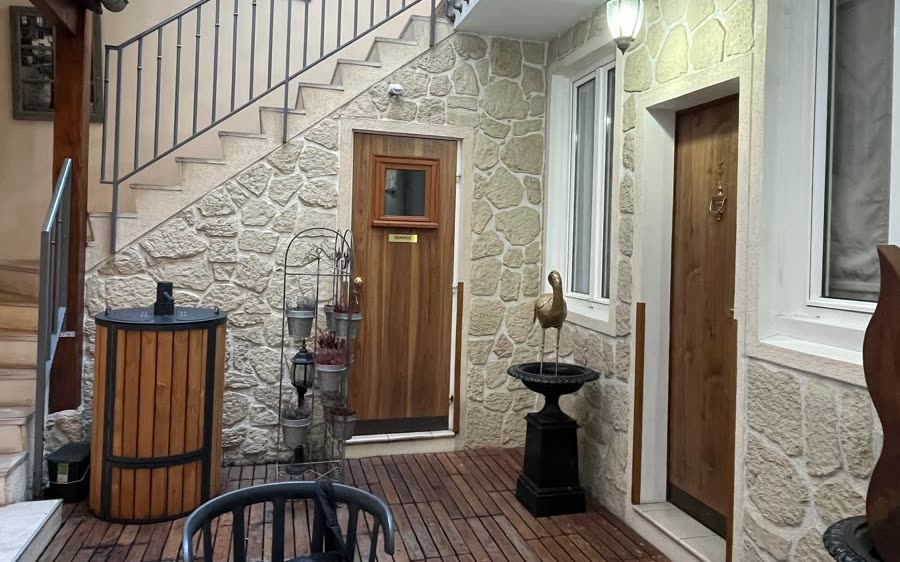
From accepting the quote to the first emptying: the location is agreed within 24 hours, delivery follows in 1 to 3 weeks.
The service yard, next to the bin store, out of sight of guests. Less than one square metre of floor space.
One at the prep station, one at the wash-up. Emptied into the composter at the end of service, like an ordinary waste bin.
One session with the kitchen brigade and the housekeeping staff. Turnover is high in this sector: the posters stay up, and we run the session again remotely for new starters.
Three removals a year in this case, timed outside service hours and arranged with a local operator. The bulking material comes in a delivery of its own, on its own schedule.
Emptying is optional. If you have a green space, a kitchen garden or planted beds, the compost stays with you.
The ABC composter delivered, the bulking material delivered, maintenance, remote training and the team awareness kit. You keep the compost and use it on site.
See this offerThe same, plus the mature compost taken away: 3 removals a year for this example, handled by a local operator you contract. Nothing piles up on your site.
See this offerIn France, collection is billed at 10 € excl. VAT a month per annual visit, from 1 to 12 collections a year depending on your actual volumes; elsewhere the removal of the mature compost is arranged with a local operator of your choice, and we help you scope the brief. Above 1,500 kg a year, a second composter is added.
Catering is the first sector targeted by source separation, and the most closely inspected. Wherever you operate, the rule applies whatever the number of covers served, a neighbourhood brasserie included; the exact regime depends on your jurisdiction.
Rules differ from one jurisdiction to the next, but the direction is the same everywhere: food waste has to be separated at source and recovered, either composted on site or collected separately. Check what applies where you operate.
The rules where you operateIt goes in the service area, not out front, and gives off no odour: the mixing keeps composting aerobic and the bulking material absorbs the moisture. Several hotels choose to show it to their guests instead.
The vessel is closed and steel cannot be gnawed through. It is the open food waste bin, left waiting for collection, that attracts rats and flies, not a closed composter.
Small quantities of meat scraps are fine. We set the rules during training, based on your menu and your volumes.
The volume climbs and the emptying frequency follows. The range runs from 1 to 12 emptyings a year; in high season extra emptyings are added rather than let it overflow.
We also recycle your cigarette buttsThe 36 questions in the FAQ →
Production kitchens turn up in retail & commerce and in healthcare & care homes.
 Peazy
PeazyThe quote is done online, price included, or over a call with our team.

Smoking areas, terraces, forecourts: Easy to Change collects and recycles the cigarette butts on your site, with the same method as your food waste. We install, we collect, we report.
