
Food waste rules
Separating food waste is no longer optional
Since 31 March 2025, workplaces in England must keep food waste separate from general waste. No tonnage threshold, no exemption for small producers: a twenty-cover café is under the same rule as a distribution centre. Most businesses meet the duty by paying a contractor to take it away. There is a second route, and it does not involve a lorry.
The essentials
Three things to remember, if you read nothing else
The law
One duty, two ways to meet it
The duty comes from section 57 of the Environment Act 2021, which inserted new obligations into the Environmental Protection Act 1990. For commercial and industrial waste, section 45AZB(3) requires that recyclable relevant waste be collected separately from other relevant waste. The Separation of Waste (England) Regulations 2024 then set out which streams that covers, food waste among them.
Treatment on site
You treat your food waste where it is produced, by composting. The Simpler Recycling guidance is explicit that on-site composting is a permitted alternative to food waste collection: compost it where it arises and you are not required to arrange a separate collection for it.
Separate collection
You hand your food waste to a contractor who collects it separately and treats it elsewhere, in industrial composting or anaerobic digestion.
The law prescribes no particular process: it requires food waste to be separated at source, then genuinely treated. The choice of solution is yours. What it does not allow is mixing that stream back in afterwards, sorting done later, at a treatment plant, does not meet the duty. And composting on site does not exempt you from anything else: glass, metal, plastic, paper and card still have to be separated too.
Since when
England came last, and set two dates
England is the last of the four UK nations to bring this duty in. There was never a tonnage threshold to lower here: the rules simply came into force, on one date for most workplaces and a later one for the smallest.
- 2012Scotlandregulations made
- 2015N. Irelandregulations made
- 20165 kga week, Scotland
- 2021EnglandEnvironment Act
- 2024Walesfrom 6 April
- 2025Englandfrom 31 March
- 2027micro-firmsfrom 31 March
The two English dates come from the government Simpler Recycling guidance and from the commencement of the inserted sections, rather than from the 2024 and 2025 regulations themselves. Micro-firms, fewer than 10 full-time equivalent employees, counted across all your sites, part-time staff pro rata, have until 31 March 2027. There is nothing to register: the exemption applies automatically, and it expires automatically.
Who is covered
Every workplace in England, whatever the quantity
The duty covers workplaces in England, private and public alike. It applies to the waste you produce, not to what you sell: an office with no kitchen still produces food waste, coffee grounds, lunches brought in, fruit. Wherever there is a kitchen, a canteen, a tea point or unsold food, it applies.
Hospitality, in all its forms
Restaurants, pubs, cafés, caterers, food courts, dark kitchens: the number of covers no longer counts.
Accommodation and healthcare
Hotels, holiday parks, student halls, care homes, clinics and hospitals, for their kitchens as much as for plate returns.
Offices and industry
Head offices, coworking spaces, staff restaurants, industrial sites and logistics platforms with a canteen.
Retail and education
Supermarkets, greengrocers, bakeries, butchers, primary and secondary schools, sixth forms and universities with catering.
A caveat before you read on: the rules set out on this page are those of England. Each of the four UK nations runs its own regime, and Ireland, still in the EU, has its own again, operate across borders and you are under more than one. What applies where is set out further down.
What you need to be able to show
Separating is not enough: you have to be able to show it
The Environment Agency enforces the workplace duty in England. A check does not stop at the existence of a bin: what matters is that the material is genuinely treated, and that you can show where it went.
The arrangement itself
A contract with a waste contractor, or evidence of a treatment solution on your own site.
Your waste log
A log of the quantities leaving the site and where they went, kept up to date and retained.
Collection paperwork
One document per collection, dated and weighed, showing that the material was taken away.
Team training
Sorting is done by people: their training in what goes where, and a record of it, belong in the same file.
What you are exposed to
Who enforces it, and what applies where
The Environment Agency enforces the workplace duty. It can issue a compliance notice. Failing to comply with that notice is an offence, and enforcement action may follow.
| Where | The rule |
|---|---|
| Scotland | Waste (Scotland) Regulations 2012 |
| Wales | Workplace recycling, in force 6 April 2024. Sending food waste to sewer banned outright |
| Northern Ireland | Food Waste Regulations (NI) 2015 |
Ireland is a separate case: it is still in the EU, and since S.I. 294/2024 widened S.I. 508/2009 on 1 July 2024, every commercial food waste producer is covered, with no threshold. On-site composting is allowed there too, but it needs a Certificate of Registration from the local authority. And the consequences that bite first are often more mundane than enforcement: a higher waste bill, a finding in a quality audit, a blocking point in a tender.
Putting it right
Three routes, depending on what you produce
Which route suits you depends above all on how much you produce in a year. A composter is sized to your volume: above a certain volume, on-site composting stops being the sensible answer and a collection contract does.
Collection by a contractor
You separate in the kitchen, a lorry takes the bins away. Simple to set up, but the cost and the carbon footprint climb fast once collections are weekly.
On-site composting
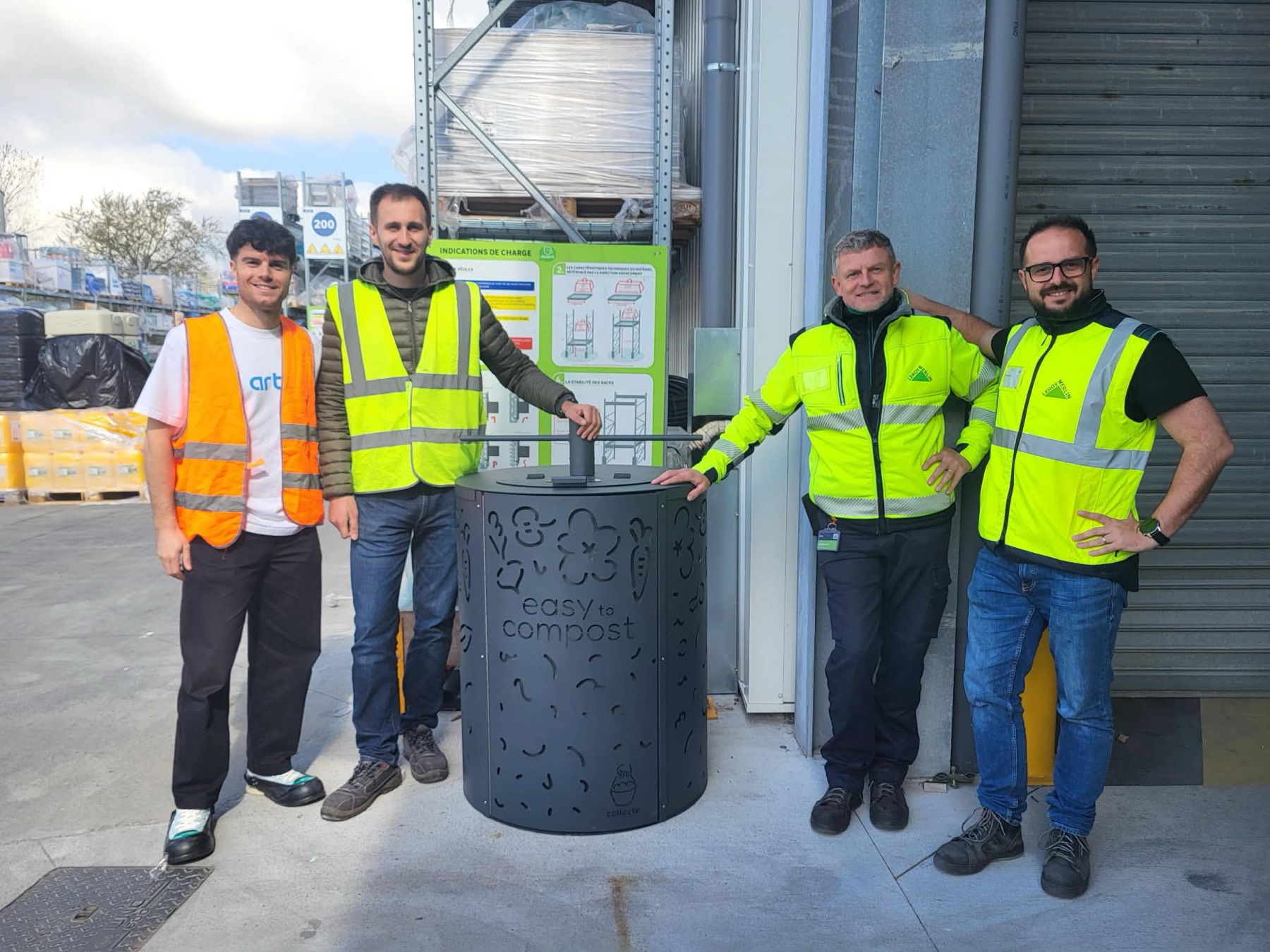
The material is treated where it is produced, and only leaves once it has been reduced and stabilised: the composter takes 65% of the mass out, and turns fifty-two collections a year into a handful, with no electricity and no connections. What comes out is compost, and you need somewhere to put it: grounds, planting, a neighbouring farm, or a contractor who takes the finished material rather than the raw waste. From 79 € excl. VAT a month.
Anaerobic digestion
Suited to large industrial volumes, it produces biogas. Oversized for a site producing less than a few tonnes a year.
One more sorting rule, and it is not a limitation. Regulation (EC) 1069/2009 treats catering waste as Category 3 material once it contains animal matter and is destined for composting, and that material belongs in an approved facility. In practice it does not stop a site with a kitchen from running a composter: it means one more fraction gets separated. Peelings and trimmings, fruit and vegetables, coffee grounds, tea leaves, prunings, cut grass and flowers go into the composter; meat, fish and plate scrapings stay on your existing route. The rule is set during the training session, according to your kitchen and your menu.
Going further
The detail, text by text
This page gives the framework. Our other guides go into the practice, sector by sector and question by question.
The route Composting at work, and what it takes off your hands The machine, the method, and what a site actually has to do. By sector Food waste, sector by sector Hospitality, offices, retail, healthcare, public bodies. The other route Food waste collection for business How separate collection is priced and organised. The sorting rule What can go in a commercial composter Where meat and fish go, and why they go elsewhere. The output What to do with the compost you produce Grounds, planting, or a contractor who takes the finished material. Sizing Sizing a composter to your volume How much you produce, and how many units that means.
This page sets out the state of the law at its last update, as general information. It is not legal advice: for a particular situation, take advice from a qualified adviser or from the relevant authority. Last checked against primary sources on 1 September 2026, at legislation.gov.uk and in GOV.UK guidance.
Separating at source has been the law in England since March 2025. Do not look at me, I did not decide it. Peazy
Peazy
PeazyFinding out where you stand takes thirty minutes
Estimate your volumes and your budget online, or talk it through with an expert: we will tell you what the rules expect of your site, and what it costs to meet them.
