The Seine-Eure local authority is equipping its member towns in a single campaign. On a programme of this size, the subject is not the composter: it is the production run, the lorry, and the 30 minutes of installation repeated 150 times.

In France, since 1 January 2024, separation at source of food waste has applied to every producer, with no tonnage threshold at all. For an local authority, that obligation arrives through two different doors, which should not be confused.
School canteens, staff restaurant, technical services, sheltered housing for older people: a local authority produces food waste of its own. On that count it is a producer like any other, subject to separation at source for its own sites.
It is also responsible, in France, for the public waste management service for its residents. That is a second hat, distinct from the first: it concerns the organisation of the service, not the waste from its own buildings.
On a municipal lawn, next to a school or a town hall, the equipment is not tucked away in a bin store. It is in front of residents, neighbours and elected members, every day. Visual acceptance becomes a condition of success, not a finishing detail.
The ABC composter does not plug in: no electricity, no water, no drainage, no civil works. On public land that removes the trenching, the connection lead times and the road-works coordination. A flat, compacted piece of ground is enough.
This project sits in France, where failing to separate food waste at source carries a fine, an administrative penalty and, in the most serious cases, a criminal one. Those figures belong to French law and do not carry across a border. In the European Union the duty itself comes from Article 22 of the Waste Framework Directive 2008/98/EC, which since 31 December 2023 has required food waste to be either collected separately or recycled at source; the United Kingdom sits outside the directive and runs four regimes of its own, each with its own enforcing body and its own penalties.
It is the cheapest kit and the most common on neighbourhood composting areas. But it needs a trained champion at every drop-off point, regular turning and hand-dosing of bulking material. Badly run, it produces odours and attracts pests, right in the middle of a public space.
Workable on a site carried by a motivated group, hard to sustain across a programme of 150 units.
The same closed 2 mm steel vessel, the same aeration chimney, the same auger worked by a crank, the same capacity. It takes up less than 1 m² of floor space, and it comes on the same terms as the ABC composter: to buy, or to rent over 48 months. But standing bare in the middle of an open lawn, it reads as one more piece of technical equipment.
The right choice in a service yard or a bin store, much less so in full view of residents.
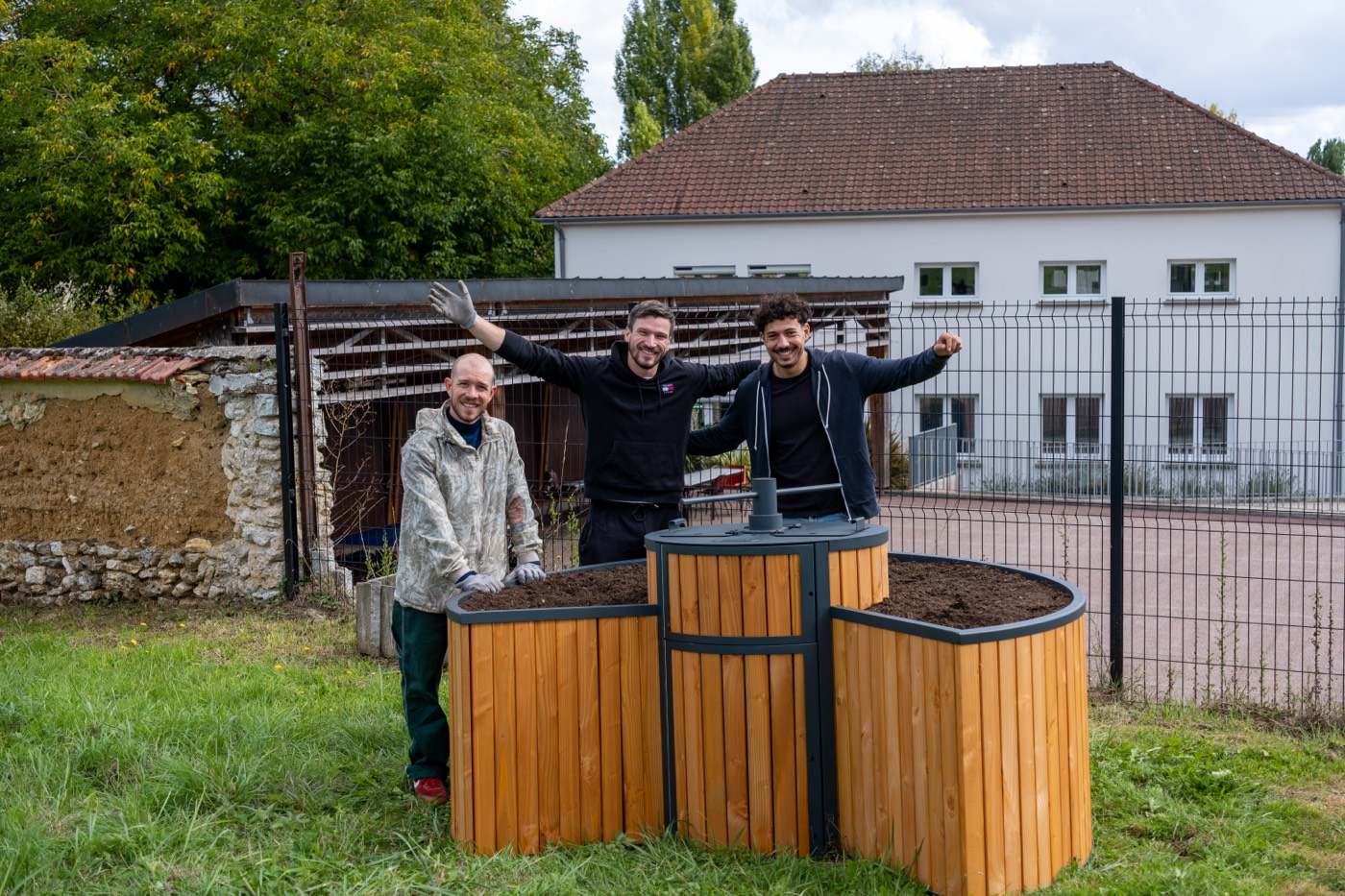
The same ABC composter, ringed with a circular 2,000 L planter built into the structure and filled with soil. The composting capacity does not change by a single gram. What changes is how it reads: a planted bed, tended like the town's other beds.
Chosen everywhere the equipment stays in public view.
A garden composter and a bare ABC composter take exactly the same volumes: up to 1,500 kg of food waste a year. What separates the two options is therefore not capacity. It is acceptance. On public land that is precisely what is most often missing: a technically faultless piece of kit can be turned down because it looks out of place.
The planter is not just decorative. A transfer grille lets the compost liquor be absorbed by the soil of the bed, which it enriches with nutrients, with no handling and no special watering. What would be an effluent to deal with on a standalone composter becomes fertiliser here, on the spot, at the foot of the planting.
That leaves appearance, settled in the workshop rather than on site: five colours to choose from, in the authority’s own colours if it wants them, and its logo carried on the cladding. One point worth making when the question comes up in a meeting: some finishes have an outer skin cut with decorative openings, but that is not what keeps animals out. The barrier is the inner 2 mm steel vessel, closed at the bottom and shut with a solid lid.
The garden composter in detail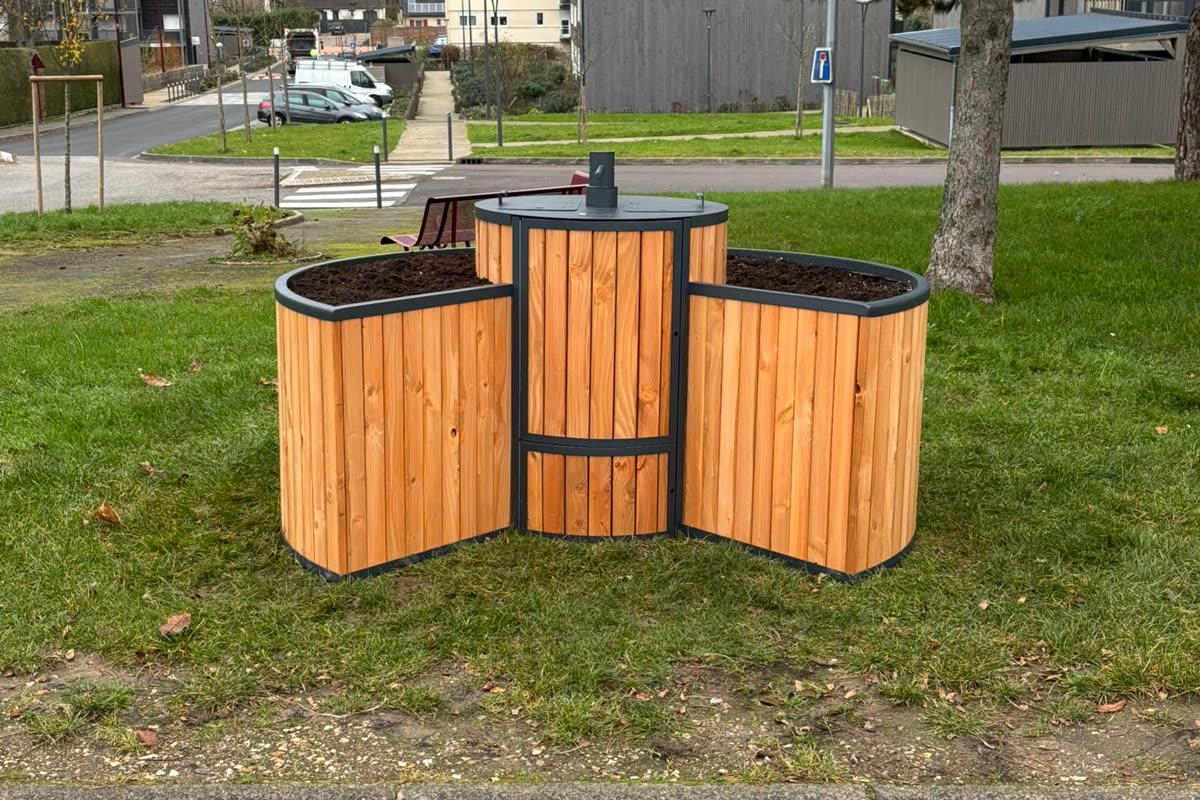
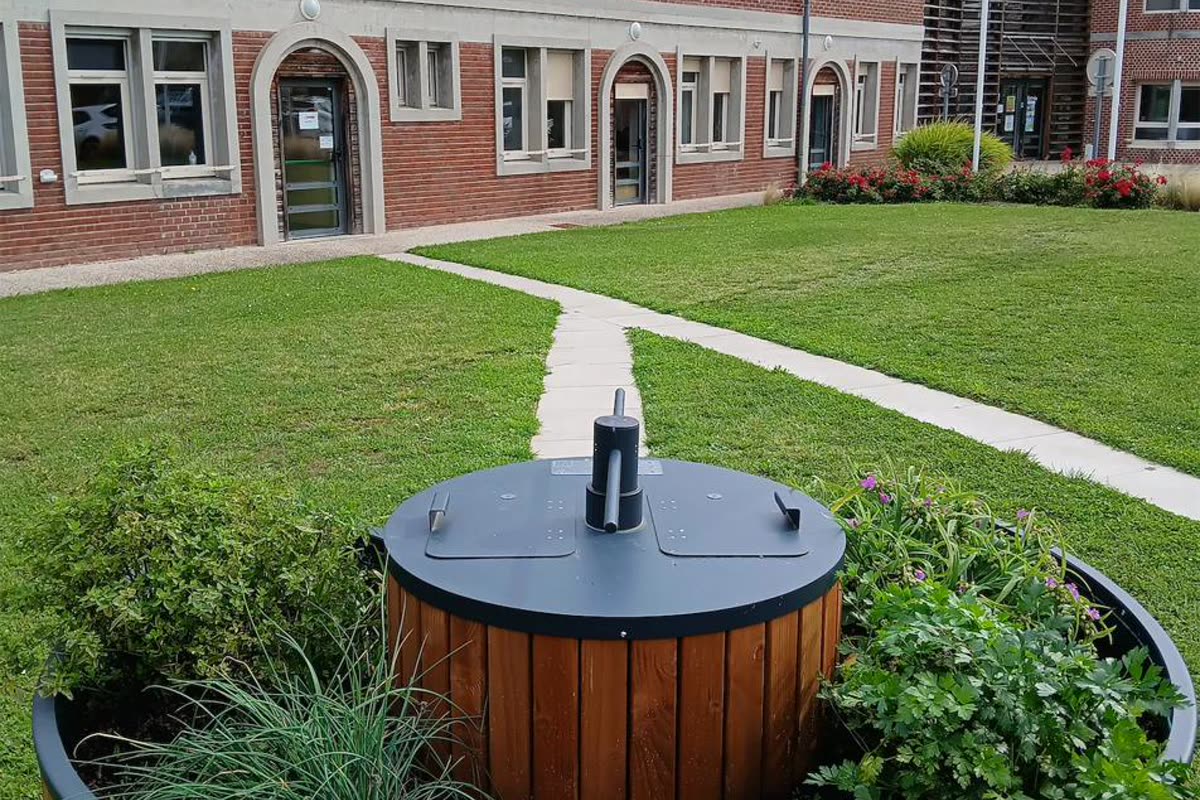
On one unit, everything is simple. On 150, repetition becomes the subject: build identical, load full, install fast, and leave behind a team able to run the equipment on its own.
The garden composters are built in our workshop in Albert, in northern France. The production run fixes the choices once and for all: the same 2 mm steel vessel, the same aeration chimney, the same colour, the same cladding. Decisions about appearance are made there, before departure, and not site by site.
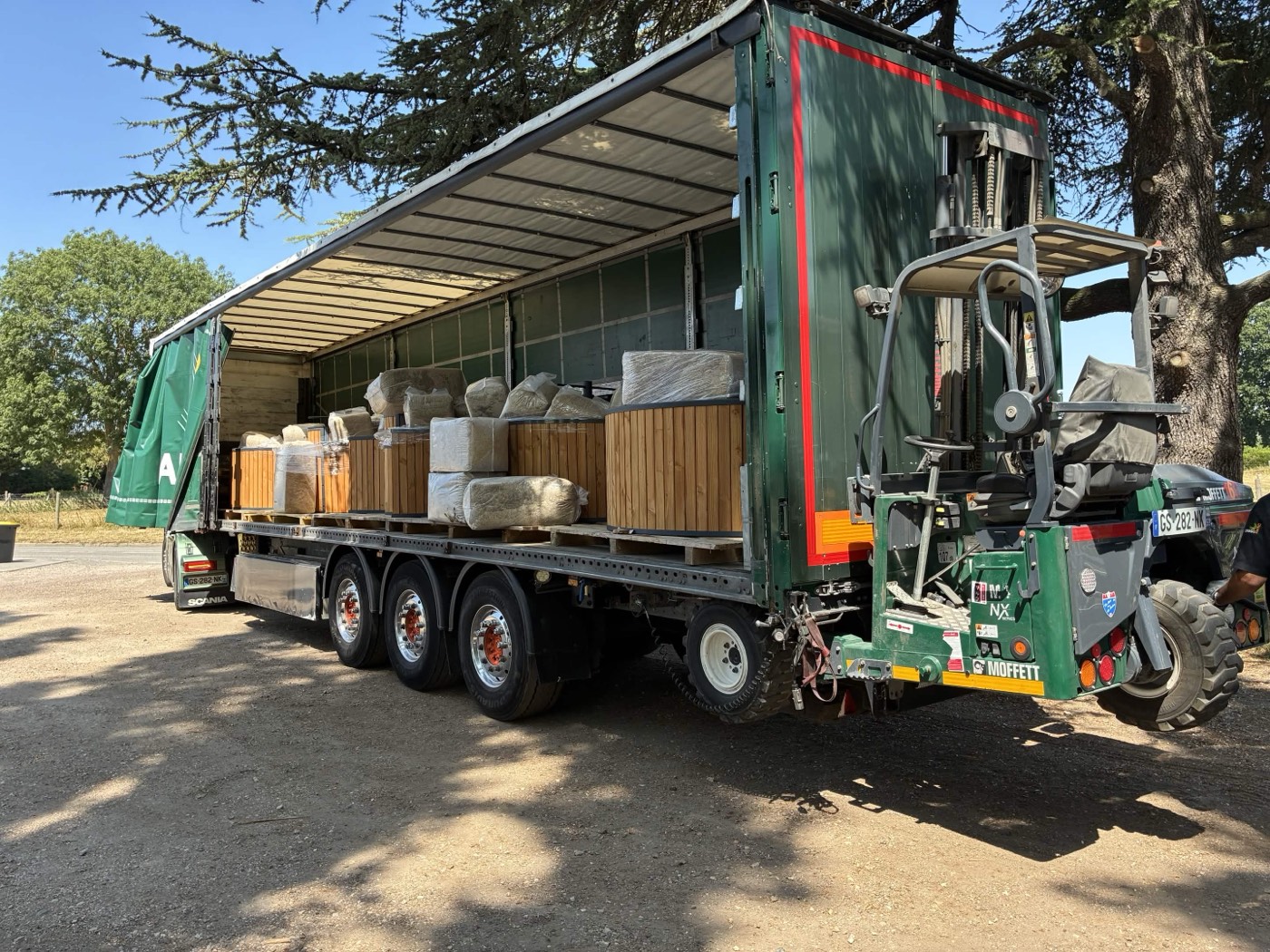
The kit leaves by full lorry loads, bulking material included: the bales of flax shives travel on the same trailer as the garden composters. An on-board forklift comes with the load, which avoids having to bring in handling equipment in every town.
You need flat, compacted ground and a little under 2 metres of diameter for the whole thing, which means 5 to 6 m² of footprint. No foundation, no connection, no waiting. That is what makes the repetition sustainable: several sites can be handled in the same day.
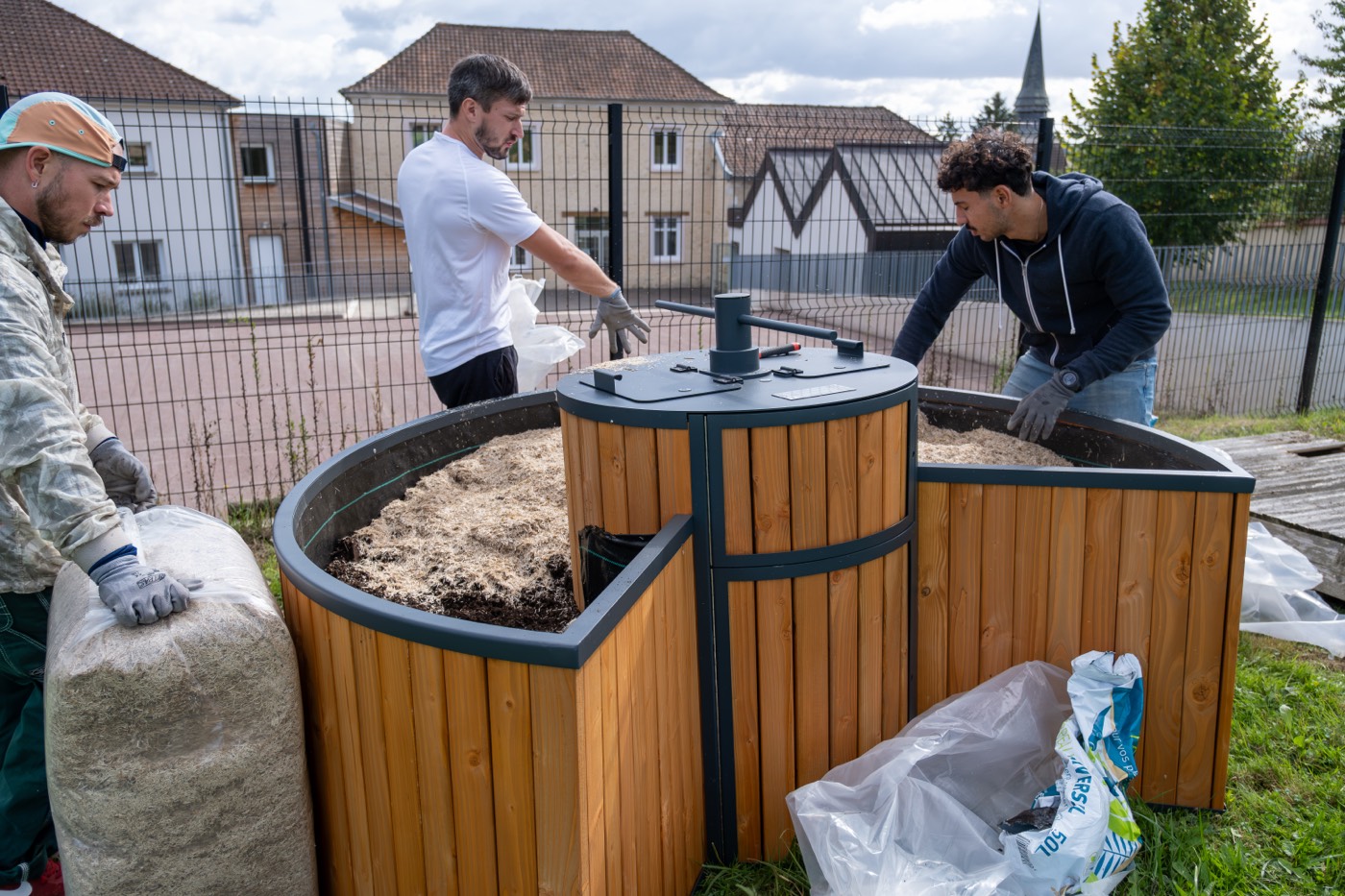
A thick layer of flax shives at the bottom to drain, then potting soil against the composter's holes, where the liquor comes out. Flax shives and potting soil are then alternated to the top, finishing without fail with potting soil, ready to plant. This is assembled on installation day, and never has to be done again.
This is the step that cannot be industrialised. In France the town's staff were trained on site: what can and cannot be composted, the dosing of bulking material, the 2 minutes of crank a week that mix the material, and taking the mature compost out through the bottom door. The awareness kit stays on site.
The planter is looked after like any municipal bed: watering, weeding, seasonal planting, by the grounds team or its contractor. Just one rule never to forget: no fresh food waste goes into the soil of the bed. Food waste goes into the composter, and only into the composter.
The capacity of a fleet is calculated. The tonnage it actually captures is measured. Those are two different things, and we publish only the first.
Each ABC composter offers 450 L of composting volume in a closed 2 mm steel vessel. Across the 150 units of the programme, that comes to 67,500 L of composting volume. The planters come on top of that, but beware of the misleading figure: their 2,000 L is a volume of soil, not a composting capacity.
That is the maximum volume an ABC composter takes over a year, planter or no planter. Multiplied by the 150 garden composters in the programme, the sizing ceiling for the whole comes to 225,000 kg, that is 225 tonnes of food waste a year.
It is not a captured tonnage. It is the result of a multiplication, a unit capacity times a number of units. The tonnage actually diverted depends on the quality of the sorting, on how busy each drop-off point is and on the season. It is measured site by site, and we do not publish it.
The sizing rule is the same everywhere: above 1,500 kg a year at a single drop-off point, a second composter is added, which brings that point up to 3,000 kg. Above 3,000 kg a year, on-site composting is no longer the right answer, and separate collection is where to look.
An honest case study also says what it does not know. Here is exactly what is missing from this one, and why we would rather leave the box empty than fill it.
No tonnage captured, no savings made, no cost avoided, no carbon assessment. Those figures were not measured and then signed off with the local authority. A result figure that has not been verified is not proof, it is a sales argument dressed up as proof.
Nor do we publish the programme timetable, the number of units currently in service, the number of towns equipped, the contractual arrangement chosen or its value. We publish no quotes, no name of an elected member or a member of staff: these belong to the local authority and require its formal agreement.
What is written above is what we know and what we stand behind: 150 garden composters built in series in our workshop in northern France, shipped out by full lorry loads, installed and commissioned town by town alongside the local staff. The rest will come when it is documented, and not before.
A programme of 150 units is built one unit at a time. Here is what a single drop-off point comes to on our current price list, at list price. The figures come out of the calculator, exactly as your online quote does.
up to 1,500 kg of food waste a year
Beyond that, a second composter goes in at the same drop-off point. Beyond 3,000 kg, on-site composting is no longer the right answer.
Total129 to 249 € excl. VAT/month
Per unit, on a 48-month rental contract. With no collection, the town keeps its compost and uses it on site. For a multi-site programme: a single contract and the same terms for every unit.
Price up my own programme Peazy
PeazyThe quote is produced online, price included. Or on a 30-minute video call, with us.

Smoking areas, terraces, forecourts: Easy to Change collects and recycles the cigarette butts on your site, with the same method as your food waste. We install, we collect, we report.
