
Resource
Sizing a composter: what volume for what food waste
A 450-litre ABC composter absorbs up to 1,500 kg of food waste a year. Here is how to estimate your own volumes, work out how many composters that means, and how often the tank has to be emptied.
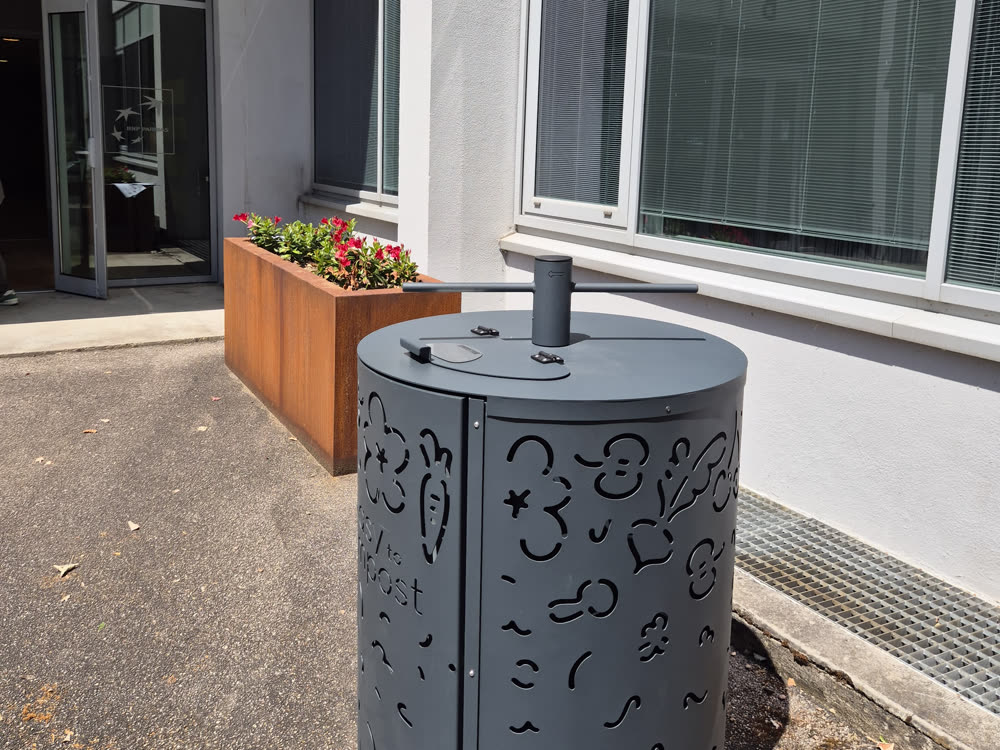
How many composters for your volumes
It all rests on one figure: 1,500 kg captured per year and per composter. Below that, a single unit is enough, whatever your sector. Between 1,500 and 3,000 kg, you need two. Above 3,000 kg a year, on-site composting is no longer the right answer, and it is better to learn that now than after signing.
Sizing is therefore not a matter of picking a size out of a catalogue: there is only one model, described on the ABC composter page, and the only volume variable is the number of units. The second variable is how often the tank is emptied, and that one is not a free choice either: it follows from your volumes.
The table below is the complete answer. Find the line matching the volumes you actually capture in a year and you have the number of composters, the same figure that the online sizing tool returns.
| Volumes captured (kg/year) | Composters | Collection visits a year, in France | Monthly, excl. VAT |
|---|---|---|---|
| up to 250 | 1 | 1 | 89 € |
| 251 to 450 | 1 | 2 | 99 € |
| 451 to 625 | 1 | 3 | 109 € |
| 626 to 750 | 1 | 4 | 119 € |
| 751 to 875 | 1 | 6 | 139 € |
| 876 to 1 125 | 1 | 9 | 169 € |
| 1 126 to 1 500 | 1 | 12 | 199 € |
| 1 501 to 1 750 | 2 | 6 | 278 € |
| 1 751 to 2 250 | 2 | 9 | 338 € |
| 2 251 to 3 000 | 2 | 12 | 398 € |
| above 3,000 | Outside the scope of on-site composting: assessment and referral to an industrial route | ||
Key takeaways
Two thresholds govern everything: 1,500 kg a year per composter, 3,000 kg in total. And the units are identical, so sizing that shifts is corrected by adding one more, not by replacing the machine you have.
450 litres that absorb 1,500 kg a year
It is the objection that comes up most often in meetings: 450 litres of tank for a tonne and a half of food waste sounds impossible. Those 450 litres are not a year's storage volume, they are the volume of a reactor in steady state: material goes in at the top, breaks down, loses its water and its bulk, and travels down.
The maths
- Volumes absorbed by one composter 1,500 kg/year
- Spread over 365 days, that is 4.1 kg/day
- Bulk density of fresh food waste (a full 240 L bin weighs about 95 kg) 0.40 kg/L
- Volume added each day 10.3 L
- Volume of the tank 450 L
Tank full in44 days, if nothing happened inside it
Two mechanisms head off those 44 days. Breakdown first: the aeration chimney keeps oxygen in the heart of the material, the hand-cranked mechanical mixing turns it over, blending with the bulking agent stops it compacting, and the material loses most of its water within a few weeks (see the technology behind the aeration chimney). Emptying second: at 1,500 kg a year the tank has to be emptied about every 30 days, whereas a site at 250 kg adds 0.7 kg a day and needs emptying once a year. The rhythm of removal is not a comfort: it is what makes 450 litres enough.
One point worth being clear about: what comes out of the tank after a few months is a young compost, not a certified fertilising product. On your own grounds you use it as it is. To pass it to a third party, or to spread it on farmland, fertilising-material rules apply, Regulation (EU) 2019/1009 is the European reference and the United Kingdom has its own, and a waste contractor you appoint locally handles that step.
Estimating your volumes with the right ratios
The whole of the sizing rests on a single figure: the kilos of food waste that will actually reach the composter in a year. If you already weigh your bins, use your own weights. If not, here are the ratios published by ADEME (France), cross-checked against the readings from the sites we have equipped, and the ones the online sizing tool applies.
| Situation | Ratio | Annual basis |
|---|---|---|
| Office with no catering | 0.015 kg per person per day | 220 working days |
| Office with a coffee point or tea point | 0.015 kg × 1.5 | 220 working days |
| Contract catering (staff restaurant, canteen) | 0.075 kg per meal served | days of service |
| Healthcare and care homes | 0.140 kg per bed per day | 365 days |
| Hotel breakfast | 0.025 kg per breakfast | days open |
| Cover in fast food | 0.05 kg per cover | days open |
| Cover in a brasserie or full-service restaurant | 0.10 kg per cover | days open |
| Cover in fine dining | 0.15 kg per cover | days open |
| Food retail | weekly kilos weighed × 52 | as they stand |
That leaves the step most estimates forget: capture. Meals taken elsewhere, absences, sorting mistakes, part of the theoretical volume never reaches the caddy. We use 70 % of the theoretical figure, except on kilos that have actually been weighed: 1,000 theoretical kg become 700 captured kg, and it is that figure that goes into the table. The online sizing tool applies the same ratios sector by sector.
The maths
- 200 people on site, 220 working days, 0.015 kg 660 kg
- Coffee point and packed lunches (× 1.5) 990 kg
- Share actually captured (× 0.7) 693 kg
- Emptying needed over the year 4 removals
- 79 € of composter + 4 × 10 € of collection in France 119 € excl. VAT/month
A 200-person head office1 composter, 4 removals a year
Set against one another, these ratios hold some surprises: a 200-person head office weighs less than a 40-bed care home, which feeds its residents 365 days a year while the office only produces on 220.
| Site | Calculation | Volumes captured | Solution | Monthly, excl. VAT |
|---|---|---|---|---|
| 200-person head office, coffee point | 200 × 220 × 0,015 × 1,5 × 0,7 | 693 kg/year | 1 composter, emptied 4 times a year | 119 € |
| 40-bed care home | 40 × 0,140 × 365 × 0,7 | 1,431 kg/year | 1 composter, emptied 12 times a year | 199 € |
| Local supermarket, 30 kg weighed per week | 30 × 52, with no reduction | 1,560 kg/year | 2 composters, emptied 6 times a year | 278 € |
| Hotel with a brasserie, 55 breakfasts and 70 covers a day, 300 days | (55 × 300 × 0,025 + 70 × 300 × 0,10) × 0,7 | 1,759 kg/year | 2 composters, emptied 9 times a year | 338 € |
The switch to two composters turns on a few tens of kilos: the supermarket at 1,560 kg would have fitted on a single unit at 28 kg weighed per week. Between 1,400 and 1,600 kg, weighing your bins for two weeks settles it better than a ratio does. Our pages on hotels and restaurants and healthcare and care homes go into these profiles.
How often the tank has to be emptied
Emptying is not something you order by the quarter for its own sake. Your volumes set how many times a year the tank has to be emptied, between 1 and 12: the tank fills at a rate you can calculate, and the material has to leave before it saturates. What that costs depends on the waste contractor or the farm you contract with locally, and on the rates in your area.
An example reads better than an explanation. At 500 kg a year the tank needs emptying about 3 times; at 750 kg, 4 times; at anything from 1,200 to 1,500 kg, 12 times, which is roughly monthly. With two composters, a single visit covers both tanks: a site at 1,600 kg needs 6 visits where a site at 1,400 kg needs 12, for the same number of individual tank emptyings.
Outside France, emptying is yours to organise. The composter on its own is what we ship, with its bulking agent, a remote handover and its spare parts: you empty the tank at the rhythm your volumes set, and the young compost stays with you, which is a resource rather than a chore if you have grounds to spread it on. If you would rather hand that step over, a local waste contractor can take it, and what a food waste collection covers sets out what to ask for. Our article on what to do with the compost you produce covers the other route.
Two composters, then none at all
Above 1,500 kg captured a year, you add a second unit and everything doubles. The two tanks stand side by side or, more often, at two separate drop-off points, one near the kitchen and the other near the break room: an advantage of the single-unit format that a machine twice the size does not give you. Above 3,000 kg a year, on the other hand, we no longer offer on-site composting and we point you towards an industrial route: three composters means daily handling that no team keeps up over time.
Multi-site groups fall under the same rule, site by site: a head office at 5,000 kg is out of scope, but forty stores at 600 kg each are forty times one composter, which is the logic of the Decathlon rollout across its national network and of our guide to composting across multiple sites. If the constraint is as much about how it looks as about what it does, the garden composter houses the same 450 litres inside a circular 2,000-litre planter.
No rule sets a volume
A lot of sizing exercises start from a badly framed question: what volume are we required to install? None. Across the markets we ship to, the requirement is on separating food waste at source, not on litres: Simpler Recycling in England, the Waste (Scotland) Regulations 2012, the Workplace Recycling rules of 2024 in Wales, a separate regime in Northern Ireland, and in Ireland the national food waste regulations. Thresholds and start dates differ, and several of them have moved recently, so if a supplier is still quoting you an old tonnage threshold, check the text that applies to you.
What the rules ask for is an effective, evidenced solution, not a capacity. Penalties are set nation by nation, from a fixed penalty or a compliance notice up to prosecution, and the level that applies to you is the one your own regulator publishes. What you show is the record of what left the site and where it went, not the litres you installed.
Seasonality does not change the total
A seaside hotel can produce four times as much in August as in January, and a school canteen produces nothing for eight weeks. The reflex is to size on the peak: that is an expensive mistake, because the composter treats a flow and what counts is the total over twelve months, not the maximum in one week. So calculate your volumes month by month using the days you are actually open, and add them up.
What does get adjusted is the emptying calendar: how many times a year follows from your volumes, how they are spread follows your season. In the quiet months the material carries on breaking down inside the sealed tank and the level drops by itself. At the peak, a daily load well above 4 kg mainly calls for more bulking agent and more frequent mixing: a question of day-to-day routine, not of capacity.
Floor space and siting
The second limiting factor, after volumes, is where it goes. The ABC composter is 810 mm across and 1,000 mm high, a strict footprint of 0.52 m²; allow around 2 m² clear per unit once you add the room to swing the mixing bar and open the door. It weighs 121 kg empty and up to 330 kg loaded, which rules out lightweight floors and terraces that have not been checked.

No services are needed: the ABC composter does not plug in, no electricity, no water, no drain, no groundworks. That is what sets it apart from electromechanical solutions and powered dehydrators, whose sizing depends as much on the distribution board as on your volumes. Here the 2 mm steel tank with its closed base and the solid lid do the work, standing on a hard surface, set up in 15 minutes by two people with no work on the building (see how it works).
- A hard, level, stable surface: concrete slab, tarmac or paving, rather than bare soil or loose gravel.
- Around 2 m² clear per composter, including room to manoeuvre.
- Vehicle access that works for the delivery, and then for each removal.
- The shortest possible walk from the kitchen or the break room: distance is what decides adoption, not the staff handbook.
- Somewhere to store the bulking agent right next to it.
- A named lead on site and a deputy: no one should be the only person who knows how to mix.
- A check that we deliver to you, on our map of where we deliver: outside France we ship the composter, its bulking agent and its spare parts, and the removal of the mature material is contracted locally.
Common questions
What size of composter for 100 people?
A single 450-litre composter, comfortably. A hundred people in an office with a coffee point produce around 347 kg captured a year, which means emptying the tank twice. You would need around 430 people on the same profile to reach the 1,500 kg threshold that justifies a second unit.
Should you allow a safety margin on the volume?
No, not on the volume: 1,500 kg is an annual ceiling, not a limit that a busy month could not brush against. The margin is taken on the bulking agent and on how often you mix during peaks. If your estimate falls between 1,400 and 1,600 kg, weigh your bins for two weeks instead.
What happens if my volumes rise after installation?
You add a second composter next to the first. Because every unit is identical, you extend what you have rather than replacing it: that is the point of sizing by identical units rather than by machine sizes.
Other answers on how it works, on the contract and on odours are in We also recycle your cigarette buttsthe site FAQ and in the article on what does and does not go in a commercial composter.
Where to start
Two figures are enough: your headcount on a normal day, and the number of meals or covers served on site. Multiply by the ratios in the table, apply the 0.7 capture factor, then read the matching line of the table: you have your sizing and the emptying rhythm that goes with it.
The online sizing tool runs the same calculation for you, with the same ratios, and returns your sizing straight away with no sign-up. A quote follows from our team, and the sizing is only adjusted if the assessment turns up different volumes.
1 email a month on food waste obligations and what we see on site
Regulatory watch, case studies, product news, the funding available where you are. Unsubscribe in 1 click. GDPR-compliant.
A free assessment, a quote within 24 h
Thirty minutes on a video call to go over the food waste separation duty that applies where you operate, size the solution and estimate your savings.
