
Resource
What to do with the compost you produce: 4 routes out
What comes out of the composter is not a certified compost. Real quantities, maturity tests, spreading, giving it away, a neighbouring farm or removal: the 4 routes, with the figures.
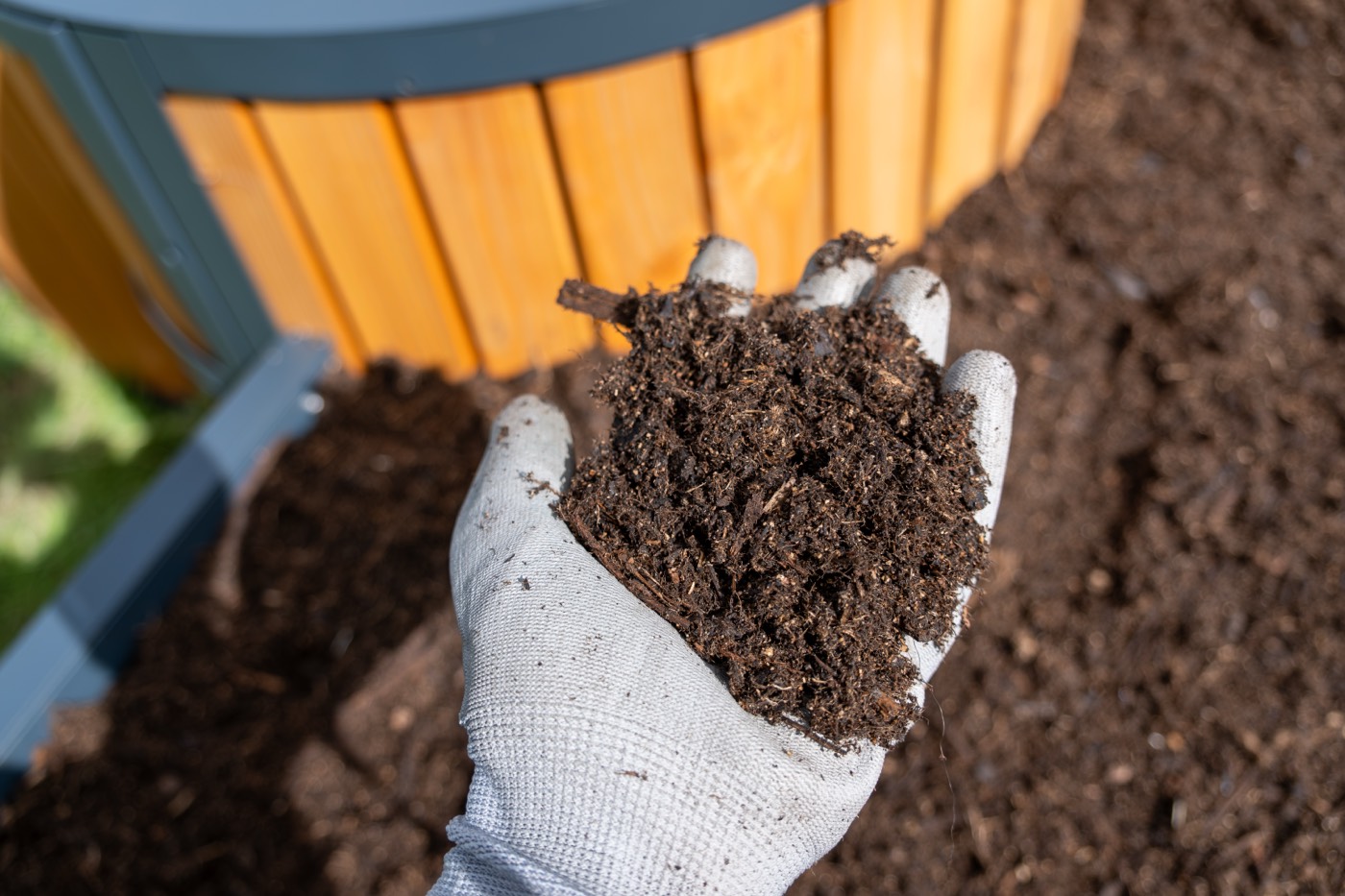
Yes, what your composter produces can be used, but not at the moment you open the hatch. After a few months in the vessel, an ABC composter gives back a stabilised pre-compost: dark, dense, reduced by around 70 % in mass, and not yet mature. It still has maturation to do, and it is neither sanitised nor certified. Four routes out then exist: your own grounds, giving it away nearby, a neighbouring farm, or removal by a contractor. The choice does not depend on what you would like, but on two figures: how much you produce, and how many square metres you have to absorb it.
Key takeaways
What comes out of the vessel is not a certified compost: it is a pre-compost. For as long as you use it on your own land, no authorisation comes into play, because you are not passing anything on to anyone. As soon as you transfer it to a third party, fertilising-material rules apply, and they fall on whoever places the product: the farmer or the contractor, rarely you. Those rules are national, so the detail is worth checking locally before the first load leaves the site.
How much compost do you actually get back
The first question to settle is one of volume, not of law. A 450 L ABC composter absorbs up to 1,500 kg of food waste a year. Of that mass, most leaves as evaporated water and carbon dioxide during fermentation: what remains is between 25 and 35 % of what went in. A tonne of food waste therefore does not leave you a tonne of compost to place, but 250 to 350 kg, coming out in small quantities as the composter is emptied. The difficulty is almost never the volume: it is the area available to receive it.
The maths
- Food waste added over the year 900 kg
- Mass lost as water and gas during fermentation (mid-point of the 65 to 75 % range) 70 %
- Material coming out over the year 270 kg
- Dose on established grounds (bottom of the 5 to 10 kg/m² range) 5 kg/m²
Area treated per year54 m²
54 m² is a strip of lawn 2 m by 27, or four medium beds; at the higher dose of 10 kg/m², the same output covers only 27 m². A site with grounds has no problem placing it; an entirely tarmacked site has one from the first emptying onwards. So put the input figure down first: two weeks of weighing gives it, and sizing the composter follows from it.
Pre-compost or mature compost: settling it in five minutes
A pre-compost spread too early does the opposite of what is expected of it. Finishing its breakdown in the soil, it takes up the available nitrogen for the benefit of micro-organisms and yellows what it was meant to feed: that is nitrogen lock-up, reversible but at the cost of a growing season. Five checks avoid it, and none of them needs a laboratory.
- Smell: damp woodland, never sour or ammoniacal. A smell of ammonia means breakdown is still active.
- Temperature: measure at the core of the heap 48 h after mixing. A mature compost no longer heats up again.
- Structure: crumbly, it breaks apart between your fingers. Nothing that went in should still be recognisable, apart from stones, shells and bones, which come through the whole cycle without breaking down.
- Wildlife: compost worms, woodlice and springtails present. Their arrival marks the start of maturation.
- The germination test: sow cress seeds in a pot of pure compost and in a control pot of potting compost. If germination is comparable after ten days, the compost is no longer phytotoxic.
If a single one of those five points is off, leave the heap to mature another two or three months, sheltered from driving rain and turned once a month. The temperatures and the length of each stage are set out in our article on the composting cycle and its phases.
The four routes out, compared
These four routes are not mutually exclusive: on the same site they often add up, the grounds taking what they can and the rest going elsewhere. The table gives the sorting criterion, and it comes down to one question: how far are you prepared to carry the logistics and the evidence?
| Route | Volume it suits | What you do | Evidence you can show | Cost |
|---|---|---|---|---|
| Your own grounds | up to about 300 kg a year, if you have 60 m² to treat | maturation then spreading, by your own teams | an internal log, kept by you | 0 € |
| Giving it away nearby | batches of a few dozen kg | finding the taker, recording each handover | a handover note, written by you | 0 € |
| Neighbouring farm, direct | from 300 kg to several tonnes | agreement, loading, transport | the agreement and the removal notes | transport at your expense |
| Removal by a waste contractor | any volumes, up to 3,000 kg a year on site | choose the contractor, then nothing | weighing and a transfer note at each collection | set by your local waste contractor, per collection |
Route 1: spreading on your own grounds
This is the simplest route, and the one the composter on its own is built for: the machine is rented, or bought, both routes are open, the compost belongs to you, and you do what you like with it on your own land. No authorisation comes into play, since there is no sale, no transfer and no transport off site.
The only discipline to keep is maturation. Take the material out of the vessel, heap it in a sheltered corner, leave it two to three months turning it once a month, then run the five tests above. Usual doses are 5 to 10 kg/m² to maintain an established bed or lawn, and 30 to 50 kg/m² to prepare a planting or rebuild a bed, worked into the top twenty centimetres of soil rather than left on the surface.
Three habits avoid trouble: no spreading on frozen, waterlogged or steeply sloping ground, where the material runs off instead of soaking in; an unspread strip along watercourses and abstraction points, agricultural spreading plans generally keeping 35 m back; and no young compost at the foot of young plants. Local rules on buffer strips vary, so check the distance that applies where you are. If use on your own grounds is the plan from the outset, the garden composter shortens the circuit further: the same 450 L composter is ringed by a 2,000 L planter, and the compost liquor feeds the soil of the bed directly.
Route 2: giving it away nearby
When the area is lacking, look at who nearby is short of compost: staff who garden, a community garden in the area, the school next door and its teaching plot, the council's grounds team. Demand for mature compost almost always exceeds local supply, and the question is often settled with one call to the council, which usually knows the community gardening groups.
Two precautions. The first is technical: only give away mature compost, tested. A pre-compost handed to a private individual will end up in a vegetable plot, and the complaint comes back straight away. The second is administrative: a gift is still a transfer. If you want the operation to count towards your obligations, write it down. One line per handover is enough, with the date, the estimated quantity, the recipient and their signature. It is a small thing, but it is the difference between a story you can tell and evidence you can produce.
Route 3: the neighbouring farm, direct
Above a few hundred kilos a year, the logical route out is agricultural. A farm absorbs without difficulty what an office site produces in a year, it has the storage area and the spreading equipment, and above all it carries the regulatory framework: its spreading plan covers the input, which settles the question of the product's status.
Four things are worth checking before anything is loaded: distance, with 50 km a sensible working limit beyond which transport starts to eat the benefit of the short circuit; that a spreading plan genuinely exists, confirmed in writing; a storage area where the material can finish maturing in a windrow without running off; and access, because a lorry cannot turn round everywhere. Tell the farmer what you are bringing, too: a pre-compost, not a finished compost. That said, this route assumes that somebody at your end organises the loading and the transport at every emptying. It is workable on a single site with a farm five minutes away, much less so as soon as there are several sites.
Route 4: have the compost taken away, weighed
The last route is to hand the job over. A waste contractor local to you comes and takes the material away, weighs it, and sends it on to a composting site or a farm that can finish it. It is the only one of the four routes that produces your evidence without you having to write it yourself, because the weighing and the transfer note come from the contractor. Choosing that contractor, and checking where the material actually ends up, is your decision and not part of what we supply.
The price follows a single rule: 79 € excl. VAT a month for the composter delivered, bulking agent, awareness kit, training and maintenance included, plus, in France, 10 € excl. VAT a month for each annual visit and per composter. The rental runs over 48 months, and the composter can be bought as well. The number of visits is not guesswork: it follows from your volumes, using the table below; elsewhere the removal of the mature compost is arranged with a local operator of your choice.
| Annual volumes | Collections a year | Monthly, excl. VAT |
|---|---|---|
| up to 250 kg | 1 | 89 € |
| 251 to 450 kg | 2 | 99 € |
| 451 to 625 kg | 3 | 109 € |
| 626 to 750 kg | 4 | 119 € |
| 751 to 875 kg | 6 | 139 € |
| 876 to 1,125 kg | 9 | 169 € |
| from 1,126 to 1,500 kg | 12 | 199 € |
A site producing 500 kg a year therefore needs 3 collections, a site at 750 kg moves to 4. That rhythm is why the material never piles up: at 900 kg a year the table places 9 collections across the year, that is some thirty kilos of compost taken away each time, with the bulking agent topped up straight afterwards. Above 1,500 kg a year a second composter is added and everything doubles. Above 3,000 kg a year, on-site composting is no longer the right answer.
What the rules allow, and what they govern
Two sets of rules cross here, and they are often confused. The first is about separation, not about the compost. Businesses must keep food waste out of residual waste and send it for organic recovery: in the European Union that comes from Article 22 of the Waste Framework Directive 2008/98/EC, with a deadline of 31 December 2023 and a national transposition in each member state, which is the framework in Ireland; in the United Kingdom four separate regimes apply, Simpler Recycling in England, the Waste (Scotland) Regulations 2012, Workplace Recycling in Wales since 2024, and Northern Ireland's own rules. All of them accept either recovery on site or separate collection, so the four routes described above fall under one or the other. What an inspection asks for is the evidence, not the method.
Where the evidence is missing, penalties apply, and they are national: the amounts, the body that issues them and the appeal route are set by each regime, and figures published for one country say nothing about another. Ask your local authority or environmental regulator which text covers your site and what it provides for.
The second set of rules is about the product. Placing a fertilising material on the market normally requires it to meet a recognised standard or to be covered by an approved spreading plan. In the European Union the reference text is Regulation (EU) 2019/1009 on fertilising products, and national law sets the analyses and the thresholds that go with it; outside the Union the equivalent rules are national. A pre-compost coming out of a workplace composter meets neither condition on its own. The practical consequence is one sentence: for as long as you use it on your own land you are placing nothing on the market; as soon as you transfer it, the framework is better carried by someone whose trade it is.
Common questions
How much compost do you get from a tonne of food waste?
Between 250 and 350 kg, that is 25 to 35 % of the incoming mass. The rest leaves as evaporated water and carbon dioxide during fermentation. A tonne of food waste therefore does not leave a tonne of material to place, but the equivalent of a few barrowloads spread across the year.
Is the compost that comes out of the composter usable as it is?
No. What comes out of the vessel after a few months is a stabilised pre-compost, not a mature, certified compost. It needs another two to three months maturing in a heap before it goes onto the soil. The cress germination test settles it in ten days: for as long as germination stays below that of a control pot of potting compost, the compost is still phytotoxic.
Do you need an authorisation to give away or transfer your compost?
For use on your own land, no: you are placing nothing on the market. For a transfer to a third party, fertilising-material rules apply, and they generally require either conformity with a recognised standard, Regulation (EU) 2019/1009 being the European reference, or an approved spreading plan. In practice the farmer or the waste contractor carries that responsibility, not you. The detail is national, so confirm it locally before the first transfer.
What happens to the compost if you have it taken away?
A waste contractor local to you takes it away, weighs it, and sends it on to a composting site or a farm that can finish it. At each collection you receive the weight actually diverted and the transfer note that goes with it, which is what you keep as evidence. Choosing that contractor, and checking where the material ends up, is your decision: it is not part of what we supply.
Where to start
- Weigh before you reason: two representative weeks of weighing, multiplied by 26, fix your annual volumes and therefore the quantity of compost to place.
- Count the square metres of grounds you have and multiply by 5 kg/m²: that gives you what they can absorb in a year. If that figure exceeds your annual compost output, route 1 is enough and you have nothing else to organise.
- Otherwise, choose between giving it away, the neighbouring farm and removal on one criterion alone: who, at your end, will keep the evidence.
The composter is rented at 79 € excl. VAT a month, equipment, bulking agent, training and maintenance included, and it can be bought as well. In France, collection remains an option at 10 € excl. VAT a month per annual visit; elsewhere the removal of the mature compost is arranged with a local operator of your choice. The online quote applies the grid as it stands: it estimates your volumes from a few figures from your trade, one in healthcare, three or four elsewhere, works out the number of visits and shows the monthly figure to the euro, with no sign-up.
A free assessment, a quote within 24 h
Thirty minutes on a video call to go over the food waste separation duty that applies where you operate, size the solution and estimate your savings.
