
Resource
What can go in a commercial composter: the complete list
What composts, what needs rationing, what never goes in: a sorting table family by family, how much bulking agent to add, and what the law actually asks of you.

Into a commercial composter go the site's food and kitchen waste: peelings, cooked or raw plate waste, coffee grounds with their filter, bread, eggshells, food-soiled kitchen paper, dead flowers and spent compost from indoor planters. Meat and fish go in too, as long as the vessel is closed, which an open garden bin does not allow. Never any plastic, even labelled compostable, and no glass, metal, animal bedding, nappies or cigarette ends. Between the two lies a grey area: citrus, dairy, nut shells, grass cuttings. The detail is in the table further down.
Key takeaways
This list is not a matter of preference. Since 31 December 2023, Article 22 of the Waste Framework Directive 2008/98/EC has required food waste across the EU to be collected separately or recycled at source, with no tonnage threshold in most transpositions; the United Kingdom sits outside the directive and runs four regimes of its own. The green list below is therefore not an optional good practice: it is the perimeter of an obligation whose exact wording is set by your own country.
What makes a workplace composter fail is almost never a banned food forgotten in the caddy, but two things: not enough bulking agent, and a plastic wrapper that goes through the whole cycle without breaking down.
What composts with no restriction
These are the water-rich, nitrogen-rich wastes a break room and a kitchen produce, plus the food-soiled paper that comes with them. They break down within a few weeks in an ABC composter, a 450 L vessel in 2 mm steel whose aeration chimney keeps oxygen at the heart of the mass, and whose mechanical mixing, turned by hand, spreads each new load without any electrical connection at all.
- Fruit and vegetable peelings, all varieties
- Cooked or raw plate waste, rice, pasta, pulses, light sauces
- Coffee grounds with their paper filter, paper tea bags
- Stale bread, pastries, dry biscuits
- Crushed eggshells
- Kitchen paper, napkins and brown cardboard egg boxes, soiled with food only
- Dead flowers, house plants, spent compost from indoor planters
Two habits change the outcome. Cut things smaller, first, because micro-organisms work from the surface. Then take out whatever is not organic: the staple on the tea bag, the elastic band round the radishes, the plastic tie on the bouquet, the tray under the leftovers. Inside the vessel these intruders disappear from view, but they come back out intact at emptying.
What composts in moderation
The grey area is not a list of bans in disguise. These are genuinely compostable materials, where the quantity and the way they go in decide the outcome. This is where the gap with a garden bin opens up: most of them are refused in home composting and accepted here. None of them is settled by a "do not" sign; all of them are settled by a dose.
- Meat, fish, bones, fatty leftovers: accepted in a closed vessel, buried in the middle of the mass and covered straight away with bulking agent. On an open composter, leave them out.
- Dairy and cheese: small quantities, buried, because fat coats the material and slows microbial colonisation.
- Citrus: acidity and essential oils hold the bacteria back when peel arrives in bulk, typically in a hotel pressing its juice every morning.
- Nut shells, stones, woody stems: rich in lignin, they go through a whole cycle without breaking down. Crushed, they aerate the mass; whole, you find them again at emptying.
- Grass cuttings and leaves: in small doses, alternating with the kitchen inputs. A whole mowing tipped in at once packs down into an airtight layer and heats up; if the grounds are the main source, you are looking at different equipment.
- Untreated wood ash: a handful now and then, never a shovelful, or the pH climbs.
What must never go in
The red list is short and admits no exception, because each of these comes back out of the composter exactly as it went in, or worse, contaminates the material leaving the site and the land it ends up on.
- Plastics of every kind, including thin film, trays, cutlery and stirrers
- Bags, cups and capsules marked "compostable": the EN 13432 standard certifies breakdown in an industrial facility, at a high temperature held and monitored for several weeks. An on-site composter does heat up, but not under those conditions, and the bag comes back out whole
- Glass, metal, ceramics, aluminium capsules
- Animal bedding and droppings, human waste
- Nappies, wet wipes, sanitary products, face masks
- Cigarette ends: the filter is cellulose acetate and concentrates heavy metals
- Medicines, chemicals, solvents, paints, engine oil
- Frying oil in quantity, which suffocates the material and belongs in a separate collection
- Treated timber, pallets, chipboard sawdust
- Vacuum cleaner dust and bags, full of synthetic fibres
The most common case on the ground is none of those. It is the ready-meal tray tipped into the caddy with its film still on, and the paper cup whose base is lined with polyethylene: both slip through because they look like paper.
The sorting table, family by family
The three lists in one. The right-hand column is the most useful day to day: it gives the action, not just the verdict.
| Waste | Verdict | Why | What to do |
|---|---|---|---|
| Fruit and vegetable peelings | Yes | Nitrogen and water, breaks down fast | Cut the larger pieces |
| Cooked plate waste | Yes | The main input on an office site | Do not leave it in a compact heap |
| Coffee grounds and paper filter | Yes | C/N ratio close to 20 | With the filter, without the capsule |
| Paper tea bag | Yes | Paper and leaves, both compostable | Remove the staple and the tag |
| Eggshells | Yes | Calcium input, breaks down slowly | Crush before throwing in |
| Bread, pastries, biscuits | Yes | Readily available carbon | Crumble, dampen if very dry |
| Food-soiled kitchen paper | Yes | Cellulose, acts as a brown | Only when soiled with food |
| Flowers and indoor plants | Yes | Green material, nitrogen-rich | No pot, no tie, no floral foam |
| Meat, fish, bones | In moderation | Fatty and attractive to pests, needs a closed vessel | Bury in the middle, cover with bulking agent |
| Dairy, cheese | In moderation | Fat slows the restart | Small quantities, buried |
| Citrus | In moderation | Acidity and essential oils | Spread over time, double the bulking agent |
| Nut shells, stones | In moderation | Lignin, several cycles | Crush, or leave out |
| Untreated wood ash | In moderation | Pushes the pH up | A handful, not a shovelful |
| Recently treated plants | No | Residues carried into the output | Green waste stream |
| Bag or cup marked "compostable" | No | EN 13432: industrial composting | The usual recycling bin |
| Plastic, glass, metal, ceramics | No | Come back out intact | The site's recycling bins |
| Animal bedding, droppings, nappies, wipes | No | Health risk | Residual waste |
| Cigarette ends, medicines, chemicals | No | Heavy metals, active molecules | Dedicated streams |
The carbon-to-nitrogen ratio and how much bulking agent to add
A perfect sorting list is not enough on its own. What decides the outcome is the balance between carbon and nitrogen: micro-organisms consume roughly 25 to 30 parts of carbon for one part of nitrogen. Break room waste, though, sits almost entirely on the nitrogen side, coffee grounds at around 20 to 1 and peelings below that. Left on their own in a vessel they pack down, release their water, and oxygen disappears from the heart of the mass: that is where a smell begins.
Hence the bulking agent, supplied with the machine. The rule on the ground: one handful per caddy emptied, doubled after a load of meat, fish or citrus, and doubled again when the contents of the vessel look glossy with moisture. Too wet and the material smells within days; too dry and it stops shrinking. Temperature markers are in our article on the composting cycle, and the common drifts in the one on composting without odour or pests.
- Greens, nitrogen-rich: plate waste, peelings, coffee grounds, fresh cuttings, dead flowers
- Browns, carbon-rich: wood chip, unprinted brown cardboard, kitchen paper, dead leaves, straw, untreated sawdust
What the law requires you to separate
The question "what goes in the composter" has a regulatory answer before it has an agronomic one. Article 22 of the Waste Framework Directive 2008/98/EC has required every EU member state, since 31 December 2023, to have food waste either collected separately or recycled at source, and each country has transposed it in its own way: Ley 7/2022 in Spain, D.Lgs 152/2006 in Italy, the GewAbfV and the KrWG in Germany. Ireland sits inside that framework; the United Kingdom sits outside it, with Simpler Recycling in England, the Waste (Scotland) Regulations 2012, Workplace Recycling in Wales and Northern Ireland's own rules. What the directive covers is food and kitchen waste plus non-hazardous garden and park waste, which is exactly the green list above.
Penalties, on the other hand, are national, and there is no common scale:
- In the EU, each member state sets its own enforcement in the law that transposes the directive, and the amounts are not comparable from one country to the next.
- In the United Kingdom, each of the four regimes carries its own enforcement powers, held by a different regulator in England, Scotland, Wales and Northern Ireland.
- In every case the figure that binds you is the one written in your own national law, not one carried over from another market.
In practice an inspection does not rummage through the vessel, it asks for evidence: sorting has to leave a written trail. Keep a dated record of every emptying and an annual summary, and confirm with your local authority what form it expects that evidence to take.
Making the list survive the daily gesture
A sorting decision is made in a second and a half, standing up, with a tray in one hand. Nobody consults an eighteen-row table at that moment. The only signage that works is the one in the line of sight as the hand opens, and it shows the site's own items rather than generic pictograms.
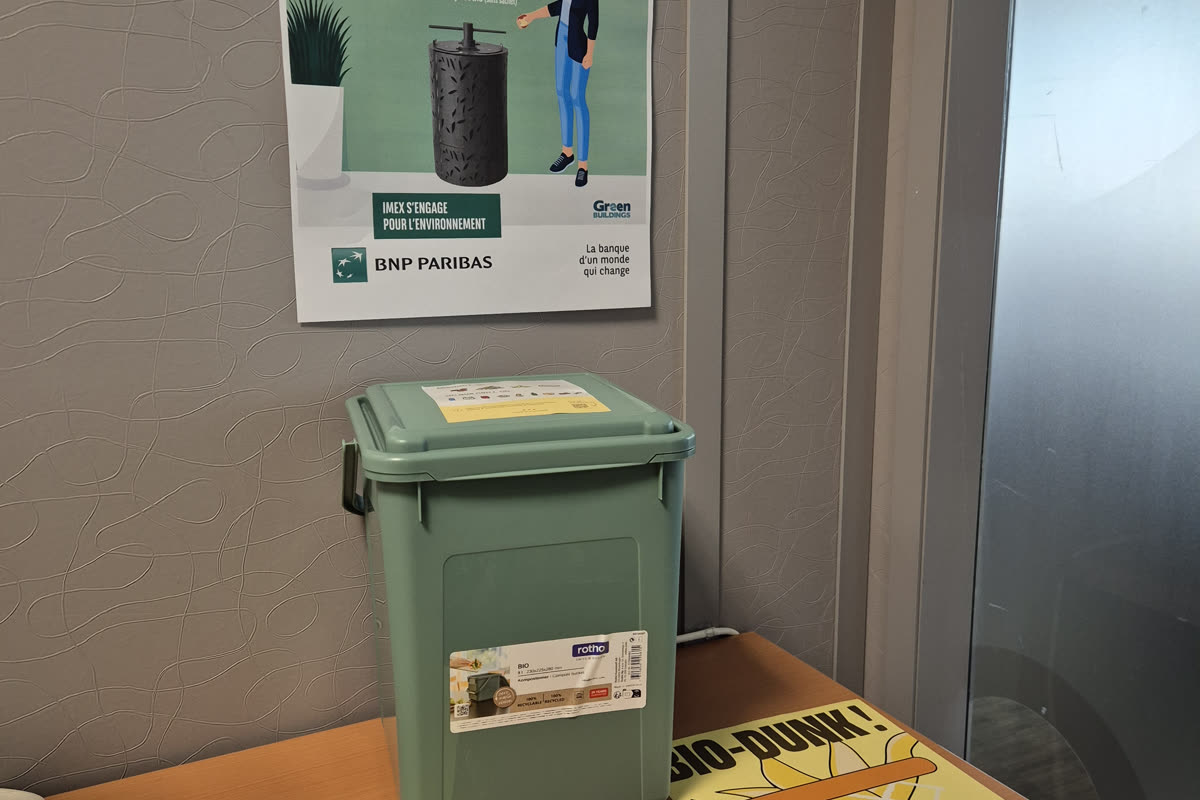
- A "yes / no" sticker on the caddy lid, where the eye falls
- A laminated A4 poster on the wall, in pictograms that work without reading English
- The site's three traps named: the film-wrapped tray, the polyethylene-lined cup, the so-called compostable capsule
- The bag of bulking agent standing against the composter, with the scoop that shows what a handful means
- One lead per floor or per department, who answers without going through facilities
- The instruction repeated in the induction of new starters
- A weekly glance into the caddy, to correct a mistake before it becomes a habit
The awareness kit and the remote handover come with the machine, and the sequence is described on the how it works page. Everything after that is run by your own team: at export there is no visit, no refresher session on site and no reporting service, so the weekly glance into the caddy is what keeps the list alive.
When the problem is no longer the list but the volume
An ABC composter absorbs up to 1,500 kg of food waste a year. Below that, sorting is the only question that matters. Above it, a second composter is added. Above 3,000 kg a year, on-site composting is no longer the right answer.
The maths
- People on site on a normal day 150
- Ratio used, office with breaks and lunches on site 0.025 kg/person/day
- Working days in the year 220
- Annual volumes: 150 × 0.025 × 220 825 kg
- 825 kg stays under the 1,500 kg capacity 1 ABC composter
- Emptyings, from the scale (875 kg band) 6 a year
- Composter delivered, bulking agent, maintenance, training by video call 79 € excl. VAT/month
- Collection, 10 € excl. VAT per annual visit, French benchmark 60 € excl. VAT/month
Total139 € excl. VAT a month
That is 1,668 € excl. VAT a year, with no up-front investment: the composter is rented over a 48-month commitment, and it can be bought as well. The number of visits is not chosen, it follows from your volumes; in France, collection remains an option of 1 to 12 visits a year, and elsewhere the removal of the mature compost is arranged with a local operator of your choice. Without it, the composter on its own is 79 € excl. VAT a month and you keep the material. To put your own assumptions in, see sizing a composter against your food waste. And if most of your inputs come from the grounds rather than the kitchen, that is different equipment: the garden composter, a circular 2,000 L planter at 129 € excl. VAT a month.
Common questions
Can coffee grounds and filters go in?
Yes, with no limit on quantity. Coffee grounds are rich in nitrogen, their fine structure mixes well with the bulking agent, and a carbon-to-nitrogen ratio close to 20 to 1 makes them one of the best inputs an office site has. The paper filter composts with them. Aluminium or plastic capsules, on the other hand, do not go in, even emptied, and neither do so-called compostable capsules.
Can meat and fish go in?
Yes, in a closed-vessel commercial composter such as the ABC, whose 2 mm steel vessel has a closed base and a solid lid and stands on a hard surface. Bury the leftovers in the middle of the mass and cover them straight away with bulking agent. In an open garden composter, leave them out: odours and pests arrive within days.
Do bags and cups marked "compostable" go in?
No. The EN 13432 standard certifies breakdown in an industrial facility, at a high temperature held and monitored for several weeks. An on-site composter does heat up, but not under those conditions. The bag comes back out whole at emptying and has to be pulled out by hand. Empty the caddy without a liner, or with a liner you take back.
What happens if somebody throws plastic in?
Nothing irreversible for a single item: it gets picked out at emptying. The problem is not the incident, it is the repetition. A steady flow of film and trays ends up as fragments spread through the whole mass, impossible to pick out one by one, and that is what downgrades a batch when it comes to being spread on land.
What becomes of the material that comes out of the composter?
After a few months it is emptied into a 120 L bin, and where it goes next is yours to arrange: your own grounds first, or a local farm or composting site for the surplus. It leaves the composter stabilised rather than fully mature, so keep a dated record of each emptying. The possible uses are set out in our article on what to do with the compost you produce.
Where to start
Hold the table above against what actually comes out of your break room over one week. Two or three recurring families will show up, rarely more: those are the ones that belong on the caddy sticker. The rest is what the wall poster and the composting lead are for.
That leaves the question of whether your volumes fit in one composter or two. Our sizing tool covers that ground in a few minutes: you enter your sector and your headcount, it estimates the volumes and proposes the sizing. The where we deliver page lists the countries the machine ships to; outside France we supply the composter, and collection is contracted locally.
A free assessment, a quote within 24 h
Thirty minutes on a video call to go over the food waste separation duty that applies where you operate, size the solution and estimate your savings.
