
Resource
Food waste collection for businesses: how it works, what is at stake, the alternatives
Everything about food waste collection for businesses: the steps, the organisation, the regulatory duties and orders of price.
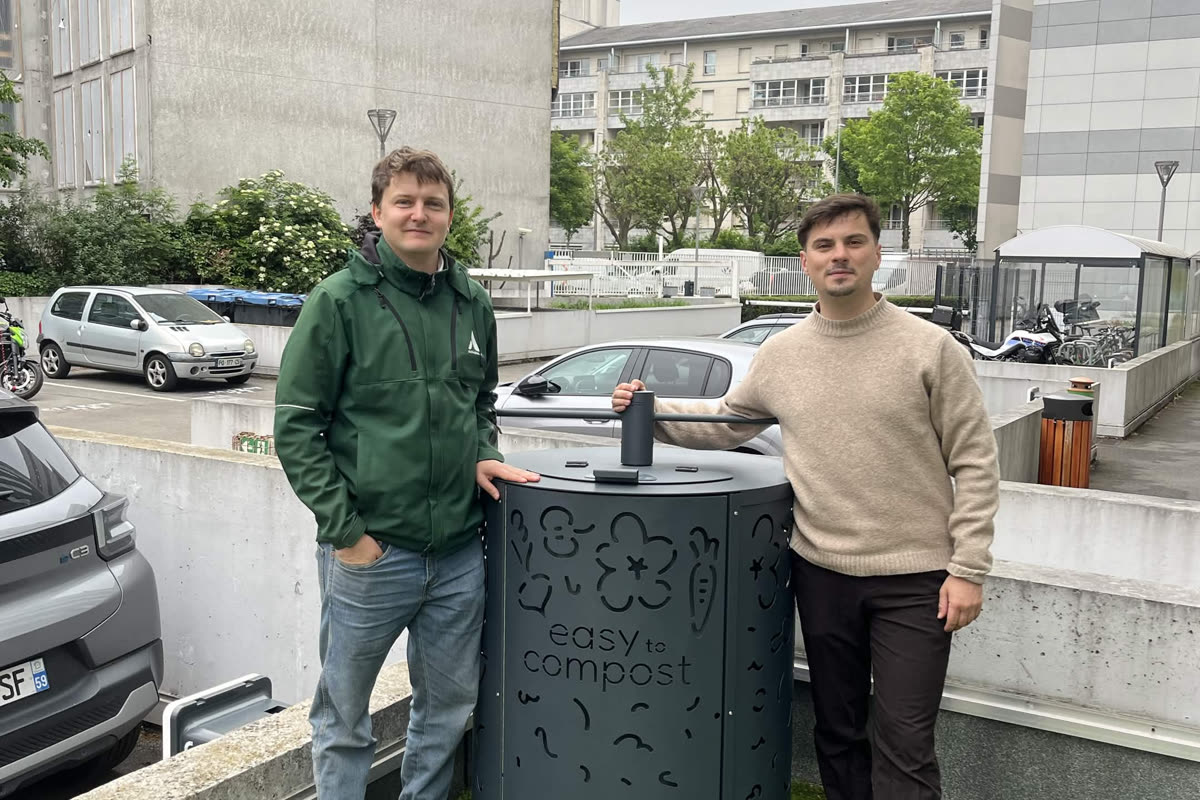
Food waste collection for a business is the separate removal of a site’s food waste so that it can be recycled. Across the European Union, Article 22 of the Waste Framework Directive 2008/98/EC has required since 31 December 2023 that every producer either recycle at source or have the waste collected separately. The text does not require a lorry: it requires separation at source and recycling, through separate collection or through on-site management. Two logistics therefore compete for the same volumes: having fresh food waste removed 1 to 3 times a week, or composting it on the spot and sending out only a stabilised material 1 to 12 times a year. The first is billed per lift, the second on a subscription: 79 € excl. VAT a month for the composter, plus 10 € excl. VAT per annual visit in France.
Key takeaways
The duty is about separation and recycling, not about collection. Article 22 opens two routes, and recycling at source is one of them.
The number of visits is not a choice: it follows from the volumes captured, from 1 visit a year below 250 kg to 12 up to 1,500 kg. Beyond 3,000 kg a year, on-site composting is no longer the answer.
Food waste collection: what we are talking about
Bio-waste is defined at Article 3(4) of the Waste Framework Directive 2008/98/EC: biodegradable non-hazardous garden or park waste, and food or kitchen waste from offices, restaurants, canteens, caterers and retail. On a business site, three families make up most of the volumes: plate leftovers and returned trays, preparation trimmings such as peelings and tops, and break-time residues such as coffee grounds, tea and fruit. The borderline cases are handled in the list of what composts.
What separates this collection from an ordinary household waste round comes down to one word: the destination. Separated food waste goes to a composting platform or to an anaerobic digester and comes back as a soil improver or as biogas. Left in the grey bin, it goes to incineration, where its high water content penalises combustion, or to landfill, where breaking down without oxygen produces methane.
What the law has required since 31 December 2023
Across the European Union, Article 22 of the Waste Framework Directive 2008/98/EC has applied since 31 December 2023 to every producer and holder of bio-waste, whatever the quantity: the text sets no tonnage threshold. A ten-person practice with a coffee machine is covered on the same footing as a central kitchen. Each country sets the terms in its own transposition, and the guide to the French framework goes through the French text article by article.
The duty has two parts, and that is the point quotes forget: separate at source, then have the material recycled. What an inspection looks at is the evidence: the set-up in place, the habit held, the record of where the material went, and our article on food waste traceability lists the documents.
The penalties are often quoted badly. They belong to national law and differ from one country to the next: the amounts in force in France carry no weight across a border, and the sliding scales that circulate online correspond to no provision at all. Our article on the French penalties sets out the French case. The same goes for the permitting thresholds that apply to a composting installation: they are set nationally, and an on-site composter sits well below them wherever they exist.
How a collection runs, from caddy to lorry
The move that decides everything is the first one. A 7 to 10 L caddy at the workstation, in the dishwashing area or in the break room captures the material; fifteen paces away, sorting becomes a favour instead of a reflex. That is why the capture rate used in our estimates is 70 % and not 100 %: a costing that ignores it oversizes the solution. The subject is more human than material: see getting the teams on board with sorting.
Then comes the buffer container: in a conventional collection, a 120 or 240 L wheeled bin in the waste room, about 1 m² of floor, a full 240 L weighing around 95 kg. The removal rhythm is then not an economic trade-off, it is imposed by biology: fresh material ferments from the second day, and a site producing 15 kg a week still has to bring a lorry in every week. The visit takes a few minutes: emptying or swapping the bin, checking for unwanted items, weighing, paperwork. Organising a local round explains why the density of stops weighs more than the distance covered.
The three models compared, line by line
For the same volumes, three set-ups answer the duty. Columns 2 and 3 describe the composter with its collection offer as it is billed, not a market average.
| Criterion | Collection of raw food waste | Composter + collection | Composter without collection |
|---|---|---|---|
| What leaves the site | fresh, fermentable material | a stabilised compost, in a wheeled bin | nothing |
| Removal rhythm | 1 to 3 times a week | 1 to 12 times a year | no visit at all |
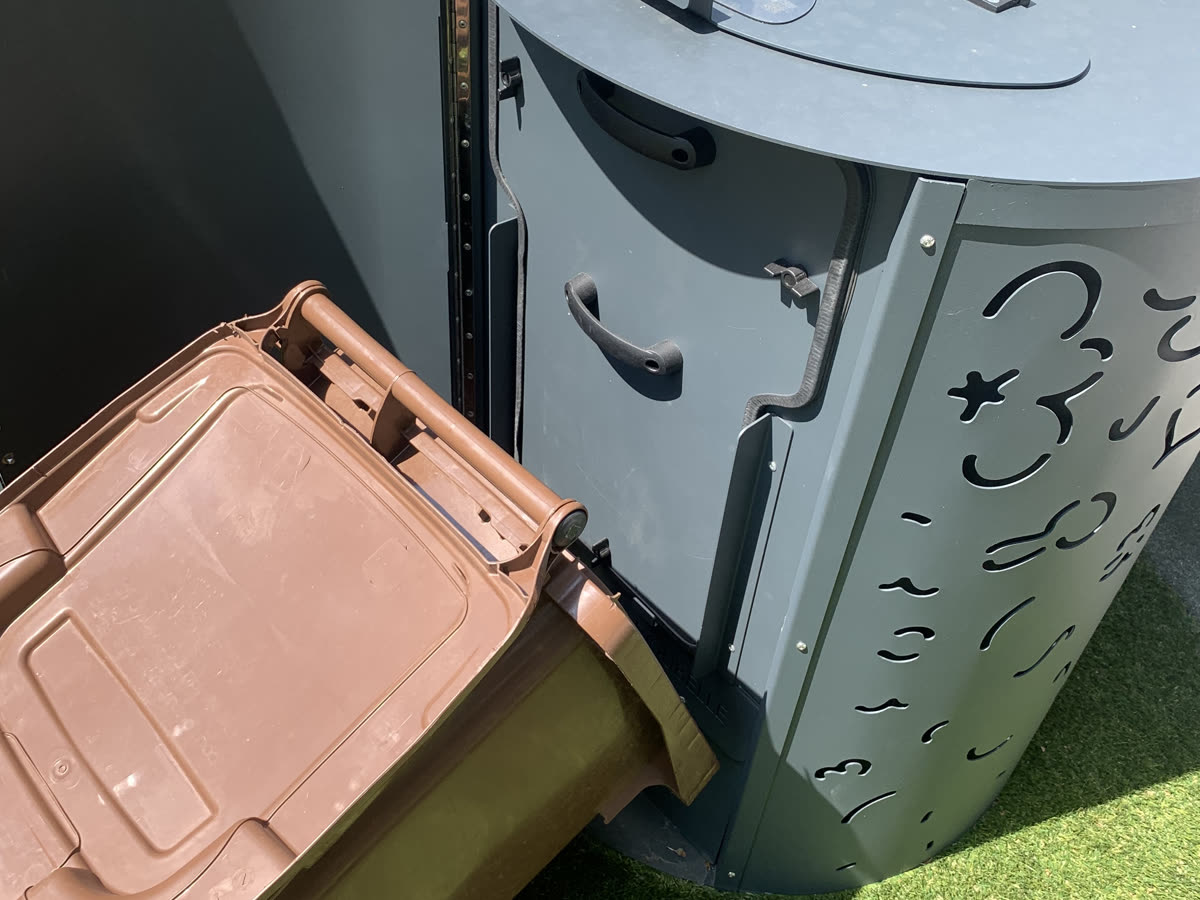
| Equipment on site | 1 to 4 bins of 120 or 240 L | 1 ABC composter, 2 mm steel, 450 L | the same ABC composter |
| Footprint | about 1 m² per bin, permanently | under 1 m², hard and level surface | under 1 m², hard and level surface |
| Connections, works | none | none: no electricity, no water, no drain, no civil works | none, the same |
| What sets the bill | the number of lifts and the volume presented | the annual volumes, and nothing else | nothing: the rent is fixed |
| Volume ceiling | no technical ceiling | 1,500 kg/year per composter, 3,000 kg with two | the same ceilings |
| What becomes of the material | the contractor’s own route | sanitising and land spreading arranged with a local operator | your own green spaces |
| Proof of separation | the contractor’s docket | weighing and a record at every visit | certificate that the set-up is in place |
| Contract | billed per round | rental over 48 months, or purchase on request | rental over 48 months |
| Easy to Compost price | not part of the offer | 89 to 199 € excl. VAT / month for one composter, French grid | 79 € excl. VAT / month |
The third column is the one comparisons forget. A site with planted beds or a park keeps its compost and has no collection line at all: that is the composter only offer, and also the principle of the garden composter, a circular planter of 2,000 L at 129 € excl. VAT a month. The mechanics of the first two columns are developed in the weekly versus low-frequency comparison.
What a collection costs, and how to check it
With Easy to Compost, collection is an option in France: 10 € excl. VAT a month per annual visit, added to the 79 € excl. VAT a month for the ABC composter, which cover the composter delivered, the bulking material, maintenance and the awareness work. The number of visits is not negotiable: you take the first line of the grid whose threshold covers the annual volumes captured. It is the grid the online quote applies: the price read here and the one in the tool are identical.
| Annual volumes captured | Visits a year | Monthly, excl. VAT | Annual cost, excl. VAT |
|---|---|---|---|
| up to 250 kg | 1 | 89 € | 1 068 € |
| 251 to 450 kg | 2 | 99 € | 1 188 € |
| 451 to 625 kg | 3 | 109 € | 1 308 € |
| 626 to 750 kg | 4 | 119 € | 1 428 € |
| 751 to 875 kg | 6 | 139 € | 1 668 € |
| 876 to 1,125 kg | 9 | 169 € | 2 028 € |
| 1,126 to 1,500 kg | 12 | 199 € | 2 388 € |
Here is the full calculation for a head office of 150 people with a staff restaurant serving 60 meals a day, over 220 working days, using the ratios of the online quote (ADEME office data, France, and readings from the sites we equip). The two lines count separately: the 1.5 coffee point coefficient is not added here, since the restaurant meals are already counted on their own.
The maths
- People on site, restaurant aside: 150 people x 220 days x 0.015 kg 495 kg
- Staff restaurant: 60 meals x 220 days x 0.075 kg 990 kg
- Theoretical annual volumes 1,485 kg
- Capture rate used: 70 % 1,040 kg captured
- 876 to 1,125 kg band of the grid 9 visits a year
- Rent of the composter 79 € excl. VAT / month
- Collection: 9 visits x 10 €, French benchmark 90 € excl. VAT / month
Total169 € excl. VAT / month
That is 2,028 € excl. VAT over twelve months, which gives an immediate point of comparison: spread over the 52 lifts of a weekly contract, that budget works out at 39 € excl. VAT per lift. Above that price per visit, your current contract already costs more than the composter with its 9 removals, bulking material, maintenance and awareness work included. The items missing from quotes are listed in our article on the real cost of food waste collection.
Choosing: the two thresholds, and the traps on the ground
The decision turns on a single figure, the annual volumes captured, and on two thresholds. The first is 1,500 kg a year, what one ABC composter absorbs: beyond that you add a second composter and everything doubles, rent as well as collection, which in France puts the monthly figure between 278 and 398 € excl. VAT depending on the volumes. The second is 3,000 kg a year: beyond that, on-site composting is no longer the right answer, a call set out in anaerobic digestion or on-site composting. Between the two, space often decides before price: under 1 m² on a hard, level surface reachable by a vehicle. That leaves the volumes to be established, by weighing over two weeks or by trade ratios, two routes compared in our method for working out the volumes. Orders of magnitude vary sharply between an office site with no catering and a hotel or restaurant business: 60 brasserie covers a day over 300 days already represent 1,260 kg captured, and the 1,500 kg threshold is crossed as soon as you move to a fine-dining kitchen or to year-round service.
Four traps come up next. Smells and pests never come from the principle but from imbalance: too much nitrogen, not enough carbon, no aeration. A closed bin of fresh leftovers turns smelly within 48 hours in warm weather; the ABC composter answers differently, a closed vessel in 2 mm steel with a solid base, a solid lid, standing on a hard surface, continuous aeration through an aeration chimney and mechanical mixing turned by hand. The subject is covered in composting at work without smells or pests.
A public service is not a given: collection of business waste alongside household waste is not provided everywhere, some local authorities limit it, charge a special fee for it or have dropped it; check the local rules. Then the scope of the contract: bins and washing, bulking material, training, signage, reporting, breakages, anything not listed comes back as a variation. Lastly, what comes out of the composter is not a finished compost: the material removed after a few months is stabilised, and it is then sanitised and spread through an operator you contract locally.
The checklist before you sign
Eight points to check, whoever the contractor is. The first three set the sizing, the next five the real cost.
- The annual volumes captured, in kilos, not in litres or in numbers of bins.
- The space available: hard, level, reachable by a vehicle, and how far it is from the kitchen.
- The number of visits agreed, and the rule that sets it if the volumes change during the contract.
- Who empties the caddy, how often, and who takes over during holidays.
- The record handed over at each removal and its form: weighing, docket, reporting.
- The final destination of the material, named and verifiable, not a generic route.
- What the price covers: bulking material, maintenance, training, signage, breakages.
- The length of the commitment, any need for electricity or works, and what happens to the equipment at the end of the contract.
Our answers are on the how it works page. For a group, the Decathlon network case study shows how these questions are handled across dozens of stores.
Common questions
Is food waste collection compulsory for every business?
Separation at source is, since 31 December 2023 and with no tonnage threshold, under Article 22 of the Waste Framework Directive 2008/98/EC. Collection is not: the text opens two equivalent routes, separate collection or recycling on the spot. A site that composts on site and has its material taken for spreading takes the second route, and the terms that apply to it come from its own national transposition.
How many collection visits are needed each year?
The number is not a choice, it follows from the annual volumes captured: from 1 visit a year up to 250 kg to 12 visits from 1,126 to 1,500 kg. In France a site at 500 kg a year needs 3 visits and pays 109 € excl. VAT a month; a site at 750 kg needs 4 visits and pays 119 €; a site at 1,200 kg needs 12 visits and pays 199 €.
What does a business risk if it does not separate its food waste?
The penalties belong to national law and differ from one country to the next. In France there are three: a fine for failing to separate, an administrative penalty issued by the mayor, and a criminal penalty in the most serious cases. Those amounts carry no weight across a border: what your own establishment faces is set by your national framework and by its authority.
Does the composter need electricity or building works?
No: no electricity, no water, no drain, no civil works. It is a vessel in 2 mm steel holding 450 L, with a solid base and a solid lid, standing on a hard surface; aeration is continuous, through an aeration chimney, and the mechanical mixing is turned by hand. That is what separates it from the electric dehydrators sold under the name of electromechanical composters.
The sector-by-sector questions are handled in the We also recycle your cigarette buttssite FAQ.
Where to start
Three steps, the first two of which take under ten minutes. Put figures down: the online quote estimates your volumes from a few landmarks in your trade, applies the grid above and shows the exact monthly figure, with no sign-up. Compare: divide the annual amount of your collection contract by the number of lifts billed and set the result against the calculation above. Then decide, looking at the floor space before the price: it is what most often rules an option out.
What comes next is local. More than five hundred sites are already equipped, and the equipment, the delivery, the maintenance and the bulking material reach the fourteen countries listed on the page on where we deliver. The removal of the mature compost is not part of the offer there: it is arranged with the local operator of your choice, while the follow-up, from the assessment to the training, is handled remotely.
A free assessment, a quote within 24 h
Thirty minutes on a video call to go over the food waste separation duty that applies where you operate, size the solution and estimate your savings.
