
Resource
Shopping centres and food waste: units, hypermarket, common areas
Four waste streams, four answers: what composts on site, what goes to a collection, who holds the contract and how the line is recharged through the service charge.
Who has to separate, from landlord to tenant
In a shopping centre there is not one food waste producer but several dozen. Across the British Isles and Ireland, food waste now has to be separated at source: that catches the hypermarket, every food court brand, the bakery among the retail units, and the centre management for the common areas. The centre manager does not separate on behalf of the tenants, but is the only party able to organise a shared scheme.
Key takeaways
A shopping centre is handled not as a single site but as four very different waste streams. The retail units and the common areas belong with on-site composting, the food court and the hypermarket with a dedicated collection. The centre manager organises the shared scheme and documents it: it does not stand in for its tenants before the law.
Food waste means kitchen and catering waste, garden waste and unsold food products. And the duty of care that runs through waste law in these jurisdictions makes each producer responsible for its own waste until it is finally recovered, even where it hands the job to a third party: a tenant that uses the centre's waste room still has to be able to produce its own paperwork.
Enforcement follows the regime: the Environment Agency in England, SEPA in Scotland, Natural Resources Wales, the NIEA in Northern Ireland, and the local authority in Ireland. Powers run from a compliance notice through to a financial penalty, and the levels differ from one regime to the next, so ask yours what applies to your centre. The more immediate pressure, though, is commercial: the cost of your residual waste, which rises as soon as an audit of the general waste stream turns up food waste.
The four food waste streams of a shopping centre
Asking for "the centre's tonnage" leads nowhere: the four areas produce neither the same materials nor the same volumes, and they do not sit under the same contracts.
| Area | Materials produced | Order of magnitude | Suitable route |
|---|---|---|---|
| Hypermarket | Fruit and vegetable markdowns, bread, chilled products withdrawn from sale | 5 to 15 t a year | Dedicated collection, contract held by the retailer |
| Food court, 10 to 20 brands | Preparation trimmings, plate returns, coffee grounds | 5 to 12 t a year in total | Shared dedicated collection, held by the centre manager |
| Retail units | Greengrocer, cheesemonger, wine merchant, bakery, takeaway counters | 0.5 to 2 t a year in total | Shared on-site composting |
| Common areas and centre offices | Coffee grounds, staff meals, garden waste from grounds maintenance | 0.2 to 0.6 t a year | On-site composting |
These ranges frame a discussion, not a report. The only defensible figure is a measured one: a weighing exercise over two representative weeks, outside holidays and outside sale periods, extrapolated with a written seasonality coefficient. The guide to sizing a composter gives the ratios by activity.
What belongs in the composter, and what does not
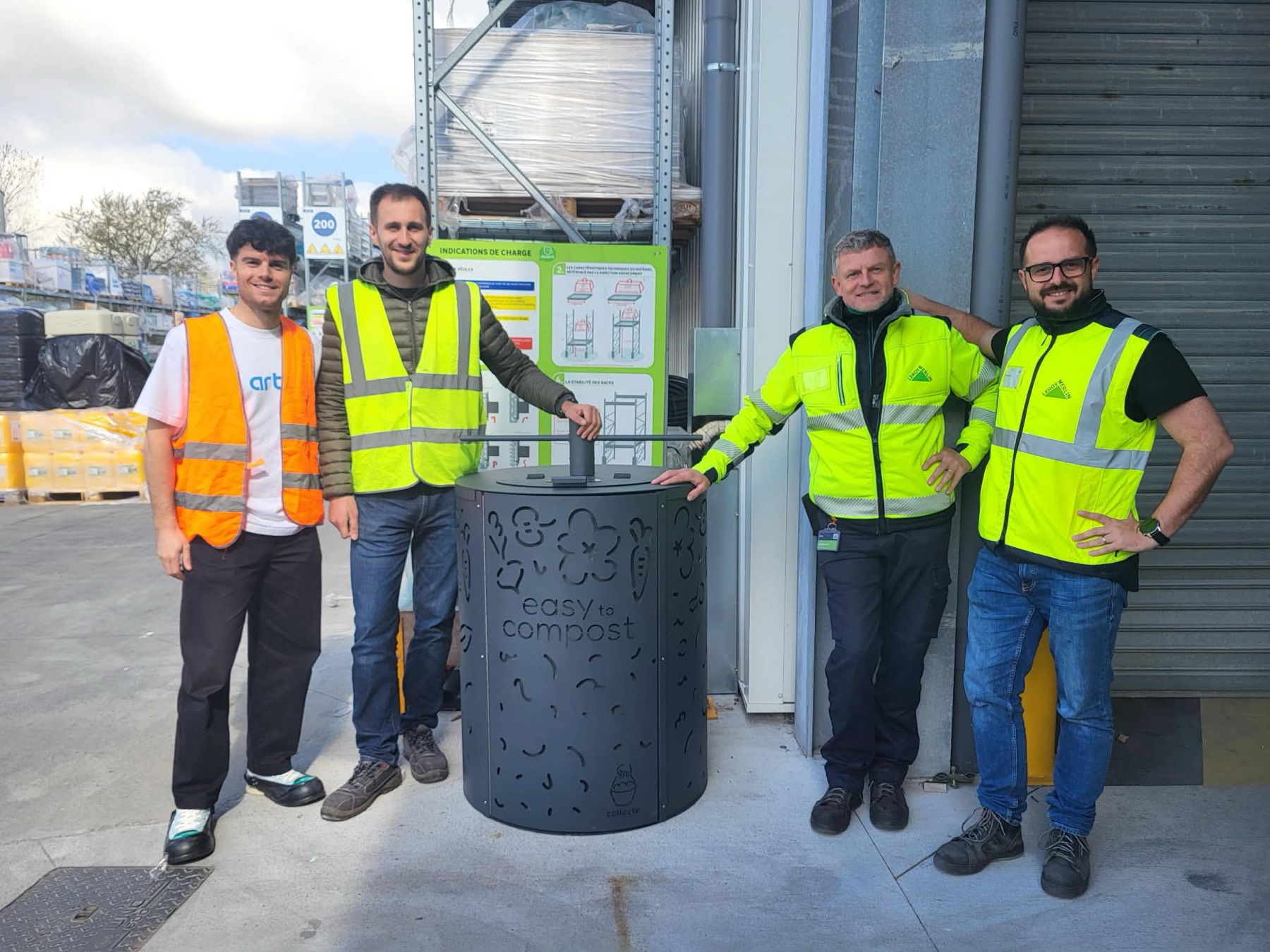
An on-site composter is not a skip: it has a biological capacity, not just a volume. The ABC composter is a 2 mm steel cylinder, 450 L, a metre high and 810 mm across, so under 1 m² on the ground, built in our workshop in France. The mixing is mechanical and turned by hand, on a crank: it does not plug in, and needs no electricity, no water, no drainage and no groundworks. It stands on an existing slab or on the tarmac of a service yard, with no building work: see the composter on its own.
The sizing rule then decides which route to take. One composter absorbs up to 1,500 kg a year; beyond that you add a second; beyond 3,000 kg a year at a single drop-off point, on-site composting is no longer the right answer and you switch to a food waste collection. That rule sorts the four areas by itself: the retail units and the common areas fall inside, the food court and the hypermarket fall outside.
The retail units, the best-suited stream
The retail units are where on-site composting works best: their producers are numerous but individually small. A bakery produces 500 kg to 1.5 t a year, a cheesemonger or a butcher 200 kg to 1 t, a takeaway counter a few hundred kilos. None of them alone justifies a collection contract, and yet every one of them is caught by the same separation duty.
The standard setup: a food waste room or an area of the service yard reachable by the units concerned, one caddy per tenant with its instruction stuck on it, a drop-off at the end of trading, a turn of the crank. The real constraint is neither the volume nor the price, it is the distance: as soon as the drop-off point means a detour from the route the team already takes out of the stockroom, the habit erodes. So it goes on that route, not at the far end of the yard. To make the scheme visible, the garden composter rings the same machine with a 2,000 L planter and takes up 5 to 6 m² on a forecourt.
Food court and hypermarket: collection takes over
On these two areas, an on-site composter is not enough. A food court of 12 brands at 8 t a year is more than double the ceiling of 3,000 kg a year; a hypermarket at 11 t a year is close to four times it. Those streams need a dedicated collection, with wheeled bins per brand and a frequency suited to highly fermentable plate returns.
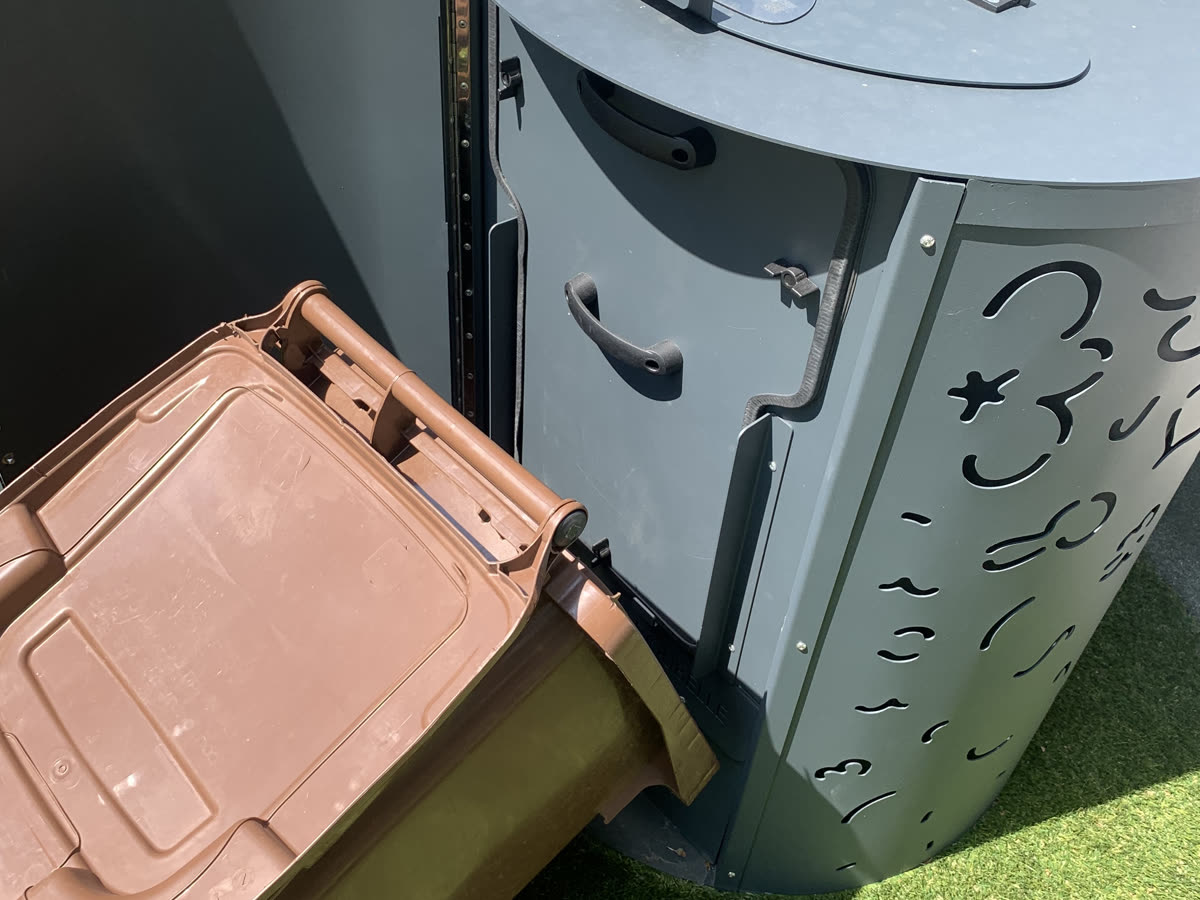
That distinction sets the rhythm of removals: raw food waste ferments, hence one or two rotations a week, whereas a composter gives back only stabilised compost and is emptied a handful of times a year depending on its volumes. Two articles cover these areas in detail: the food court and the supermarket. One last point: the hypermarket most often holds its own contract, decided by its national head office.
Sizing: the centre manager's calculation
Here is the calculation to set out for the share that genuinely falls to the centre manager, the retail units and the common areas. Replace the volumes with your own and the result follows.
The maths
- Measured volumes, retail units and common areas 2,000 kg a year
- Annual capacity of one ABC composter 1,500 kg
- Number of composters (2,000 divided by 1,500, rounded up) 2
- Rental of one composter delivered, everything included 79 € excl. VAT/month
- How often the compost leaves the site agreed with your local contractor
- Collection of the compost, 9 visits a year and per composter, French benchmark 90 € excl. VAT/month
- Monthly cost per composter 169 € excl. VAT
Volume treated on site2,000 kg a year
Assumptions: volumes measured, not estimated; the composter taken either way, bought or rented over 48 months; and one composter per 1,500 kg captured, rounded up. Two things sit outside this calculation. Taking the finished compost away is arranged with a local waste contractor, and how often it comes depends on your volumes and on what that contractor offers; a centre that keeps its material for its own beds and forecourt planters needs nothing at all. And the collection of raw food waste from the food court and the hypermarket stays well outside this scope: see retail and commerce.
Framework contract, lease and recharging to tenants
The centre manager signs for the whole centre and recharges the tenants through the service charge. Two points are settled before signature. The commitment first: the composters can be bought, which puts them on the balance sheet as a capital item with a residual value, or rented over 48 months, which leaves nothing on the balance sheet and gives a term to line up against the lease horizon. The house rules next: instruction annexed, drop-off hours, drop-off point, upkeep of the waste room. Without that annexe, the scheme does not survive the first change of store manager.
That leaves the evidence. Keep a log per composter: kilos brought in, maintenance, compost removed, with the weight tickets from your contractor. On shared equipment that gives one figure for the retail units, not one per tenant. If a tenant has to evidence its own stream, there are two options: its own composter, or a drop-off register with a written apportionment key.
Worked example: a 50,000 m² centre
A 50,000 m² centre: a 6,000 m² hypermarket, a gallery of 80 units of which 6 are food, a food court of 12 brands, a cinema. Volumes taken from a two-week weighing exercise.
| Area | Volumes | Route chosen | Who carries it |
|---|---|---|---|
| Hypermarket | 11 t a year | Dedicated collection | The retailer, to be priced with its own contractor |
| Food court, 12 brands | 8 t a year | Shared dedicated collection | Centre management, to be priced with the contractor appointed |
| Retail units, 6 food shops | 1.6 t a year | 2 ABC composters, compost removed a few times a year | Centre management |
| Common areas and centre offices | 0.4 t a year | 1 ABC composter beside the staff service yard, compost removed once or twice a year | Centre management |
The centre manager therefore carries 3 composters for the streams it controls, treating 2 tonnes a year that would otherwise go out in the residual waste. Spread across the 80 units through the service charge, the line is small against a single skip rotation, and it is recharged as a fixed amount per unit per month. Across several centres, the issue becomes the consistency of the evidence file: the Decathlon case study shows that on a national network.
The centre manager's checklist
To work through in order, allowing two to three months until commissioning.
- List the tenants that produce food waste, area by area, including the cinema, the kiosks and your own offices.
- Weigh two representative weeks per area, then write down the seasonality coefficient you have used.
- Apply the 1,500 kg rule area by area, never across the whole centre.
- Identify the sitings: flat, stabilised ground, service yard access, on the route already taken from the food stockrooms.
- Check who holds the hypermarket's contract with its national head office before bringing it into the framework contract.
- Draft the separation annexe to the house rules: instruction, drop-off hours, upkeep of the waste room.
- Set the service charge apportionment key as a fixed amount per unit per month, not as a percentage.
- Keep the evidence file from the first month: contract, dated instruction on display, drop-off register and the weight tickets from your contractor.
Common questions
Who is responsible for separating food waste, the landlord or the tenant?
Each tenant remains responsible for its own food waste under the duty of care that runs through waste law, and the separation duty applies to it directly. The centre manager answers for the common areas and organises the shared scheme, which relieves no tenant of its own paperwork.
Can a single composter serve all the retail units?
Yes, if the combined volumes of the food shops stay under 1,500 kg a year. Above that you add a second composter; above 3,000 kg a year, on-site composting is no longer the right answer.
Is one composter enough for the hypermarket?
No. A hypermarket commonly produces 5 to 15 tonnes of markdowns a year, close to two to five times the 3,000 kg a year ceiling above which on-site composting stops being relevant. That stream needs a dedicated collection.
Does the composter need building work or a connection?
No. The ABC composter does not plug in: no electricity, no water, no drainage, no groundworks. It is a 2 mm steel cylinder, 450 L, mixed by a hand-turned crank and standing on a flat, stabilised surface.
How is the scheme recharged to the retailers?
Through the service charge, on the basis of the framework contract and an apportionment key annexed to the house rules, presented as a fixed amount per unit per month rather than as a percentage.
Where to start
Three steps, in this order. Open the residual waste bin at the retail service yard: that is what an inspector will see. Then weigh, area by area, over two weeks. Finally, split the areas using the 1,500 kg rule, with separate contracts rather than one single contract that does not exist.
For the share that genuinely belongs with on-site composting, our online quote estimates the volumes from your activity and your headcount, then returns the number of composters and the price, with no sign-up. Outside France, the removal of the mature compost is not part of what we supply: it is arranged with a local operator of your choice, and we help you scope the brief. The countries we deliver to are listed on our where we deliver page.
A free assessment, a quote within 24 h
Thirty minutes on a video call to go over the food waste separation duty that applies where you operate, size the solution and estimate your savings.
