
Resource
Food waste in food courts: who separates, who pays, and above what tonnage
Every tenant is a producer in law; the equipment, on the other hand, can be shared. The three models compared, the calculation that decides, and recharging through the service charge.
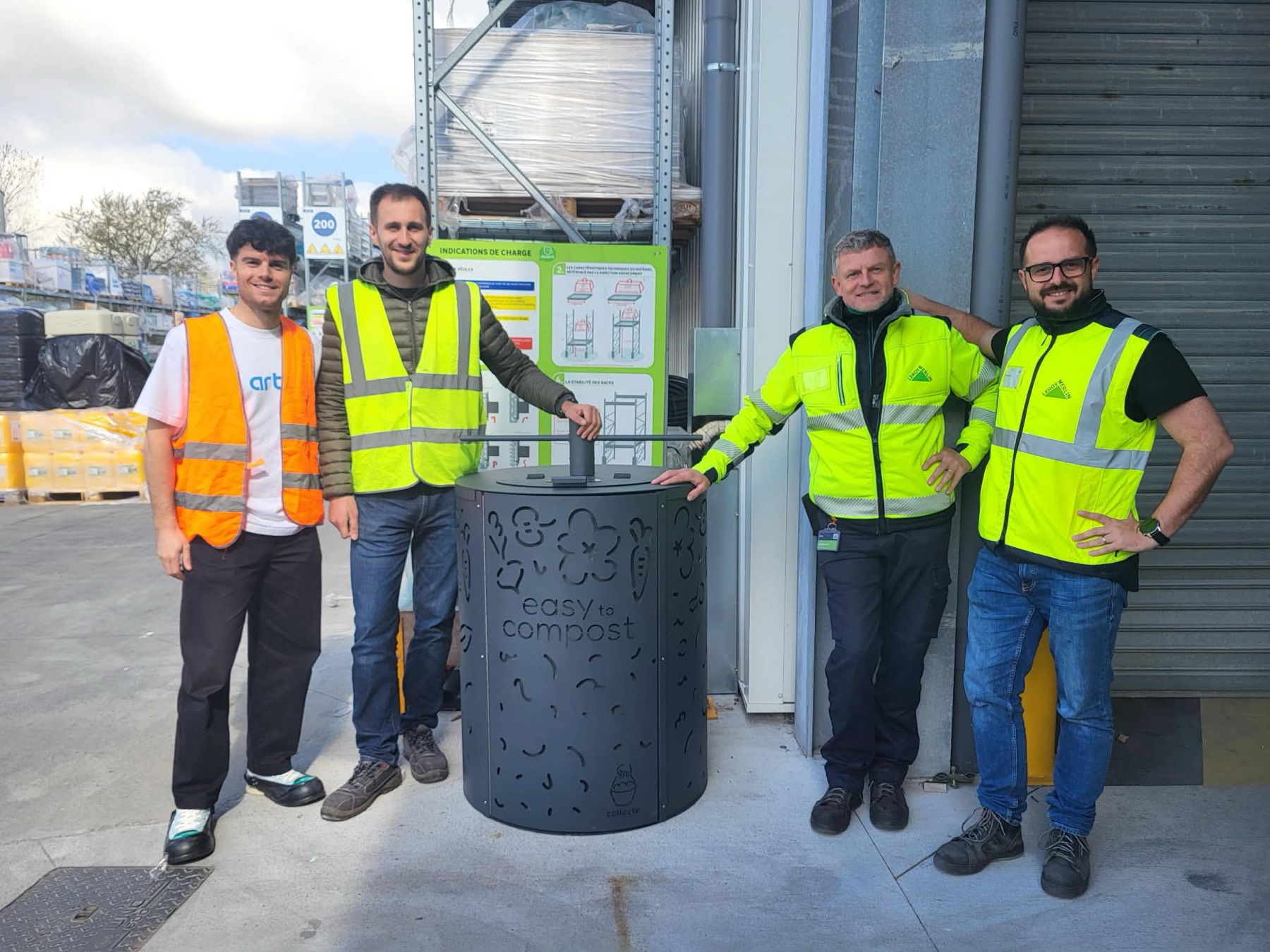
In a food court, every tenant is a producer of food waste in its own right and has to separate it at source: in the European Union under Article 22 of the Waste Framework Directive 2008/98/EC, transposed country by country, and in the United Kingdom under each nation's own rules. Sharing the equipment is almost always the right answer: one shared drop-off point, one contract held by the landlord, and a recharge through the service charge. But the tonnage decides before the model does. An on-site composter absorbs up to 1,500 kg a year, a second one takes the ceiling to 3,000 kg, and beyond that on-site composting is no longer the right answer. The total volumes of a food court almost always exceed that ceiling: on-site composting then covers one specific stream, not all of the food waste.
Key takeaways
The duty falls on each tenant, not on the landlord: separation at source binds the producer of the waste, and in a food court that is each individual operator, whatever its size.
The organisation can be shared: one common drop-off point, a single contract, and a separation clause written into the house rules annexed to the lease.
Volume decides: 1,500 kg a year per composter, 3,000 kg in total. Above that, the material has to be collected.
What makes a food court different from a restaurant
A restaurant is one kitchen, one team, one employer, one contract. A food court is five to thirty kitchens sharing a back-of-house area, a service bay and a skip, without sharing an employer. The whole difficulty of separation lies in that gap.
Four consequences follow. Legally, there are as many producers as there are tenants: the 12 m² kiosk carries the same duty as the counter serving 120 covers. Operationally, there is no shared management line, and nobody can bring every team together to pass on an instruction. Physically, back-of-house space is the scarce resource on the site, and an arrangement that demands a dedicated room will never be installed. And the line-up changes as leases turn over: equipment tied to one tenant disappears with it.
With split shifts and a lot of seasonal staff, the instruction has to hold without a trainer present, and the list of what can and cannot go into a commercial composter is the support that does the work at the workstation. One principle overrides all the others: the separating action has to be shorter than the competing one. If the general waste skip is 10 metres away and the food waste bin is 40, separation will not last three weeks.
Who is legally required to separate
Separating food waste at source is a duty on the business that produces it. In the European Union it comes from Article 22 of the Waste Framework Directive 2008/98/EC, which required separate collection or recycling at source by 31 December 2023 and applies in Ireland, each member state transposing it in its own way. The United Kingdom sits outside the directive and runs four separate regimes: Simpler Recycling in England, the Waste (Scotland) Regulations 2012, the Workplace Recycling rules of 2024 in Wales, and Northern Ireland's own arrangements. The decisive point for a landlord is that the thresholds, the dates and the wording differ from one regime to the next, and several of them no longer have a tonnage threshold at all: check the one that binds your site rather than the figures circulating in trade documents.
The producer is whoever's activity generates the waste: each tenant, individually. The landlord is not a legal screen and does not absorb its tenants' duty. What the landlord can do is decisive: provide the equipment, make its use compulsory through the house rules, and give each tenant written evidence that its food waste was separated and recovered.
Penalties are national. The amounts, the body that enforces them and the route of appeal are set by each regime, and figures published for one country say nothing about another. They are aimed at the tenant that is inspected, except where it is the landlord that holds the waste and hands it over mixed. Ask your local authority or environmental regulator which text covers the site and what it provides for.
Three ways of organising separation, compared
Three arrangements come up again and again on the sites we equip. The choice turns on two concrete variables: the distance between the furthest kitchen and the drop-off point, and whether or not there is a facilities operative on site.
| Criterion | One shared central composter | One composter per tenant | Hybrid: one bin per tenant |
|---|---|---|---|
| Contracts | 1, held by the landlord | 1 per tenant | 1, held by the landlord |
| Back-of-house footprint | One shared location | One location per tenant | One shared location, plus a bin per tenant |
| Equipment for 8 tenants, excluding collection | 1 composter | 8 composters, one per tenant | 1 composter, plus one bin per tenant |
| Who carries the food waste | Each team, at every service | Each team, on its own premises | One operative, on a fixed round |
| Measurement per tenant | No, the streams are merged | Yes, per unit | Yes, by weighing the bin |
| Change of tenant | Absorbed, the equipment stays | To be redone at every lease | Absorbed, a bin to reassign |
| What makes it fail | The distance from the kitchens | The number of units and the space they take | Nobody is in charge of the round |
The shared central composter
A single drop-off point in the back-of-house area, where each team brings its caddy down. It is the cheapest arrangement and the simplest to put under contract. It assumes the furthest kitchen stays within a round trip in the middle of service: walk that route with a loaded bin, at peak time, not on a drawing. Its limitation is the flip side of its strength, the streams merge and no tenant knows its own figure.
One composter per tenant
Each tenant has its own unit and its own reporting, which creates ownership and makes the arrangement visible. It is also the most expensive: eight units cost eight times what one costs, for volumes that one or two composters would take. And it does not push the ceiling back, which stays at 3,000 kg a year across the site whatever the split between units: beyond two composters on one site, the sizing leaves the standard range and calls for an assessment. So this model only makes sense on a plateau where each tenant brings modest volumes.
The hybrid: one bin per tenant, one central drop-off
Each tenant separates into its own named wheeled bin; an operative collects the bins on a fixed round, weighs them and empties them into the central composter. It is the best compromise where there is already a facilities operative: it takes the journey away from the kitchens while keeping a weight per tenant. Its weakness is human, without someone named as responsible for the round, the bins stay full and separation stops of its own accord.
The calculation that comes before the model
Before choosing between the three models, you need to know whether on-site composting is even in the running. Published catering benchmarks (ADEME, France) give ratios per meal served in commercial catering: around 0.05 kg in fast food, 0.10 kg in a brasserie-style restaurant, 0.15 kg in fine dining. A food court usually sits between 0.05 and 0.10 kg, depending on how much preparation is done on the premises; our guide to sizing a composter sets out the full method.
The maths
- Meals served per day, 8 tenants combined 700
- Days open per year 350
- Meals served over the year 245,000
- Ratio taken within the food court range of 0.05 to 0.10 0.08 kg per meal
Annual food waste volumes19,600 kg
Close to 20 tonnes, six times the ceiling above which on-site composting stops being the right answer: that result is not an exception, it is the rule, and no amount of stacking composters changes it. What remains workable is one precise stream, the vegetable preparation fraction: peelings, trimmings, tops, coffee grounds and stale bread, separated in the kitchen and never mixed with customer tray returns, which are full of meat, sauces and packaging. That stream is quick to weigh, two full weeks, one weighing at the end of each service, tenant by tenant.
| Compostable stream weighed, per opening day | Over a year of 350 days | What it calls for |
|---|---|---|
| Up to 4.3 kg | Up to 1,500 kg | 1 ABC composter on site |
| 4.3 to 8.6 kg | from 1,500 to 3,000 kg | 2 ABC composters on site |
| More than 8.6 kg | More than 3,000 kg | On-site composting is no longer enough; the material has to be collected |
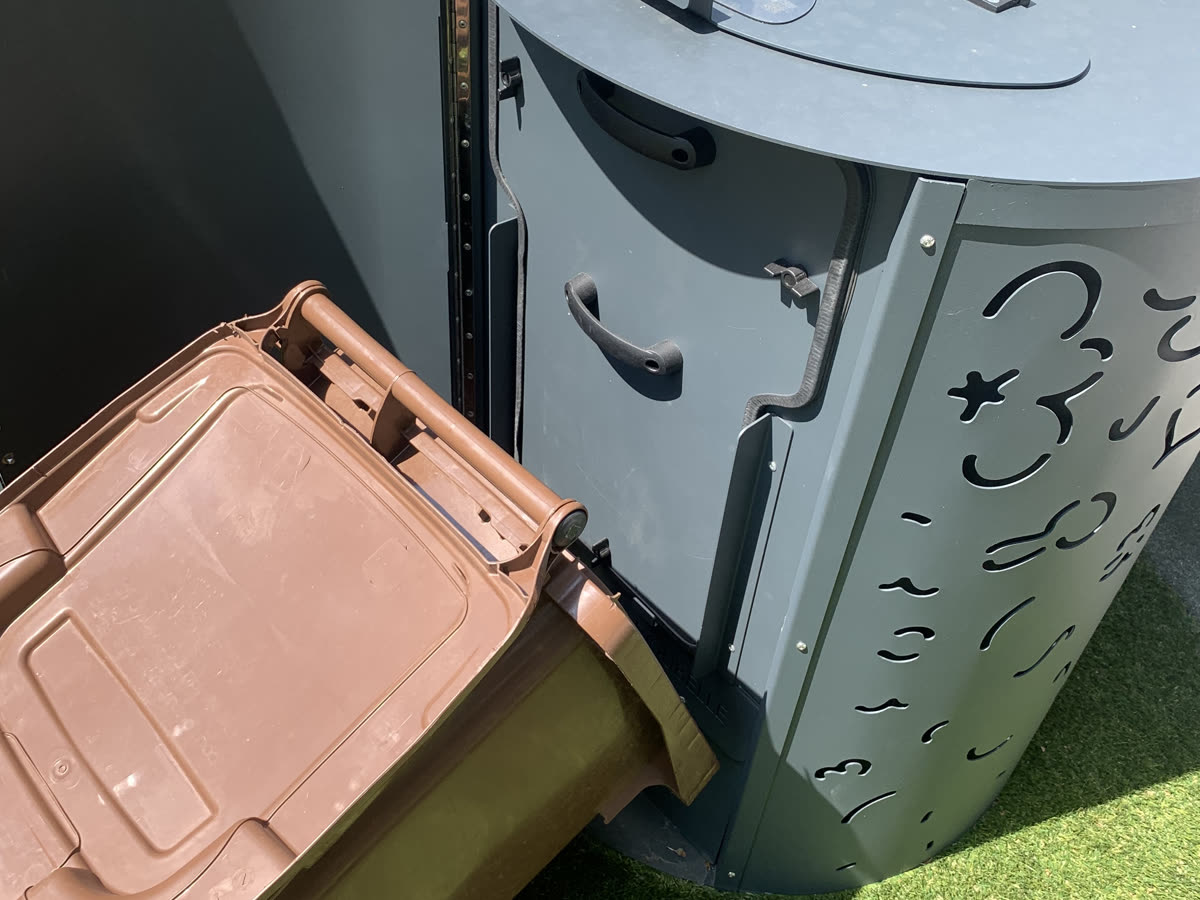
The ABC composter is a 2 mm steel drum of 450 litres, designed and built in our workshop in France. It does not plug into anything: no electricity, no water supply, no drainage, no groundworks, and mixing is mechanical, turned by hand. In a back-of-house area where no power point is free, that is what makes installing it possible, and reversible. The sequence is described on our how it works page.
Who pays, and how to recharge it
In almost every case the contract is held by the landlord and then recharged to the tenants through the service charge. It is the only arrangement that survives a change of tenant, since the equipment belongs to the site and not to the lease.
The composter is available to buy or to rent over 48 months: either way it is delivered on a pallet with its bulking agent and its awareness kit, your own team installs it, and the handover is done remotely. Emptying is not part of what we supply, the landlord arranges it with a local waste contractor, and the number of collections follows from the volumes, from one to twelve a year. The two configurations are set out on the composter on its own and food waste collection pages.
The maths
- 1 ABC composter for the whole plateau 1 unit
- Emptying, arranged with a local contractor 6 a year
- Monthly cost of the set-up 139 € excl. VAT
- Split equally between 8 tenants ÷ 8
Per outlet and per month17.40 € excl. VAT
Whatever that comes to, it covers on-site composting of the one stream that stays under the limits, not all of the food court's food waste. As soon as total volumes exceed 3,000 kg a year, a separate collection contract is added for the rest, and it is that contract that weighs most in the budget: presenting the shared composter as the cost of the site's compliance would be false. Both lines are recharged the same way.
That leaves the apportionment key, and this is where arrangements break down. The reflex is to apportion by floor area, since the other service charges are calculated that way; it is the wrong choice, because the area of a pitch does not predict its volumes. Two keys work in practice: equal shares, which is hard to argue with when the amount is modest, or the declared number of covers, which is fairer as soon as the gaps become visible. Either way, write the key into the house rules annexed to the lease, not into a letter: it will then apply of its own accord to the tenants that follow.
The checklist for putting it in place
The order matters as much as the content. An arrangement installed before the location and the lease clause are settled ends up unused, and restarting teams who watched the first attempt fail is far harder than starting from scratch.
- Weigh the vegetable preparation stream for two full weeks, tenant by tenant, at the end of service.
- Compare the daily average with the 4.3 and 8.6 kg limits to know whether on-site composting is in the running.
- Choose where the drop-off point goes before choosing the model: stable ground, step-free access for a wheeled bin, out of customers' sight.
- Walk the real route from the furthest kitchen, with a loaded bin, in service hours.
- Write the separation clause and the apportionment key into the house rules annexed to the lease.
- Name one person responsible per tenant, and the operative in charge of the round if the hybrid model is chosen.
- Put the instruction up at the preparation station, in pictograms, rather than at the drop-off point: the action is decided in the kitchen.
- Repeat the training with every new tenant and at the start of every season.
- File the reporting every month, with your other traceability records: dated weights, and the paperwork issued by whoever takes the material away.
If the food court sits inside a larger scheme, the decision has to be taken across the whole site: see our article on food waste in shopping centres and our page on retail.
Common questions
Can the landlord separate on the tenants' behalf?
It can provide the equipment, make its use compulsory and carry the cost, but it cannot carry the duty in place of its tenants. Each tenant remains the producer of its own food waste, and it is the tenant that will be inspected. The right arrangement shares the means, writes the obligation to use it into the house rules, and gives each tenant the reporting that concerns it.
What does a shared arrangement for 8 tenants involve?
One ABC composter for the whole plateau, delivered on a pallet with its bulking agent, its awareness kit and a remote handover for the teams; your own staff install it. Emptying is arranged with a local waste contractor, from one to twelve collections a year depending on the volumes, and six is typical for a plateau of this size. The cost is recharged through the service charge, split equally or by declared covers. It only covers the stream composted on site: if the plateau's volumes exceed 3,000 kg a year, a separate collection contract is added for the rest.
Can separation be measured tenant by tenant?
Yes, with the hybrid model or with individual composters. A named wheeled bin, weighed when the round is done, gives each tenant its own figures: that is often the condition for chain operators, who have to report to head office, to join the arrangement at all. With a central drop-off point and no named bins, only the site total can be measured.
What do you do with customer tray returns?
They do not go into the composter. A tray return mixes meat leftovers, sauces, napkins and packaging; it cannot be sorted afterwards and it is not compatible with on-site composting, where meat and fish are best avoided. On-site composting handles the vegetable preparation fraction, separated in the kitchen; tray returns call for separation in the seating area and then a collection route.
Does the composter need electricity in the back-of-house area?
No. The ABC composter does not plug into anything: no electricity, no water supply, no drainage, no groundworks. Mixing is mechanical and turned by hand. What it needs is stable ground and a few square metres reachable by a wheeled bin, which means it can be moved if the back-of-house layout changes.
Our food court goes over 3,000 kg a year, what then?
On-site composting is then not the right answer for the whole of the volumes, and adding units changes nothing. Two routes stay open, and they are often combined: give the main volumes to a waste contractor running frequent rotations, and keep on-site composting for a stream that stays under the limits, the vegetable preparation of one or two tenants for instance.
Where to start
Do not start with the equipment or with the model: start with the scales. Two weeks of weighing the vegetable preparation stream, service by service and tenant by tenant, give you the one figure that decides everything else. You will know whether you are under 1,500 kg a year, between 1,500 and 3,000, or above, and the choice of model will come down to two questions: the distance from the furthest kitchen, and whether or not there is a facilities operative.
To place your order of magnitude before you even weigh, our online sizing tool estimates the volumes from your activity and returns the sizing in a few minutes. Where we deliver is set out on our delivery page.
A free assessment, a quote within 24 h
Thirty minutes on a video call to go over the food waste separation duty that applies where you operate, size the solution and estimate your savings.
