
Resource
Rolling out composting across multiple sites: a method for groups
Qualify the estate, pilot on three sites, agree a framework, roll out in waves: the method, the timetable and what each phase actually produces.
A group does not have one duty, it has as many as it has establishments: separating food waste at source binds the producer, and the producer is the site. In the European Union that duty comes from Article 22 of the Waste Framework Directive 2008/98/EC, transposed country by country; the United Kingdom sits outside the directive and runs four separate regimes. Whichever applies, it is the site that is inspected, not head office. The method that holds across an estate runs in four steps: qualify the sites one by one, pilot on three deliberately contrasting sites for three months, agree a framework, then roll out in waves of 10 to 30 sites. Allow 4 to 8 months for an estate of 30 to 100 sites.
Key takeaways
The duty is local. It is assessed establishment by establishment, and the inspection happens on site. In a group spread over several countries it is also written differently from one country to the next. A framework agreement organises the rollout; it does not pool compliance.
Scale does not change the equipment. The same composter goes on every site, whatever the size of the estate; what varies is how often the material has to leave, and that follows from each site's volumes. The saving across an estate comes from collection frequency, not from a volume discount.
Collection is never included. Outside France we supply the equipment: the composter is bought or rented over 48 months, delivered on a pallet and put in place by your own team, with training given remotely. Removal of the mature compost is arranged with a local operator of your choice, country by country, and we help you scope the brief.
What changes when you go from one site to thirty
A group does not hold a single duty it could deal with at head office. Waste law binds each producer of food waste, and therefore each establishment: in the European Union under Article 22 of Directive 2008/98/EC, which required separate collection or recycling at source by 31 December 2023 and applies in Ireland, and in the United Kingdom under four separate regimes, Simpler Recycling in England, the Waste (Scotland) Regulations 2012, the Workplace Recycling rules of 2024 in Wales, and Northern Ireland's own arrangements. The consequence is operational as much as legal: the inspection happens on site, and it is the site that answers. Penalties are national, the amounts, the enforcing body and the appeal route are set by each regime, so ask your local authority or environmental regulator which text covers each establishment.
A second difference, less visible and more expensive: across an estate, the volumes per site are almost always small. A non-food shop, a branch office or a logistics platform produces a few kilos a week, from lunch breaks. At volumes of that order it is no longer the treatment that weighs on the bill, it is the journey. A weekly collection contract means 52 visits a year per site: multiplied by 40 sites, the cost per kilo becomes absurd long before the environmental question arises.
Third difference: how unlike each other the sites are. A head office with a staff restaurant, a 40-bed care home and a 15-person branch call for neither the same equipment nor the same frequency. A single configuration applied everywhere gets it wrong at both ends: oversized on the small sites, short on the large ones.
Qualifying the estate before choosing anything
The first deliverable is not a tender, it is an estate file. Three columns are enough to decide: estimated annual volumes, the location you have in mind, the local constraint you already know about. Everything else comes afterwards.
Volumes are estimated by ratio before they are weighed: 0.015 kg per person per office day, multiplied by 1.5 where there is a coffee point, 0.075 kg per meal served in contract catering, 0.140 kg per bed per day in healthcare. Two limits then govern the whole sizing exercise: an ABC composter absorbs up to 1,500 kg a year, a second one takes the ceiling to 3,000 kg, and beyond that on-site composting is no longer the right answer. Our guide to sizing by volume covers the borderline cases.
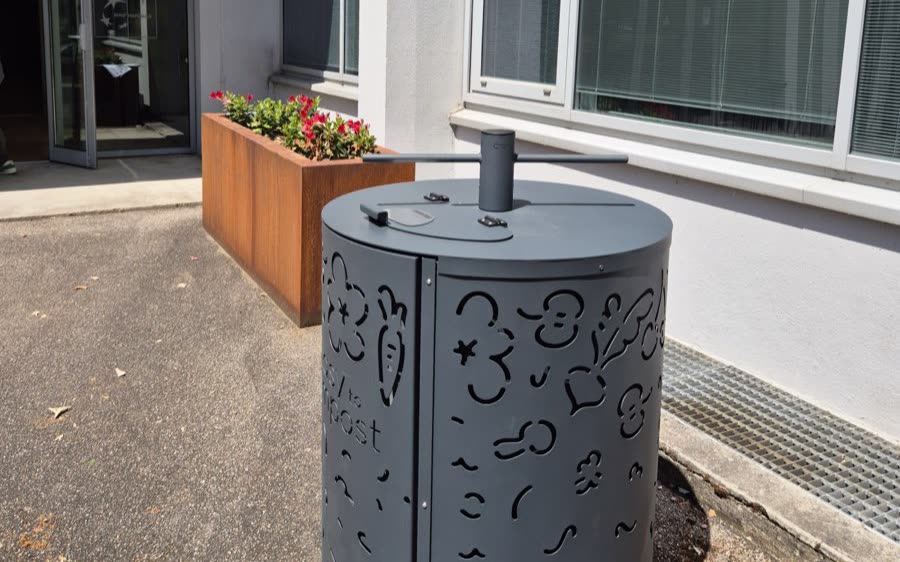
The location deserves as much attention as the volumes, because it is what sorts the sites of an estate. The ABC composter is a closed 2 mm steel vessel of 450 litres, designed and built in our workshop in France, and it does not plug into anything: no electricity, no water supply, no drainage, no groundworks, and mixing is mechanical, turned by hand. So there is no technical file and no works to process site by site, which removes the main source of delay in a multi-site rollout. What you do need is a few square metres of flat, stable ground, reachable by a wheeled bin without a step, out of customers' sight: a surfaced bay, a back-yard slab or compacted grass all do the job. That criterion is checked on site or from a photograph, never from a drawing.
| Type of site | Estimated annual volumes | Equipment | Collections a year | Monthly per site, excl. VAT |
|---|---|---|---|---|
| Non-food shop, 40 staff | 140 kg | 1 composter | 1 | 89 € |
| Logistics platform, 80 staff | 315 kg | 1 composter | 2 | 99 € |
| Regional office, 200 people, coffee point | 690 kg | 1 composter | 4 | 119 € |
| Care home, 40 beds | 1,430 kg | 1 composter | 12 | 199 € |
| Hotel, 40 breakfasts and 60 covers a day | 1,470 kg | 1 composter | 12 | 199 € |
| Head office, 300 people, restaurant serving 120 meals | 2,080 kg | 2 composters | 9 | 338 € |
| Industrial site, canteen serving 400 meals a day | 5,250 kg | Out of scope | Not applicable | On-site composting is no longer enough; the material has to be collected |
The last row is the one nobody plans for, and it is often the group's flagship site. A mixed estate almost always includes a handful of establishments above 3,000 kg a year: they need a food waste collection contract sized separately. Telling a steering committee that the composter settles the question across 100% of the estate invites a contradiction at the first inspection.
Where the saving on an estate really comes from
Nothing about the equipment changes with the number of sites. The composter on its own is the same machine everywhere, with its bulking agent and its awareness kit, and the same remote handover for the local team. Emptying is arranged with a waste contractor near each site, and how often it happens follows from that site's volumes, using the sizing our online sizing tool applies. That is also where the reporting comes from, since the weighing happens when the material is taken away: a site that keeps its compost on the premises has no external weighing and has to keep its own log. Looking for a volume discount is therefore a dead end. The economy of scale is real, but it lies elsewhere.
The maths
- 24 low-volume sites, up to 250 kg a year 1 collection each
- 10 medium sites, around 690 kg a year 4 collections each
- 4 heavy sites, around 1,470 kg a year 12 collections each
- 2 head offices with a restaurant, around 2,080 kg a year, 2 composters 9 collections each
Monthly budget for a fleet of 40 sites4,798 € excl. VAT
Only the mix of sites changes from one group to the next: run the calculation again with your own figures.
The real saving sits in a line this calculation does not show: the number of journeys. Those 40 sites come to 130 collections a year. The same sites on weekly collection would come to 2,080, sixteen times more, to move the same kilos. That is the mechanism documented in the Decathlon case study: across more than 300 shops and logistics platforms, 52 collections a year per site were replaced by one, and the food waste management bill fell by 70%. Our page on arranging food waste collection sets the two models side by side. The second source of saving is the rollout itself: no connection, therefore no technical study and no works request.
The pilot: three contrasting sites, three months
The pilot is not there to prove that it works, it is there to find out what breaks. Hence the selection rule: three sites chosen for their differences, not for their enthusiasm. A simple site, with space and a stable team, gives you the upper bound. An average site, representative of most of the estate, gives you the figure to extrapolate. And a difficult site, with no back yard, high turnover and outsourced cleaning: that is the one that decides the fate of the rollout, and taking it on as a pilot costs infinitely less than discovering it in the fourth wave.
Three months of operation is enough, provided you measure the right things. The first is the actual capture rate, that is, the gap between the volumes calculated by ratio and the kilos that really reach the composter. That gap is structural: meals taken outside, absences, imperfect separation. Our estimates allow for it by keeping only 70% of the theoretical figure, but your estate has its own rate, and it is measured on the weighbridge ticket, not from a declaration. The second thing to watch is exactly where the habit breaks down: between the workstation and the caddy, or between the caddy and the composter. The two are not fixed the same way, and the list of what can and cannot go into a commercial composter is where the first of them starts.
What comes out of the pilot feeds straight into the framework agreement: a real range of volumes by type of site, the installation time actually observed, the real workload for the local team, and the friction points to handle in the activation procedure.
The framework agreement and what it has to settle
The point of a framework agreement is not the price. It is procedural: it means a site manager who wants to be equipped has nothing left to negotiate or get approved, only something to trigger. That is what lets you go from 3 sites to 40 without procurement becoming the bottleneck again.
- The price list that applies to each configuration: the composter on its own, the garden composter for sites with outdoor space, and, in France, the composter with collection.
- The rule that sets how often each site is emptied, tied to that site's volumes rather than to a local preference.
- The term, 48 months per composter on the rental route, and when it starts: the date the unit goes in on that site, not the date the framework agreement is signed.
- The procedure for activating a site: who triggers it, what information is supplied, and how long delivery takes.
- What happens to a site that closes or moves: the composter goes with it, since it belongs to you.
- Which countries the agreement actually covers, and on what terms: currency, VAT treatment and delivery terms are settled market by market.
- What the reporting contains, how often it is produced, and the export format your finance department expects.
- The traceability documents issued each time material is taken away, who issues them, and who receives them on the group's side.
- The appointment of one person responsible and one deputy per site, and who appoints them.
- How out-of-scope sites are handled, above 3,000 kg a year, which do not belong in the same arrangement.
Rolling out in waves
A realistic pace is 10 to 30 sites a month, driven by geographical spread far more than by numbers. Twenty shops in one region go in faster than eight sites spread over five. So build each wave by proximity, not alphabetically and not by size: that is what lets you group deliveries and awareness sessions.
On coverage, two limits belong in the calendar from the start. Outside France the removal of the mature compost is not part of what we supply: each site needs a local operator lined up, or a use for the compost on its own grounds, before it goes into a wave. And while the price list is the same in euros excl. VAT in every market, the VAT treatment and the delivery terms are settled market by market, so a group spread over several countries should expect one arrangement per market rather than a single one. Where we deliver is set out on our delivery page.
| Phase | Duration | Who decides | What it produces |
|---|---|---|---|
| Qualifying the estate | 2 to 4 weeks | Sustainability or procurement | Estate file: estimated volumes, intended location and configuration per site |
| Pilot on 3 contrasting sites | 3 months | Group management and the pilot site managers | Actual capture rate, weights recorded at collection, friction points identified |
| Framework agreement | 4 to 8 weeks | Procurement and legal | Unified terms and an activation procedure for each site |
| Deployment waves | 10 to 30 sites a month | The person responsible on each site | Composters in place, people named, signage installed |
End to end, that gives 4 to 8 months for an estate of 30 to 100 sites. The two phases you can compress are the qualification, if the estate file already exists, and the waves, if the estate is concentrated. The pilot does not compress: three months is the minimum to watch a full cycle and a first weighing.
Evidence, site by site, and consolidated reporting
Compliance is not demonstrated by a contract, it is demonstrated by documents. That is why the weighing matters: it happens every time material is taken away, it produces a dated figure attached to a site, and that figure feeds both the inspection file and the sustainability report. The practical consequence for a group: a site whose compost stays on its own grounds has no external weighing and therefore has to keep its own log, dated, of what goes in and what is spread. What to keep and for how long is a matter for national rules; ask the regulator that covers each site.
What comes out of the composter after a few months is not mature, standardised compost: it needs a maturing phase before it goes on the land, and the route it takes is the one you have set up locally, a contractor, a nearby farm, a municipal composting site, or your own grounds. For a group, that detail has reporting value: it documents a local, traceable destination, site by site, where a centralised chain only ever gives you a global tonnage. The full sequence is described on our how it works page.
On the sustainability side, the useful data are the tonnage separated and recovered per site and then consolidated for the group, the collection frequency, and where the material went. They feed the resource and circular-economy indicators directly, under the CSRD and its ESRS E5 standard for companies in scope in the European Union, and under whatever reporting duty applies in your own country otherwise. Our carbon footprint page shows how the same figures are used. One piece of method: fix the export format before the first wave, not when the annual report is being closed. Reconstructing 40 site histories after the fact costs more than collecting them in the right format from the start.
Common questions
How long does a multi-site rollout take?
4 to 8 months for an estate of 30 to 100 sites: 2 to 4 weeks of qualification, 3 months of pilot on three contrasting sites, 4 to 8 weeks for the framework agreement, then waves of 10 to 30 sites a month. The duration depends far more on geographical spread than on the number of sites, because deliveries and awareness sessions are grouped by region.
Does equipping a lot of sites change the terms?
Not on the equipment: the same composter goes on every site, with its bulking agent, its awareness kit and a remote handover, and how often each site is emptied follows from that site's volumes. The economy of scale comes from collection frequency, not from a volume discount: an estate of 40 sites comes to about 130 collections a year, against 2,080 on weekly collection.
Do you need works or a connection on each site?
No. The ABC composter does not plug into anything: no electricity, no water supply, no drainage, no groundworks, and mixing is mechanical, turned by hand. So there is no technical file and no works request to process site by site. What you do need is a few square metres of flat, stable ground, reachable by a wheeled bin without a step: tarmac, a slab or compacted grass all do the job.
How does this work for a group with sites in several countries?
The equipment is the same everywhere and the training is given remotely, so the technical side of a rollout does not change from one country to the next. What does change is everything around it: collection is contracted locally, site by site, and the commercial terms, currency, VAT treatment, delivery terms, are settled market by market. Sites abroad are therefore better handled in their own plan than slotted into the same waves.
If there is an inspection, who answers: head office or the site?
The site. The duty to separate food waste at source is assessed establishment by establishment, and the inspection happens on the premises. A framework agreement organises the rollout; it does not pool compliance: each site has to be able to produce its own evidence of separation and recovery.
How do you size the whole estate?
Site by site, then add it up. The online sizing tool applies the ratios to a given volume and returns the configuration in a few minutes, without signing up: run it on three or four sites representative of your estate and you have the standard configurations to multiply by the number of sites in each category.
Where to start
Start with the estate file, not with the tender. One line per site, three columns: annual volumes estimated by ratio, the location you have in mind with a photograph, the local constraint you know about. For 40 sites with up-to-date headcounts, that takes half a day, and on its own it settles three questions that meetings do not: which sites stay under 1,500 kg a year, which need a second composter, and which go over 3,000 kg and belong in a separate collection contract.
Then run three or four representative sites through our online sizing tool: it applies the ratios and returns the sizing without signing up. You get the standard configurations for your estate before committing to anything. Depending on what the estate is mostly made of, our offices and workplaces, retail and healthcare and care homes pages set out the points to watch for each type of site.
A free assessment, a quote within 24 h
Thirty minutes on a video call to go over the food waste separation duty that applies where you operate, size the solution and estimate your savings.
