
Resource
Food waste in supermarkets and grocery retail: volumes, cost and the right solution by store format
Shrink, unsold stock, space in the stockroom: what the rules ask of a food shop, how much the volumes weigh by format, and above what cost per collection on-site composting becomes cheaper.
What separating food waste asks of a food shop
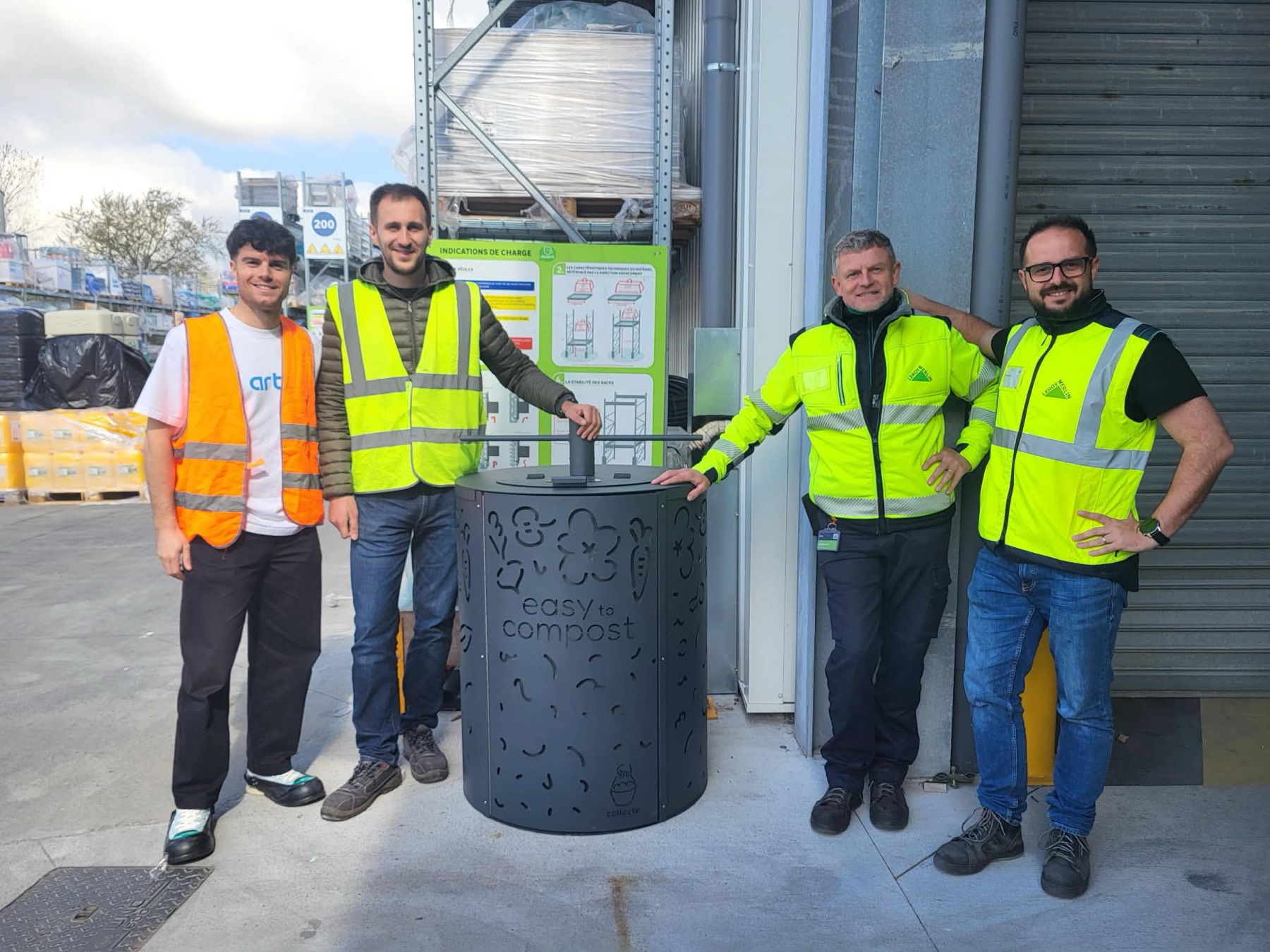
Every food shop has to separate its food waste at source and have it recovered. In the European Union that duty comes from Article 22 of the Waste Framework Directive 2008/98/EC, which required separate collection or recycling at source by 31 December 2023 and applies in Ireland; the United Kingdom sits outside the directive and runs four separate regimes. For a convenience store of 400 to 800 m², it means taking fruit and vegetable shrink, bread, cut flowers and coffee grounds out of the residual waste stream, then proving where that material went. Only two routes lead there: composting on the premises, which a composter does up to 1,500 kg a year, or having the volumes taken away by separate collection. The choice turns on three things only: the real tonnage, the space available behind the store, and what a lorry visit costs.
Two provisions of the directive are enough. Article 22 sets the duty to separate at source. Article 3(4) defines bio-waste and expressly names food waste from retail premises: for a food shop, the scope is not open to argument. Each member state transposes both in its own text, and the United Kingdom's four regimes cover the same ground in their own words, so the one to read is the one that binds your store.
Key takeaways
Thresholds are where the regimes differ most, and several of them have none at all: in more than one country a 250 m² convenience store falls under the same rule as a hypermarket, so check the threshold that applies to you rather than one quoted in a trade note. What does not change is where responsibility sits: it stays with the store, never with its cleaning contractor or its head office, and it is the store that produces the evidence if it is inspected.
Penalties are national. The amounts, the enforcing body and the appeal route are set by each regime, and figures published for one country say nothing about another, so ask your local authority or environmental regulator which text covers your store. In practice, though, the first signal is almost never a fine: it is the waste bill, which climbs when the residual bin is full of organic material.
How much food waste a store really produces
The volumes depend far less on floor area than on the range: a 120 m² greengrocer produces more food waste than a 400 m² convenience store built around dry groceries. The orders of magnitude below, taken from assessments, are there to size the equipment and prepare a tender, never to declare: only a weighing exercise over a representative week gives a figure you can defend.
| Format | Typical annual volumes | Dominant composition and seasonality |
|---|---|---|
| Convenience store (under 400 m²) | 300 kg to 1 tonne | Fruit and vegetable shrink, bread; little seasonality |
| Neighbourhood supermarket (400 to 800 m²) | 1 to 3 tonnes | Fruit and vegetable shrink (40 to 60% of the volumes), bread, flowers; peak from June to September |
| Hypermarket (over 5,000 m²) | 10 to 30 tonnes | Shrink, in-store preparation counters, garden centre; peaks in summer and at the end of the year |
| Independent greengrocer | 2 to 8 tonnes | Trimming and grading losses, almost entirely vegetable; up to double in summer |
| Bakery | 200 kg to 1.5 tonnes | Unsold stock, shaping offcuts; a lull in August |
| Cheesemonger, butcher | 200 kg to 1 tonne | Trimmings; animal by-products to be kept separate |
| Non-food shop | 100 to 400 kg | Break room: lunch leftovers, coffee grounds |
One point avoids an unpleasant surprise at audit: meat and fish do not follow the same rules as plant material. They are animal by-products within the meaning of Regulation (EC) No 1069/2009, which applies across the European Union and is retained in United Kingdom law as assimilated legislation, and they follow a dedicated route with an approved operator and its paperwork. They never go into an on-site composter, so a store with a service counter needs two contracts. For the rest, the method fits in one line, set out in our guide to sizing a composter: weigh the shrink bin for a week, multiply by 52, and add 10 to 15% for the summer peak.
Shrink, unsold stock and donation: the order to follow
Composting comes at the end of the chain, not at the beginning. The waste hierarchy of Article 4 of the Waste Framework Directive 2008/98/EC puts prevention and reuse for human consumption ahead of any recovery, and several countries go further: France, for instance, requires food retailers above a floor-area threshold to offer a donation agreement to an approved charity and forbids deliberately spoiling unsold food that is still edible. Check what your own country imposes. Either way, sending a batch of short-dated yoghurts to the composter is not an environmental act.
The order of treatment comes down to four actions at the waste bench. What is still edible goes to donation. What is no longer edible but can still feed animals follows that route, where it exists locally. What is bruised, damaged, stale or wilted becomes food waste and goes to separation at source. What is left, film, trays, bags, nets, goes to residual waste or to packaging recycling.
That fourth action decides everything: a crate thrown out with its stretch film ruins the quality of the stream. De-packaging happens at the waste bench, where the product is already being handled, never in front of the composter, where nobody has the time. It is the one real organisational constraint of separation in a store.
Floor space: what the stockroom gets back
The stockroom is the most expensive space in the store after the shop floor, and wheeled bins take up more than their theoretical footprint, because you have to be able to get them out. The assumptions behind the calculation: a standard 240 L bin measures about 0.58 m by 0.74 m, and you need a 0.80 m service aisle in front of the row.
The maths
- Footprint of a 240 L bin, 0.58 × 0.74 m 0.43 m²
- Four bins in a row against a wall, 2.32 m of frontage 1.72 m²
- A 0.80 m manoeuvring aisle along that frontage 1.86 m²
Stockroom space tied up3.58 m²
Against that, the ABC composter is 810 mm across and 1,000 mm high, 0.66 m² in its bounding square, and above all it goes outside: service yard, delivery bay, grass verge, against a wall. It does not plug into anything. No electricity, no water supply, no drainage, no groundworks: it arrives and stands on flat ground, and the mechanical mixing is turned by hand, two or three turns of the crank after each drop. So the stockroom gets back all 3.58 m², a full rack bay, or close to four euro-pallet positions on the floor. How it works is set out on the how it works page.
When on-site composting works out cheaper
The composter is available to buy or to rent over 48 months: either way it is delivered with its bulking agent and its awareness kit, your own team installs it and the handover is done remotely. Emptying is not part of what we supply, you arrange it with a local waste contractor, from one to twelve collections a year, per composter, and the reporting comes from the weighing done when the material is taken away. A store with beds and borders keeps its compost and stays with the composter on its own; the alternative is set out on our food waste collection page. Here is the case of a store whose volumes stay under 1,500 kg a year, with four collections; above that, a second composter is needed and both lines double.
The maths
- ABC composter delivered, with bulking agent, awareness kit and remote handover 1 composter
- Four collections a year, arranged with a local contractor 4 a year
- Over twelve months, 119 × 12 1,428 € excl. VAT/year
Annual budget, volumes up to 1,500 kg1,428 € excl. VAT
The comparison that matters is one you can run yourself. Take the annual cost of your current collection contract, bin rental and surcharges included, and divide it by the number of visits it buys: a weekly collection is 52 visits a year. Then put that cost per visit against a composter that needs four collections a year for the same volumes. Two assumptions to keep in mind: the calculation holds for one composter and volumes under 1,500 kg a year, and it leaves out internal handling time, which falls either way. Our page on arranging food waste collection compares the two collection models.
Which solution to choose for which volumes
On-site composting is not the right answer everywhere, and saying so avoids disappointment. One composter absorbs up to 1,500 kg a year; beyond that you add a second; above 3,000 kg a year, the subject belongs to an industrial route.
| Annual volumes | Formats concerned | Suitable solution | What it involves |
|---|---|---|---|
| Up to 450 kg | Non-food shop, cheesemonger, butcher, convenience store or bakery with little shrink | 1 composter, 1 to 2 collections a year, or none if the site has grounds | A caddy in the break room, a composter at the back |
| 500 to 1,500 kg | Convenience store, bakery, neighbourhood supermarket without a large produce section | 1 composter, 4 to 12 collections a year | A separation bin at the waste bench, filled daily |
| 1,500 to 3,000 kg | Neighbourhood supermarket with produce, mid-size store, small greengrocer | 2 composters, collections timed to the peaks | About 1.3 m² outdoors, rotation between the two vessels, twice the equipment |
| More than 3,000 kg | Hypermarket, high-volume greengrocer, food court | Industrial route: dedicated separate collection, transfer station or anaerobic digestion | A suitable waste area, a service contract, transfer notes |
Mixed cases are handled by separating the streams: a hypermarket can send its bulk shrink to an industrial route while composting the food waste from its break room on site. The same logic applies in a shopping centre, where the hypermarket, the units and the food court share neither volumes nor opening hours: see food waste in shopping centres, and the constraints specific to retail on our retail page.
Organising separation in the back-of-house area without adding a task
In a store, an instruction that adds a journey does not last three weeks. Separating food waste works if it fits into something that already happens: the trip to the stockroom with the shrink cage. The checklist below is what separates, on the sites we equip, the stores where the stream keeps moving from those where it runs out of steam.
- Put the separation bin at the waste bench, where the product is already being unwrapped, and a caddy in the break room.
- Keep under 30 metres between where the waste is produced and the composter, on a route already walked every day.
- Put the instruction up above the bin, in two columns: what goes into the composter, what does not. The negative list matters more than the positive one.
- Name someone responsible and a deputy: in retail, turnover makes an instruction carried by one person disappear.
- Build the action into the induction for seasonal staff, alongside breakages and shrink.
- Give the crank two or three turns after each drop: that is what buries the material and stops odours coming back up.
- Plan ahead for June: the peak in stone fruit coincides with fruit flies, which lay on peelings before they even reach the composter.
- File the tonnage records and the proof of recovery alongside the store's packaging and cardboard contracts.
Two worries come up at the start. Odours come from excess moisture, food waste being 70 to 90% water: absorbing it is exactly what the bulking agent delivered with the composter is for. Rodents, a sensitive subject near a food delivery bay, come down to the vessel being closed with no way in: see composters and rodents.
A multi-site network: evidence before tonnage
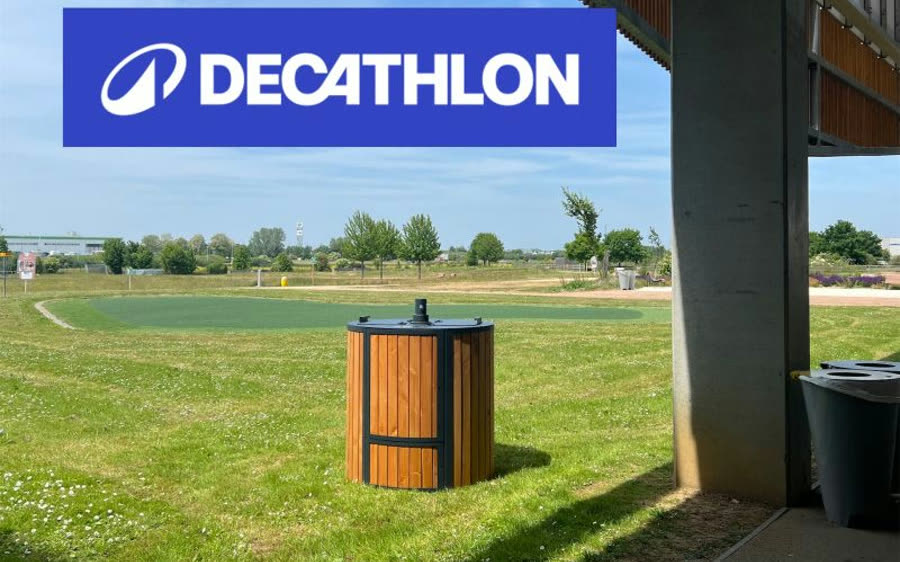
For a retail chain the difficulty is logistical: on small volumes spread across many sites, collection weighs far more than treatment, and multiplied by the number of stores, the frequency of visits becomes the biggest line in the waste bill. That is the problem behind the rollout carried out with Decathlon: more than 300 stores and logistics platforms, 2 to 5 kg a week per site, that is 104 to 260 kg a year, a long way from the 1,500 kg a composter absorbs. Replacing 52 visits a year with one brought the food waste bill down by 70%, and the transport footprint followed.
That leaves the evidence. Tonnage records per site and per month, proof of recovery and the history of collections feed the store's waste file as much as the group consolidation; the method, from pilot store to full rollout, is in our guide to multi-site rollouts. One point for international chains: outside France the removal of the mature compost is not part of what we supply, it is arranged locally, store by store, and while the price list is the same in euros excl. VAT in every market, the VAT treatment and the delivery terms are settled market by market. Where we deliver is set out on our delivery page.
Common questions
Is a 600 m² supermarket really covered? Yes. Several regimes set no floor-area threshold and no tonnage threshold at all, so a store producing 2 tonnes a year carries the same duty as a hypermarket producing 25. Check the wording that applies to your store, since the thresholds are where the regimes differ most.
Can meat and fish from the counter be composted? No: they are animal by-products within the meaning of Regulation (EC) No 1069/2009, which follow a dedicated route. The on-site composter takes plant material, bread, coffee grounds and flowers.
Does a store composter need a waste permit? Permitting thresholds for composting are national and almost always expressed in tonnes handled per day rather than per year: a composter absorbing 1,500 kg over a whole year sits a very long way below them. If your site already holds a permit for another activity, your environmental regulator is the one to ask.
Does the composter use electricity or water? Neither: no connection, no water supply, no drainage, no groundworks, and mixing is mechanical, turned by hand. That is what sets it apart from electric dehydrators, which need a power supply and a connection. The other questions are gathered in We also recycle your cigarette buttsour FAQ.
Where to start this week
Three actions are enough, and they fit into one week in store. Weigh the shrink bin for seven consecutive days, keeping plant material separate from animal by-products: it is the only figure worth having, both to size the equipment and to talk to a contractor. Check what your own country requires on food donation: where a duty exists, it comes before any recovery. And get out your last collection invoice and add up twelve months, bin rental and surcharges included: that annual figure is the one to compare with the equipment, whatever the frequency of collection.
With those three figures in hand, the annual tonnage, where you stand on donation and the annual cost of your collection, the online sizing tool gives you, in five questions, the number of composters you need and the number of collections to plan for your store.
A free assessment, a quote within 24 h
Thirty minutes on a video call to go over the food waste separation duty that applies where you operate, size the solution and estimate your savings.
