
Resource
Customising your composter: logo, colours and finishes that fit in
Five lacquered colours, a cut-out skin, marking or a planter: what customising the composter changes on site, and why it does not change the price.
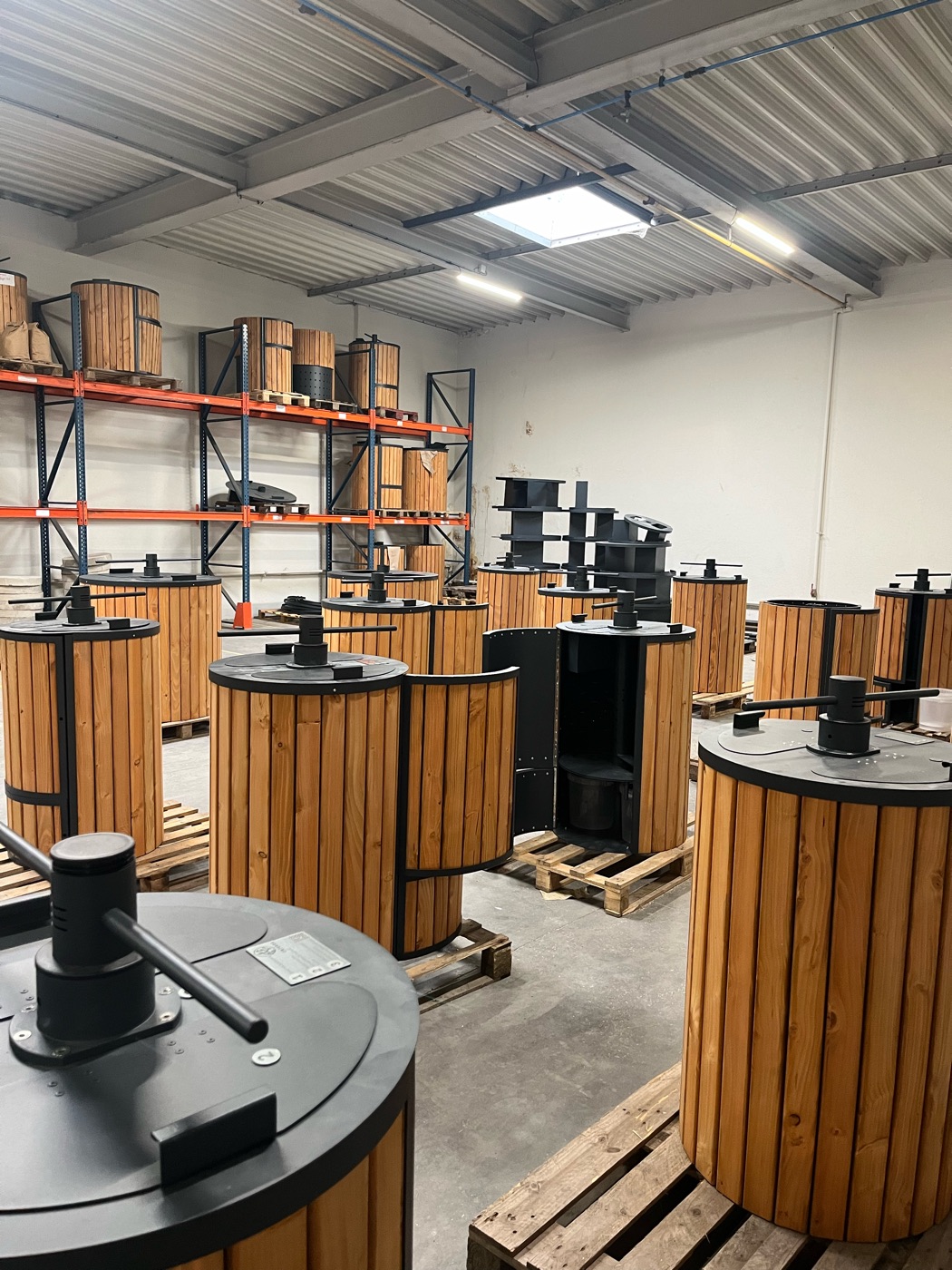
Yes, a professional composter can be customised, and it makes no difference to the monthly figure. The ABC composter comes in five lacquered colours, baked in our workshop in Albert. On the lacquered versions the outer skin is cut with decorative openings, and the lettering is cut out of the sheet rather than stuck on top. The subscription stays at 79 € excl. VAT a month whatever finish you choose: what makes the bill vary is never the colour, it is the volumes, which set the number of composters and of collection visits. The only real constraint is a calendar one: the finish is decided on the sheet metal and at the lacquering station, so before manufacturing starts.
Key takeaways
Five colours, one monthly figure: 79 € excl. VAT a month for the 450 L ABC composter, 129 € for the garden composter, whatever the colour. The finish changes the way the equipment reads in the place, never its mechanics: a closed vessel in 2 mm steel, an aeration chimney, mixing on a crank, no connections.
Five colours, one monthly figure
The ABC composter comes out of a single workshop, at Albert in northern France: cutting, folding, welding and lacquering all happen on site. Lacquering is a three-stage operation, degreasing, primer, then paint: the colour is baked onto the steel, never applied on site.
Five lacquered colours are in the catalogue: anthracite grey, forest green, chestnut brown, garnet red and electric blue. The configurator on the product page shows them at the same scale, which avoids the swatch trap: a colour judged on a 2 cm patch says nothing about how it looks on a cylinder 1 metre tall standing in front of a glazed façade.
The table sets each finish against the setting it answers. The capacity, 450 L, and the mechanism never change.
| Finish | What you see | Where it earns its place | Rental, excl. VAT |
|---|---|---|---|
| Anthracite grey | Dark lacquered steel, perforated skin | Forecourts, service yards, car parks: the colour that draws the least attention | 79 €/month |
| Forest green | Deep green lacquered steel | Lawns, borders, parks, campuses: the vessel disappears into the planting | 79 €/month |
| Chestnut brown | Warm brown lacquered steel | Gravel paths, pale hard landscaping, existing timber cladding | 79 €/month |
| Garnet red | Dark red lacquered steel | Sites where the collection point has to be found without being explained | 79 €/month |
| Electric blue | Bright blue lacquered steel | Blue brand identities, logistics platforms, corporate campuses | 79 €/month |
| Garden composter, douglas fir | A timber-clad composter with a planted ring built into the structure | Public space, the foot of a building, a school: it reads as street furniture | 129 €/month |
Six of the seven rows are the same machine in a different skin. What sets the last one apart is not a colour: it is a 2,000 L planter and the structure that carries it.
The perforated skin and the lettering: what gets cut into the sheet
An ABC composter is made of two things that should not be confused. First the vessel: a 2 mm steel cylinder with a closed base, topped by a solid lid, 450 L of capacity, 1,000 mm high by 810 mm across, 121 kg empty and 330 kg loaded. Then the outer skin: a separate sheet that dresses the cylinder, and which alone carries the decorative cut-outs, foliage or fruit and vegetables, along with the lettering.
The openwork you see in the photographs therefore belongs to the cladding, not to the composting chamber: the material stays inside a closed vessel standing on a hard surface, and the question of rodents is settled by that vessel and how it closes, never by the decoration. The rest owes nothing to the skin either: aeration is continuous through the central chimney, and mixing is done on the crank, two minutes a week.
That leaves the consequence for your timetable. A motif or a piece of lettering is a cutting file, worked on the sheet before lacquering and therefore before assembly: a brand mark on an ABC composter is not a sticker applied on delivery day. It is decided with the quote, not at commissioning.
The wood of the garden composter, and what it asks for
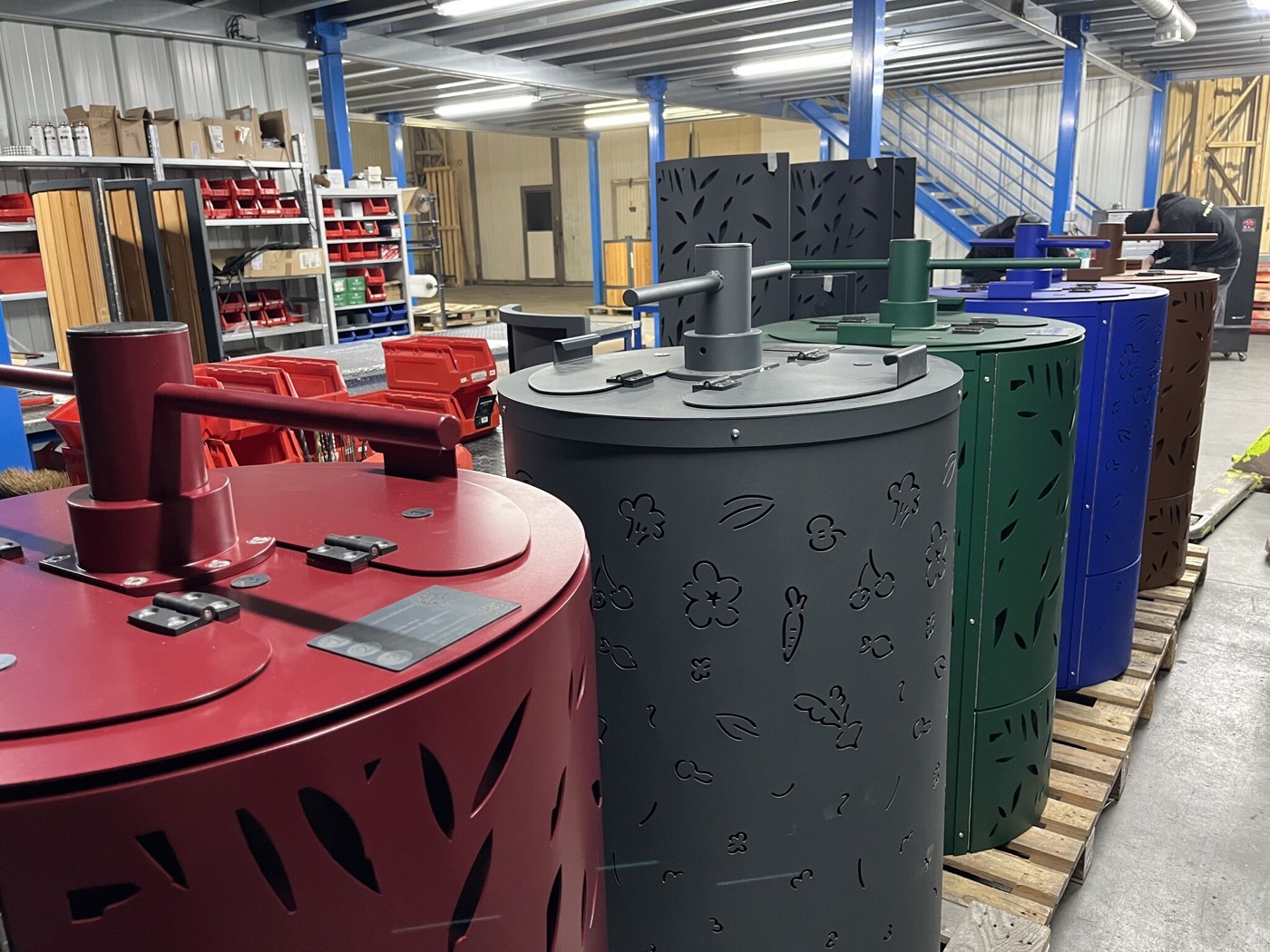
The garden composter, for its part, is not offered in a colour: its skin is a material, slats of French Douglas fir screwed vertically onto the cylindrical body, with the lid and the bands staying lacquered. The steel structure and the mechanism do not change, only the skin changes. Douglas fir is used as external cladding for its natural resistance to the weather.
Two things to know before choosing it. Timber greys: exposed to rain and ultraviolet, douglas fir goes from honey to silver grey over a few seasons, unevenly from one face to another. It is not decay, but it is better said before than after. The cladding also needs looking at: a damaged slat is replaced one at a time, without touching the vessel, which fits into the monthly maintenance check, and the material-by-material comparison is set out in our head-to-head of steel, wood and plastic.
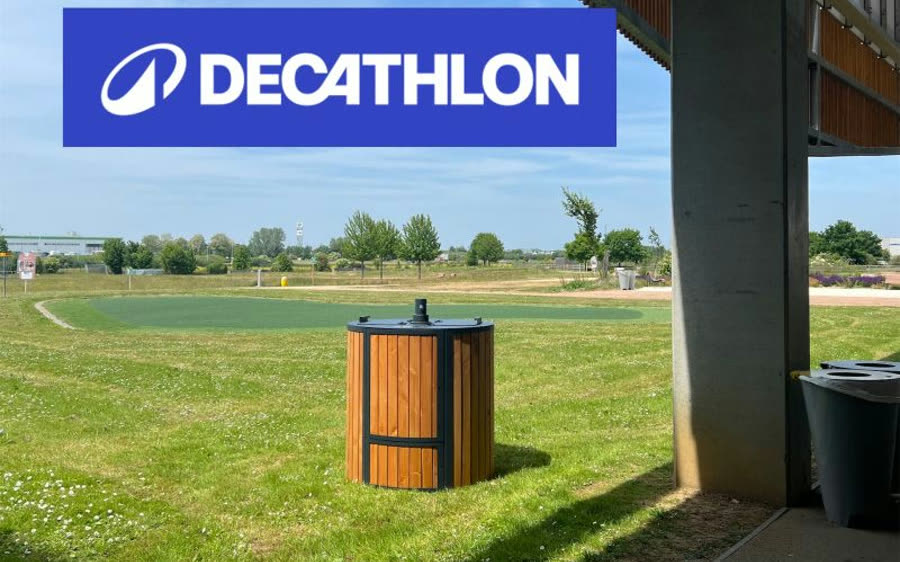
Timber earns its place wherever bare steel would read as a plant room: a hotel courtyard customers walk through, an office terrace, the back of a shop visible from the car park, as at the Decathlon store network. It is also the reflex of hotels and resorts, whose service yards are never entirely out of sight.
The garden composter, when the equipment has to read as street furniture
In a space open to the public, the finish is no longer enough: it is the silhouette that has to change. The garden composter answers that need. The composter inside is identical, 450 L, same aeration, same crank, but it is ringed by a circular planter built into the structure, 2,000 L of soil in all, which takes the planting. It exists only in douglas fir: it is the one finish where there is no choice to make.
What you get for that is a larger object, not a different machine: the composted material comes out the same way, through the lower door, into a 120 L wheeled bin. What becomes of it afterwards is up to you, and here it feeds the soil in the planter first, which is the whole point of the garden version. Anything left over leaves the site by whatever local route you have arranged.
It is the version most often chosen by local authorities and schools: on a council lawn or at the foot of a building, equipment that looks like street furniture is accepted where a container is not. Siting requirements are set out on our public sector and education page.
What the finish does not change
The five colours are the same machine, off the same line, in the same 2 mm steel: what changes between them is the skin. The monthly figure comes in two lines. The composter: 79 € excl. VAT a month, finish included, with delivery, the bulking material, maintenance, the awareness kit and training for the teams, on a 48-month rental; buying one is possible as well, talk to us and we will quote it. Setting it down stays on your side, and it is light work: two people, fifteen minutes, no lifting gear. Collection, which stays an option, is a French line: 10 € excl. VAT a month per annual visit, from 1 to 12 visits a year, weighing report and traceability record included, since it is the removal that weighs what the site has produced. Elsewhere the removal of the mature compost is arranged with the local operator of your choice.
How often the composter has to be emptied is not a matter of preference either: it follows the volumes. One vessel absorbs up to 1,500 kg a year; above that a second one is added, and the routine doubles with it.
The maths
- Annual volumes used, entered in kilos 750 kg a year
- Composters needed, one vessel absorbing 1,500 kg a year 1
- Emptyings set by the scale, first band covering 750 kg 4 a year
- Rental of the ABC composter, finish included 79 € excl. VAT/month
- Collection, 10 € excl. VAT a month per annual visit, French benchmark 40 € excl. VAT/month
Monthly, whichever finish you choose119 € excl. VAT/month
Do it again in forest green: 119 €. In garnet red: 119 €. Only the garden composter moves the rental line, at 169 € excl. VAT a month for the same volumes. A site at 1,200 kg a year moves to 12 annual visits, so 199 € excl. VAT a month, without any colour coming into it; beyond 3,000 kg a year, on-site composting is no longer the right answer. The online quote applies exactly that grid.
Choosing your finish for the place: the checklist
On the rental route the term runs for 48 months: the equipment will be looked at every day for at least four years, by the same people. So the right question is not "what is our brand colour" but "what is already there".
- Find the viewpoint that counts: the façade customers see, or the yard only your teams see. The colour is chosen from that spot, not from a swatch card in a meeting room.
- Look at what is already there: cladding, outdoor furniture, signage, ground surface. A colour that picks up the existing background draws less attention than a brand colour dropped into the middle of it.
- Check the ground: installation is done on a hard, flat surface, with no foundation and no connection, by two people in fifteen minutes. 121 kg empty, 330 kg loaded.
- Decide who comes near it: if only your own teams have access, a lacquered composter is enough; if the public passes within three metres, the garden composter version settles the discussion.
- In a conservation area, or under a planning condition on external appearance, have the colour approved in advance by whoever signs off appearance locally: it is the one decision capable of costing you weeks.
- Deal with the signage at the same time: what your teams see every day is the caddy and the poster in the break room, not the vessel itself.
That last line is not cosmetic. Since 31 December 2023, Article 22 of the Waste Framework Directive 2008/98/EC has required food waste across the EU to be collected separately or recycled at source, with each country setting its own rules; the United Kingdom sits outside the directive and runs four regimes of its own, while Ireland follows the EU framework. And a composter only counts for anything if it is actually fed: how the equipment looks, and how clear its signage is, decide whether the habit holds over the years. Our guide to what can and cannot go in a commercial composter is the practical half of that.
Common questions
Can you put your logo on the composter?
Yes, and it is not a sticker. On our vessels the lettering and the motifs are cut into the outer skin before lacquering: it is a cutting file, handled at the Albert workshop during manufacture. A mark in an organisation's own colours follows the same logic, and is therefore decided when you order, with the quote, never after delivery.
Does customising the composter cost more?
No. The five colours are included in the subscription: 79 € excl. VAT a month for the 450 L ABC composter, whatever the colour, with delivery, the bulking material, maintenance, the awareness kit and training for the teams. The weighing report comes with the collection, because it is the removal that weighs what the site has produced. Only the garden composter moves that line, at 129 € excl. VAT a month, because it adds its circular planter of 2,000 L.
Can the colour of a composter already installed be changed?
Not on site. The lacquer is a powder baked onto the steel in an oven, after degreasing and priming: changing a colour means a trip back to the workshop, not a job done in front of the building. In practice the question is settled when equipment is replaced, and it is decided with your order.
Does a customised composter need building work?
No. The ABC composter does not plug in: no electricity, no water, no drainage, no groundworks. Aeration is continuous through the aeration chimney and mixing is mechanical, turned by hand. The vessel is set down on a hard, flat surface by two people in fifteen minutes, timber-clad or lacquered alike.
Can every site in a network have the same finish?
Yes, and it is the most common case: the finish is settled once for the network, then repeated site after site. Because the colour is baked in the workshop and not applied on site, two vessels delivered six months apart come off the same paint line. That is what avoids a patchwork of colours between sites opened on different dates.
Where to start
Take the decisions in the order they arise: the finish comes last. First the volumes, which set the number of composters, the number of visits and therefore the monthly figure. Then the siting, which sets the colour and the choice between the lacquered composter and the garden composter. It is the wall opposite that names the colour, not the brand guidelines.
The sizing tool takes the first step: it estimates your volumes from your headcount or your covers, works out the sizing and shows how often the composter will need emptying, which is the same whatever finish you choose afterwards. Allow a few minutes. The finish itself is settled when you order, before the machine goes into production.
A free assessment, a quote within 24 h
Thirty minutes on a video call to go over the food waste separation duty that applies where you operate, size the solution and estimate your savings.
