
Resource
What is a garden composter?
Garden composter: what it is, the four forms that exist, what it absorbs and where it earns its place. Comparison table and a worked example.
What is a garden composter?
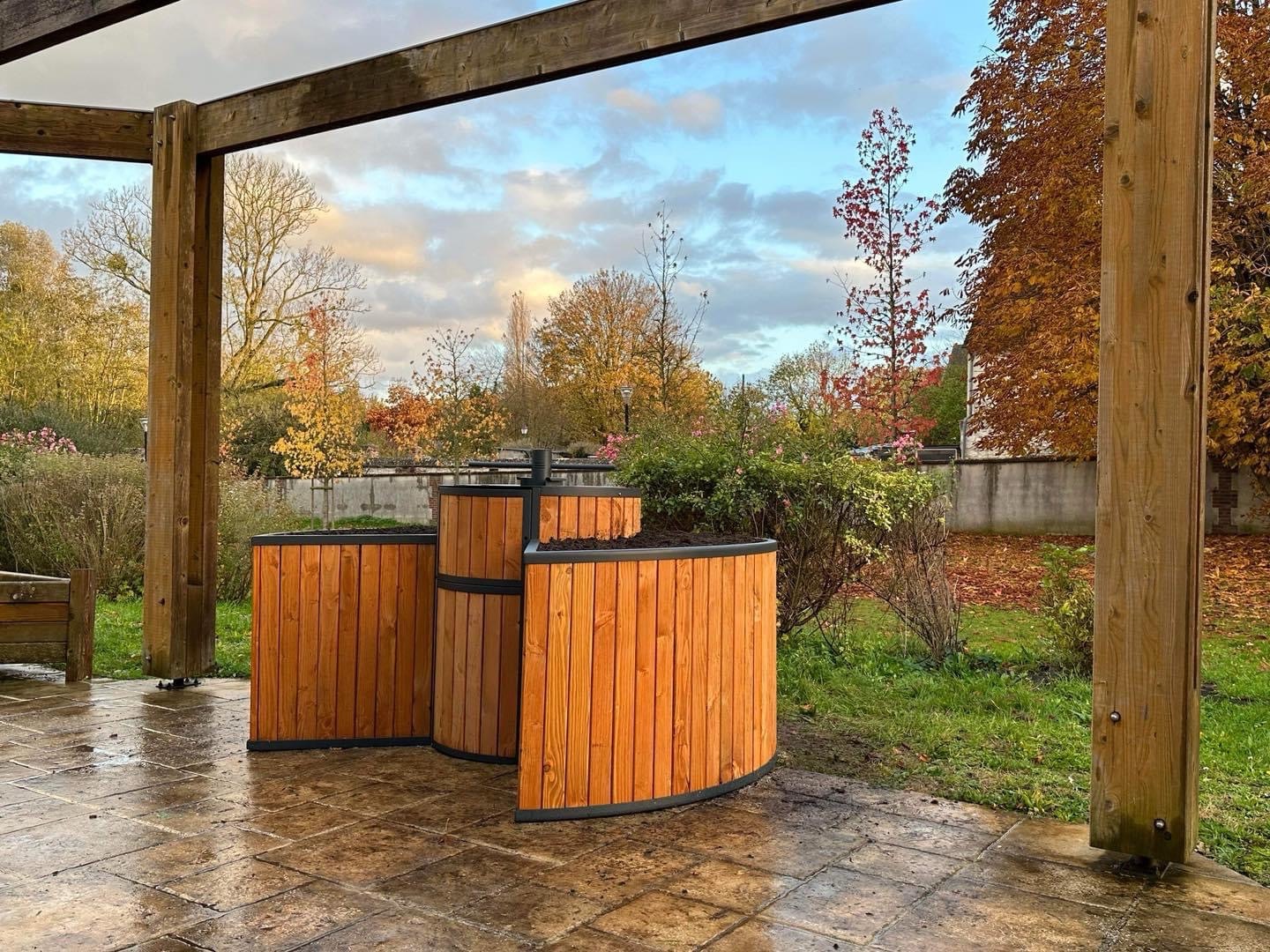
A garden composter is a composter ringed by a growing space: food waste goes into a central compartment, breaks down there, and the material it produces feeds the planting around it. Same function as an ordinary composter, with two differences that change everything: the loop closes on the spot, and the object reads as garden furniture rather than as a waste container.
The definition therefore lies in a geometry, not in a technology. A conventional composter stands out of the way, at the back of a yard or behind a plant room, and the compost that comes out then has to be carried to a use. In a garden composter, the use is built around the composter: a bed, a planter, a raised vegetable box or open ground depending on the model. The material travels a few tens of centimetres instead of a few kilometres.
In this form the biology is exactly the same as in any composter, and the same three conditions govern how the micro-organisms work, and therefore the result: air circulation, a moisture level that neither falls nor climbs too far, and the balance between nitrogen-rich material (peelings, meal leftovers, grass cuttings) and carbon-rich material (bulking agent, flax shive, brown cardboard). A garden composter short of carbon smells as bad as any badly run heap: the planting does not excuse you from the basics of the composting cycle.
Key takeaways
A garden composter is not a particular composting technique but a way of arranging a composter: at the centre of a growing area that receives the compost it produces. At Easy to Compost this form is called the ABC garden composter: the 450 L composter, ringed by a circular 2,000 L planter, at 129 € excl. VAT a month to rent.
The four forms of garden composter
The expression covers very different objects, from a circle of boards at the end of a family vegetable patch to a 6 m² unit standing on a campus forecourt. Three criteria are enough to tell them apart: the volume of food waste they genuinely absorb in a year, who uses them, and whether what has been treated can be evidenced. The first two forms in the table belong to domestic gardening; the last two can carry an institution's flow.
| Form | How it is made | What it absorbs | Where you find it | Its limit |
|---|---|---|---|---|
| Pit or silo built into the vegetable patch | A circle of timber, metal or stone in the middle of the plot, food waste laid straight onto the soil | A few tens of kilos a year, with no way of measuring | Private gardens, allotments, open-ground plots | Depends entirely on the quality of the soil beneath, open to rodents, no traceability |
| Raised bed or vegetable box with a built-in compost section | An above-ground structure filled with a chosen growing medium, with a compost compartment to one side | Low: the compartment saturates quickly | School grounds, teaching gardens, tight urban spaces | Full control of the growing medium, but a capacity that cannot take a catering flow |
| Keyhole garden | A circular raised vegetable garden built around a central composter, reached through a keyhole-shaped notch | Sized for a household, watering centralised on the composter | Permaculture, community gardens, food self-sufficiency projects | Built to measure, with no organised final destination for the surplus |
| Composter ringed by a planter | Sealed steel tank, aeration chimney, mixing by crank, planters fixed to the structure and filled with soil | Up to 1,500 kg a year per column | Local authorities, campuses, head offices, healthcare sites | Needs 5 to 6 m² flat and stabilised; above 3,000 kg a year it is no longer the right answer |
The jump between the third and fourth lines is not a jump in price but a jump in kind. A pit or a keyhole garden fill up in plain sight, are worked with a fork and produce no record at all. A ringed composter shuts the material inside a 2 mm steel tank with a closed base, under a solid lid, and every removal can be logged. That is the difference that makes it usable by an organisation subject to a separation duty, and it is why you find this form on sites open to the public rather than a slatted timber bin.
From the subsistence garden to the keyhole garden
Bringing compost close to the crops is not a recent idea. In the traditional subsistence gardens of Africa, South America and Asia, leftover food waste, crop residues and leaves went back to the soil a few paces from where they were produced. Compost was not a separate object: it was a stage of the garden. Permaculture formalised these empirical practices from the 1970s onwards, around a simple principle: limit inputs, watch the cycles and close the material loops where they open.
The keyhole garden is the most fully realised version of that logic. It was developed and spread in southern Africa in the 1990s, in settings with poor soils and difficult access to water. Its plan fits in a sentence: a raised circular vegetable garden, a composter at the centre, a notch to reach it. Food waste and watering go to the centre, nutrients diffuse out to the planted rings, and evaporation stays low because nothing is watered at the surface.
What was an agricultural constraint has become an urban argument: compactness, low water use, a cycle you can read. The commercial garden composter is the direct heir of that line, with two additions the keyhole garden never had: a sealed tank and an organised final destination.
How a garden composter works day to day
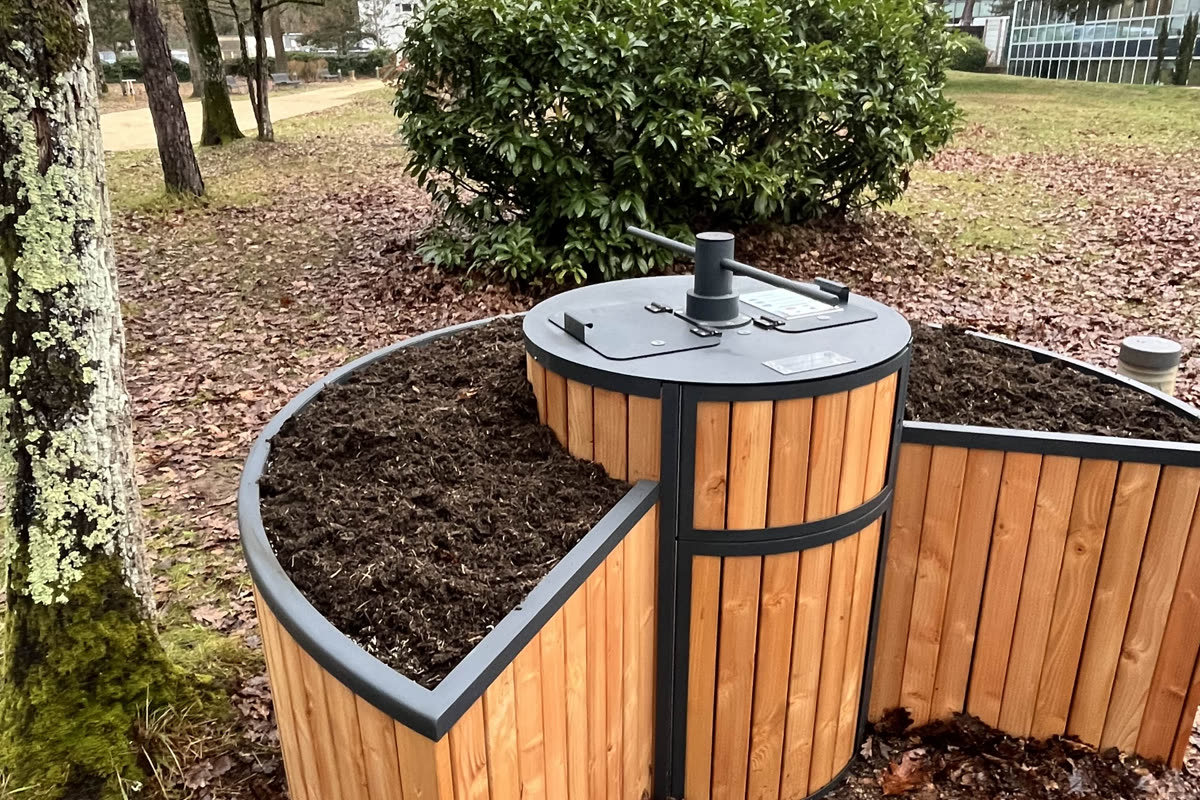
The user's action takes three seconds: open the lid, empty the caddy, add a dose of bulking agent, close it again. That is the only thing anyone has to learn, and it is also where everything is decided: without carbon the material compacts, air stops circulating and odours appear. The bulking agent supplied with the composter (flax shive, an agricultural by-product) is there for exactly that.
Aeration is in no way electric. An aeration chimney runs through the tank and lets air reach the heart of the material continuously, while an auger turned by the crank mixes the volume: two minutes a week, by hand. That is the fundamental difference from electromechanical dehydrators, which need a socket, a drain and a permanent power draw. The detail of the three mechanisms of the ABC composter takes ten minutes to read, and is worth knowing before comparing two quotes.
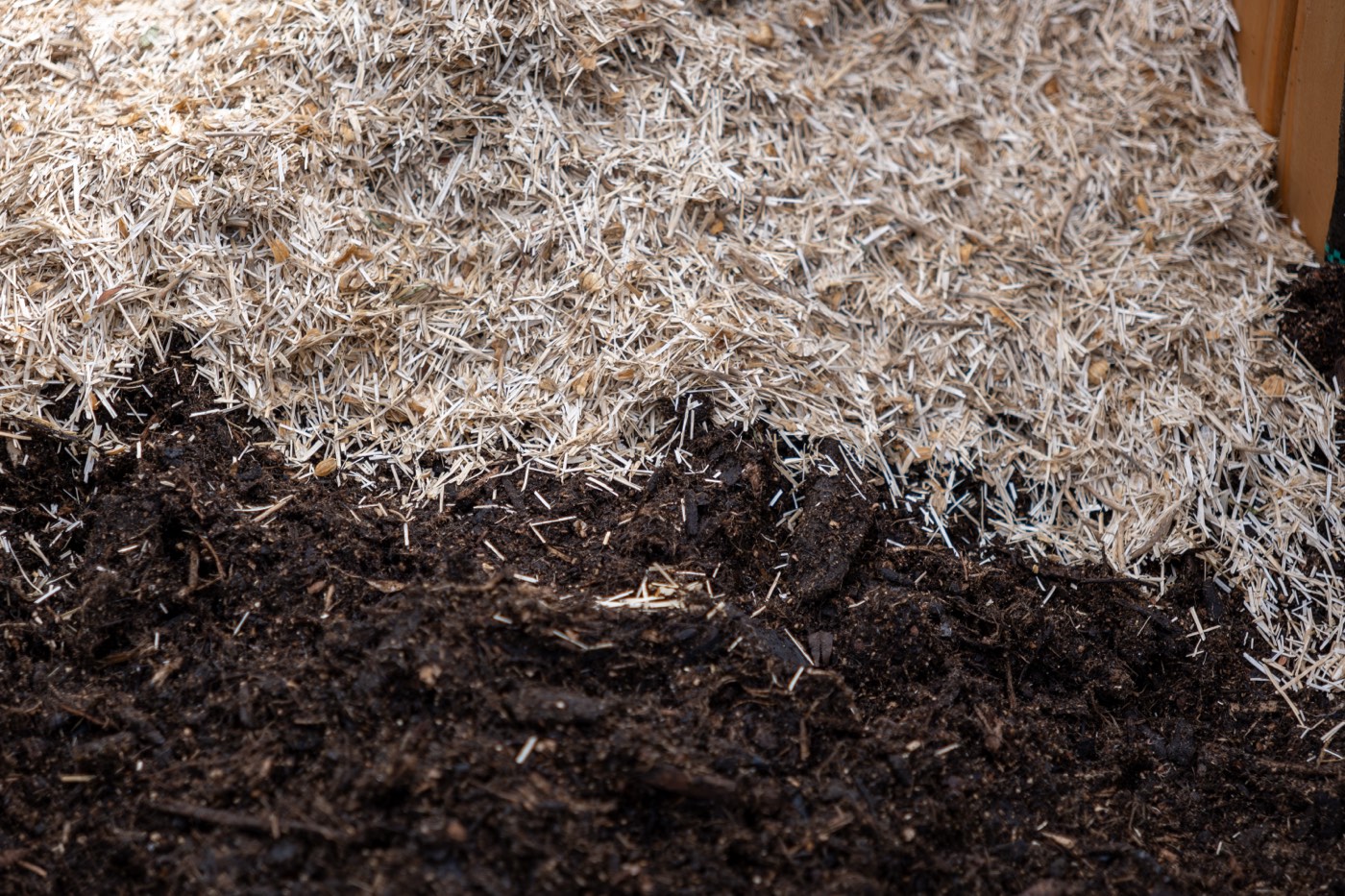
The bed itself is not filled with soil at random. The planters are packed in alternating layers at installation: a depth of flax shive at the bottom to drain, potting soil against the perforations where the compost liquor comes out, then the alternation up to the top, and potting soil as a finish, ready to plant. This build is done once only; the bed filling guide sets it out on one page. After that, the planter is managed like any other bed: watering, weeding, seasonal planting, by the grounds team or its contractor.
- Empty the caddy into the composter and close the lid after every load.
- Add a dose of bulking agent with every load: carbon is always what is missing, never nitrogen.
- Give the crank a few turns once a week, two minutes is enough.
- Check for things that should not be there: capsules, disposable cutlery, stapled tea bags, plastic film.
- Treat the planter as an ordinary bed, without burying fresh food waste in it.
- Log every removal, with its date and its weight: that record is what you can show.
What comes out of the column after a few months is not a mature, standard-compliant compost. Depending on how you set it up, it goes into the planter, where it finishes maturing in contact with the soil, or it is taken away for collection, sanitised at a facility permitted for it and then spread, through an operator you contract locally. The other possible routes out for the compost depend mainly on how much green space you have.
What a garden composter absorbs, and what it takes
One composter absorbs up to 1,500 kg of food waste a year. Beyond that you put a second one beside it or at a second drop-off point; above 3,000 kg a year, on-site composting is no longer the right answer and you need to look at industrial routes. Those two thresholds govern everything else, which is why your annual volumes in kilos are the first figure to establish.
| ABC composter on its own | ABC garden composter | |
|---|---|---|
| How it is supplied | Purchase, shipped on a pallet | Purchase, shipped on a pallet |
| Composting volume | 450 L | 450 L |
| Planter | None | 2,000 L, circular |
| Footprint | Ø 810 mm, H 1,000 mm, under 1 m² on the ground | Ø 2,000 mm, 5 to 6 m² on the ground |
| Volumes absorbed | Up to 1,500 kg a year | Up to 1,500 kg a year |
| Connections | None | None |
| Aeration and mixing | Aeration chimney, mixing by crank | Identical, same composter |
| Base it stands on | Hard, level surface | Flat, stabilised ground, set up in 30 minutes by three people |
| When to choose it | The equipment stays in the bin store | The equipment is in public view and has to be made welcome |
Both formats come on the same terms: to buy, or to rent over 48 months. What is not included either way is the removal of the mature material: you contract that locally, and how often it is needed follows from your volumes, not from a tariff. Here is how the sizing works out for a primary school serving 120 covers.
The maths
- 120 meals served × 140 days of the school calendar × 0.075 kg 1,260 kg
- 10 staff on site × 220 days × 0.015 kg 33 kg
- Theoretical volumes, before the capture factor 1,293 kg
- Share actually captured, 70 % (meals taken elsewhere, imperfect sorting, absences) 905 kg/year
- Below the 1,500 kg threshold 1 garden composter
- Emptying needed over the year at that volume 9 removals
- 129 € of rent + 9 × 10 € of collection in France 219 € excl. VAT a month
That is, over the year2,628 € excl. VAT
The ratios used here are the contract catering and office ones, set out in our article on sizing a composter to your food waste: 0.075 kg per meal served, 0.015 kg per person per office day. Run it again with your own headcount and the answer changes: at 500 kg a year the tank needs emptying about 3 times, at 1,200 kg about 12. The online sizing tool applies the same ratios and the same 70 % capture rate; it works without creating an account.
Where a garden composter stands against the rules
Separating food waste at source is now required of businesses and public bodies across the markets we ship to, under regimes that differ nation by nation: Simpler Recycling in England, the Waste (Scotland) Regulations 2012, the Workplace Recycling rules of 2024 in Wales, a separate regime in Northern Ireland, and in Ireland the national food waste regulations. Old tonnage thresholds have been falling away one after another, so a three-class school, a ten-person practice and a logistics platform are increasingly caught by the same rule, but the dates and the exemptions are not the same everywhere: check the text that applies to you.
Composting on site is one of the two routes the rules provide, the other being separate collection. A garden composter can therefore do the job, provided it stays within its capacity: a saturated unit that overflows is not a separation system, it is a dump. Records still have to be kept: a log of what goes in, and the paperwork from whoever takes the material away. Permitting thresholds for composting activities are set nationally and a site-scale unit sits far below them; what your own regulator expects as evidence is settled with it.
Penalties are set nation by nation, from a fixed penalty or a compliance notice up to prosecution, and who enforces them differs too: in some places the waste regulator, in others the local council, and for permitted installations the environmental agency. The level that applies to you is the one your own regulator publishes, and carrying a figure over from another market tells you nothing useful.
Where a garden composter is the right choice
What a garden composter costs over the ABC composter on its own does not buy capacity, since capacity is identical: it buys acceptance. That is only worth anything if the unit is seen. On a loading bay or in a bin store, nobody looks at the composter and the planter serves no purpose. On a forecourt, in a school yard, in the middle of a council lawn or in front of a head office entrance, the object is looked at every day by people who never asked to see waste equipment under their windows.
Local authorities and education are the most natural ground for it: the unit is in semi-public access, it explains as much as it treats, and it fits a grounds budget. A local authority such as Seine-Eure has programmed 150 of them, installed town by town, built in series in our workshop in France. University campuses combine both needs: a real catering flow and a public to bring on board. In healthcare and residential care, the courtyard or the grounds take an object residents walk past without reading it as a bin.
- You have 5 to 6 m² of flat, stabilised ground outdoors, reachable without a step.
- The spot is in view: forecourt, courtyard, park, lawn, terrace, entrance path.
- Your annual volumes stay under 1,500 kg per column, 3,000 kg for two.
- A grounds team or a contractor can look after a planted bed.
- You expect the unit to raise awareness as much as to treat waste.
- You have a route for the mature material: a waste contractor or a farm near the site, contracted locally, since outside France we ship the equipment but not the collection.
If any of the first three lines does not hold, the answer lies elsewhere: the ABC composter on its own for a technical location, two columns for volumes between 1,500 and 3,000 kg, an industrial route above that. Our where we deliver map shows the countries we ship to.
Common questions
Does a garden composter put you in the clear on the separation duty?
It can be, provided its capacity covers the volumes the site produces. Where food waste has to be separated at source, recycling it on the spot is one of the two routes the rules provide, the other being separate collection, and the wording differs from one nation to the next. A saturated unit that overflows no longer does the job, and the records of what left the site have to be kept. What your own regulator expects as evidence is settled with it.
How much space do you need?
5 to 6 m² on the ground for the garden composter, a circle 2,000 mm across including the bed, on flat, stabilised ground. The ABC composter on its own needs under 1 m², a cylinder 810 mm across and 1,000 mm high. Add room for the bulking agent stock and the clearance needed to open the lid.
Does a garden composter attract rodents?
It is open dumps and slatted timber bins that cause that problem. Here the material is shut inside a 2 mm steel tank with a closed base, under a solid lid, standing on a hard surface: the outer cladding dresses the structure, it does not hold the food waste. Odours, for their part, signal a lack of air or too much nitrogen, which the continuous aeration through the chimney and the addition of bulking agent deal with at source.
What can you plant in the planter?
Whatever grows in any bed of that depth: perennials, grasses, herbs, seasonal flowers. The choice belongs to the team that looks after the site's grounds. Fresh food waste always goes into the central composter and never into the soil of the planters.
What does a garden composter involve?
129 € excl. VAT a month to rent, bulking agent, maintenance, awareness kit and training included, on a 48-month commitment, and it can be bought as well. In France, collection is an option at 10 € excl. VAT a month, per annual visit and per composter, from 1 to 12 visits depending on volumes; elsewhere the removal of the mature material is arranged with a local operator of your choice, a waste contractor or a farm near the site.
What happens to the compost produced?
What comes out of the column after a few months is not a mature, standard-compliant compost. It goes into the planter, where it finishes maturing in contact with the soil, or it is taken away, sanitised at a facility permitted for it and then spread, through an operator you contract locally.
Where to start
Start with the figure that governs all the others: your annual volumes in kilos. It settles the choice between on-site composting and collection, it fixes the number of composters and how often the tank has to be emptied, and it is the first question any supplier and any inspector will ask. The online sizing tool estimates it from your sector and your headcount, then shows the matching configuration, with no account to create. Leaving your details is what starts the conversation.
Then walk the site with the checklist above in hand: if a visible spot of 5 to 6 m² comes free, the garden composter is the right format; if not, the ABC composter on its own does the same work for less. If the discussion is still about the principle, how it works, from assessment to weekly routine, takes five minutes to read, and the daily habits that decide whether it succeeds are covered in composting at work without odour or pests, better prepared before installation than after.
A free assessment, a quote within 24 h
Thirty minutes on a video call to go over the food waste separation duty that applies where you operate, size the solution and estimate your savings.
