
Resource
Commercial composter maintenance: who does what
What your teams do (3 hours 44 minutes a year), how often, and what to watch for: the split of tasks, the monthly checklist and the real calendar.
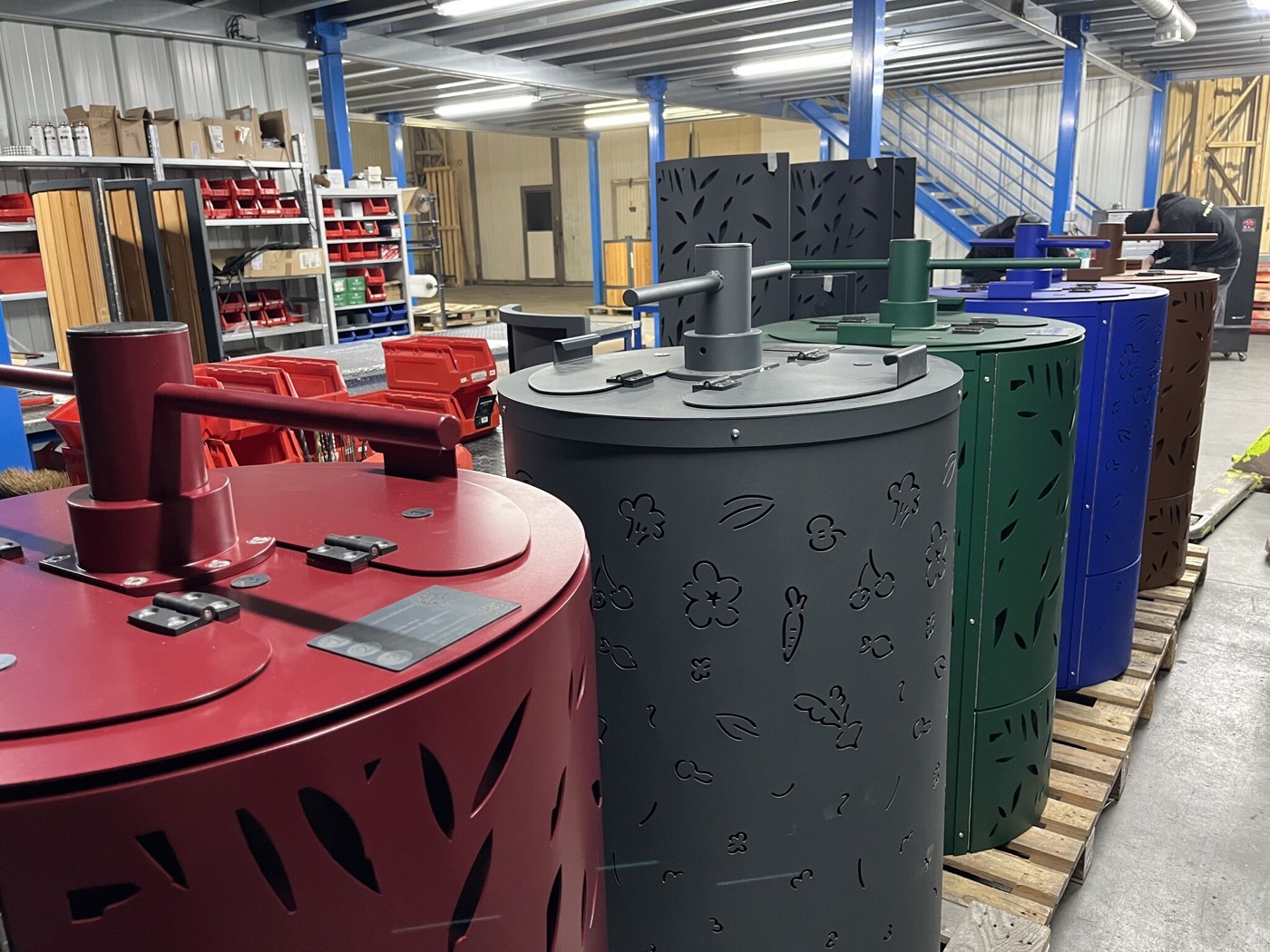
Maintaining an ABC commercial composter comes down to two jobs on site: two minutes on the crank each week, and a ten-minute visual check once a month. There is no motor to service, no filter to change and no maintenance contract to negotiate on the side, for one simple reason: the ABC composter does not plug in. No electricity, no water, no drainage, no groundworks. The only calendar you need is your emptying calendar, and it is not a matter of preference: it follows the volumes you capture over a year.
Key takeaways
Maintenance costs your team 3 hours 44 minutes a year. That is 104 minutes on the crank (2 minutes, 52 weeks) and 120 minutes of visual checks (10 minutes, 12 times). Add day-to-day sorting, the emptying itself and a wipe of the casing when it gets dirty, and you have the whole job.
Nothing is billed on top by us. The 79 € excl. VAT a month cover the composter delivered ready to use, the bulking agent, the maintenance with parts and labour, the awareness kit and the training by video call. Everything on our side is handled remotely and the parts are shipped to you; fitting one is a simple job for your team or its local contractor. In France, only the collection is an option, at 10 € excl. VAT a month per annual visit; elsewhere the removal of the mature compost is arranged with a local operator of your choice.
Who does what, task by task
The question that stalls most projects is not technical, it is contractual: who turns the crank, who tops up the bulking agent, who pays for a broken part. The table below answers line by line, on the basis of the offer as it is billed, not a market average, on the rental route the parts are covered and shipped to you, and fitting one is a simple job for the site or its local contractor.
| Task | Frequency | Who | Billed on top? |
|---|---|---|---|
| Tipping food waste through the top hatch | daily | your teams | no |
| Two or three turns of the crank | weekly, 2 minutes | your teams | no |
| Visual check under the lid | once a month, 10 minutes | your composting lead | no |
| Topping up the bulking agent | at every emptying | your teams, after our remote handover | no, included in the rent |
| Emptying through the lower door, and weighing | on the interval set by your volumes | your teams | 10 € excl. VAT/month per annual visit, in France |
| Checking the mechanism and replacing wear parts | when the monthly check flags something | your teams, after our remote handover | no, included in the rent |
| Signage and training for new starters | as needed | your teams, after our remote handover | no, included in the rent |
| Wiping down the outer casing | when it needs it | your teams | not applicable |
One line is worth reading twice: the parts are in the rent. That is the trade-off of the model, a rental with no equipment to buy, committed over 48 months, and the composter is available to buy as well. You do not own the composter, so you do not carry its wear. The diagnosis and the guidance are done remotely and the parts are shipped; fitting one is a simple job, with no special tools. The same principle applies to the garden composter, a circular 2,000 L planter at 129 € excl. VAT a month.
Two minutes on the crank, week after week
It is the one job that comes back every single week, and the only one whose absence shows. An auger runs through the vessel, driven by a crank. Two or three turns are enough to bury fresh material in the mass and mix it with what is already breaking down. Nothing to lift, nothing to move, no turning with a fork: you do it standing up, in passing, with no protective equipment.
What mixing prevents says more than what it produces. Material left still settles. Settling drives the air out of the gaps, fermentation turns anaerobic, and that is where the putrid smells everyone associates with composting come from. The perforated aeration chimney keeps air moving inside the closed vessel, but it can do nothing against a compacted mass. Those two minutes a week are odour insurance, not a gardening chore.
In practice the weak point is not how hard the job is, it is ownership. A composter with no named lead is a composter nobody turns. Naming a composting lead, and a stand-in for holidays, is part of commissioning; the subject is covered in our guide to rolling composting out across several sites.
Moisture and bulking agent, the two settings of the cycle
Compost works properly at around 50 to 60 % moisture, about the feel of a wrung-out sponge. Checking it needs no instrument: a handful squeezed in the fist should hold its shape without liquid running between your fingers, and fall apart when you open your hand. Too dry and it crumbles to dust and breakdown slows; too wet and it sticks, it weighs, and air stops moving through it.
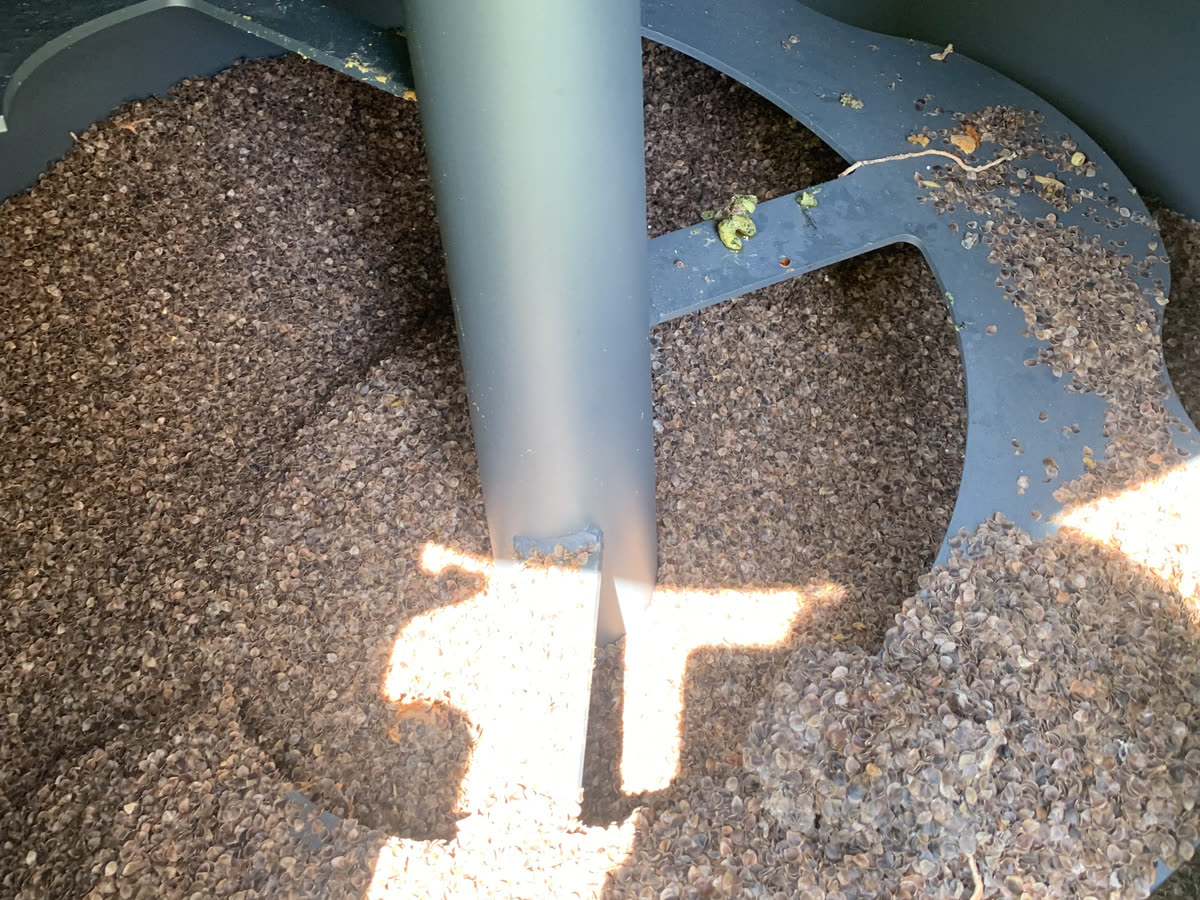
The adjustment is made with the bulking agent, a carbon-rich mix laid in a thick bed at the bottom of the vessel when the composter is commissioned. It soaks up the excess water in your inputs and balances the carbon-to-nitrogen ratio, which is what stops liquor pooling. One point that matters for your team's workload: nobody adds bulking agent day to day. Food waste goes in as it would in any bin, someone turns the crank, the auger does the rest. Topping up happens at emptying, and only then.
Then there is the season. In summer, fruit and salad inputs carry more water and the vessel heats up faster: that is when the monthly check earns its keep. In winter, biological activity slows without stopping, and material takes longer to work its way down. To follow what happens inside the vessel month by month, see the phases and temperatures of the composting cycle. And remember that a moisture problem is usually, first of all, a content problem: the list of what goes into a commercial composter is worth more than an adjustment after the fact.
Emptying, and what leaves the site
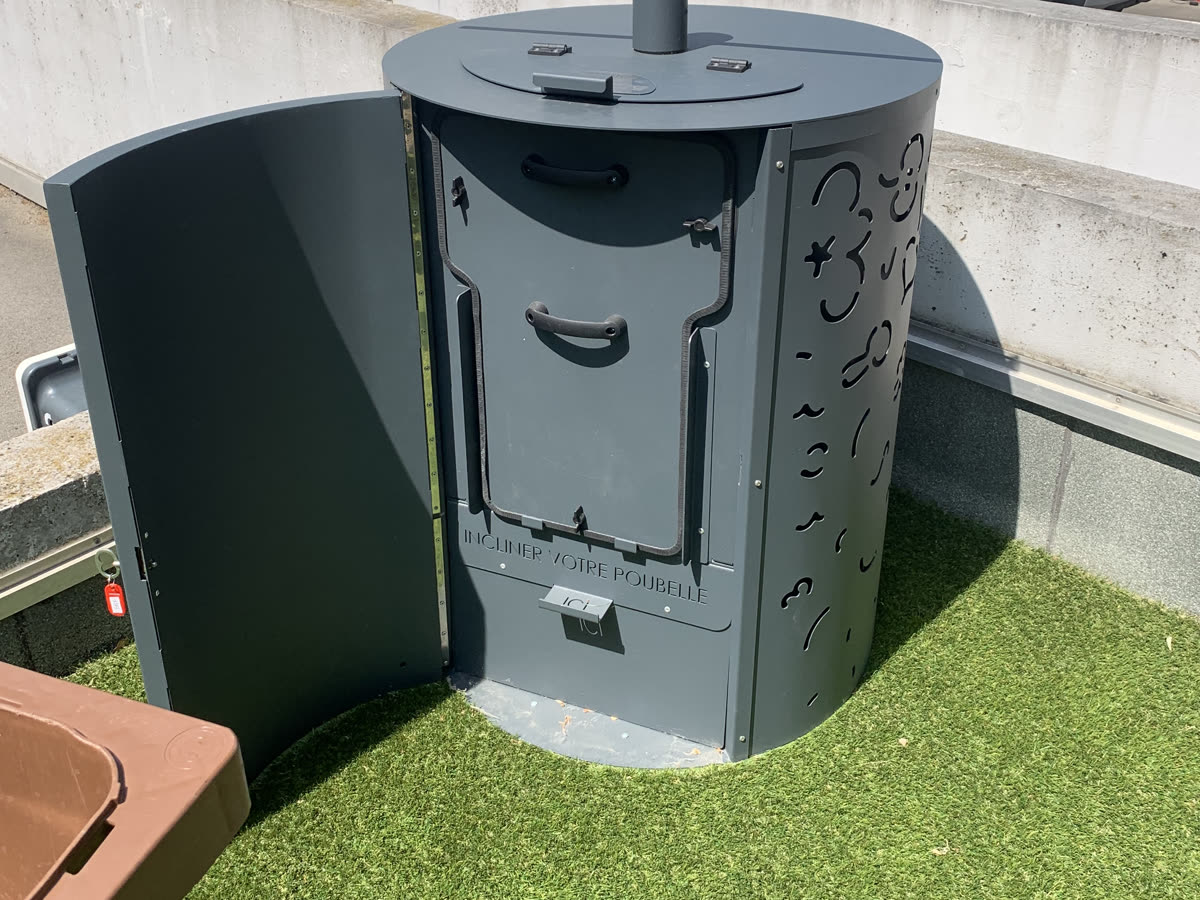
Emptying is done from the bottom, without tools. Wheel a standard 120 L bin up to the lower door, open it and turn the crank: the composted material is pushed straight into the bin. It takes less than five minutes and needs no special container. It is a job for your own team, in the same ten minutes as the monthly check.
One clarification that saves misunderstandings in meetings: what comes out of the composter after a few months is not a mature, certified compost. It is stabilised material, whose water and volume have shrunk and which no longer ferments in a way that smells, but which has not finished maturing. Where it goes next is arranged locally: your own grounds, a nearby farm, or a composting site. It is that route, and not the presence of the composter alone, that turns the output into compost worth using.
Weigh the bin at every emptying and write the figure down. Across the EU, Article 22 of the Waste Framework Directive 2008/98/EC has required food waste to be either collected separately or recycled at source since 31 December 2023, with each country transposing it in its own way: Ley 7/2022 in Spain, D.Lgs 152/2006 in Italy, the GewAbfV and the KrWG in Germany. The United Kingdom sits outside the directive and runs four separate regimes, Simpler Recycling in England, the Waste (Scotland) Regulations 2012, Workplace Recycling in Wales and Northern Ireland's own rules, while Ireland follows the EU framework. Recycling at source is one of the two routes on offer, and that is what the composter does: it treats the food waste on the site that produces it. What evidence your own regime expects, and where whatever you cannot use on site goes, are settled locally, our page on organising local collection covers the second point.
Your emptying calendar follows your volumes
There is no universal maintenance frequency, and certainly no quarterly service plan that suits everyone. How often the composter has to be emptied is not something you pick from a menu: you take the first row of the table whose ceiling covers the volumes you capture over a year. The same table drives the sizing tool, so the calendar you read here is the one the tool shows.
| Annual volumes captured | Emptyings per year | Interval between emptyings | Monthly, excl. VAT |
|---|---|---|---|
| up to 250 kg | 1 | 12 months | 89 € |
| from 251 to 450 kg | 2 | 6 months | 99 € |
| from 451 to 625 kg | 3 | 4 months | 109 € |
| from 626 to 750 kg | 4 | 3 months | 119 € |
| from 751 to 875 kg | 6 | 2 months | 139 € |
| from 876 to 1,125 kg | 9 | about 6 weeks | 169 € |
| from 1,126 to 1,500 kg | 12 | 1 month | 199 € |
Two readings follow. First, the smaller your volumes, the more the in-house check counts: at one emptying a year, nobody looks under the lid for twelve months. Second, the figure to use is the volume you actually capture, not the theoretical one, and our guide to sizing a composter against your food waste gives the ratios by sector. Above 1,500 kg a year a second composter is added and everything doubles; above 3,000 kg a year, on-site composting is no longer the right answer.
Here is how that works out for a head office with a staff restaurant, whose captured volumes are estimated at 750 kg a year.
The maths
- Captured annual volumes used 750 kg
- Emptyings, from the table above 4 a year
- Rent of the ABC composter, maintenance and bulking agent included 79 € excl. VAT/month
- Collection option, 4 × 10 €, French benchmark 40 € excl. VAT/month
- Extra budget line for maintenance 0 €
- In-house time, 104 min on the crank + 120 min of checks 3 h 44 a year
Monthly, everything included119 € excl. VAT
Export sites run without any collection service from us, and that changes what triggers action. You empty the composter yourself, you spread the material on your own grounds or hand it to whoever you have arranged locally, and nobody arrives on a schedule to look under the lid. The monthly check is your only safety net, which is exactly why the checklist below matters more here than it does in France.
The ten-minute monthly inspection checklist
To be done once a month by the composting lead, notebook or phone in hand. Seven points are enough, and each one has a clear follow-up if it is not green.
- The crank turns without effort. If it stiffens, do not force it: stop, and work through the three causes listed further down before turning again.
- No smell one metre from the composter with the lid closed. A noticeable smell means a skipped mixing session or too much water.
- Material squeezed in the hand holds its shape without dripping. If it does not, add bulking agent.
- Nothing unwanted visible at the surface: plastic bag, cutlery, cup, cigarette end, wipe. These do not break down and come back out, unchanged, at emptying.
- The vessel is not full to the brim before the planned emptying. If it is, your real volumes are above the original estimate.
- The paint is intact, with no flaking and no rust spot on the steel.
- The base is still flat and stable, and the signage at the indoor collection points is legible.
Add an eighth question, the only one you cannot read off the machine: has anyone joined the team since the last check? If so, walk them through the sorting rules; the poster and the caddy stickers are there for that.
Three common drifts, and how to put them right
A smell appears. In the great majority of cases the crank has been skipped for several weeks: material has settled, airless pockets have formed, fermentation has tipped over. The fix is mechanical: five to ten turns instead of two, repeated over two or three days. If the smell holds, it is the moisture: a fresh layer of bulking agent restores the balance. The subject is dealt with in full in our guide to composting at work without odour or pests.
The crank stiffens. Three causes, in order of frequency: material packed down for want of mixing, too much moisture weighing the mass down, or an input that had no business being there, such as a large bone, a hard stone or a shell. The right response is not to push harder: a forced auger gets damaged, whereas emptying the vessel and restarting on a fresh bed of bulking agent costs nothing but ten minutes.
Sorting quality slips. This is the quietest drift of the three, and it is almost always down to staff turnover: the first training session only covers the people who were there on the day. Unwanted items do not break down; they come back out at emptying and have to be picked out by hand. Posters, caddy stickers and a digital awareness kit ship with the composter, and it is worth using them again each time the team changes: awareness is a consumable, not a launch event. On pests, often feared without cause on a 2 mm steel vessel with a closed base standing on a hard surface, our article on rodent-proof composters sets out where the real risks are.
Common questions
How often does a commercial composter need maintenance?
There are two calendars. The in-house one is weekly: two minutes on the crank, plus a ten-minute visual check once a month. The emptying calendar comes from the volumes you capture over a year, from one emptying a year up to 250 kg to twelve a year between 1,126 and 1,500 kg. A site at 750 kg a year falls in the four-a-year band, so roughly once a quarter.
Is there a separate maintenance contract to sign?
No. There is nothing to service in the way a machine with a motor is serviced: no motor, no heating element, no filter, no cartridge to replace. What the composter asks for is two minutes on the crank each week, ten minutes under the lid each month, and bulking agent added at each emptying. The mechanism is a single hand-driven auger, which is why there is no service plan to negotiate alongside it.
Does the ABC composter need mains power?
No. Nothing to connect: no electricity, no water, no drainage, no groundworks. Aeration comes from a perforated chimney running through the vessel, and mixing from an auger turned by hand with a crank. That is what separates it from the electric dehydrators sold under the name of electromechanical composters, whose maintenance is about a motor, a heating element and filters.
What should I do if the composter starts to smell?
Start with the crank: in the great majority of cases a smell means mixing has been skipped for several weeks and airless pockets have formed. Give it five to ten turns instead of two, on two or three consecutive days. If the smell persists it is excess moisture: add a fresh layer of bulking agent and go back to the weekly routine.
Who empties the composter if there is no collection service?
You do. Emptying takes less than five minutes: wheel a 120 L bin up to the lower door, open it, and turn the crank until the composted material has been pushed out. Then top up the bulking agent. Because nobody visits your site, the monthly visual check is the only thing standing between a small drift and a smell, which makes it the one routine worth putting in a calendar.
Where to start
If the composter is already installed, print the checklist above, name a lead and a stand-in, and put a recurring ten-minute slot in their calendar once a month. That is the only routine to create, and it is enough to hold the whole thing together between two emptyings.
If the project is still being scoped, the maintenance calendar depends on a single figure: your volumes. The sizing tool estimates it from a few markers of your trade (people on site, meals served, covers, beds), applies the table above and shows how often the composter will need emptying, in your browser and without signing up. For the full commissioning sequence, how it works sets out the nine steps, and the Decathlon network case study shows how the routine holds across a large retail estate.
A free assessment, a quote within 24 h
Thirty minutes on a video call to go over the food waste separation duty that applies where you operate, size the solution and estimate your savings.
