
Resource
Steel, wood or plastic: the right material for a commercial composter
Service life, resistance to rodents, upkeep, end of life and cost: the three materials compared, and why the structure and the cladding are not chosen together.
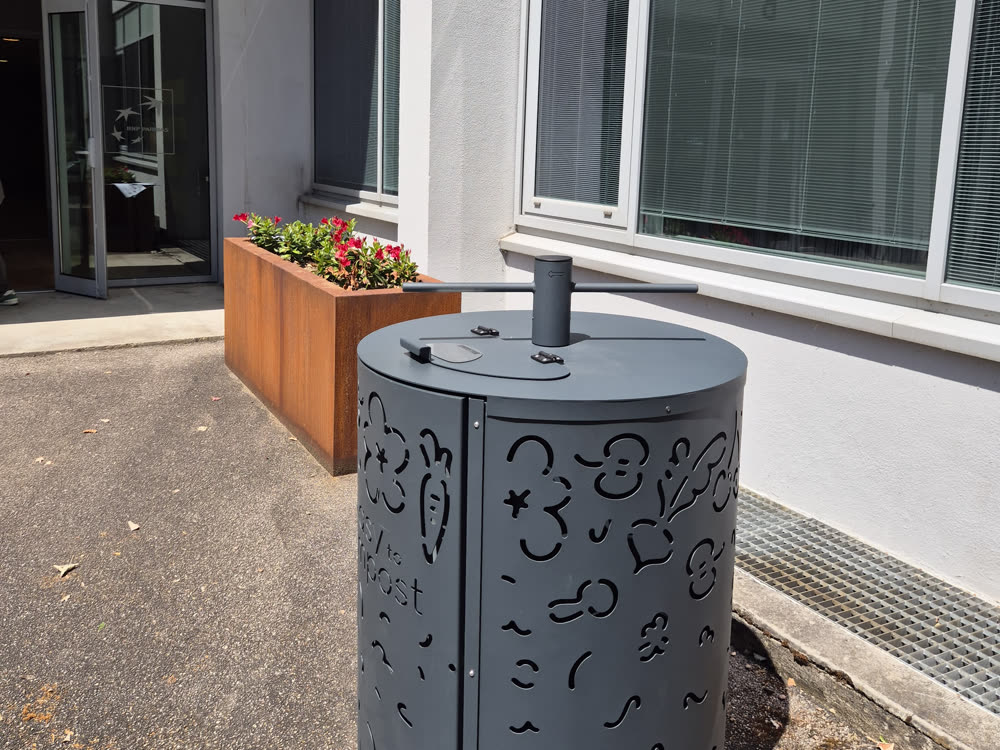
For a commercial composter standing outdoors and fed all year, steel is the only one of the three materials that ticks all four boxes: out of reach of rodents, able to take knocks, an outdoor life measured in decades, recyclable at the end of it. Plastic is the cheapest and the first to fail. Wood is the most pleasant to look at and asks for upkeep almost nobody plans. The right answer is not "steel versus wood" though: it is a steel structure, clad in wood where the setting calls for it.
Key takeaways
Steel for the structure, wood for cladding where it is on show, plastic for a domestic garden bin. The Easy to Compost ABC composter is a vessel in S235 steel 2 mm thick, 450 L, designed and manufactured in our workshop in Albert, available in five lacquered colours.
The comparison, criterion by criterion
The three materials were not made for the same job. Plastic was designed for a private garden and a few kilos a week, wood for outdoor furniture somebody looks after, steel for equipment that stays put. The table sums up what separates them where the composter takes daily drop-offs, sits within reach of a trolley and has to stay presentable.
| Criterion | Plastic (HDPE) | Wood (Douglas fir, larch, oak) | 2 mm powder-coated steel |
|---|---|---|---|
| Resistance to rodents | None, the wall can be gnawed through | None without a metal lining | Total, by construction |
| Resistance to impact | Snaps once UV has aged it | Marks, splits at the fixing point | Takes trolleys and pallet trucks |
| Service life outdoors | 3 to 5 years | 8 to 12 years if maintained | 20 years and more |
| Upkeep | None, you replace it | Checking screws and boards, wood oil | Touching up deep scratches |
| Repairability | Clip-together panels not supplied as spares | Boards replaced one at a time | Seals and wearing parts replaced |
| Mechanical mixing can be built in | No, turning with a fork | Rarely | Yes, an auger turned by a crank |
| Empty weight | 10 to 20 kg | 60 to 120 kg | 121 kg for the 450 L ABC vessel |
| End of life | Limited plastic recycling routes | Waste wood, energy recovery | Metals recycling, remelted with no loss |
None of these materials is bad in itself: two of them simply lose their advantage the moment you leave the garden.
Plastic: the cheapest, and the first to fail
High-density polyethylene (HDPE) is used in almost every garden composter sold in DIY stores, at between 30 and 200 € for 300 to 800 L. That price explains the rest: moulded walls in clip-together panels, ten kilos or so, ten minutes to assemble, replaced without a second thought.
The limits show up the moment you leave the private garden. Garden bin manufacturers make no claim of resistance to rodents, and with good reason: a rat's incisors get through a polyethylene wall without difficulty, and clip-together panels leave permanent gaps between the faces. It is the most common tipping point on the sites that call us, and it deserves an article of its own: we have set out what actually puts a composter out of reach of rats. Outdoors, UV then embrittles the material: after two or three seasons the corners snap instead of flexing.
One structural flaw remains: a plastic composter cannot be mixed. You have to turn it with a fork, which means opening it, handling the material and accepting the smell, and no commercial site can ask that of its teams every week. The real cost is not the price of the bin, it is the interruption. When the composter fails, separation stops, while the duty to separate food waste at source does not. In the European Union that duty comes from Article 22 of the Waste Framework Directive 2008/98/EC, transposed by each member state; the United Kingdom sits outside the directive and runs four separate regimes, in England, Scotland, Wales and Northern Ireland. Your local authority or environment regulator will tell you which applies to your site.
Wood: fitting into the landscape, and what it asks in return
Wood is not a bad material: it is a material that sets conditions. The species that hold up outdoors without chemical treatment are Douglas fir, larch and oak. All of them grey on the surface after a few seasons: that is a patina, not decay. PEFC or FSC certification attests to where the timber came from, which is an argument that stands up in a sustainability report.
Here are the conditions. The weak point of a timber composter is never the wall: it is the contact with the ground and the fixings, where moisture sits and rot starts. Wood on its own offers nothing against a rodent, which gnaws through a board the way it gnaws through a shed door; you therefore need a metal lining or fine mesh behind the cladding, which comes to paying for two materials to do the job of one.
Finally, a timber composter assumes a maintenance plan: checking the screws, replacing damaged boards, oiling the wood where needed. In practice that plan rarely exists, and that is where the gap opens between the service life claimed for a timber enclosure and the one it actually reaches. If you go with wood, settle from the outset who holds that plan and how often: our commercial composter maintenance checklist is a starting point. Put plainly, wood is an excellent cladding and a questionable structure.
Steel: why 2 mm and not 1
Steel settles all three of the previous problems at once, provided it is the right thickness. Sheet of 0.5 to 1 mm, the kind used in metal garden stores, dents at the first knock from a pallet truck and deforms under load. At 2 mm you are in a different category: the vessel no longer moves under the weight of the material, it takes knocks, and it is beyond the reach of a rodent's teeth. That is the thickness chosen for the vessel of the ABC composter, in S235 grade, with sealed openings so that nothing gets in and nothing gets out between drop-offs.
Bare metal is not enough: it is the surface treatment that decides the service life. Powder coating, a polymer powder baked in an oven after degreasing and priming, forms a continuous film that does not flake the way liquid paint does, and it comes in RAL colours. With us that coating is done in the same workshop in France as the cutting and the welding.
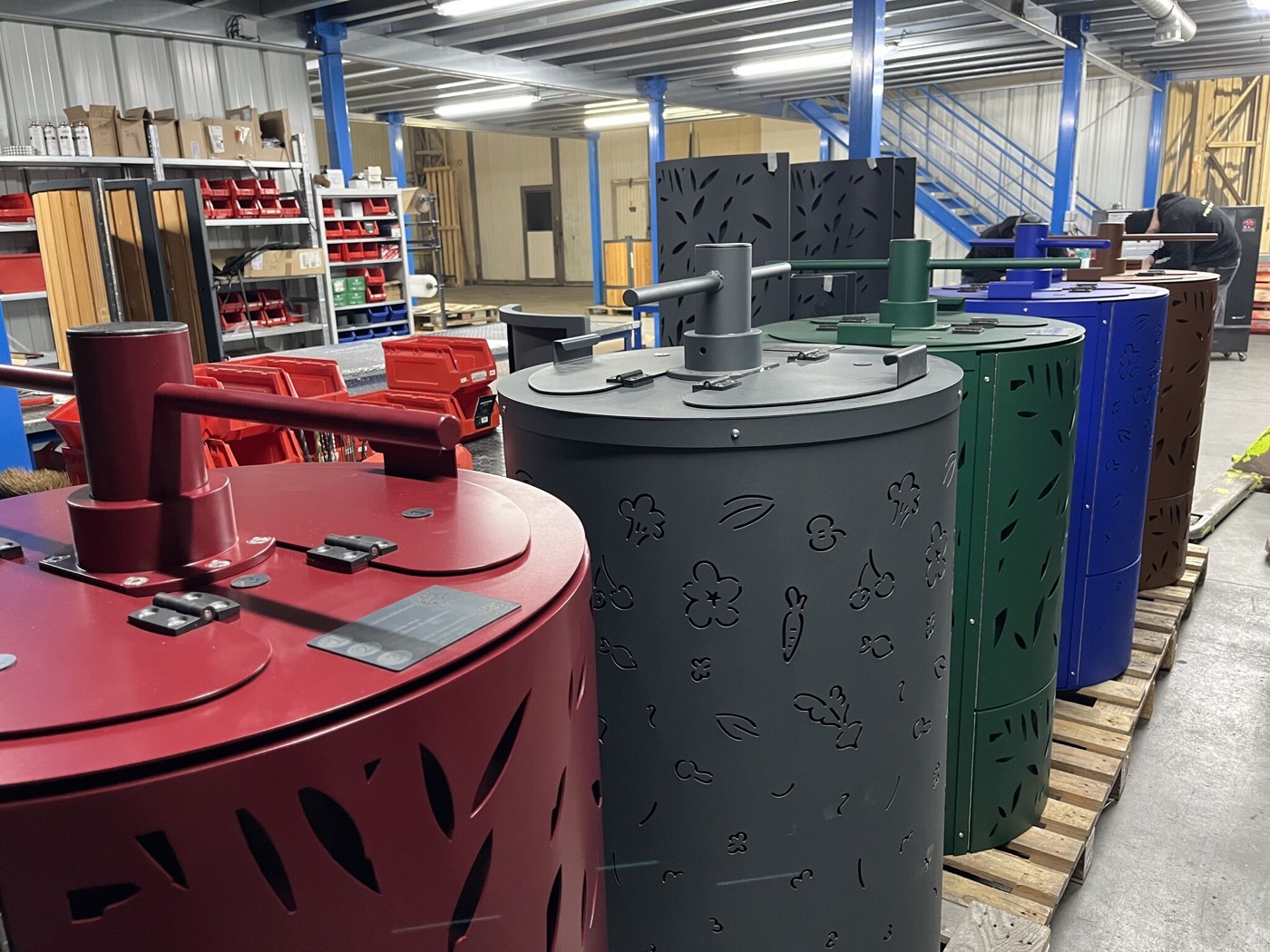
Two trade-offs, stated honestly. Steel is heavy: the ABC vessel weighs 121 kg empty and 330 kg loaded, which is worth checking before installing it on a roof or a lightweight slab. And a deep scratch that reaches the metal has to be touched up, or corrosion will start there. At the end of its life, on the other hand, steel goes back into the metals stream and is remelted with no loss of properties, which no polymer allows: that counts as soon as the equipment goes into a carbon footprint.
Steel or wood: the question is wrongly put
Setting steel against wood means comparing a structure with a covering. On the ABC composter the vessel is steel in every case; what changes is the skin. Five lacquered colours are offered, baked onto the steel. The detail of what the subscription covers is on the composter only page.
That construction has a practical consequence a solid timber enclosure does not offer: a damaged board unscrews and is replaced on its own, without touching the vessel or interrupting the composting cycle under way. The wood carries the look, the steel carries the mechanics and the seal against pests. Each does what it is good at.
The choice of finish therefore turns on the place, not on the technique. A delivery yard or a waste room calls for a dark lacquered colour, which does not show marks. A hotel patio, a shop entrance or a school forecourt calls for a colour aligned with the identity of the site, or for the garden composter and its wood cladding: the trade-offs are set out in our article on customising the composter. For a space open to the public, the garden composter takes the same logic to the scale of a circular planter of 2,000 L.
What the material changes in your costs
The material weighs heavily on a purchase price. With Easy to Compost the usual route is a rental: a monthly subscription of 79 € excl. VAT covering delivery, the bulking material, maintenance for parts and labour, the awareness kit and training for the teams by video call, on a 48-month agreement. Buying one is possible too: talk to us and we will quote it. Two things to be clear about: you move the composter from the pallet to its final position yourself, and reporting on tonnages is measured when the material is taken away, in France through the collection option and elsewhere by whoever you contract for that locally. The sequence is set out on the how it works page.
That changes the nature of the question. On the rental route, a vessel that corrodes, a board that breaks or a seal that tires is put right at our cost: the durability of the material is our industrial risk, not your budget line, and the replacement parts are shipped to you, fitting one is a simple job, with no special tools. If you buy the machine instead, that durability is exactly what you are buying, which is why the thickness on the data sheet matters. It is also why we have never had any interest in going below 2 mm. Collection remains an option in France, billed at 10 € excl. VAT a month per annual visit, from 1 to 12 visits; elsewhere the removal is arranged with a local operator of your choice. The number of visits is not a matter of choice: it follows from your volumes.
The maths
- Annual food waste volumes, measured or estimated 750 kg
- Capacity of one ABC composter 1,500 kg/year
- Number of composters needed 1
- Emptying operations these volumes call for (750 kg) 4 a year
- Rent of the composter, everything included 79 € excl. VAT/month
- Collection: 4 visits × 10 €, French benchmark 40 € excl. VAT/month
Monthly total119 € excl. VAT
The same arithmetic gives 3 emptying operations a year for 500 kg and 12 for 1,200 kg. Above 1,500 kg a year you add a second composter and everything doubles. Above 3,000 kg a year, on-site composting is no longer the right answer. To place your own volumes before reading any of this, see our method for sizing a composter.
The checklist before you sign
An honest data sheet answers these questions before you have to ask them. If a supplier cannot answer one of them in writing, the absence of an answer is already an answer.
- Is the sheet thickness written in millimetres, rather than described as "reinforced"?
- Is the steel grade named (S235, for example)?
- Is the surface treatment specified (powder coating, RAL reference)?
- Is the container closed: top hatch, low door, seals, no flexible wall anywhere?
- If the model includes timber, is the species named and PEFC or FSC certified?
- Can the wearing parts (boards, seals) be replaced separately?
- Who carries the cost of replacement if something breaks: you or the supplier?
- Does the mixing require a power supply, a water supply or drainage?
- Is it emptied into a standard 120 L wheelie bin, with no proprietary container?
- Are the empty and loaded weights given, so you can check the load-bearing capacity of the ground?
The last question is the one that sorts fastest: it separates on-site composting from electromechanical solutions and powered dehydrators, which reduce volume by heat and need a connection. Our data sheet for the ABC composter runs to one page and carries the material, dimensions and weight figures; whatever belongs to the contract, such as who carries a replacement, is read off the quote.
Common questions
Is a plastic composter suitable for a business?
No, not for commercial outdoor use. Polyethylene resists neither rodents nor UV over time, and garden bin manufacturers make no claim of resistance to pests. A plastic bin is still fine for a private garden or a very small drop-off point, but not for a site that has to keep its separation going all year.
Does steel cost more than wood?
To buy, a vessel in 2 mm steel costs more than a wooden box of the same volume. On a rental the question disappears: the Easy to Compost subscription is 79 € excl. VAT a month whatever colour you choose.
Does powder-coated steel rust outdoors?
Not while the coating film is intact: the polymer powder baked in an oven forms a continuous layer that isolates the metal from moisture. The point to watch is a deep scratch that reaches the steel: it has to be touched up, and touching it up is part of the routine upkeep the site carries out.
Does a steel composter need electricity?
No. The ABC composter plugs into nothing: no electricity, no water, no drainage, no groundworks. The mixing is mechanical and hand-operated, by a crank that drives an auger. The solutions that do need a connection are powered dehydrators, which belong to a different family of equipment.
Where to start
The material is not the first decision to take, it is the last. The first is your volumes: until you know how many kilos of food waste leave your site each year, no comparison of materials will get you to a decision. That figure is what determines the number of composters and how often each will need emptying.
The sizing tool takes that path in order: it estimates the volumes from your covers or your headcount, works out the sizing from there, and does so identically whichever finish you choose. Allow a few minutes. Only then comes the question of colour or timber, which is a question of setting, and one where an outside eye helps. Where we deliver is set out on where we deliver, and the multi-site rollout at Decathlon across its national network shows what the same decision looks like replicated store by store.
A free assessment, a quote within 24 h
Thirty minutes on a video call to go over the food waste separation duty that applies where you operate, size the solution and estimate your savings.
