
Resource
Food waste in fast food: what can be composted on site
Fast food: the real volumes per meal, what actually reaches the composter, how to size the answer by tonnage and how to roll it out across a network.
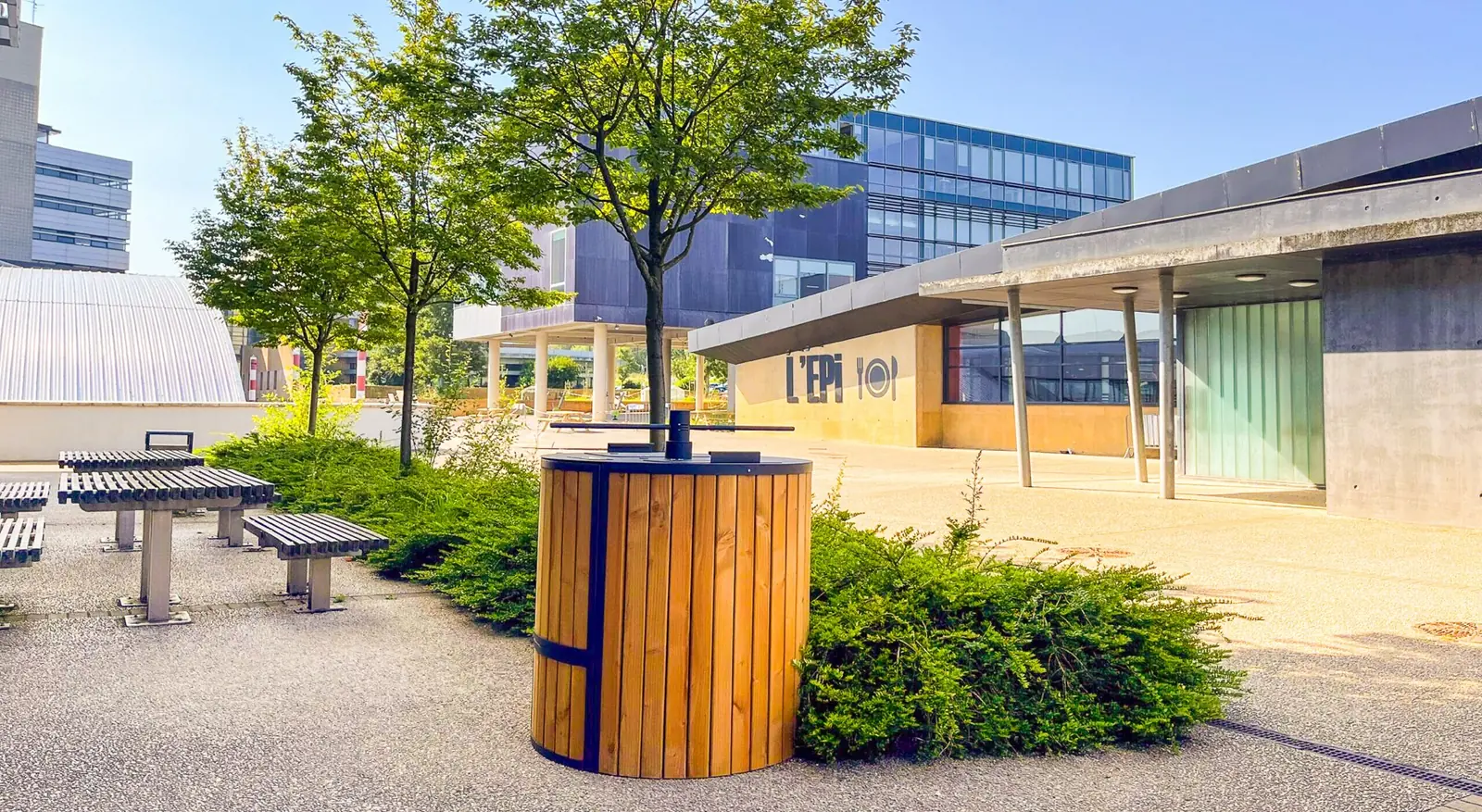
A quick-service restaurant serving 250 covers a day produces something like 4 tonnes of food waste a year, and that figure makes the answer counter-intuitive: on-site composting does not absorb volumes of that size. One ABC composter takes up to 1,500 kg a year, a second raises the limit to 3,000 kg; above that a collection is needed. What does hold on site in quick service is the plant preparation fraction, separated in the kitchen and never mixed with tray returns. For a restaurant serving 200 meals a day that stream weighs around 1,050 kg a year: one composter.
Key takeaways
The duty no longer depends on your size: in England, Scotland, Wales, Northern Ireland and Ireland, food waste has to be separated at source and kept out of general waste. The start dates and the thresholds differ between the five regimes, so check which one covers each restaurant.
The dividing line is in the kitchen: the composter takes plant preparation waste, not tray returns, not frying oil, not packaging.
The limits are fixed: 1,500 kg a year per composter, 3,000 kg with two. Above that, a collection is needed.
The real volumes of a quick-service restaurant
Quick service produces little food waste per meal and a great many meals. ADEME (France) uses around 0.05 kg per cover in quick service, against 0.10 kg in a brasserie and 0.15 kg in fine dining: portions are calibrated and produce often arrives already trimmed. On top of that comes the opening pattern, seven days a week and often 350 days a year, where a staff restaurant runs 220. The full method is in our article on sizing a composter from your volumes.
The really structural point lies elsewhere: the volumes split into two streams that have nothing in common. On one side, kitchen preparation waste: plant material, clean, unpackaged, produced by staff. On the other, customer tray returns, which mix meat scraps, sauces, napkins, cups and straws, and which no downstream sorting recovers. Only the first is compostable on site. Its share varies with the brand and with how much preparation is done on the premises: most often 20 to 35% of the total volume, a range you weigh rather than estimate.
| Meals a day | Total volume a year (0.05 kg per meal, 350 days) | Kitchen preparation fraction (assumption: 30%) | What that calls for on site |
|---|---|---|---|
| 100 | 1,750 kg | 525 kg | 1 ABC composter |
| 150 | 2,625 kg | 790 kg | 1 ABC composter |
| 200 | 3,500 kg | 1,050 kg | 1 ABC composter |
| 250 | 4,375 kg | 1,310 kg | 1 ABC composter |
| 300 | 5,250 kg | 1,575 kg | 2 ABC composters |
| 400 | 7,000 kg | 2,100 kg | 2 ABC composters |
| 550 | 9,625 kg | 2,890 kg | 2 ABC composters, upper limit |
| 600 and above | 10,500 kg and above | 3,150 kg and above | On-site composting is no longer enough, a collection is needed |
The reading is clear: on the preparation fraction, almost every quick-service restaurant falls within the scope of on-site composting; on the total volume, none does. Telling a network that the composter settles the food waste question is inviting a contradiction at the first inspection. It settles the share that comes out of the kitchen.
What goes into the composter, and what does not
Into the composter go vegetable trimmings (lettuce, tomato, onion, gherkin), damaged fruit, bread and uncooked dough, coffee grounds with their paper filter, and paper napkins lightly soiled with food, which add carbon. Our list of what can go in a commercial composter covers the borderline cases.
What does not go in matters just as much: tray returns, which are a mixture and not a stream; frying oils and fats, which belong to a dedicated route; bones and meat scraps in quantity, which attract pests and slow the process; and plastic-lined paper cups, whose lining comes out intact.
The most misunderstood case is packaging labelled compostable. EN 13432 certifies compostability under industrial conditions, which on-site composting does not reproduce: PLA cutlery and trays come out whole. Hence a safe instruction, one that survives in a kitchen far better than a twelve-row table: into the composter, food only, nothing that held it. On the fears about rodents and odour in the back of house, entirely legitimate where vermin is grounds for closure, see our article on composting at work without odour or pests.
Sizing the setup
Sizing does not start from the number of covers but from the stream actually separated in the kitchen. Here is the calculation, with its assumptions, for a restaurant serving 200 meals a day.
The maths
- Meals served per day 200
- Opening days a year 350
- Meals served over the year 70,000
- ADEME quick-service ratio (France) 0.05 kg per meal
- Total food waste volume 3,500 kg
- Share arising from kitchen preparation, an assumption to confirm by weighing 30%
Stream compostable on site1,050 kg a year
1,050 kg a year fit into a single ABC composter: a 2 mm steel drum of 450 litres, designed and built in our workshop in France. It does not plug in: no electricity, no water supply, no drainage, no groundworks, and the mixing is mechanical, turned by hand. In a back-of-house area where every socket is taken and where building work is out of the question during trading, that is what makes an installation possible, and reversible. The sequence is set out on our how it works page.
The composter is rented at 79 € excl. VAT a month over 48 months, bulking agent, awareness kit, training by video call and maintenance included, and it can be bought as well. Either way it is delivered on a pallet and your own staff put it in place. Taking the finished material away is a separate matter: in France it is an option at 10 € excl. VAT a month per annual visit, from 1 to 12 visits; elsewhere you appoint a local operator, and it is that operator who weighs what leaves the site and gives you the paperwork. Our online quote gives you the number of composters, and the composter on its own and arranging collection pages set out the two halves of the decision.
| Compostable stream a year | Composters | Visits a year | Monthly, excl. VAT |
|---|---|---|---|
| Up to 250 kg | 1 | 1 | 89 € |
| 251 to 450 kg | 1 | 2 | 99 € |
| 451 to 625 kg | 1 | 3 | 109 € |
| 626 to 750 kg | 1 | 4 | 119 € |
| 751 to 875 kg | 1 | 6 | 139 € |
| 876 to 1,125 kg | 1 | 9 | 169 € |
| 1,126 to 1,500 kg | 1 | 12 | 199 € |
| 1,501 to 1,750 kg | 2 | 6 | 278 € |
| 1,751 to 2,250 kg | 2 | 9 | 338 € |
| 2,251 to 3,000 kg | 2 | 12 | 398 € |
| More than 3,000 kg | Outside the scope of on-site composting: those volumes belong with a collection contract | ||
Our restaurant serving 200 meals a day therefore needs one composter for its 1,050 kg. Two restaurants in the same network 200 kg apart can still land on different answers once you factor in how often each one can have material taken away, so a network exercise is done restaurant by restaurant. The useful comparison is between a composter that is emptied a handful of times a year and a food waste bin on a weekly round: arranging collection sets out what changes.
What the law requires of a restaurant network
Separating food waste at source is a legal duty, but the text that imposes it depends on where the restaurant is. In England, Simpler Recycling requires workplaces to have their food waste collected separately, the duty applying to employers of 10 or more full-time equivalent staff from 31 March 2025 and to the smallest from 31 March 2027. Scotland has required businesses to separate food waste since the Waste (Scotland) Regulations 2012, Wales since the Workplace Recycling rules of April 2024, and Northern Ireland under its own food waste regulations. In Ireland and the rest of the EU, Article 22 of Directive 2008/98/EC has required separate collection or recycling at source since 31 December 2023. For a network, the decisive point is that these duties are read site by site: the smallest kiosk has to be checked against the same regime as the drive-through serving 400 covers.
The producer is whoever generates the waste through their activity, which means the company operating the restaurant. In a franchised network the duty rests on each franchisee: the franchisor can specify a solution, mandate it through the operations manual and pay for it, but it does not carry the duty on its franchisees' behalf, and it is the restaurant that will be inspected.
Enforcement follows the regime. In England it sits with the Environment Agency, in Scotland with SEPA, in Wales with Natural Resources Wales, in Northern Ireland with the NIEA, and in Ireland with the local authority. Powers run from a compliance notice through to a financial penalty, and the levels differ from one regime to the next. For a network operating across several nations, that means checking each one rather than applying a single figure everywhere.
An inspection does not ask for an equipment invoice but for evidence that the stream was separated and put to use: the contract with your waste contractor, its transfer paperwork, dated tonnages. Keep that series restaurant by restaurant. Because a composter is emptied a few times a year rather than every month, the record is thin by design; what matters is that it is complete and dated. Ask your contractor for a weight ticket at every removal, and agree that with them before the first collection rather than after.
Team turnover and the sorting instruction
Quick service runs on short contracts, students, seasonal staff and split shifts. The operational consequence: the sorting instruction has to hold without a trainer present and be passed on in under a minute to someone starting their first shift. A procedure that assumes a dedicated training session for every arrival does not survive the pace of replacements.
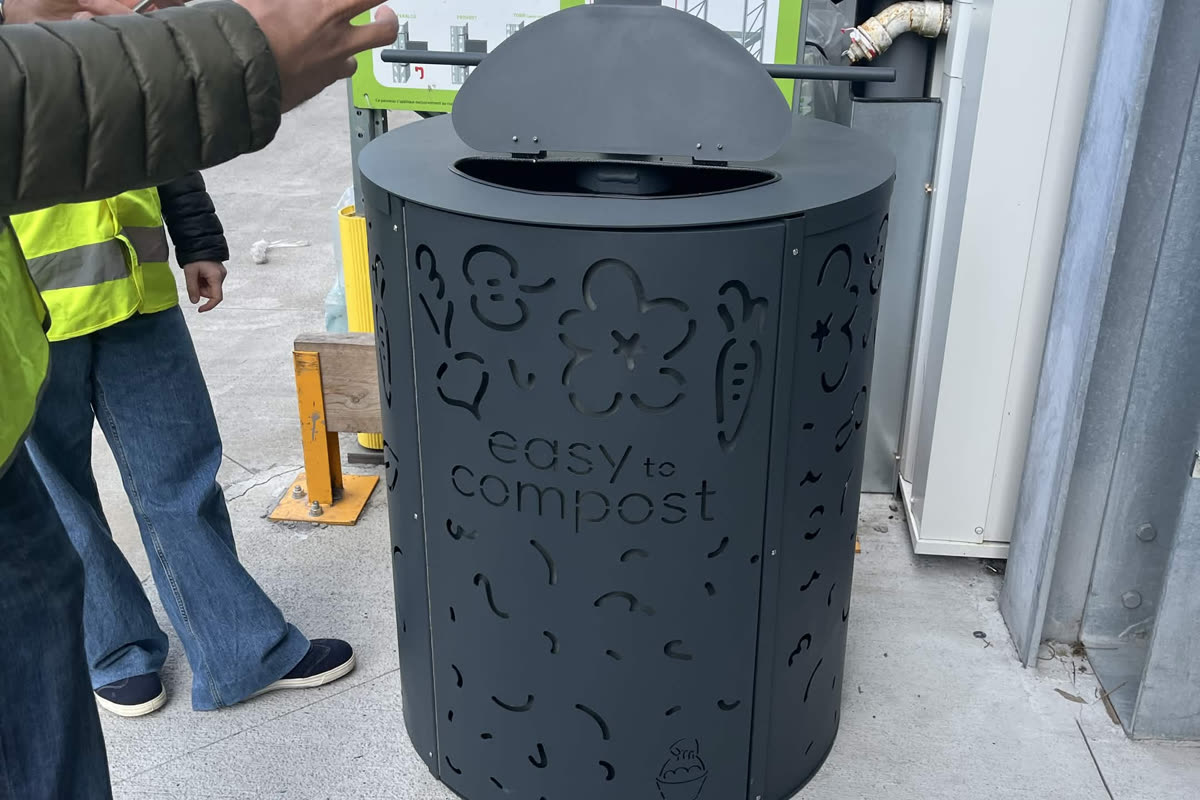
Three principles survive turnover. The sorting action has to be shorter than the competing one: if the general waste bin is under the worktop and the food waste caddy is at the far end of the kitchen, separation runs out of steam within weeks, without anyone ever having questioned the instruction. The instruction goes where the decision is made, above the worktop, and not on the composter where it is already too late; pictograms without text work better than lists. Finally, a named lead and a deputy per restaurant, written into induction alongside hygiene: with no name against the line, the task belongs to nobody.
Rolling out across a restaurant network
A network is not rolled out like a standalone site. The right sequence starts with a pilot of two or three deliberately contrasting restaurants: a city-centre site with no back yard, a suburban drive-through with outdoor space, a counter in a shopping centre. Three months of operation and a check weighing are enough to tell whether the instruction holds and what share of the volumes actually reaches the composter.
The blocking point is almost never the equipment, it is the siting. Because the composter needs no connection, there is no technical submission and no building work to process, but it does need a few square metres of stable ground, reachable by a wheeled bin without a step, out of customers' sight. That is the criterion that sorts the restaurants in a network, not their turnover. Our article on rolling out composting across multiple sites sets out that qualification, and the Decathlon case study shows how one national network went about it.
Contracting follows the reality on the ground: one contract per restaurant, bought outright or rented over 48 months, rather than a single order held centrally, so that the equipment stays with the site through disposals and changes of franchisee. The weight tickets your waste contractor issues at each removal, kept site by site, then feed the waste indicators expected of large groups: ESRS E5 under the CSRD for companies reporting in the EU, and the equivalent disclosure frameworks elsewhere.
Two limits to be clear about. Outside France, the removal of the mature compost is not part of what we supply: it is arranged with a local operator of your choice, and we help you scope the brief. An international network therefore has to line up a removal route in each country before the first delivery, not after. The countries we deliver to are listed on our where we deliver page. For counters inside a shopping centre, the decision is taken at the level of the whole dining area: see our article on food waste separation in food courts and our hospitality page.
The checklist before equipping a restaurant
The order matters as much as the content. A composter installed before the stream is separated and the siting settled ends up unused, and restarting a team that has watched the first attempt fail costs more than starting well.
- Weigh the plant preparation fraction for two full weeks, at the end of each service, in a restaurant representative of the network.
- Scale the daily average to the year on the real number of opening days, then compare it with the 1,500 and 3,000 kg limits.
- Physically separate the kitchen stream from the dining room stream before installing anything.
- Choose the siting before the equipment: stable ground, out of customers' sight, reachable by a wheeled bin without a step.
- Walk the real route from the prep station, caddy loaded, at the height of service, not on a plan.
- Put the caddy at the prep station and the pictogram instruction above it, not on the composter.
- Name a lead and a deputy per restaurant, and write them into induction.
- Plan the route for everything else: tray returns, frying oil and packaging do not go into the composter.
- Keep the weight ticket from every removal, restaurant by restaurant, together with the contract and your waste contractor's transfer paperwork.
- Only generalise across the network after three months of pilot and a check weighing.
Common questions
Can a fast food restaurant compost all of its food waste on site?
No. One ABC composter absorbs up to 1,500 kg a year and a second raises the limit to 3,000 kg, whereas a restaurant serving 250 covers a day produces something like 4 tonnes. On-site composting handles the plant preparation fraction separated in the kitchen, most often 20 to 35% of the total volume. Tray returns belong with a collection.
What does a quick-service restaurant have to budget for?
One composter per restaurant, to buy or to rent over 48 months, the bulking agent it consumes through the year, and a local contract for taking the finished material away. A restaurant serving 200 meals a day, with 1,050 kg of compostable stream, needs a single composter. Export pricing is not published: ask for a quote for your country, giving the meals a day and opening days a year for each site.
Does it need electricity or a drain to install?
No. The ABC composter does not plug in: no electricity, no water supply, no drainage, no groundworks. The mixing is mechanical and turned by hand. It needs stable ground and a few square metres reachable by a wheeled bin, which means it can be moved if the back of house is reorganised.
Can compostable packaging go into the composter?
No. EN 13432 certifies compostability under industrial conditions, which on-site composting does not reproduce: PLA cups, cutlery and trays come out whole or in fragments, and plastic-lined paper cups behave the same way. The safe instruction fits in one sentence: into the composter, food only.
How do you hold the instruction with teams that change constantly?
By making the action shorter than the competing one, and by displaying the instruction where the decision is made. The caddy goes at the prep station within arm's reach, the text-free pictograms are fixed above the worktop and not on the composter, and a named lead with a deputy appears in the induction.
What happens to a restaurant that does not separate its food waste?
Enforcement sits with the regulator for the nation concerned: the Environment Agency in England, SEPA in Scotland, Natural Resources Wales, the NIEA in Northern Ireland, and the local authority in Ireland. Powers run from a compliance notice to a financial penalty, and the levels differ from one regime to the next. In a franchised network it is the restaurant inspected that answers, not the franchisor.
Where to start
Start with the scales, not with the equipment. Two weeks of weighing the plant preparation fraction, at the end of each service, in a representative restaurant: that is the only figure that decides the rest. You will know whether the stream sits under 1,500 kg a year, between 1,500 and 3,000, or above, and what share of your volumes will need a separate collection contract.
Our online sizing tool then returns the sizing in a few minutes, with no sign-up. One precaution specific to quick service: when it estimates the volumes itself from the number of covers, it works on the total volume, tray returns included, and therefore comes out well above what your composter will actually treat. Choose the "I already know my volumes" entry and enter the kilos of kitchen preparation you have weighed: the sizing then applies to that stream alone.
A free assessment, a quote within 24 h
Thirty minutes on a video call to go over the food waste separation duty that applies where you operate, size the solution and estimate your savings.
