
Resource
Food waste in food manufacturing: what can be composted on site
Line by-products belong in an approved route. On-site composting answers a different stream, and one that is often forgotten: the staff restaurant and the grounds.
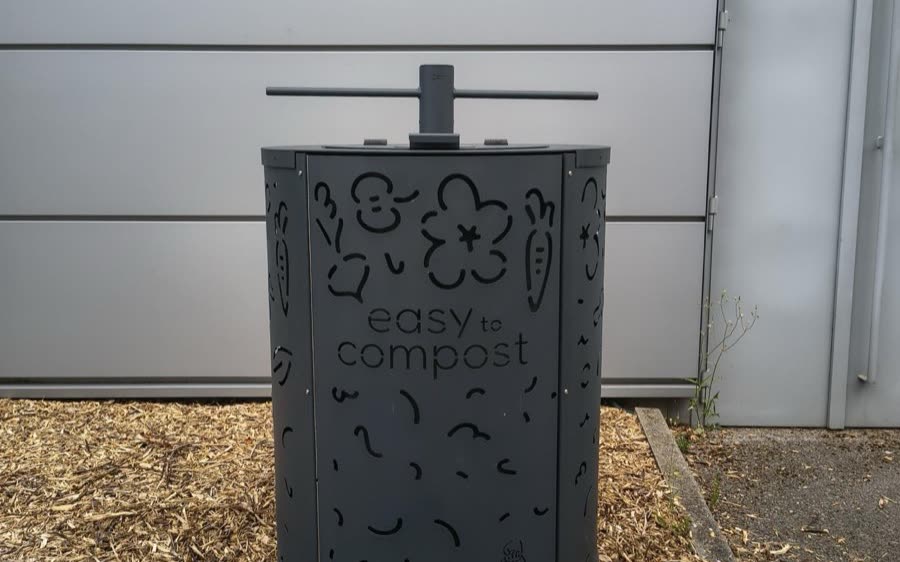
No, a food factory does not compost its process waste on site. A production line puts out tonnes a day where a composter absorbs 1,500 kg a year, and above all most of that material is not waste at all: it is by-products that go to animal feed, to rendering or to anaerobic digestion. On-site composting answers a different stream, one that is often orphaned on industrial sites: the food waste of the staff restaurant, the canteen and the grounds. On a factory of 180 staff with a canteen serving 120 meals, that stream comes to about 2,000 kg a year, which means 2 composters and 9 collections.
Key takeaways
The dividing line is not the nature of the material but where it comes from: anything leaving an animal production line falls under Regulation (EC) No 1069/2009 and an approved route, not a composter.
The duty to separate does not depend on any tonnage: in the European Union it comes from Article 22 of the Waste Framework Directive 2008/98/EC, and in the United Kingdom from each nation's own rules.
The limits of on-site composting are fixed: 1,500 kg a year per composter, 3,000 kg with two. Above that, the volumes belong in a collection contract or at an anaerobic digestion plant.
By-product, bio-waste, waste: three statuses, three routes
The question a QHSE manager asks is almost never "how many tonnes", it is "which of my tonnes are legally food waste". That determines the contract, the paperwork and who inspects you: a large tonnage that is not waste falls outside the rules on separation at source, while a modest tonnage that is waste falls squarely inside them.
Article 5 of the Waste Framework Directive 2008/98/EC defines a by-product: a substance arising from a production process that is not its primary aim, and which escapes the status of waste where four conditions are met together. Further use is certain; the substance can be used directly without any processing other than normal industrial practice; it is produced as an integral part of the production process; and the use is lawful, meeting the health and environmental requirements that apply to it. Spent grains, beet pulp, oilseed meal, milling residues: these streams have been used for decades and raise no separation question. The directive applies across the European Union and its by-product test has been carried into United Kingdom law as assimilated legislation.
Bio-waste itself is defined in Article 3(4) of the same directive: biodegradable garden and park waste, food and kitchen waste from households, offices, restaurants, wholesale, canteens, caterers and retail premises, and comparable waste from food processing plants. A food manufacturing site rarely re-reads that definition before signing a contract: it is that definition, though, that puts the canteen and the unsold stock on the same side of the line.
| Stream | Most common status | Usual route | On-site composting |
|---|---|---|---|
| Spent grains, pulps, oilseed meal, cereal residues | By-product, Article 5 of Directive 2008/98/EC | Animal feed, or an input to another industry | No, these streams do not leave the process |
| Trimmings, cuts, hides, bones, dairy returns | Animal by-product, Regulation (EC) No 1069/2009 | Rendering, pet food, approved processing plant | No, approval required |
| Peelings and out-of-spec vegetable material from the line | Bio-waste, Article 3(4) of Directive 2008/98/EC | Anaerobic digestion, industrial composting, animal feed | No, unless the whole stream stays under 3,000 kg a year |
| Unsold stock and quality withdrawals, still packaged | Bio-waste once de-packaged | Food donation, de-packaging then anaerobic digestion | No, the de-packaging step is missing |
| Staff restaurant, canteen, break room, coffee grounds | Bio-waste, Article 3(4) of Directive 2008/98/EC | On-site composting or separate collection | Yes, within the capacity limits |
| Cuttings, prunings and leaves from around the site | Bio-waste, Article 3(4) of Directive 2008/98/EC | On-site composting, commercial waste site | Yes, as a carbon top-up |
| Separation rejects, sludge from the on-site treatment plant | Non-hazardous waste or sludge | Dedicated route, land-spreading plan | No |
Read this table with your quality department: how a stream is classified depends on what actually happens to it, and two factories producing the same material may classify it differently. What does not move: the two rows marked "yes" are the only ones that feed an on-site composter as a matter of routine. Out-of-spec vegetable material from the line only joins them in the rare case of a workshop whose entire output stays under 3,000 kg a year, and that is checked by weighing before any commitment.
Why animal by-products do not stay on site
This is where an industrial composting project stalls fastest, and it is better known before any sizing is done. Regulation (EC) No 1069/2009 classifies animal material not intended for human consumption into three risk categories. Trimmings, cuts and returns from animals judged fit for human consumption fall into Category 3, the least restrictive of the three, which does not mean unrestricted.
Composting them calls for an approved plant and a standardised process. Regulation (EU) No 142/2011, which sets out the implementing rules, lays down standard transformation parameters for composting plants: particle size reduced to a maximum of 12 mm, then a temperature of 70 °C held for at least 60 minutes throughout the material. A composter standing behind a workshop does not shred to 12 mm and cannot demonstrate a uniform temperature: it cannot be approved for this. Both regulations apply across the European Union and are retained in United Kingdom law as assimilated legislation, so the rule holds on either side of the Channel.
The practical consequence fits in one sentence: anything leaving an animal production line never joins the composter, including the small quantities people are tempted to slip in "because it is organic anyway". The staff restaurant stream is a separate one, produced outside the production area and treated in law as bio-waste to be separated at source. The operating instruction still stands, though: no bones and no meat leftovers in quantity, which attract pests and slow the process down; our article on what goes into a commercial composter covers the borderline cases.
The stream that is still compostable at a factory
Once the by-products and the line volumes have gone off to their own routes, one stream is left that nobody really manages: the one produced by the people who work on the site. Canteen, mess room, coffee machines, reheated packed lunches, fruit bowls, plus the cuttings and prunings from the grounds. Modest against production tonnages, it slips under the radar, and it is precisely the stream the duty to separate at source is aimed at.
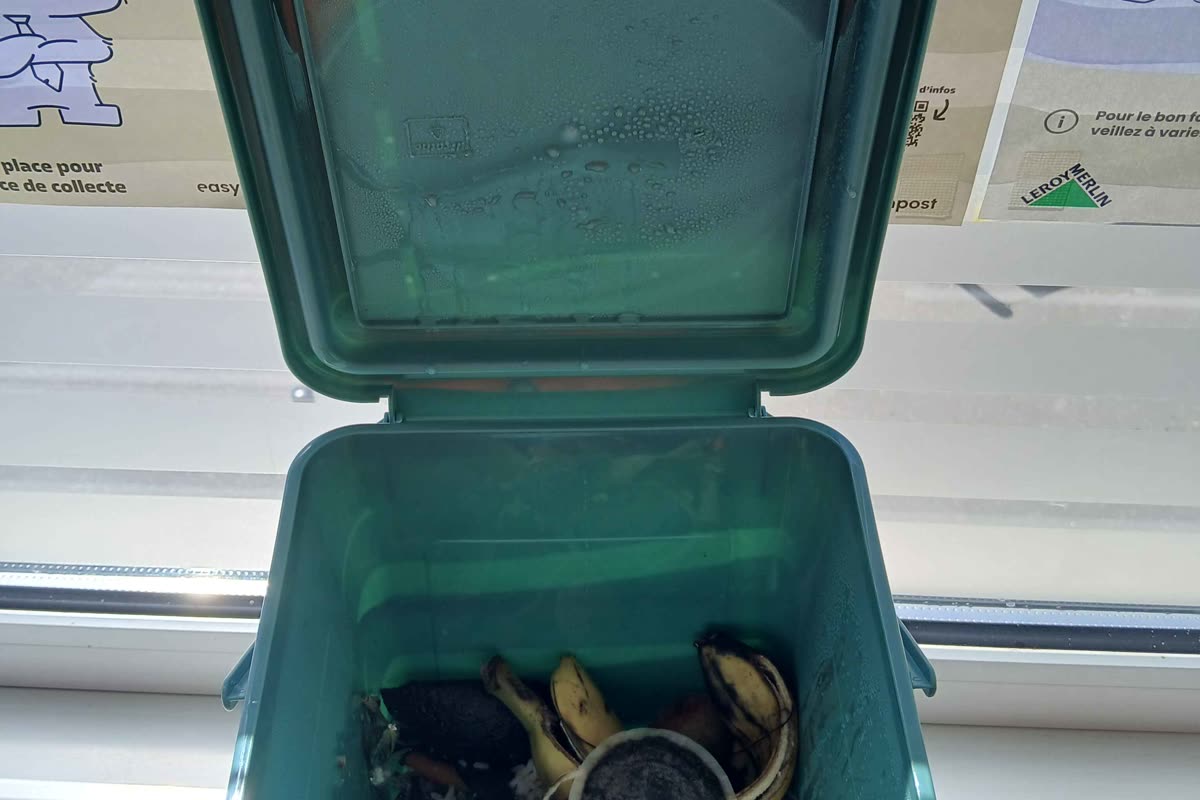
Those volumes are measured with stable ratios. Our online sizing tool applies to industrial sites the published catering benchmarks (ADEME, France) cross-checked against readings from the sites we have equipped: 0.015 kg per person per day on site, increased by 50% where teams eat in the mess room from their own containers, and 0.075 kg per meal served where there is a canteen, over 250 working days. A capture rate of 70% is then applied: no separation arrangement recovers the full theoretical figure. The full method is in our guide to sizing a composter.
The maths
- Headcount on a normal day 180 people
- Working days a year 250
- Ratio for time spent on site 0.015 kg per person per day
- Volumes from people being on site 675 kg
- Meals served a day in the canteen 120
- Contract catering ratio 0.075 kg per meal
- Volumes from the canteen 2,250 kg
- Combined theoretical volumes 2,925 kg
- Capture rate applied 70%
Volumes compostable on site2,048 kg a year
At 2,048 kg a year, that is two composters and a factory approaching the upper limit of on-site composting. The same site with 220 meals served and 300 staff comes out at 3,675 kg: above 3,000 kg a year, on-site composting is no longer the right answer, and the question becomes one of a collection contract or an anaerobic digestion plant. Our comparison of anaerobic digestion and on-site composting sets out the criteria without forcing the answer.
Sizing the equipment
The ABC composter is a 2 mm steel vessel of 450 litres, designed and built in our workshop in France. It does not plug into anything: no electricity, no water supply, no drainage, no groundworks. Aeration is continuous through a central chimney, and mixing is mechanical, turned by hand. On a site where every electrical intervention goes through a lock-out procedure and where drilling a slab opens a file, that absence of any connection makes installation a matter of hours, and reversible. It is also what sets it apart from electric dehydrators, whose consumption and servicing constraints our article on the electromechanical composter sets out.
The composter is available to buy or to rent over 48 months: either way it is delivered on a pallet with its bulking agent and its awareness kit, your own team installs it and the handover is done remotely by video call. Emptying is not part of what we supply, you arrange it with a local waste contractor, and that is also where the reporting comes from, since the material is weighed when it is taken away. The number of collections is not a matter of choice: it follows from the volumes, from one to twelve a year, and it is counted per composter. A site with two composters therefore needs twice the collections of a site with one, which is what the table below reflects.
| Site profile | Volumes captured a year | Composters | Collections a year | Monthly, excl. VAT |
|---|---|---|---|---|
| 40 staff, mess room and no canteen | 158 kg | 1 | 1 | 89 € |
| 80 staff, mess room and no canteen | 315 kg | 1 | 2 | 99 € |
| 150 staff, mess room and no canteen | 591 kg | 1 | 3 | 109 € |
| 90 staff, canteen serving 60 meals | 1,024 kg | 1 | 9 | 169 € |
| 180 staff, canteen serving 120 meals | 2,048 kg | 2 | 9 | 338 € |
| 300 staff, canteen serving 220 meals | 3,675 kg | Outside the scope of on-site composting: these volumes belong in a collection contract | ||
Two lessons for a manufacturer. First, the canteen weighs more than the headcount: 90 staff who eat on the premises produce more than 150 who bring their own lunch. Second, the sizing moves in steps rather than smoothly, because you take the first band whose threshold covers the volumes: 100 kg more can take you from 6 collections to 9. Across a group of sites, that rules out extrapolating from a pilot factory, and we set out that mechanism in our guide to multi-site rollouts.
What comes out of the composter after a few months is not a ready-to-use soil improver: it is taken away at each collection and needs a maturing phase before it goes on the land. Where it goes is the route you have set up locally, a waste contractor, a nearby farm, a municipal composting site, or your own grounds. Our article on what to do with the compost you produce describes those routes and the paperwork they generate.
Passing an IFS, BRCGS or FSSC audit with a composter on site
A certified site does not judge a composter on its data sheet but on where it sits in the food safety plan. Three requirements come up in every audit, and they bear on the siting more than on the equipment.
The first is zoning. The composter goes outside the production buildings, or in a dedicated room with no opening onto clean areas, in line with the hygiene logic of Regulation (EC) No 852/2004. The second is one-way flow: the caddy goes down from the catering area to the composter and nothing comes back, which means tracing the real route on the traffic plan before choosing the location. The third is the pest control plan: the composter has to be listed in it as a point of attention, with its distance from production doors and its inspection round, failing which an auditor will read it as an uncontrolled source.
On the equipment itself, the points that can be demonstrated are concrete: a vessel in 2 mm steel with a solid base, a solid lid that closes after every input, standing on a hard, cleanable surface, and washing with water and a brush recorded in the cleaning plan. The aeration chimney keeps an aerobic process going in a closed vessel, and it is the aerobic route that avoids the smell of putrefaction: our article on composting at work without smells or pests sets out that mechanism and the mistakes that break it. One clarification that often comes up in front of an auditor: some of the five colours have an outer skin cut with decorative openings. That cladding is not the hygiene barrier, it is a façade treatment; the barrier is the inner vessel with its solid base, closed by its solid lid, and that is what to show.
Duties, permitting and traceability
Separating food waste at source is a duty on every producer. In the European Union it comes from Article 22 of the Waste Framework Directive 2008/98/EC, which required separate collection or recycling at source by 31 December 2023 and applies in Ireland; the United Kingdom sits outside the directive and runs four separate regimes, Simpler Recycling in England, the Waste (Scotland) Regulations 2012, the Workplace Recycling rules of 2024 in Wales, and Northern Ireland's own arrangements. Several of them have no tonnage threshold at all, and the older thresholds still quoted in internal procedures are worth re-checking against the text that binds your site. A factory that has carefully organised its by-product routes without ever dealing with its canteen can be in breach, even though almost all of its organic material is properly recovered.
Penalties are national. The amounts, the body that enforces them and the route of appeal are set by each regime, and figures published for one country say nothing about another, what is a fixed penalty notice in one is an administrative fine issued by the local authority in another. Ask your local authority or environmental regulator which text covers your site and who inspects what.
That leaves the question that worries an already-permitted site most: does a composter add a line to its permit? Permitting thresholds for composting are national and almost always expressed in tonnes handled per day: an ABC composter absorbs up to 1,500 kg a year, about 4 kg a day, and two composters about 8 kg, which is orders of magnitude below any of them. What a permitted site should check is different and specific to it: that its own permit does not restrict the storage of putrescible material at the spot you have in mind. Your environmental regulator confirms both points for your own site.
On evidence, what is expected is the same as for your other streams: a dated waste log, filled in at each collection, the contract, and proof of recovery. Every collection produces a weight and a document, and that is also what feeds sustainability reporting. What has to be kept, in what form and for how long is set by national rules: ask the regulator that covers your site.
The checklist before equipping a food manufacturing site
The order matters as much as the content. A composter installed before the streams have been classified ends up unused at best, and at worst becomes one more non-conformity at the next audit.
- List every organic stream on the site and give each one its status: by-product, animal by-product, bio-waste, waste.
- Have the classification of animal-origin streams confirmed by your quality department and by the competent authority for animal by-products in your country, before any sizing is done.
- Isolate the scope of on-site composting: catering, break room, grounds, and nothing else.
- Weigh that scope for two full weeks, at the end of service, rather than estimating it.
- Scale the daily average up to the year using the real number of working days, then compare it with the 1,500 and 3,000 kg limits.
- Choose a location outside the production area, on a hard surface, reachable by a wheeled bin without a step and without crossing a clean zone.
- Trace the caddy's route on the traffic plan and check that it does not contradict the one-way flow.
- Add the composter to the cleaning plan and to the pest control plan before it is commissioned.
- Check that the site's own environmental permit does not restrict the storage of putrescible material at the location chosen.
- Name one person responsible and a deputy, and file the weight and the paperwork from each collection in your waste log.
Common questions
Can a food factory compost its process food waste on site?
No. A production line puts out tonnes a day where an ABC composter absorbs 1,500 kg a year, and two composters 3,000 kg. More to the point, most of that material is not waste but a by-product within the meaning of Article 5 of the Waste Framework Directive 2008/98/EC. On-site composting answers the stream from the staff restaurant, the canteen and the grounds.
Can meat and fish trimmings go into the composter?
No. They fall under Regulation (EC) No 1069/2009 on animal by-products, usually in Category 3, and composting them calls for an approved plant. Regulation (EU) No 142/2011 sets standard transformation parameters for that: particles of 12 mm at most, then 70 °C for at least 60 minutes. A composter standing behind a workshop meets neither condition. Both regulations apply across the European Union and are retained in United Kingdom law as assimilated legislation.
Does a composter on site bring the factory under a new permitting requirement?
Almost certainly not. Permitting thresholds for composting are national and almost always expressed in tonnes handled per day, where an ABC composter represents about 4 kg a day and two composters about 8 kg. What an already-permitted site should check is different: that its own permit does not restrict the storage of putrescible material at the location it has in mind. Both points are worth confirming with your environmental regulator.
Is a composter compatible with IFS, BRCGS or FSSC 22000 certification?
Yes, on three conditions that bear on the siting more than on the equipment: the composter goes outside the production buildings or in a dedicated room with no opening onto clean areas, the caddy's route respects the one-way flow, and the composter appears in the cleaning plan and in the pest control plan. In front of an auditor, the points you can demonstrate are the 2 mm steel vessel with its closed base, the solid lid, and siting on a hard, washable surface.
What does a composter involve on an industrial site?
The composter on its own is rented at 79 € excl. VAT a month, delivered, with the bulking material, maintenance, awareness work and training included, on a 48-month agreement; buying one is possible as well, talk to us and we will quote it. Collection is an option in France: 10 € excl. VAT a month, per annual visit and per composter, from 1 to 12 visits, the number following from the volumes rather than from a preference; elsewhere emptying is arranged with a local waste contractor. A factory of 180 staff with a canteen serving 120 meals, that is 2,048 kg captured a year, needs two composters and 9 visits, which in France comes to 158 € of rent and 180 € of collection: 338 € excl. VAT a month.
What does a food manufacturing site risk if it does not separate the food waste from its canteen?
Penalties are national: the amounts, the enforcing body and the appeal route are set by each regime, so ask your local authority or environmental regulator which text covers your site. One point holds everywhere: having organised your by-product routes does not cover the duty to separate food waste at source, and several regimes attach no tonnage threshold to it at all.
Where to start
Start with the table of statuses, not with the equipment. Half a day with your quality department is enough to put every organic stream on the site in its box, and that half day heads off most of the projects that fail: either someone tries to put material into a composter when it needs an approved plant, or the only stream actually caught by the duty to separate is forgotten. Once the scope is isolated, weigh it for two full weeks: it is the only figure that decides the rest.
Our online sizing tool then returns the sizing in a few minutes, without signing up. One point specific to food manufacturing: the "Industry and logistics" entry estimates volumes from headcount and meals served, in other words from the catering scope alone, which is exactly what you are after. If you have already weighed, choose the "I already know my volumes" entry and enter your kilos, and whatever you do, do not enter your process tonnages, they would throw everything off. Our industry and logistics page and our how it works page then describe installation, maintenance and reporting.
A free assessment, a quote within 24 h
Thirty minutes on a video call to go over the food waste separation duty that applies where you operate, size the solution and estimate your savings.
