
Resource
Electromechanical and electric composters: what they actually do
Dehydrators, grinders, short-cycle reactors: what these machines really produce, what they consume, what they cost over five years, and how they compare with a composter that plugs into nothing.
An electromechanical composter is not a composter: it is a machine wired to the mains that heats, grinds and stirs food waste to cut its mass within hours or days. What comes out is neither mature compost nor a compost meeting a fertilising-product standard: it is a dried material or a young compost, which is still a waste and still has to go somewhere. These machines have their place where volumes are heavy and there is no outdoor space; they are paid for in irreducible electricity consumption, consumables, servicing and capital to amortise. Below 1,500 kg of food waste a year, a composter that plugs into nothing handles the same volumes with no power line, no consumables beyond its bulking agent and nothing to amortise.
Key takeaways
"Electromechanical" is not a regulatory category: the word covers everything from countertop dehydrators to five-figure industrial reactors.
Physics sets a floor on consumption: evaporating the water out of food waste that is 75 % water takes 0.47 kWh per kilo in, at perfect efficiency, so 0.7 to 0.9 kWh in real conditions.
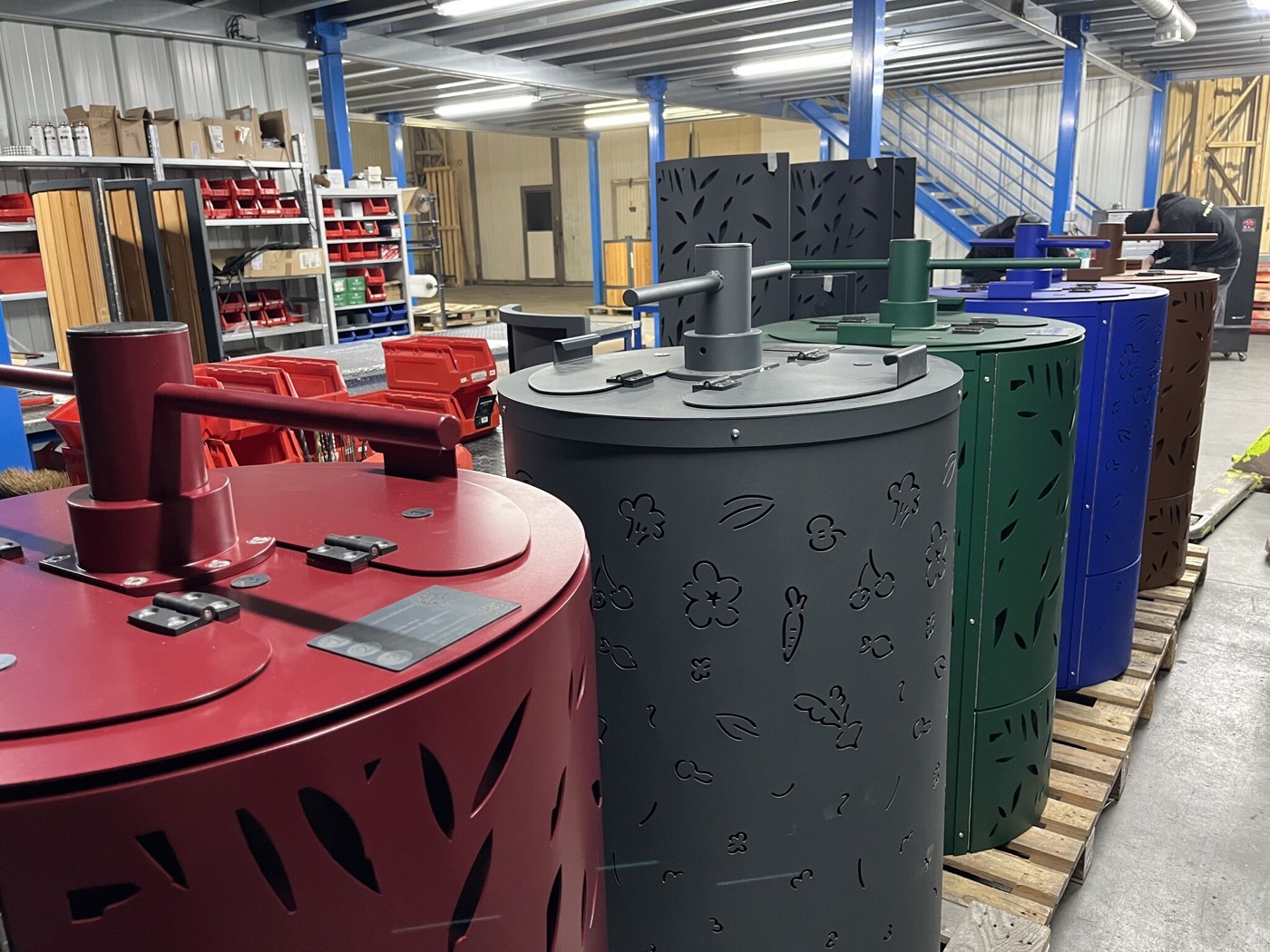
The Easy to Compost ABC composter does not belong to that family: no electricity, no water, no drainage, no groundworks. An aeration chimney, and mixing turned by hand.
What the word electromechanical covers
No regulation defines the "electromechanical composter". The phrase comes from supplier catalogues and covers any appliance that treats food waste on site by means of a motor and a heating element. Three families sit behind the same label: countertop dehydrators, about the size of a commercial coffee machine; professional grinder-dehydrators, which need a plant room; and short-cycle reactors, industrial units combining grinding, heating, motorised mixing and sometimes a bacterial inoculum.
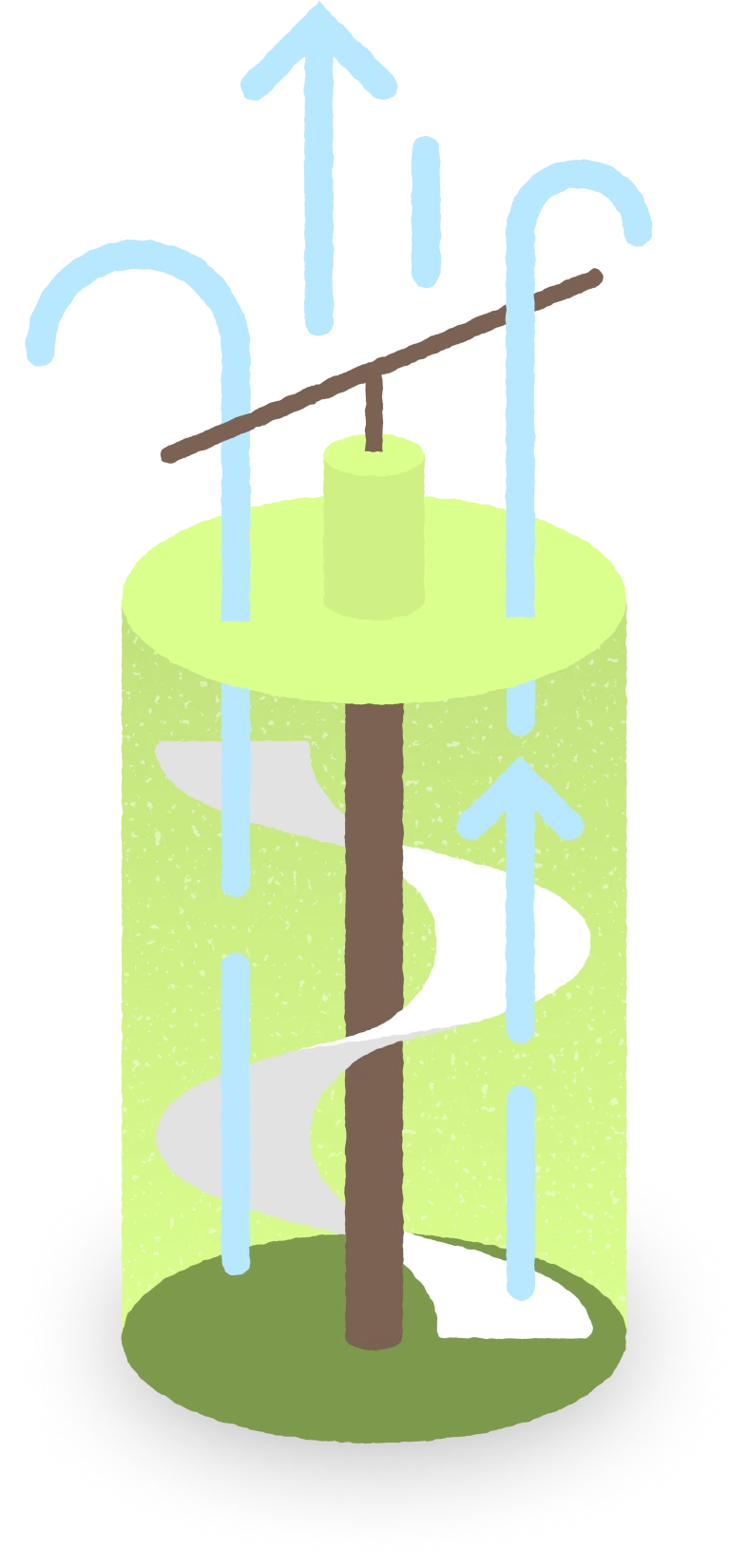
What they have in common is not the biological process: it is the power socket. That is where the most expensive confusion lies, because "mechanical" and "electromechanical" are not the same thing. The ABC composter does have a mechanical part, an auger housed in the vessel, but no motor: it is driven by a crank, a few turns a week. Air circulates continuously through an aeration chimney, the principle of which is set out in our article on ABC composting. No fan, and therefore nothing to connect.
Dehydrators: what comes out is not compost
The principle takes one sentence: a cycle of 4 to 8 hours heats and grinds the material to drive the water out of it. The mass coming out is 20 to 30 % of the mass going in, and most of what is lost is water, not carbon.
What comes out is a brown, dry, crumbly material. It is not compost, and the distinction is not a matter of wording: composting is aerobic biological decomposition and takes months, dehydration is a drying process and takes hours. Dried material is not stabilised; wet it again and it starts fermenting. It does not meet the requirements a finished soil improver has to meet before it can be placed on the market, which in the European Union are set by Regulation (EU) 2019/1009 on fertilising products, with national rules on top. It therefore remains a waste in law, with a destination to find and a traceability record to keep. That is the point commercial brochures deal with fastest, and the one that what you can actually do with the compost forces you to face.
These machines have real qualities: they cope with bones and very fatty waste, which on-site composting breaks down poorly, they sit indoors on a worktop, and they give a visible result straight away, which helps bring a team along. In return, they consume activated carbon filters, wearing parts and electricity at every cycle.
Grinders and short-cycle composting reactors
A step up, short-cycle reactors grind, heat and stir continuously by motor, and sometimes inject thermophilic micro-organisms. Suppliers claim a stable compost in 7 to 14 days.
Seven days is enough for the thermophilic phase, not for maturing. What comes out after a week or two is a young compost, still active: it locks up nitrogen and can hold crops back if it is spread as it is. Maturing remains a matter of months, whether it happens inside the machine or after it.
The rest is a question of infrastructure: three-phase power, often a water supply and drainage, ventilation, a load-bearing slab, and a noise level that pushes you to keep them away from workstations. The capital cost runs to tens of thousands of euros. At those volumes the useful comparison is no longer with a composter but with an off-site route, which our comparison of anaerobic digestion and on-site composting goes into.
The comparison, criterion by criterion
The table sets the three families side by side, at identical use. The right-hand column describes the ABC composter as it is actually supplied, not a market average; what leaves the site is contracted separately and locally.
| Criterion | Dehydrator | Short-cycle reactor | ABC composter, nothing to plug in |
|---|---|---|---|
| Process | thermal drying and grinding | grinding, heating, motorised mixing | aerobic composting, aeration chimney, mixing by hand |
| Treatment time | 4 to 8 h per cycle | 7 to 14 days claimed | several months |
| Connections | electricity | electricity, often three-phase, water, drainage, ventilation | none: no electricity, no water, no drainage, no groundworks |
| What comes out | dried material, not stabilised | young compost, not mature | pre-compost, not mature either: taken away, then sanitised and matured downstream |
| Consumables | carbon filters, wearing parts | filters, wearing parts, sometimes an inoculum | bulking agent, first load supplied, then sourced locally |
| Footprint | indoors, worktop or plant room | dedicated plant room, load-bearing slab | about 1 m² outdoors, on a hard, level surface |
| Noise and heat | moderate | significant, dedicated room needed | none |
| Commercial model | purchase, to amortise | purchase, to amortise | purchase, outright, delivered on a pallet |
| Ceiling on volumes | depends on the machine | high | 1,500 kg a year per composter, 3,000 kg with two |
| What is left for you to organise | the final destination for the dried material | the maturing, then the final destination | collection, contracted locally with a waste contractor |
A fourth column is missing from most comparisons: no collection at all. If you have planting beds or a kitchen garden, the material stays with you and all you need is the composter on its own, at 79 € excl. VAT a month, rented over 48 months or bought.
The physical floor on consumption
The consumption of a dehydrator is not a commercial parameter: it is bounded by thermodynamics. Taking 1 kg of water from liquid to vapour needs about 2,260 kJ, or 0.63 kWh. Catering food waste is 70 to 80 % water. The rest is multiplication.
The maths
- Latent heat of vaporisation of water 2,260 kJ/kg, or 0.63 kWh
- Water content of food waste, assumed 75 %
- Theoretical energy per kilo in, at perfect efficiency 0.47 kWh
- Real thermal efficiency of a machine, assumed 55 to 65 %
Realistic floor0.7 to 0.9 kWh per kilo in
For a site at 750 kg a year, that comes to 525 to 675 kWh, or 32 to 41 kg CO2e using a factor of around 0.06 kg CO2e per kWh for electricity in mainland France, as published by ADEME (France) in its Base Empreinte. Outside France, where the grid mix is more carbon-intensive, the same machine gives a very different answer.
That bound gives you an immediate check: a data sheet claiming markedly less is not drying as much as it says it is, or is counting its cycle on a smaller mass than yours. Always bring the kWh back to the kilo going in, never to the cycle: it is the only unit that compares from one brand to another.
The full cost over five years
The purchase price tells you almost nothing about the real cost. Here is the full structure for the same site at 750 kg a year. Every line is an assumption, to be replaced by your own supplier's quote: the structure itself does not move, and none of the five lines goes away.
The maths
- Machine at 9,000 € excl. VAT, amortised over 5 years 1,800 € / year
- Electricity, 600 kWh at 0.20 € excl. VAT per kWh 120 € / year
- Carbon filters, 2 sets a year 180 € / year
- Servicing and wearing parts 600 € / year
- Removal of the dried material, which is still a waste 250 € / year
Full annual cost2,950 € excl. VAT
At the same volumes, the Easy to Compost offer fits on one line. A site producing 750 kg a year falls into 4 collection visits a year on the grid behind the online quote: 79 € excl. VAT of composter plus, in France, 40 € excl. VAT of collection, that is 119 € excl. VAT a month and 1,428 € excl. VAT a year, bulking agent, maintenance and awareness included. It is a rental over 48 months, and the composter can be bought as well; elsewhere the removal of what leaves the site is arranged with a local operator of your choice.
On these assumptions the gap is 1,522 € excl. VAT a year, or 7,610 € over five years. It comes less from the electricity, which weighs 120 € here, than from the amortisation and the servicing: the classic pattern in which the line you can see when the decision is taken is not the line that drives the spending. The seven criteria for choosing a commercial composter take that apart line by line.
What the law actually requires
Separating food waste at source is a duty on businesses. In the European Union it comes from Article 22 of the Waste Framework Directive 2008/98/EC, which set 31 December 2023 for separate collection or recycling at source and is transposed by each member state; Ireland falls under that framework. The United Kingdom sits outside the directive and runs four regimes: Simpler Recycling in England, the Waste (Scotland) Regulations 2012, Workplace Recycling in Wales and its own rules in Northern Ireland. Not one of them prescribes a technology, and not one mentions a dehydrator or a composter. What they all require is that you can show where the material goes, in what form and with what evidence. A composter recycles at source and leaves a dated record at every emptying; a dehydrator leaves you with a dried material still to place, and that is the part it puts back on your plate. Your local authority or environment regulator confirms what applies to your site.
Penalties, for their part, are national. The amounts, the enforcing body and the appeal route are set by each regime, and a figure published for one country tells you nothing about another. Before you build a case on the risk of a fine, get the figure that applies where your site is.
That leaves environmental permitting, which comes up in every meeting. Composting installations fall under permitting thresholds in most countries, and those thresholds are expressed in tonnes a day, well above what an on-site composter handles: a machine taking 1,500 kg a year processes about 4 kg a day. The threshold, the regulator and the wording differ from one country to the next, so ask yours rather than transposing a figure read elsewhere. At this scale the question does not usually arise, either for a composter or for a desktop dehydrator.
The nine questions to ask before you sign
These nine questions hold for any on-site treatment solution, ours included. A vague answer to any one of them usually costs more than the gap between two quotes.
- How many kWh per kilo actually going in, rather than per theoretical cycle?
- What water content is that figure calculated on?
- What is the annual cost of consumables: filters, belts, blades, inoculum?
- Is the machine sold or leased, and what does the warranty cover after 24 months?
- Where does the output material go, with what evidence and at what price?
- What connections are needed: power rating, phase, water supply, drainage, ventilation?
- What noise level and what heat output in the room while it is running?
- Who trains the teams, and who attends a breakdown, within what response time?
- What happens if the volumes double, or disappear, during the contract?
On the last two, the how it works page sets out what is supplied with the machine, and our maintenance checklist shows what a written upkeep plan looks like, whatever equipment you end up choosing.
When electromechanical is the right choice
There are situations where on-site composting is not the right answer and a machine is. Volume, first. An ABC composter absorbs up to 1,500 kg a year; above that you add a second, which takes capacity to 3,000 kg. Past that threshold, on-site composting stops making sense: the answer becomes an off-site route, or a short-cycle reactor if the site insists on treating in place. You still have to know your own figure: the method is in our guide to sizing a composter to your volumes.
Then space: a site on an upper floor, a basement kitchen, an enclosed mall unit, with no hard outdoor surface of about 1 m², cannot take a composter. And finally the nature of the material: very fatty or very liquid waste, or waste under strict hygiene rules, does not behave like peelings and plate waste. In hotels and hospitality, the call is often made site by site.
Common questions
Does an electromechanical composter produce compost?
No, not in the sense the organic recycling sector means. A dehydrator produces a dried, unstabilised material, which is still a waste and still has to go somewhere. A short-cycle reactor produces a young compost, still active, whose maturing is yet to happen. In both cases the question to put to the supplier is the same: where does the output material go, and with what evidence?
How much does an electric composter consume?
Thermodynamics sets the floor. Evaporating the water out of food waste that is 75 % water takes about 0.47 kWh per kilo in at perfect efficiency, so 0.7 to 0.9 kWh in real conditions. For 750 kg a year, allow 525 to 675 kWh. Always bring the kWh on a data sheet back to the kilo actually going in, never to the cycle.
Is the Easy to Compost ABC composter an electromechanical composter?
No. It plugs into nothing: no electricity, no water, no drainage, no groundworks. It is a closed 450 L vessel in 2 mm steel, designed and built in our own workshop in France, with an aeration chimney and mechanical mixing turned by hand. The word electromechanical applies only to the powered solutions sold against it.
What does the alternative without electricity involve?
79 € excl. VAT a month for the ABC composter delivered, bulking agent, maintenance and awareness included. In France, collection is an option billed at 10 € excl. VAT a month per annual visit, from 1 to 12 visits depending on volumes: a site at 500 kg a year takes 3 visits and pays 109 € excl. VAT a month; a site at 750 kg takes 4 visits and pays 119 €; a site at 1,200 kg takes 12 visits and pays 199 €. It is a rental over 48 months, and the composter can be bought as well; elsewhere the removal of the mature compost is arranged with a local operator of your choice.
Where to start
In order: your volumes, then the two pieces of arithmetic in this article. The sizing tool handles the first step: it estimates your volumes from a few figures about your business and returns the number of composters and the emptying frequency, in your browser and with no sign-up. With that figure in hand, go back to the data sheet you have been offered and do the two calculations: the kWh brought back to the kilo going in, then the full annual cost, amortisation, consumables, servicing and final destination included.
Beyond that, the Decathlon network case study shows the same trade-off made across dozens of stores. Outside France we supply the equipment on its own, without collection: you contract locally for whatever leaves the site. Where we deliver sets out the countries we ship to.
A free assessment, a quote within 24 h
Thirty minutes on a video call to go over the food waste separation duty that applies where you operate, size the solution and estimate your savings.
