
Resource
Anaerobic digestion vs on-site composting: which route for food waste?
Two opposite processes, one figure that settles it: your annual tonnage. The comparison point by point, what each route really costs you, the legal frame and a decision checklist.
The short answer: the two routes are not competing for the same ground. Below 3,000 kg of food waste a year on a given site, composting on the spot treats the material where it falls, with no weekly lorry and no treatment contract. Above that, the volumes become an industrial flow and anaerobic digestion takes over. Between the two, it is not the process that decides but three measurable variables: your annual tonnage, the flat area available, and the number of lorry journeys that tonnage forces on you.
Key takeaways
Anaerobic digestion: anaerobic breakdown in a sealed digester, away from your site. Outputs: biogas and a wet digestate. Industrial scale, fed by lorry.
On-site composting: aerobic breakdown in a composter standing on your own ground. Output: a solid, stabilised compost. One ABC composter absorbs up to 1,500 kg a year, two up to 3,000 kg.
The tipping point: 3,000 kg a year per site. Below it, composting on the spot is simpler and far less dependent on somebody else's collection calendar. Above it, it is no longer the right answer.
Two opposite processes, two different products
Anaerobic digestion is an anaerobic breakdown. Food waste is fed into a sealed digester, starved of oxygen, where bacteria turn it into biogas (methane and carbon dioxide) and digestate. The biogas goes to combined heat and power or, once cleaned, into the gas grid. The digestate is a wet residue that goes back to farmland, under whatever spreading rules apply locally. None of this happens on your premises: industrial plants routinely handle several thousand tonnes a year and are fed by lorry from a radius of several tens of kilometres.
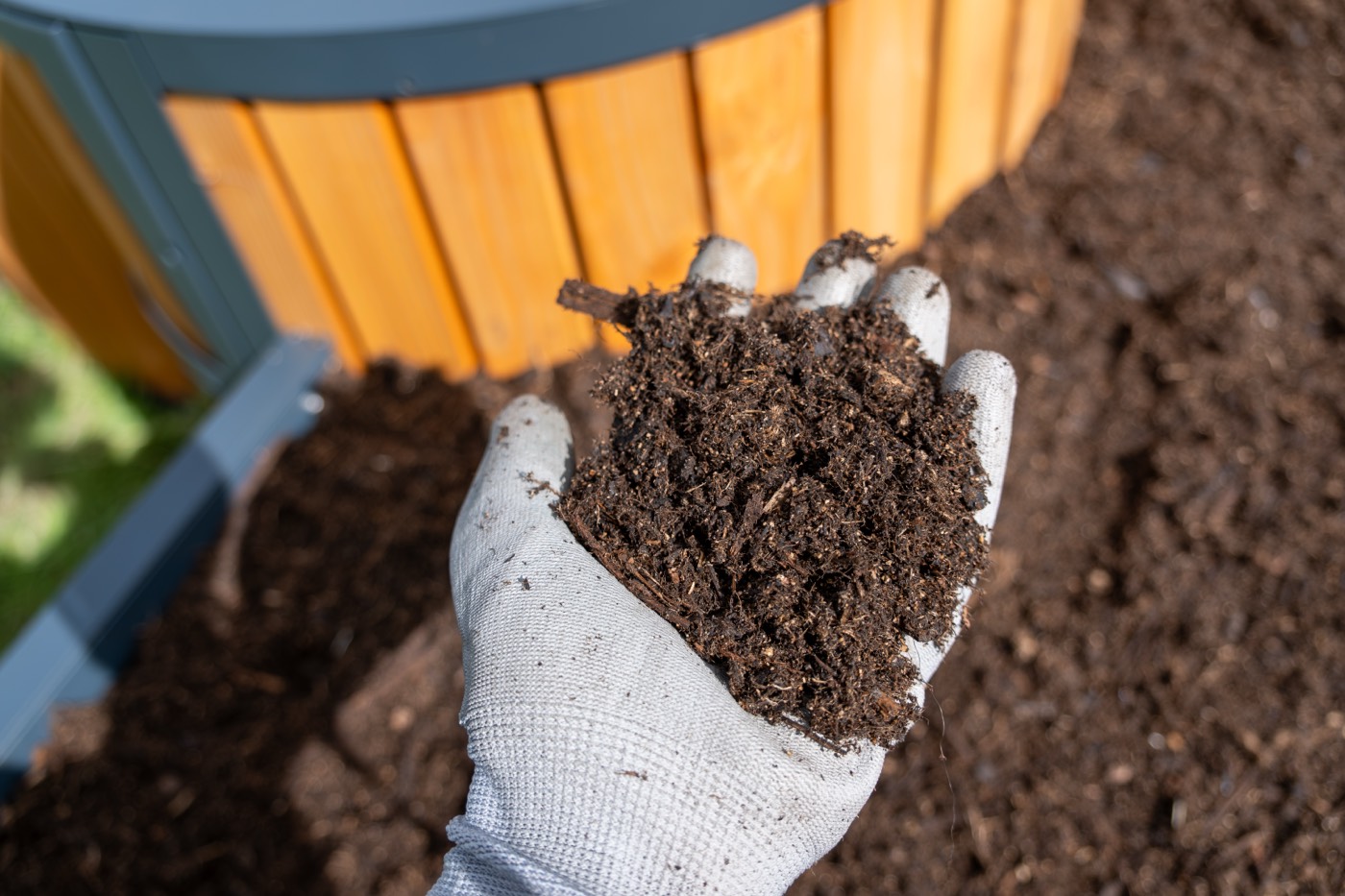
On-site composting is the exact opposite: an aerobic breakdown. Oxygen circulates, the temperature rises, bacteria and fungi reduce the material to a solid, stabilised compost that can be handled with a shovel and spread without any special installation. It goes first to the grounds of the site itself; when there is more than the grounds can absorb, it leaves by whatever local route you have arranged. The how it works page runs through the full cycle, from the kitchen caddy to mature compost.
One point is often misunderstood in tenders: the ABC composter does not plug in. 2 mm steel, 450 litres, mechanical mixing turned by hand, designed and built in our workshop in France, with no electricity, no water, no drainage and no groundworks. That is what separates it from the electric dehydrators sold under the label of electromechanical composters, whose real workings and limits we have set out elsewhere. A machine that dehydrates does not compost: it cuts the mass by evaporation and hands back material that still has to mature somewhere else.
The comparison, point by point
The table sums up what changes for the establishment producing the waste, not for the operator of the plant. That is the reading that matters when you are weighing up a budget.
| Criterion | Industrial anaerobic digestion | On-site composting |
|---|---|---|
| Process | Anaerobic, in a sealed digester | Aerobic, with oxygen circulating |
| Where treatment happens | An industrial plant, away from your site | On your own ground |
| Output | Biogas and wet digestate | Solid, stabilised compost |
| Final destination of the product | Gas grid or combined heat and power; digestate spread under supervision | The site's own grounds, or a local route you arrange |
| Scale | Several thousand tonnes a year | 1,500 kg a year per composter, 3,000 kg with two |
| Moving the food waste | Regular collection, often weekly | 1 to 12 emptyings a year, done in-house |
| Connections needed on your side | Not applicable, but allow for a bin area and washing | None: no electricity, no water, no drainage |
| Footprint | A room or an area for wheeled bins | About 1 m² per composter, on flat ground |
| Permits in your own name | None: the permit sits with the plant operator | Thresholds are national and set per tonne handled per day, not per year |
| Getting started | A collection and treatment contract | Delivery on a pallet, self-installation, then purchase or 48-month rental |
| What decides it | Volumes above 3,000 kg a year | Volumes below 3,000 kg a year, and the space available |
What each route really costs you
On the composting side, the sizing is deterministic: annual volumes give the number of composters, and the number of composters gives the emptying calendar. Take an establishment producing 800 kg of food waste a year. That is the order of magnitude of a head office of 230 people with a coffee point over 220 working days, with one caveat: the ADEME ratio (France) gives theoretical volumes of 1,140 kg (230 × 220 × 0.015 × 1.5), of which the sizing tool keeps only 70 %. That is the share that actually reaches the bin once meals eaten out, imperfect sorting and absences are taken off.
The maths
- Captured annual volumes, the basis for sizing 800 kg
- Composters needed (1,500 kg a year each) 1
- Rent of the composter, all in 79 € excl. VAT/month
- Emptyings set by the table (800 kg falls in the 875 band) 6 a year
- Collection: 6 visits × 10 € excl. VAT, French benchmark 60 € excl. VAT/month
Total139 € excl. VAT/month, that is 1,668 € excl. VAT/year
One thing does carry over, and it is the useful part: the emptying frequency is not a preference, it follows the volumes on a fixed scale (250 kg = 1 emptying a year, 450 = 2, 625 = 3, 750 = 4, 875 = 6, 1,125 = 9, 1,500 = 12). Run the figures with your own kilos in the sizing tool: it applies exactly that scale. If you have no interest in outside collection because you spread the compost on your own grounds, the composter on its own is the whole of what you need.
Above 1,500 kg a year a second composter is added and the whole routine doubles. A site at 2,000 kg a year therefore moves to two composters and 9 emptyings a year. To settle the right number of machines before you even ask for a price, the article on sizing a composter against your volumes sets out the method.
On the anaerobic digestion side there is no comparable published tariff: the price depends on the contractor, the distance to the plant, how often the round comes and how clean the sorting is. Rather than quoting an invented figure, insist that the quote breaks out five lines: bin hire, price per collection, price per tonne treated, the cost of washing the containers, and the penalties if a load is refused for poor sorting. It is by adding those lines up, not by comparing two prices per kilo, that the comparison becomes honest. Our page on organising local collection covers what to look for in a contractor's offer.
Transport, the real dividing line
Fresh food waste is 70 to 90 % water, depending on what it is made of. Collecting it means driving water around in a lorry. That is why a model built entirely on taking the waste away forces a high frequency: fresh material cannot be stored for long without smells and liquor. On-site composting changes the equation upstream: aerobic breakdown cuts the volume and stabilises the material, which is what makes low frequency possible.
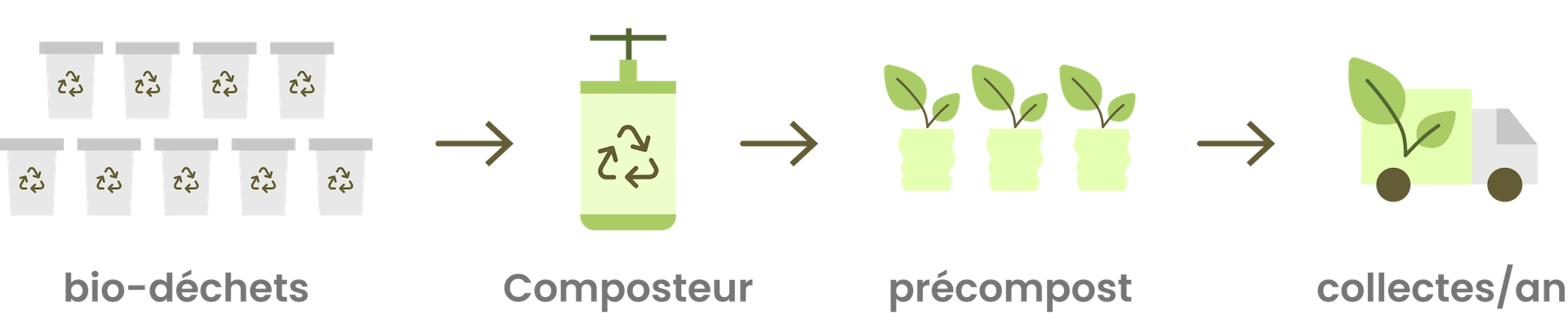
The gap is measured in journeys. A weekly collection means 52 lorry visits a year; twice a week makes 104. The same site producing 800 kg a year and treating it on the spot drops to 6 emptyings a year, which is 46 lorry visits avoided over the year, each with its kilometres, its loading-bay slot and its handling.
On carbon, the conclusion does not rest on logistics alone: it also depends on how much credit is given to the biogas produced and to the mineral fertiliser it displaces. Our life-cycle assessment comparing local composting with anaerobic digestion sets out the ISO 14040 and 14044 method, the boundary and the assumptions. To bring these flows into a corporate footprint, the carbon footprint page sets out the activity data behind the figures.
What the law requires, and what it does not
The law sets the result, not the route. Article 22 of the Waste Framework Directive 2008/98/EC has required every EU member state, since 31 December 2023, to have food waste either collected separately or recycled at source, and each country has transposed it in its own way: Ley 7/2022 in Spain, D.Lgs 152/2006 in Italy, the GewAbfV and the KrWG in Germany, the AWG 2002 in Austria. Ireland sits inside that framework. The United Kingdom sits outside it and runs four separate regimes: Simpler Recycling in England, the Waste (Scotland) Regulations 2012, Workplace Recycling in Wales, and Northern Ireland's own rules. None of these texts requires anaerobic digestion, and none requires composting: both are organic recovery. Recycling at source is one of the two routes the directive provides, and composting on site is how a building takes it; what your own national rules then ask of your establishment is set by them.
Penalties are national, and they differ sharply from one country to the next: what the KrWG allows in Germany is not what the Irish Waste Management Acts allow, and each of the four United Kingdom regimes carries its own enforcement powers. The tiered penalty scales that circulate in sales presentations are worth exactly nothing outside the country they were written for. Ask your local authority, or your own legal adviser, what applies to your site before you build a business case on a fine.
Then there is the fear of needing a permit. Thresholds for composting are set nationally and are almost always expressed in tonnes handled per day, not per year: a composter that absorbs 1,500 kg over a whole year is a very long way from any of them. The threshold that binds you is the one written in your own country's rules, so have it confirmed rather than assumed. Whichever route you take, the evidence is built the same way: a dated record for each emptying and an annual summary, kept on file.
Which volumes suit which route
The annual tonnage decides almost everything on its own. It still has to be measured rather than guessed: our method for sizing a composter against your food waste gives the ratios by sector and the one-week trial weighing.
| Annual volumes | Suitable route | What that means |
|---|---|---|
| Under 250 kg | On-site composting, 1 composter | One emptying a year is enough, or none at all if the compost is spread on site |
| 250 to 1,500 kg | On-site composting, 1 composter | 1 to 12 emptyings a year, following the scale above |
| 1,500 to 3,000 kg | On-site composting, 2 composters | Twice the emptying routine, and about 2 m² of footprint |
| Over 3,000 kg | Anaerobic digestion, or industrial composting | On-site composting is no longer the right answer: the volumes are a flow to be taken away |
A multi-site group changes the reading: 3,000 kg spread across ten establishments of 300 kg is not a site producing 3,000 kg. Each establishment is treated on its own, with its own composter and its own emptying scale. That is exactly the pattern rolled out at Decathlon across its national store network. Our where we deliver page lists the countries the machine ships to; outside France we supply the composter, not the collection, which you contract locally.
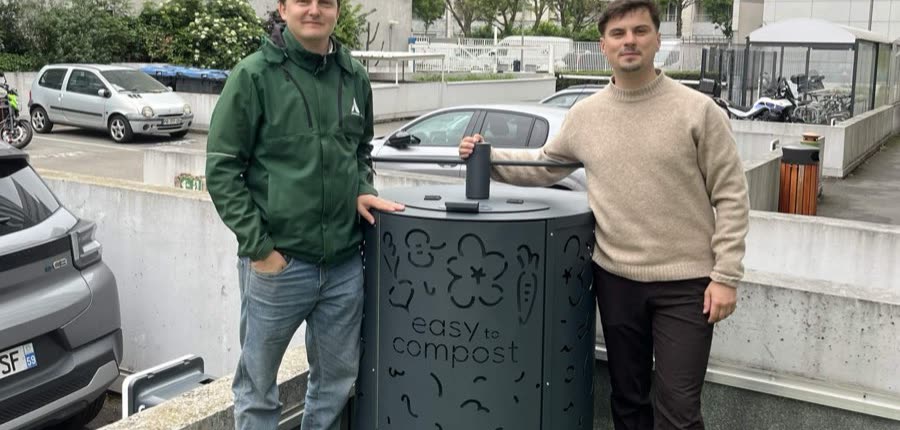
The space constraint can be checked in two minutes: a composter needs about 1 m² of flat ground and an access for handling. A corner of a car park, a service yard or a paved bin store will all do. If the site also has a landscaping brief, the garden composter does the same job while blending into planting: the same 450 L vessel, so the same 1,500 kg a year, ringed by a 2,000 L circular planter. Those 2,000 L are the planted bed, not the composting volume; in exchange it asks for 5 to 6 m² of ground, where the composter on its own takes less than one.
The checklist before you decide
Eight checks are enough to decide, and they fit inside a one-hour meeting.
- Weigh the real volumes over one representative week, then scale up over your opening days. A theoretical ratio nearly always overstates what actually reaches the bin.
- Place the result against the two thresholds that matter: 1,500 kg a year (one composter) and 3,000 kg a year (the limit of on-site composting).
- Measure the flat area available: 1 m² per composter, plus an access for handling.
- Count your current lorry visits and their full annual cost, bin hire and washing included. That is your basis for comparison, not the price per tonne.
- Check where the output actually goes: who takes the compost or the digestate, and on what terms.
- Ask for a dated record of what has been recovered, and an annual summary. Without one, neither route leaves you with anything to show.
- Put the permitting question in proportion: thresholds are expressed in tonnes handled per day, not per year. Two full composters come to roughly 8 kg a day. Confirm the figure that applies in your own country rather than carrying over one you read elsewhere.
- Read what the offer actually covers: delivery terms, what ships with the machine, and who supplies bulking agent and wear parts afterwards.
If a doubt remains on one specific point, the We also recycle your cigarette buttsFAQ covers the questions facilities managers and sustainability leads ask most often.
Common questions
Does an anaerobic digester produce compost?
No. A digester produces biogas and a digestate, a wet residue that goes back to farmland under regulated conditions. Compost is the product of aerobic breakdown: solid, stabilised, and handled by hand.
Does on-site composting count towards my legal obligations?
Composting on site is recycling at source, one of the two routes Article 22 of the Waste Framework Directive 2008/98/EC provides, the other being separate collection; the United Kingdom sits outside the directive and runs four regimes of its own. The composter treats the material where it falls, takes 65% of the mass out of the stream and leaves a dated record at every emptying. What that record has to contain, and what else your establishment has to do, is set by your national rules.
Does an ABC composter need electricity or a water supply?
No. The ABC composter needs no connection at all: no electricity, no water, no drainage, no groundworks. The mechanical mixing is turned by hand.
Can on-site composting and collection be combined?
Yes, and it is a common arrangement: the composter takes what it can absorb, and a local operator takes the balance. In France that collection is an option of 1 to 12 visits a year, billed at 10 euros excl. VAT a month per annual visit and per composter; elsewhere the removal of the mature compost is arranged with an operator of your choice, and we help you scope the brief. Either way the number of visits is not chosen: it follows from your volumes.
At what volume should you switch to anaerobic digestion?
Above 3,000 kg of food waste a year on a single site, which is two saturated composters, on-site composting is no longer the right answer. Below that, it stays simpler and far less dependent on somebody else's collection calendar.
Where to start
Start with the only figure that decides: your kilos per year. Weigh one representative week, multiply by your opening days, and set the result against the two thresholds, 1,500 and 3,000 kg. Below them, the sizing tool gives you, in a few clicks and without signing up, the number of composters and the emptying frequency the scale imposes. Above them, go and see an anaerobic digestion contractor with the five quote lines listed above in hand. And if the question is really how much to compost and how much to send away, the page on organising local collection shows how the two fit together on one site.
A free assessment, a quote within 24 h
Thirty minutes on a video call to go over the food waste separation duty that applies where you operate, size the solution and estimate your savings.
