
Resource
Composting at work without odour or rodents: how it is done
Odour and rodents always point to the same setting gone wrong. The mechanism, a diagnostic table, the siting checklist and where capacity runs out.
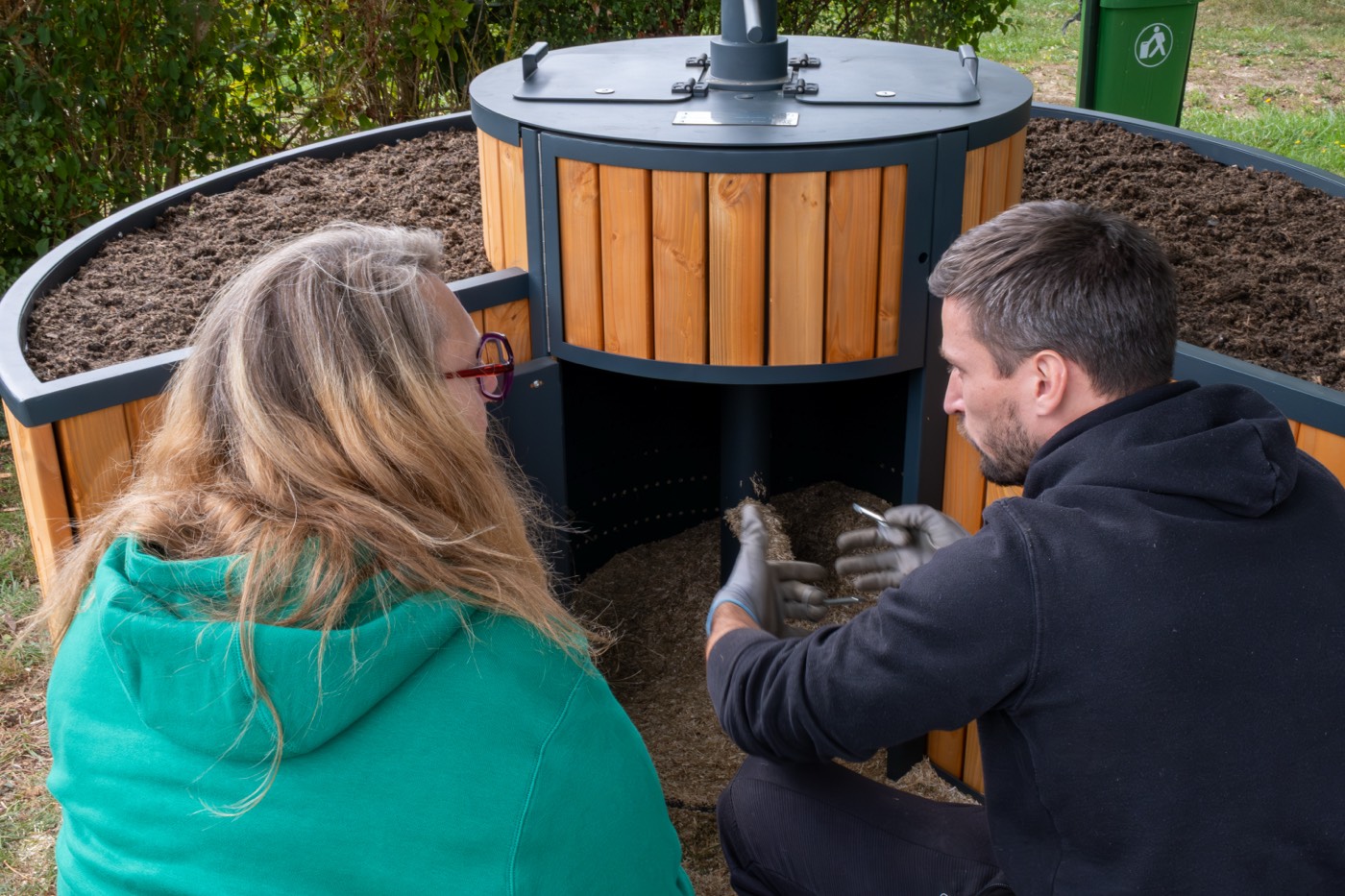
A commercial composter neither smells nor attracts rodents when three conditions are met: the mass stays oxygenated, every drop-off is covered with bulking agent, and the vessel forms a physical barrier that teeth cannot get through. An odour is never an inevitable part of composting: it is the signal of an imbalance, almost always the same one, and it clears up within a few days.
Why compost smells bad
Composting is an aerobic process: bacteria and fungi consume oxygen from the air and give off carbon dioxide, water and heat. As long as air circulates through the mass, the process is odourless, and what you smell above it is humus and woodland floor.
When oxygen runs short, a different flora takes over. Fermentation tips into anaerobic conditions and produces compounds you can smell several metres away: hydrogen sulphide (the rotten-egg smell), mercaptans, volatile fatty acids, ammonia. The odour is therefore not produced by the food waste but by the way it is held. Four causes cover almost every case in service:
- compaction: the material packs down, the air voids disappear, air no longer travels down;
- a carbon-to-nitrogen imbalance: too much food waste, nitrogen-rich and wet, not enough bulking agent;
- excess moisture: liquid saturates the pores and drives out the air, which brings you back to the first point;
- overloading: more goes in than the composter can digest.
Rodents, for their part, are not drawn to a mass that is breaking down: it is hot, disturbed, and poor in anything they recognise as food. They come for what is left lying around it. The phases and temperatures are set out in the composting cycle.
| What you see | Likely cause | Correction |
|---|---|---|
| Rotten-egg smell | Clearly anaerobic, mass compacted and waterlogged | Mix, double the dose of bulking agent, stop feeding it for 48 h |
| Sharp ammonia smell | Too much nitrogen, carbon-to-nitrogen ratio too low | Increase the bulking agent at every drop-off for two weeks |
| Sour, vinegary smell | Acidification from liquids or very acidic material tipped in bulk | Cut out liquids, spread coffee grounds instead of emptying them in one lump, mix, add structure |
| Liquid pooling at the foot of the composter | Too much moisture, not enough bulking agent | Bulking agent at the bottom of the vessel, check that the lid shuts |
| Flies when you open it | Drop-offs left bare on the surface | Cover every drop-off without exception, close the lid again |
| Scratching in the ground alongside | Waste left outside the composter, or inputs that do not belong | Restate the rule, closed caddy, clear away bags left on the ground |
| Cold mass, nothing happening | Too dry, too carbon-rich, or too little going in | Cut back the bulking agent, dampen it lightly |
The aeration chimney and mixing by hand
The question becomes mechanical: how do you get air into the centre of a 450 L vessel with no fan and no building work? The ABC composter answers with a vertical aeration chimney set at the heart of the vessel, which keeps a permanent air path open exactly where compaction usually occurs.
What drives that circulation is heat: breakdown gives off warmth, the hot air at the centre rises and escapes, and colder outside air is drawn in at the bottom. No fan, no electrical connection, no water supply, no drainage, no groundworks: the composter is set down, not plugged in.
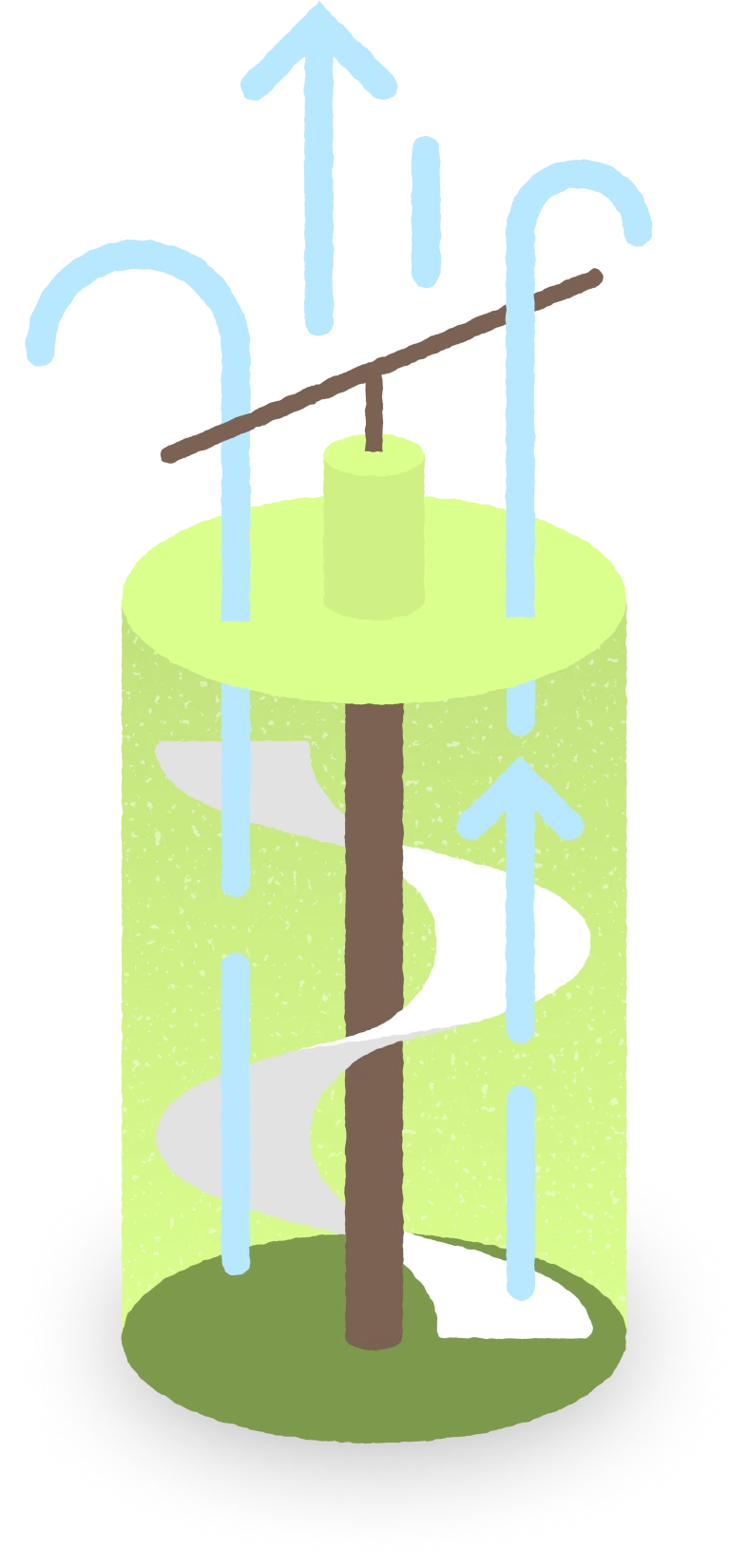
The chimney on its own would not be enough: the compaction has to be broken up as well. On a garden composter that means a fork and a motivated person, which is to say it never happens. On the ABC the mixing is mechanical and hand-operated: the user turns a handle at the top, the mechanism folds the fresh drop-off into the material already breaking down, in a few seconds and at the moment of tipping.
That is what separates the ABC from the electromechanical composters on the market, which are powered dehydrators, with a motor, a heating element and the consumption that goes with them. See the comparison of electromechanical and electric composters and how ABC composting works.
Bulking agent, the setting that decides
Leftover food is high in nitrogen and high in water. Left on its own it packs down, sticks and runs. The bulking agent brings three things at once: the carbon that balances the nitrogen, the structure that holds air voids open, and the absorbency that soaks up the liquid. On the surface it acts as a filter layer: the odour is neutralised when the lid is opened and flies can no longer reach what has been tipped in.
The routine comes down to one sentence: every drop-off is covered with a dose taken from the bin standing next to the composter. No weighing, no calculation: cover it. That is the only action the teams have to remember. What matters is that the bin next to the composter is never empty, so plan the resupply of bulking agent with a local source before the first one runs out.
That leaves what goes in. Peelings, preparation and plate waste, coffee grounds spread out rather than tipped in one lump, bread, fruit and vegetables all go into the composter. Meat, fish, dairy in quantity, oils, liquids and so-called compostable packaging do not: those are what create strong odours and what interests a rodent. The detail is in what goes into a commercial composter.
Key takeaways
On sites where an odour appears, the cause is almost always the same: the bulking agent was not used, because the bin was empty, badly placed, or because nobody ever repeated the instruction. The problem is organisational before it is technical.
What keeps a rodent out
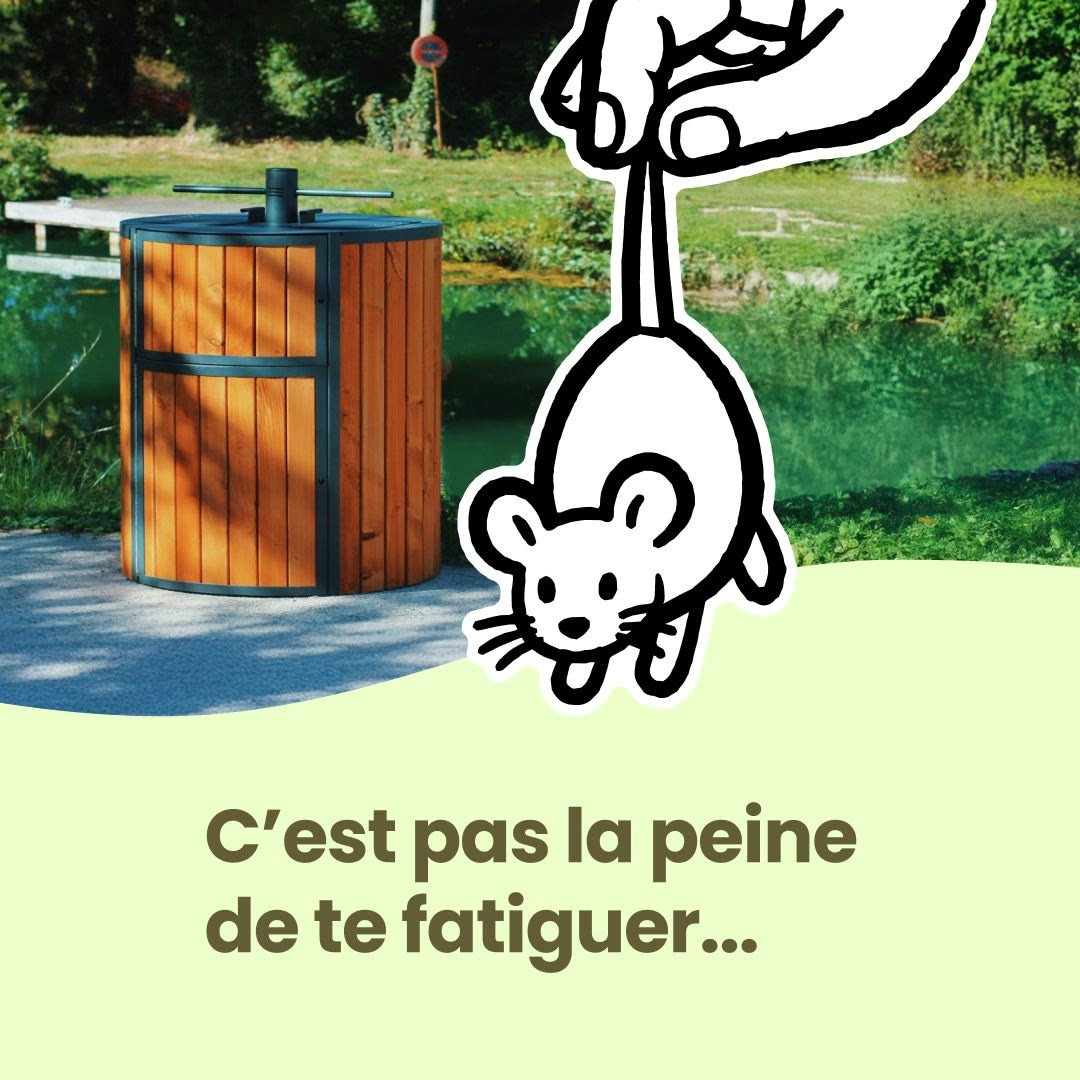
A rat does not need an opening: it makes one. Timber, however thick, and the plastics used in garden composters are within reach of its incisors, and a single weak point is enough.
The vessel of the ABC composter is 2 mm steel, galvanised and then powder-coated in our own workshop in France. The base is closed, which rules out any way in from underneath; the lid is solid; the composter stands on a hard surface, tarmac, concrete, a slab or compacted hardcore. It is that combination that counts: a rodent that can neither gnaw through nor dig under has no route left. Some finishes carry an outer skin cut with decorative openings: that is cladding, and the closed vessel sits behind it.
| Vessel material | Usual thickness | Resistance to incisors | Weak point in practice |
|---|---|---|---|
| Recycled plastic, HDPE | 3 to 6 mm | Gnawed through | Corners and hinges, embrittled by UV |
| Solid timber or boards | 18 to 27 mm | Gnawed through | Gaps between boards, rot at the foot |
| Wire mesh or welded mesh | 2 to 3 mm wire | Variable | Young rodents get through the mesh, and it is no barrier to odour |
| Open masonry bay | Variable | Not applicable | No lid at all, direct access from above |
| Galvanised and powder-coated steel (ABC) | 2 mm | Not gnawed through | Assumes a hard standing and a lid that is closed again |
The full reasoning is set out in rodent-proof composters: how to block rats, and the comparison of materials in steel, wood or plastic: which to choose. The range data sheets are on our composters.
Where to site the composter: the checklist
Half the odour and neighbour problems are settled before delivery, when the location is chosen. Here is the list we go through with you before the machine ships; it can be checked against a site plan.
- A hard, level surface: tarmac, concrete, a slab or compacted hardcore, never bare soil or grass.
- Access that does not cross a production area, a clean kitchen or a reception hall.
- Less than a minute's walk from where the caddies are gathered: any further and the routine breaks down.
- A sensible distance from opening windows, dining terraces and fresh-air intakes.
- Shade or partial shade where possible, to limit drying out in summer.
- The bulking agent bin right beside it and in plain sight, never in a store at the far end of the site.
- Vehicle access for delivery and for removals, with no kerb in the way.
- No corner nearby where a bag could be dropped and forgotten.
- Signage in plain sight, both where waste is tipped and at the internal collection point.
The constraints change with the setting: a hotel courtyard, a logistics dock, the forecourt of a head office, the bin store of a healthcare site. See hotels and hospitality, healthcare and care homes and offices and workplaces. On sites where landscaping matters, the garden composter, a 2,000 L circular planter, does the same job with a very different visual presence.
The operating routine
A well-designed composter that is badly run will end up smelling. The rent of 79 € excl. VAT a month is therefore not just the equipment: it covers the composter delivered, the bulking agent, the maintenance and the training of your teams by video call, and the composter can be bought as well. Reporting on the kilos actually composted comes when the material is taken away, by whoever you contract for that locally. Commissioning covers the siting, the signage, the caddies and one session with the teams, after which a lead person is named on site.
The rest comes down to three moments, and that is all a site has to remember:
- At every drop-off: empty the caddy, cover with a dose of bulking agent, turn the handle for a few seconds, close the lid.
- Every week: a glance at the level in the bulking agent bin and a check that no bag or pile has been left on the ground around the composter. Those are the two drifts that come before an odour or a rodent visit.
- At every service check: someone goes over the mechanism, the moisture and the look of the mass, and tops up the bulking agent. That is when a drift is caught before it becomes a nuisance.
Who does what is set out in commercial composter maintenance, and what belongs in the machine, which is the instruction hardest to hold over time, in what goes into a commercial composter.
After a few months the transformed material is taken away. It is neither mature nor standard-compliant at that stage: it still has to be sanitised and matured before it can go to land, and in the European Union the finished product falls under Regulation (EU) 2019/1009 on fertilising products, with national analysis requirements on top. Outside France that downstream stage is yours to arrange: a licensed composting site, a green-waste platform or a farm, under contract to you. What you buy from us is the composter on its own; how what leaves the site is handled is set out on organising local collection, and what the material can be used for in what to do with the compost you produce. The sequence is on how it works.
When on-site composting is no longer enough
Overloading is the fourth cause of odour, and the only one no single action corrects: it is corrected by sizing. An ABC composter absorbs up to 1,500 kg of food waste a year; above that you add a second composter; above 3,000 kg a year, on-site composting is no longer the right answer. Nor is the number of emptying operations a matter of choice: it follows from the volumes produced, on a banded schedule.
The maths
- Food waste weighed over 10 service days 5.4 kg/day
- Service days a year 250
- Annual volumes 1,350 kg
- Composters needed (1,500 kg each) 1
- Emptying operations these volumes call for (first band covering 1,350 kg: 1,500) 12 a year
- Rent of the composter, everything included 79 € excl. VAT/month
- Collection, 12 visits at 10 €, French benchmark 120 € excl. VAT/month
Monthly rent199 € excl. VAT
Two things to watch. The schedule is banded: the band that applies is the first one whose ceiling covers your volumes. A site producing 500 kg a year falls in the 625 kg band, so 3 emptying operations; a site at 750 kg, 4. Then, above 1,500 kg, everything doubles: 2,000 kg a year calls for 2 composters, falls in the 2,250 kg band of the two-composter schedule, and comes to 9 emptying operations. To establish your own volumes, see sizing a composter to your volumes.
The legal framework
Separating food waste at source is a legal duty on businesses, and where that duty comes from depends on where you are. In the European Union it is Article 22 of the Waste Framework Directive 2008/98/EC, which set 31 December 2023 for separate collection or recycling at source and applies with no tonnage threshold once transposed; Ireland falls under that framework. The United Kingdom sits outside the directive and runs four regimes: Simpler Recycling in England, the Waste (Scotland) Regulations 2012, Workplace Recycling in Wales since 2024, and its own rules in Northern Ireland. Recycling at source is one of the two routes on offer, and the ABC composter takes it: it treats the food waste on the site that produces it, removes 65% of the mass and turns fifty-two collections a year into a handful, without electricity and without any connection.
Two things follow from that. First, no regime prescribes a technology: none of them names a composter, and none of them rules one out. What they require is that food waste is genuinely kept out of residual waste and recovered, and that you can show it, an on-site composter with a weighing log does both. Second, penalties are national: the amounts, the enforcing body and the appeal route are set by each regime, and a figure published for one country says nothing about another. Ask your local authority or environment regulator what applies to your site.
Common questions
Does a composter at work smell?
No, as long as the mass stays oxygenated and every drop-off is covered with bulking agent. The odour appears when oxygen runs short: fermentation turns anaerobic and produces hydrogen sulphide and ammonia. On the ABC composter the aeration chimney keeps the draught going and mixing by hand breaks up the compaction at the moment of tipping.
Can rats get into a commercial composter?
Not into a 2 mm steel vessel with a closed base, standing on a hard surface and shut again after every drop-off: there is no material to gnaw through and no ground to dig. The real risk comes from what is left beside it, bags on the ground or caddies left open, and from inputs that do not belong, such as meat or fish.
Do you need electricity or drainage to avoid odours?
No. The ABC composter plugs into nothing: no electricity, no water, no drainage, no groundworks. Air circulation relies on the aeration chimney and on the draught created by the heat of breakdown, and the mixing is done by hand. The solutions that do need a connection are electromechanical composters, which are powered dehydrators.
What should you do if the composter starts to smell?
Open it, mix, add a double dose of bulking agent and stop feeding it for 48 hours. If the smell persists, it comes from excess moisture or from overloading: check how much bulking agent is actually available on site, then compare your real volumes with the capacity of 1,500 kg a year per composter.
Can a composter be installed near a terrace or an entrance?
Yes, provided you keep a sensible distance from opening windows, dining terraces and fresh-air intakes, and stand the composter on a hard, accessible surface. Hotel courtyards and head-office forecourts are among the settings where it works, once the location has been checked against the siting checklist above.
Where to start
Three things, in this order. Weigh your food waste over ten operating days to get real volumes rather than an estimate. Identify a location that ticks the points on the checklist, hard surface and short walk first. Then check that your volumes stay under 1,500 kg a year per composter, or under 3,000 kg with two units.
With that figure in hand, the sizing tool gives you the number of composters and how often each will need emptying, on the schedule used in the calculation above. Where we deliver is set out on where we deliver, and the questions operations teams ask are in We also recycle your cigarette buttsthe FAQ.
A free assessment, a quote within 24 h
Thirty minutes on a video call to go over the food waste separation duty that applies where you operate, size the solution and estimate your savings.
