
Resource
Composting on university and business school campuses
The main refectory produces more food waste than on-site composting can take; the cafés and office buildings do not. Sizing table by point of use, thresholds in kg and the number of composters each one needs.
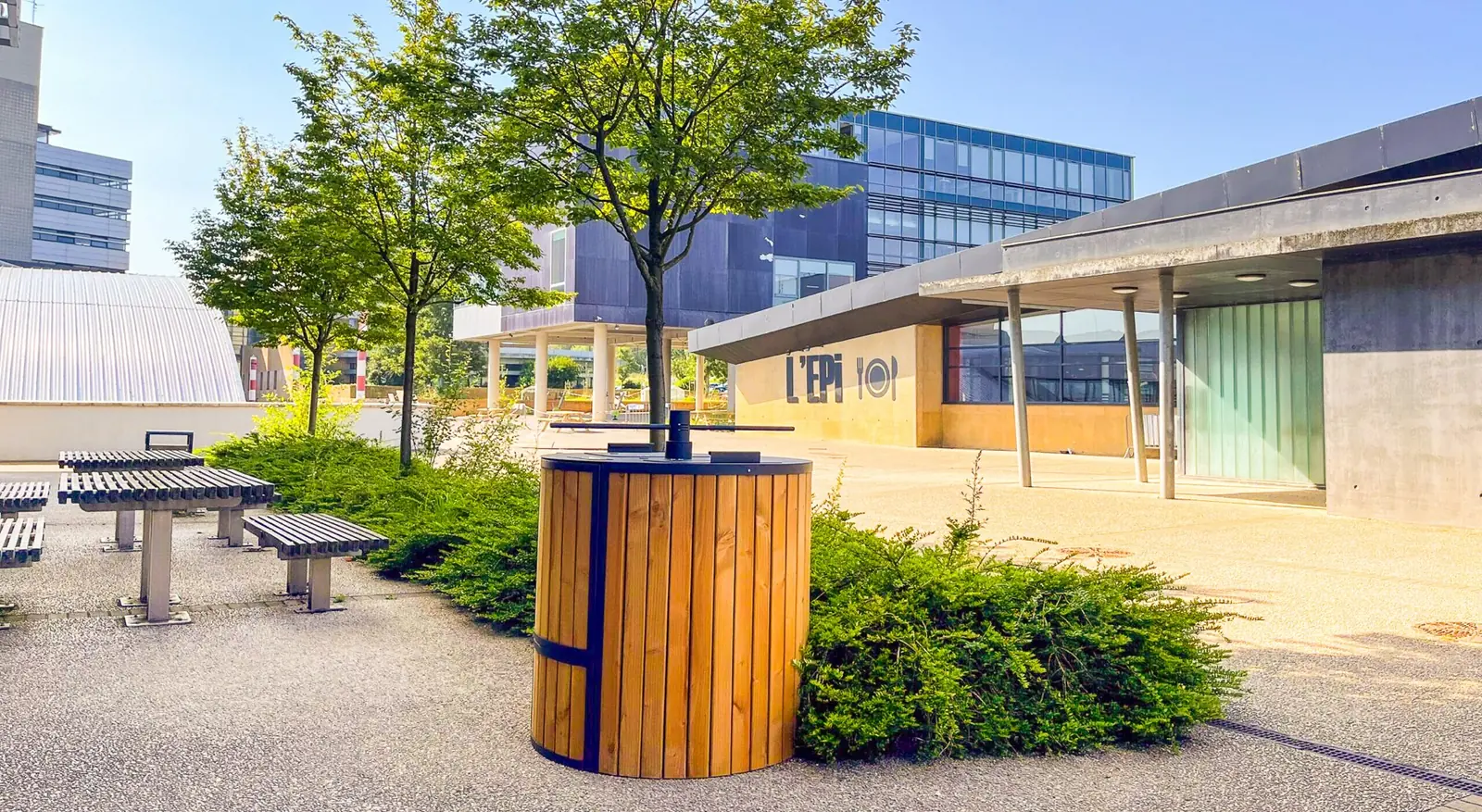
On a campus the question is not "can we compost?" but "compost what, and where?". The main refectory produces several tonnes of food waste a year: that is beyond on-site composting and belongs with a separate collection contract. The cafés, the coffee points and the administrative buildings stay under the 3,000 kg a year that two composters absorb, and most often under the 1,500 kg of a single one. A campus is therefore handled point of use by point of use. Here are the ratios, the sizing table building by building, and the regulatory picture.
Key takeaways
Volumes decide, not the space available. One ABC composter absorbs 1,500 kg a year, two absorb 3,000. That limit draws a clear line between the main refectory, which stays on a collection contract, and every other point of use on the campus.
One composter per building, not one composter for the campus. Each unit is sized for the building it serves and can be bought or rented over 48 months; removal of the finished material is arranged locally, composter by composter.
What a campus actually produces
Three ratios are enough, and they are the ones this site already publishes: 0.075 kg of food waste per meal served in a refectory, 0.050 kg per transaction in a café or takeaway counter, 0.015 kg per person per day in an office building, increased by 50% as soon as there is a coffee point. The detail is set out in the guide to sizing a composter.
A fourth coefficient changes everything and is almost always forgotten: the capture rate. Part of the theoretical volume never reaches the composter, because some diners eat off site and because separation is never perfect. We use 70%: sizing on the theoretical figure means installing one composter too many.
That leaves the specifically academic factor, the calendar. A university refectory opens for roughly 150 days a year against 220 for an office site: for the same number of covers, a campus produces a third less. Administrative buildings stay on 220 days, since staff do not follow the teaching calendar. The thresholds per cover are set out on the contract catering page.
Why the main refectory falls outside the scope
A university refectory serving 1,400 covers a day over 150 days produces 15,750 kg in theory, or 11,025 kg captured. Two composters absorb 3,000: this one building would need seven or eight, and no amount of stacked equipment makes that a sensible answer. Over 150 days of service the tipping point falls to 190 covers a day with one composter and 380 with two: that keeps the smallest business school refectories within scope and puts almost every university refectory outside it. Those volumes belong with a separate collection, an argument set out in the comparison of anaerobic digestion or on-site composting.
The reverse is just as true, and that is where the badly handled volumes sit. Cafés, library coffee points and the break rooms of research buildings currently escape any separation scheme: too small to justify a dedicated round, too scattered to be centralised. Those are the ones on-site composting solves.
Which points of use to equip, building by building
The table applies the ratios and the 70% capture rate to each type of point of use found on a campus. No commercial rounding: these are the figures the sizing calculation returns.
| Point of use | Assumption | Volumes captured | Composters | Collections a year | Monthly, excl. VAT |
|---|---|---|---|---|---|
| University refectory | 1,400 covers a day | 11,025 kg | outside the scope of on-site composting | ||
| Business school refectory | 400 covers a day | 3,150 kg | outside the scope of on-site composting | ||
| Large café | 400 transactions a day | 2,100 kg | 2 | 9 | 338 € |
| Main café | 250 transactions a day | 1,313 kg | 1 | 12 | 199 € |
| Administrative building | 300 people, coffee point | 1,040 kg | 1 | 9 | 169 € |
| Café in a building | 125 transactions a day | 656 kg | 1 | 4 | 119 € |
| Faculty or laboratory | 150 people, coffee point | 520 kg | 1 | 3 | 109 € |
| Library coffee point | 60 transactions a day | 315 kg | 1 | 2 | 99 € |
The number of composters does not rise smoothly with volumes: between 656 and 1,040 kg captured a single unit is still enough, but the emptying rhythm changes. How often the finished material leaves the site depends on the contractor you appoint locally: arranging collection is a decision separate from buying the machine, and a site that handles removal itself simply takes the composter on its own.
Worked example: a university of 15,000 students
A public university with 15,000 students: a main refectory serving 1,400 covers a day, four cafés spread across the campus, and three administrative and research buildings of 200 people each with a coffee point.
The maths
- University refectory, 1,400 covers over 150 days 11,025 kg captured, outside the scope
- 4 cafés, 125 transactions a day each 656 kg captured each
- 3 office buildings, 200 people and a coffee point 693 kg captured each
- Composters required 7, one per point of use
- Monthly per composter 79 €, plus 40 € of collection in France
Total treated on site4,704 kg a year
Those seven composters treat 4,704 of the 15,729 kg in the worked example on site, close to 30% of the total volume: the dispersed share, the part too diffuse to justify a dedicated round and which on most campuses still goes out with general waste. The 11 tonnes from the main refectory stay on a collection contract. On-site composting does not replace that collection, it covers what the collection never covered.
A rule of method: do not share one composter between two distant buildings to save the cost of a second unit. A caddy that forces a cleaner to cross the campus ends up in the first bin they pass. The practical rule fits in one sentence: the composter goes on the waste route the building already uses, with no detour to ask of anyone.
What the law requires of an education provider
Separate treatment of food waste is now a legal requirement across the British Isles, but there is no single text. In England, Simpler Recycling requires workplaces to arrange separate collection of their food waste, with the duty applying to organisations of 10 or more full-time equivalent staff from 31 March 2025 and to the smallest employers from 31 March 2027. Scotland has required businesses to separate food waste since the Waste (Scotland) Regulations 2012, Wales since the Workplace Recycling rules of April 2024, and Northern Ireland under its own food waste regulations. Ireland sits inside the EU framework, where Article 22 of Directive 2008/98/EC has required separate collection or recycling at source since 31 December 2023.
The duty bears on an act, not on a tonnage: a coffee point producing 300 kg a year is caught in the same way as the main refectory. That is what makes fine-grained coverage of a campus legally relevant, and not merely virtuous. Recycling at source is one of the two routes on offer, and an on-site composter is how a campus takes it for the volumes it can absorb. Which regime applies depends on where the campus is:
- England: Simpler Recycling, with the Environment Agency as regulator. Workplaces must arrange separate collection of food waste, phased in by employer size.
- Scotland, Wales and Northern Ireland: the Waste (Scotland) Regulations 2012, the Workplace Recycling rules of April 2024 and Northern Ireland's own food waste regulations, each with its own regulator and its own thresholds.
- Ireland and the rest of the EU: Article 22 of the Waste Framework Directive 2008/98/EC, in force since 31 December 2023, as transposed into each country's national law.
What an inspector asks for is not an invoice but evidence of where the material went. Keep a simple log: the dates the composter was emptied, the quantities, and the name of the contractor or the site that took the finished material. Ask your regulator what form of evidence it expects before you need it, rather than after. The same reasoning applies across public institutions, set out on the public sector and education page.
Buying, procurement and the rollout calendar
One point often comes up with procurement teams: the composter can be taken either way, bought or rented over 48 months at 79 € excl. VAT a month, the rent covering the composter delivered, the bulking agent, the maintenance and the awareness work. It is delivered to the site on a pallet; your own team puts it in place on an existing hard surface, and the handover training is done by video call. Bought, it is a capital purchase with a defined delivery date; rented, the term of 48 months sits comfortably inside a four-year framework agreement and the spend stays in the operating budget, with nothing to capitalise and nothing to depreciate. The rollout then follows the academic calendar: delivery in July or August, campaign timed for the first week of term. The sequence is described on how it works, and the countries we deliver to on the where we deliver page.
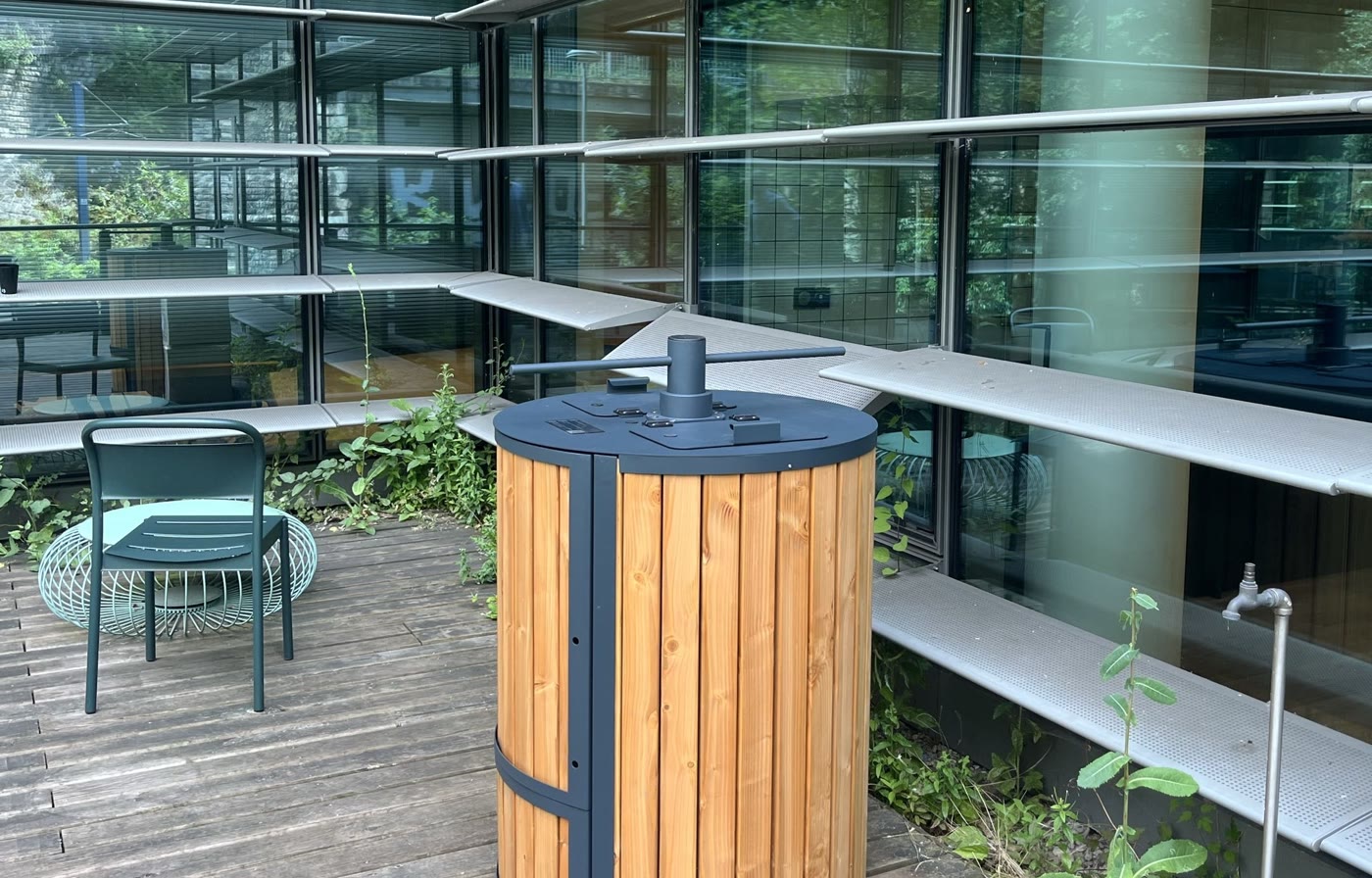
Another point that weighs in an estates file: the ABC composter does not plug in. A 2 mm steel body, 450 L, designed and built in our workshop in France, a perforated aeration chimney and mechanical mixing turned by hand. No electricity, no water, no drainage, no groundworks: an existing hard surface is enough. Close to a listed building, on the other hand, consent may be needed for the external appearance: what is then discussed is the cladding, and the finishes in the composter range are chosen accordingly.
Student engagement, without relying on it
The usual reflex is to hand separation over to student societies. It makes a good campaign and a bad chain of responsibility: a cohort stays three to five years, a society committee one, and the scheme loses its operational memory every autumn. It has to rest on permanent staff, catering, cleaning and estates teams, who will still be there in five years.
That gives students the right role, which is amplification. A start-of-term campaign run by a sustainability society reaches in one week what an internal memo never will, and an institution's environmental record now weighs in the choice of a university. On the ground, three rules hold the discipline: one closed caddy per point of production, written into the cleaning schedule; signage that leads with pictograms rather than words, for staff and international students alike; and a reminder timed to the start of term rather than to an administrative date. The wider institutional picture is on the public sector and education page.
Where the material from the composter goes
One idea comes up in almost every campus project: spreading the compost on the lawns and the teaching gardens. It needs correcting. What comes out of the composter after a few months is not a mature, standard-compliant compost: it is a stabilised material that still has to be finished elsewhere. It is emptied into your bins and taken by the contractor or the composting site you have appointed locally, which completes the process and can tell you where the material ends up. For a campus, that final destination is worth more than spreading it internally: it is traceable and it stands up in a report.
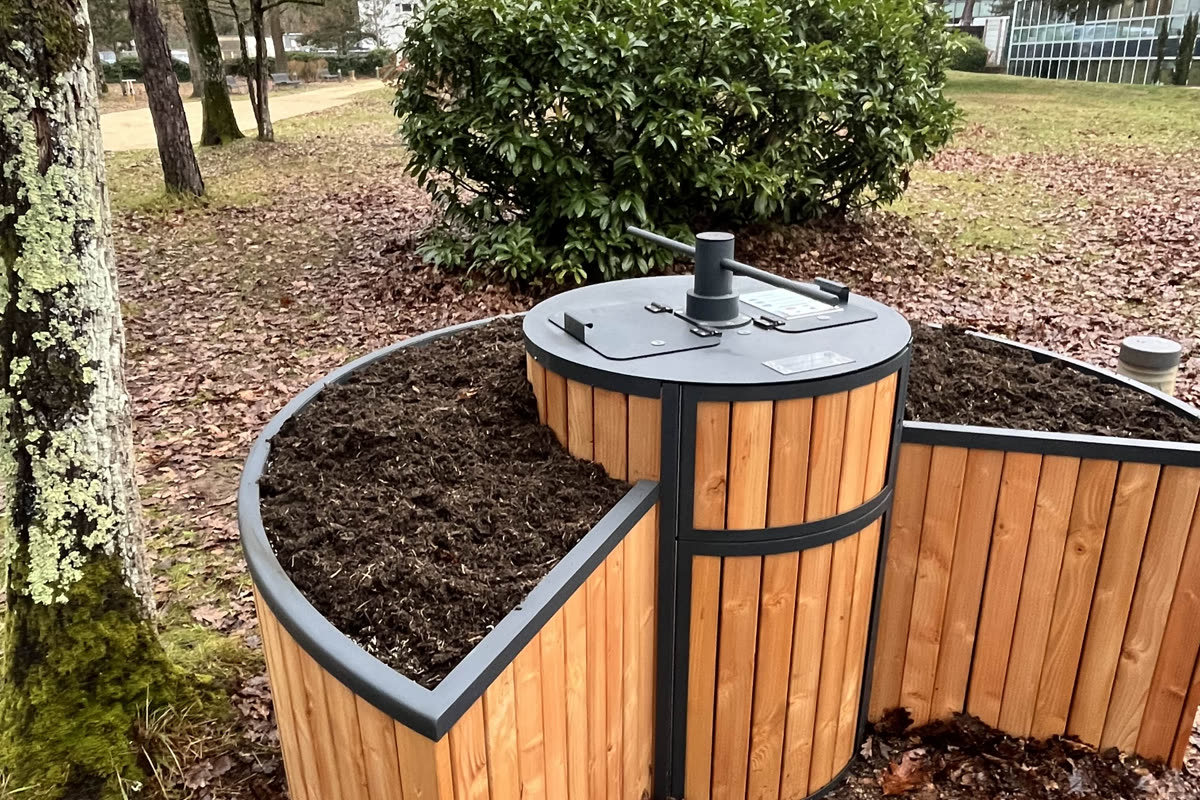
If the aim really is to green a space on the campus, the right object is not the composter but the garden composter, a circular 2,000 L planter that composts in the centre and is planted around the rim. It holds its place on a forecourt, in front of a hall of residence or along a path. Other public institutions follow the same logic, set out on the public sector and education page.
The checklist before you start
- List the points of production one by one: a campus is counted in points of use, not in enrolled students.
- Take out of scope any point above 1,500 kg captured a year, or 3,000 with two composters.
- Use 150 opening days for student catering and 220 for administrative buildings.
- Check every siting for a hard surface and vehicle access: no services, no connection, no groundworks.
- Put the composter on the waste route the building already uses.
- Name a lead among the permanent staff and write the caddies into the cleaning schedule.
- Time delivery for July or August and the campaign for the first week of term.
- Keep an emptying log from the first month: dates, quantities and where the material went. It is the evidence an inspector will ask for.
Common questions
Can a campus compost all of its food waste on site?
No. The main refectory alone produces several tonnes a year, well above the 3,000 kg that two composters absorb. The cafés, the coffee points and the office buildings almost always fall within scope. A campus is handled stream by stream, not as a block.
How many composters does a university of 15,000 students need?
Seven in the worked example above: four cafés and three office buildings, treating 4,704 kg a year between them. The main refectory stays on a separate collection contract.
Do you need an environmental permit to compost on a campus?
Permitting thresholds are set nationally, but the scale here is very small: a composter that absorbs 1,500 kg a year treats about 4 kg a day, and even seven of them stay far below the volumes at which composting is regulated as a waste treatment facility. In most regimes, composting at the place where the waste is produced falls under a registered exemption rather than a full permit. Your environmental regulator confirms the position for your own site.
Can the compost be spread on the campus grounds?
What comes out of the composter after a few months is not a mature, standard-compliant compost. It is emptied into your bins and taken by the contractor or the composting site you have appointed locally, which finishes the process. To green a space on the campus, it is the garden composter, a circular 2,000 L planter, that plays that role.
What happens if an institution does not separate its food waste?
Enforcement sits with the regulator for the nation concerned: the Environment Agency in England, SEPA in Scotland, Natural Resources Wales, the NIEA in Northern Ireland, and local authorities in Ireland. Powers run from a compliance notice to a financial penalty, and the levels differ from one regime to the next. Ask your regulator what applies to your site rather than relying on a figure quoted for another country.
How do you hold the discipline when cohorts turn over?
By resting the scheme on permanent staff rather than on students. Catering, cleaning and estates staff stay; cohorts move on. Students are an excellent campaign relay, they are not a chain of responsibility.
Where to start
In order: the list of points of use, the volumes of each, then the sizing. Take the largest point of use outside the main refectory, a café for example, and run it through the online sizing tool. It applies the ratio and the capture rate to your volumes and returns the number of composters, with no sign-up. Repeat point by point: the sum is your rollout plan. A university that has already done it is covered in the University of Lille campus case study, and the common questions in the We also recycle your cigarette buttsFAQ.
A free assessment, a quote within 24 h
Thirty minutes on a video call to go over the food waste separation duty that applies where you operate, size the solution and estimate your savings.
