A pilot project born of a request from the students, sorting problems at launch, and a communication campaign that cleared them. What the university gets out of it, and what it teaches any campus.
Photo credit: Maurice De Meulaere, UFR3S Communications Department.
The University of Lille has embarked on an Energy Transition Plan that includes reducing its carbon footprint, in particular through its waste. Easy to Compost is supporting the UFR3S campus in a pilot project to compost food waste.
food waste from students and staff fall under what is called ‘hospitality’ waste, part of which is bound for incineration. Diverting them into composting means that much material no longer burns.
The composter at the teaching hub was installed at the request of the campus students. The project did not come down from a management team, it came up from the ground.
Julien Thévenet, a biology engineer in unit 1190 ‘Translational Research on Diabetes’, runs the project within the Medicine department. A sorting scheme with no named owner stays an intention.
In France, since 1 January 2024, separation at source of food waste has applied to every producer, with no tonnage threshold. A higher education institution is covered on the same footing as a shop.
Composting therefore answers two objectives at once: the carbon footprint written into the university's plan, and the French obligation to separate at source. Our approach for local authorities and education →
With the composters, we are reducing the share of so-called ‘hospitality’ waste that goes to incineration. The aim is to extend the scheme to the whole campus.
The first weeks revealed sorting problems. A composter in open access receives whatever users put in it: without visible, repeated instructions, mistakes come quickly.
Equipment alone does not produce good sorting.
Posters on site, a newsletter, communication through the student societies. Three channels run together, because a university community is made up of groups that do not read the same media.
Three channels, not a single message on delivery day.
The campaign brought the composters into proper use. As a reward, the compost produced will be used in the campus beds, and may even be given away.
Proper use is earned, not assumed.
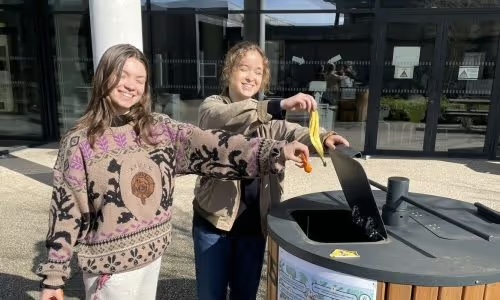
Photo credit: Maurice De Meulaere, UFR3S Communications Department.
That is the main lesson of this rollout, and the project owner puts it bluntly. The composter is the easy part. What decides the outcome is what happens around it.
The use of the composters is now understood, getting to grips with it is simple. For guaranteed effectiveness, communication is inseparable from buying the composter
The scheme rests on a named contact on the staff side. That is decisive in higher education: cohorts turn over every year, staff do not. That is where the scheme's memory lives.
The student societies acted as a distribution channel, and volunteer students take part in the composting activity. An instruction carried by peers travels better than a poster on its own.
Posters, newsletter, societies: communication was not a launch, it became maintenance. On a site where part of the population changes every year, that is what holds sorting quality over time.
We have drawn a general method from it, valid well beyond a university: getting teams on board with sorting food waste → · what the under-25s expect from an organisation →
In France, since 1 January 2024, the law has required separation at source of food waste from every producer, public and private alike, with no tonnage threshold at all. A university is therefore covered on the same footing as a town-centre shop.
The campus is in France, where failing to sort food waste carries a fine, an administrative penalty and, in the most serious cases, a criminal one. Those figures belong to French law and do not carry across a border. In the European Union the duty itself comes from Article 22 of the Waste Framework Directive 2008/98/EC, which since 31 December 2023 has required food waste to be either collected separately or recycled at source; the United Kingdom sits outside the directive and runs four regimes of its own, each with its own enforcing body and its own penalties.
No piece of equipment puts an institution in order on its own. Compliance is decided in the daily sorting, which is exactly where the UFR3S campus put its effort after launch.
What the rules say, in detailA closed 2 mm steel vessel, 450 litres, about 1 m² of floor space, built in our workshop in northern France. In France it was delivered assembled and set down close to the buildings. It does not plug in: no electricity, no water, no civil works, and therefore no intervention on the university estate.
Posters on site, a newsletter, relays through the student societies. This is the step the UFR3S campus points to as decisive, and the one that was reinforced after the difficulties at launch.
The scraps go straight into the composters installed close to the buildings. No detour through a bin store, no walk across the campus: that is what makes the habit sustainable.
A measure of bulking material balances the moisture of the scraps, and the mixing auger is worked by hand with a crank. The aeration chimney does the rest on its own, by natural draught and continuously.
It is shovelled out into a bucket at the foot of the composter, and goes back into the campus beds and around the fruit trees. A named contact and volunteer students take care of this step.
How it works, step by step → · The ABC composter datasheet →
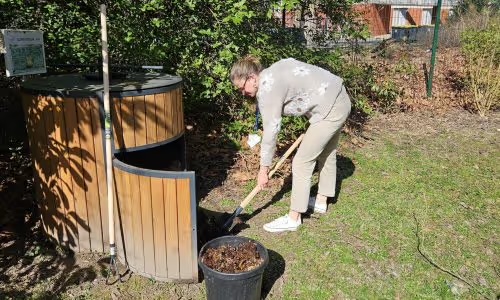
Photo credit: Maurice De Meulaere, UFR3S Communications Department.
The compost made from the food waste enriches the soil of the new green spaces laid out on campus and feeds the fruit trees. The loop is as short as it can be: the material never leaves the site.
It takes no work, and seeing the life in the compost confirmed that we had made the right choice
The compost enriches the soil of the new green spaces laid out on campus and feeds the fruit trees. It may also be given away.
A named contact among the staff and volunteer students take part in this composting activity and in community gardening projects. The composter becomes a teaching aid as much as a sorting device.
Collecting the compost was an option in our French offer, never an obligation. Since the material is used on site, it did not apply here: nothing leaves the campus, and there is no journey to count.
A composter can also be ringed with a circular 2,000 litre planter so you can plant directly around it: the garden composter → · where they are installed →
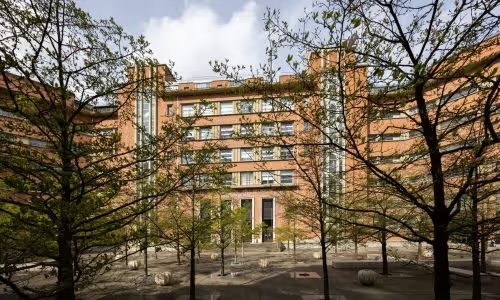
Photo credit: Maurice De Meulaere, UFR3S Communications Department.
Here is what volumes of that size come to on our current price list. The figures come out of the calculator, exactly as your online quote does.
800 of 1,500 kg of annual capacity used
Volumes of that size therefore fit into a single composter, with room to spare. The UFR3S campus has several, spread out near the buildings: on a campus, the sizing criterion is not the total tonnage, it is the number of points where the scraps arise.
Total79 € excl. VAT/month
Rental, 48-month commitment. The full sum: 79 € × 12 = 948 € excl. VAT over the year, for 800 kg sorted, that is about 1.19 € excl. VAT per kilo diverted from incineration.
Optional If the compost had to leave the site, our French price list would put volumes of 800 kg at between 4 and 6 visits a year, at 10 € excl. VAT per annual visit, that is +40 to +60 € excl. VAT a month, and a total of 119 to 139 € excl. VAT. That is not the case here.
Price up my own campusThe full sizing method, volume ratios and thresholds included: sizing your composter → · calculating your volumes →
The scheme described here is a pilot project, run within the Medicine department. Extending it to the whole campus is an objective stated by the project owner, not an accomplished fact: we therefore do not present it as done, and we will update this page when it is.
Three things are not quantified here, because the university did not disclose them: the exact number of composters installed, the budget saving against incineration, and the number of users concerned. The only figures from this deployment are the 800 kg composted a year and the more than 140 kg of CO₂ avoided, both established by the university itself. We do not convert them into catchy equivalents: they are measurements, not arguments.
For the general method that applies to a campus, volume ratios and price list included, two reports go further: university composting in the Lille metropolitan area → and the one below.
Food waste on a campus, the full method Peazy
PeazyThe quote is produced online, price included, or by talking it through with us. The assessment is free and is held on a video call, in 30 minutes.

Smoking areas, terraces, forecourts: Easy to Change collects and recycles the cigarette butts on your site, with the same method as your food waste. We install, we collect, we report.
