
Resource
Dark kitchens and cloud kitchens: sizing food waste separation
The volumes a delivery kitchen produces, the two thresholds that decide the answer, and what the law actually requires.
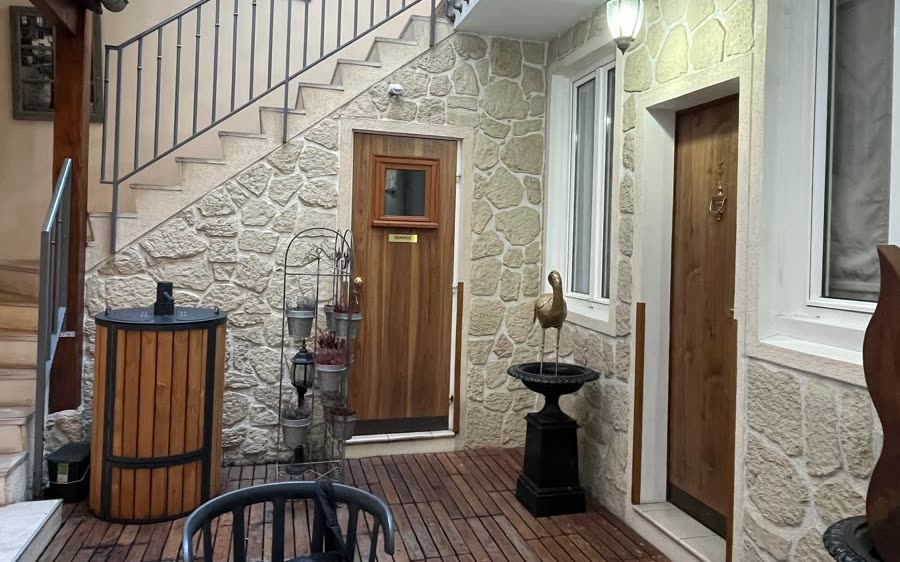
A dark kitchen produces around 0.05 kg of food waste per order, almost entirely preparation waste. Below roughly 120 orders a day, one composter on site absorbs the whole volume. Between 120 and 240 orders a day it takes two. Above that, on-site composting is no longer the right answer: those volumes need a dedicated collection.
Key takeaways
The duty does not depend on how big you are: in England, Scotland, Wales, Northern Ireland and Ireland, food waste has to be kept out of general waste and presented separately. The start dates and the thresholds differ between the five regimes, so check which one covers your unit.
Volumes can be calculated: orders a day, times operating days, times 0.05 kg, of which 70% is captured.
Two thresholds settle it: 1,500 kg a year per composter, 3,000 kg in total.
What a kitchen with no dining room changes
The dark kitchen was born with the delivery platforms: no dining room, no customers on site. It comes in three forms: the single-brand unit, the cloud kitchen running five to fifteen brands off the same line, and the hybrid kitchen of a restaurant that adds delivery.
What matters for food waste is not the number of brands, it is the absence of plate returns: in a dining room a large share of the volume comes from what the customer leaves, whereas in delivery that stream goes out with the order. What is left is peelings, trimmings and offcuts, plus prepared batches that did not sell. The volume per meal is therefore lower, but easier to capture since it arises at the production station.
The trade-off is specific to delivery, where this plant material sits permanently alongside containers, cling film and bags. That is where separation breaks down, and it is the first thing to address in the signage, with the list of what can go in a commercial composter. Fast food chains run into the same problem.
How much food waste a dark kitchen produces
The online sizing tool uses 0.05 kg of food waste per cover in quick-service catering and counts only 70% of the theoretical volume as actually captured: imperfect separation, quiet days, cancelled orders. A dark kitchen sits at the bottom of that range.
The maths
- Orders served on a normal day 100
- Operating days a year 330
- Orders over the year 33,000
- Ratio used, bottom of the quick-service range 0.05 kg per order
- Theoretical volume 1,650 kg
- Share actually captured 70%
Volume captured a year1,155 kg
| Profile | Orders a day | Days a year | Volumes captured | Answer | Monthly, excl. VAT |
|---|---|---|---|---|---|
| New single-brand dark kitchen | 60 | 300 | 630 kg | 1 composter | 119 € |
| Established single-brand dark kitchen | 100 | 330 | 1,155 kg | 1 composter | 199 € |
| Cloud kitchen, 3 brands | 200 | 350 | 2,450 kg | 2 composters | 398 € |
| Cloud kitchen, 6 brands or more | 400 | 350 | 4,900 kg | Outside the scope of on-site composting | Not applicable |
These estimates replace a hunch, not a weighing exercise: two weeks of readings, with the caddy weighed at the end of service, are worth more than any ratio (how to size a composter from your volumes).
The threshold that decides: 1,500 and 3,000 kg a year
A 450 L ABC composter absorbs up to 1,500 kg of food waste a year; beyond that you add a second; beyond 3,000 kg a year, on-site composting is no longer the right answer. The limit is not commercial but biological: the material has to sit for several months to stabilise, and an overfed composter stops composting and simply stores. Over 350 operating days that gives two markers: around 120 orders a day to stay on a single composter, around 240 to stay within the scope of on-site composting, that is 89 to 199 € excl. VAT a month with one composter and 178 to 398 € with two, French grid. Above that, the route that works is a dedicated collection to a composting site or to an anaerobic digestion plant.
What the setup involves, line by line
The composter is rented at 79 € excl. VAT a month on a 48-month commitment, and it can be bought as well: a 2 mm steel cylinder designed and built in our Picardy workshop, delivered with the training of your teams, the bulking agent supplied all year, the maintenance and the awareness kit (how it works). You put it in place yourself on a flat, stable surface. In France, collection is an option at 10 € excl. VAT a month per annual visit and per composter, from 1 to 12 visits, and the number of visits is not chosen: it follows from your volumes. Elsewhere the removal of the mature compost is arranged with a local operator of your choice.
| Annual volumes up to | Visits included, in France | Monthly, excl. VAT |
|---|---|---|
| 250 kg | 1 | 89 € |
| 450 kg | 2 | 99 € |
| 625 kg | 3 | 109 € |
| 750 kg | 4 | 119 € |
| 875 kg | 6 | 139 € |
| 1,125 kg | 9 | 169 € |
| 1,500 kg | 12 | 199 € |
With two composters everything doubles: the capacity, the bulking agent consumed and the number of times material has to leave the site. A kitchen at 2,450 kg a year sits in that bracket.
Do you need a collection at all? The composter on its own assumes you know what to do with the mature compost, and a dark kitchen in a back-of-house unit has neither garden nor beds. For a site like that, arranging removal locally is not a comfort, it is how the material leaves the premises; and because a composter is emptied a handful of times a year rather than every week, the comparison with a weekly food waste round is not close.
Fitting a composter into a back-of-house unit
The real constraint in a dark kitchen is not floor space, it is the ban on building work: these kitchens occupy leased units where drilling a slab or touching the distribution board needs the landlord's agreement.
The ABC composter does not plug in. No electricity, no water supply, no drainage, no groundworks: it stands on a flat, stable surface, and its mechanical mixing is turned by hand. That is the practical difference with electromechanical composters and electric dehydrators, which need a dedicated circuit and sometimes a drain, and therefore building work the lease often forbids.
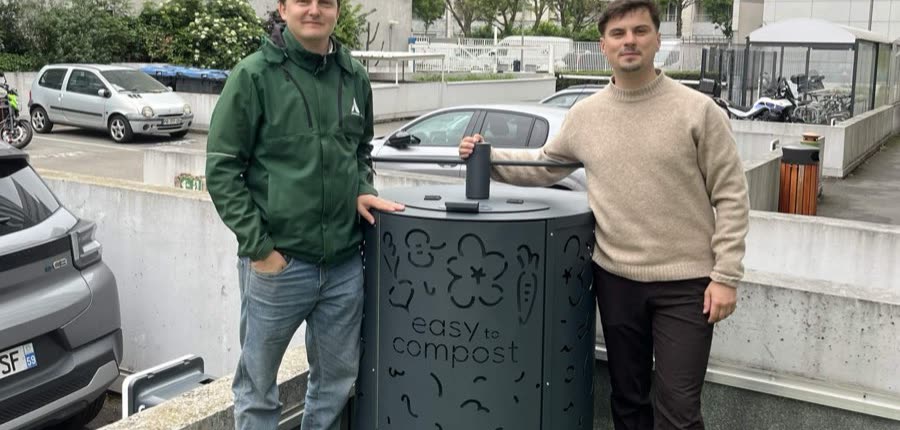
The deciding criterion is not the number of square metres but the distance between the production station and the composter, caddy full, at the height of service. These kitchens produce no garden waste, so the bulking agent that gives the compost its structure has to be stocked on site all year; without it the compost compacts, smells and attracts pests, two subjects covered in our resources on composting at work without odour or pests and on rodent-proof composters.
Several brands, one kitchen: who separates, who pays
The multi-brand case covers two legally different situations. In the first, a single operator runs several virtual brands: one legal entity, therefore one waste producer, one contract, one composter. Separation happens at the production station and not brand by brand, since the line does not know which brand the dish will leave under.
In the second, a site operator lets stations to several companies: each one remains the producer of its own food waste and will be inspected as such. The means can be shared, the duty cannot be delegated. The arrangement that holds is the one described for food waste separation in food courts: a shared composter run by the operator, a separation clause written into the house rules annexed to the occupancy agreement, and an emptying log the operator gives each occupier for its own records. In both cases turnover is high: the instruction is displayed at the station, in pictograms, and repeated with every new arrival.
What the law requires, and what it does not
Separating food waste is a legal duty, but the text that imposes it depends on where the kitchen is. In England, Simpler Recycling requires workplaces to have their food waste collected separately, the duty applying to employers of 10 or more full-time equivalent staff from 31 March 2025 and to the smallest from 31 March 2027. Scotland has required businesses to separate food waste since the Waste (Scotland) Regulations 2012, Wales since the Workplace Recycling rules of April 2024, and Northern Ireland under its own food waste regulations. In Ireland and the rest of the EU, Article 22 of Directive 2008/98/EC has required separate collection or recycling at source since 31 December 2023. A dark kitchen serving 40 orders a day is caught in the same way as a canteen serving 1,000 covers.
Enforcement follows the regime. In England it sits with the Environment Agency, in Scotland with SEPA, in Wales with Natural Resources Wales, in Northern Ireland with the NIEA, and in Ireland with the local authority. Powers run from a compliance notice through to a financial penalty, and the levels differ from one regime to the next: ask your regulator what applies to your unit rather than relying on a figure quoted for another country.
Nowhere does the law require you to compost on site: it requires food waste to be kept separate and its destination to be accounted for. Composting on site and having the waste collected are both ways of doing that; the general waste skip is not. Whether an on-site composter needs a permit is a national question: at a few kilograms a day the volumes sit far below the level at which composting is regulated as a waste treatment facility, and in most regimes composting at the place where the waste is produced falls under a registered exemption. Confirm the position with your environmental regulator.
The checklist before you sign
- Weigh the plant preparation stream for two full weeks, quiet days included.
- Place that figure against the 1,500 and 3,000 kg thresholds before any other decision.
- Find the siting before the equipment: flat, stable, in the open air, reachable without a step.
- Walk the real route from the furthest station, at peak, with a full caddy.
- Get the landlord to confirm in writing that equipment with no connection and no foundation needs no works consent.
- Deal with the packaging risk first: the instruction goes at the station, in pictograms, not on the composter.
- If the site houses several companies, write the separation clause into the house rules and set the cost-sharing key.
- Keep your own log every month: dates emptied, quantities, and where the material went.
Common questions
Is a dark kitchen really covered by the separation duty?
Yes, whatever its size. In England, Scotland, Wales, Northern Ireland and Ireland, food waste has to be kept separate from general waste. The start dates and the thresholds differ between the five regimes, but a kitchen serving 40 orders a day is treated in the same way as a canteen serving 1,000 covers. Check which regime covers your unit.
Does the composter need electricity or a water supply?
No. The ABC composter does not plug in: no electricity, no water supply, no drainage, no groundworks. It stands on a flat, stable surface and its mixing is turned by hand, which removes any need to ask the landlord for works consent.
What if the kitchen goes above 3,000 kg of food waste a year?
On-site composting is no longer the right answer: one composter absorbs up to 1,500 kg a year, two up to 3,000 kg, and beyond that the composter stores the material instead of composting it. What is needed then is a dedicated collection to a composting site.
Can a composter be shared between several brands or several operators?
Yes for the means, no for the duty. A single operator running five brands has one producer and one contract. If the site houses several companies, each one remains a producer: the composter is shared, but the separation clause has to appear in the house rules.
What does a dark kitchen have to budget for?
One or two composters, rented over 48 months at 79 € excl. VAT a month each, the bulking agent they consume through the year, and a local contract for taking the finished material away. Buying one is possible as well: talk to us and we will quote it. In France, where collection is an option at 10 € excl. VAT a month per annual visit and per composter, a site sits between 89 and 199 € excl. VAT a month with one composter, 178 to 398 € with two.
Where to start
Start with the measurement: two weeks of weighing is enough to know which side of the thresholds you sit, and that figure serves the compliance case as well as the budget. If you do not have it, the online sizing tool estimates it from your orders and your opening days and returns the number of composters, with no sign-up.
Above 3,000 kg a year, go for a dedicated collection. Below it, the next question is the siting, and it is worth settling before you order: flat, stable, in the open air, on the route the kitchen already takes to put its waste out. The countries we ship to are listed on the where we deliver page. Kitchens attached to a hotel follow the same logic as the hospitality sector.
A free assessment, a quote within 24 h
Thirty minutes on a video call to go over the food waste separation duty that applies where you operate, size the solution and estimate your savings.
