
Resource
On-site composting or anaerobic digestion: what life-cycle assessment actually shows
Life-cycle assessment: where the gap between on-site composting and anaerobic digestion really opens up, and the 7 assumptions that flip the result.
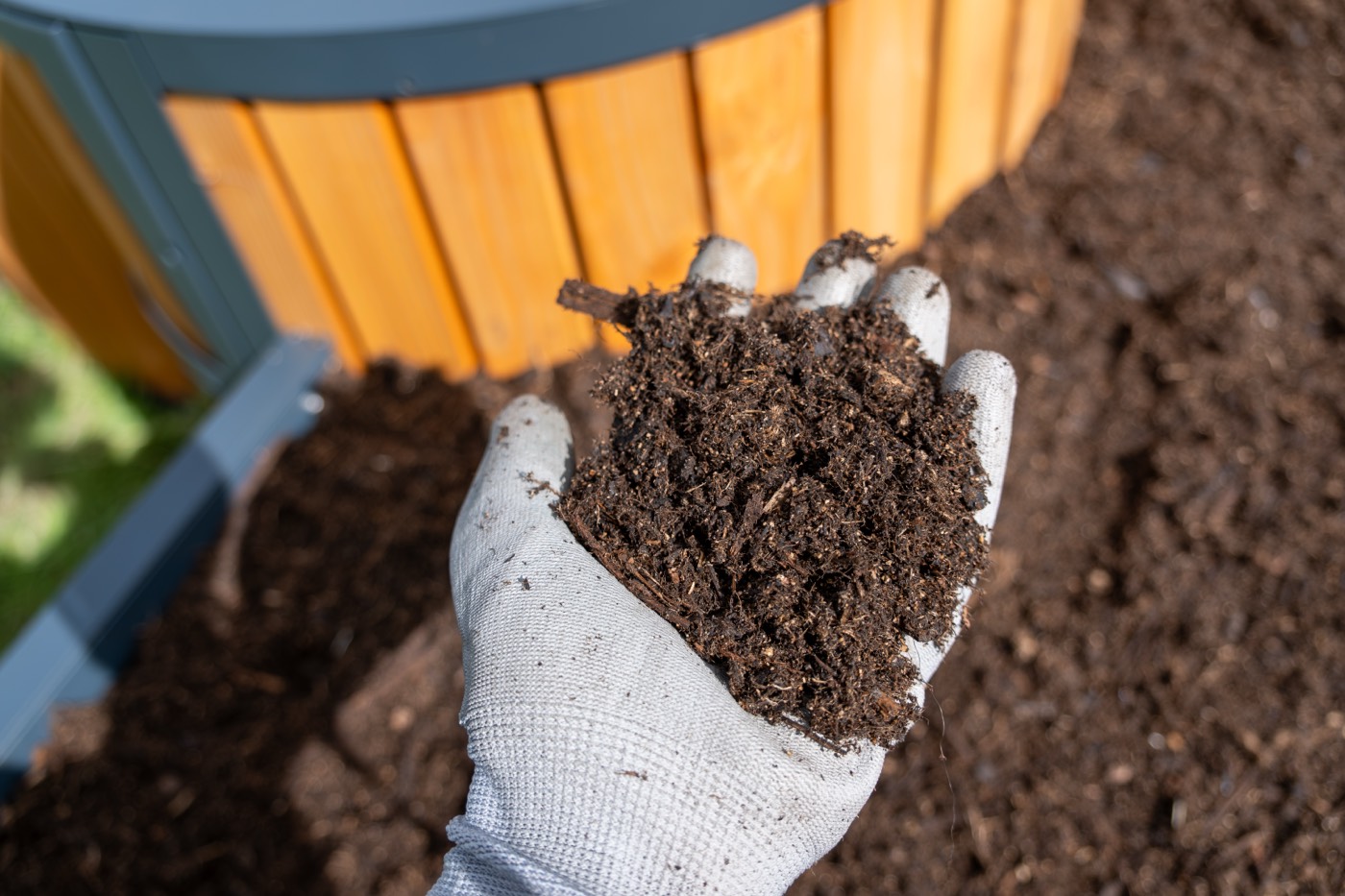
For a site producing less than three tonnes of food waste a year, composting on the premises starts with two advantages that any life-cycle inventory brings out, whichever method is used: no process energy at all, and most of the collection mileage removed. As soon as tonnages concentrate in one place, economies of scale work the other way and industrial anaerobic digestion takes the lead. This is not a contest between two technologies: it is a question of scale and distance. An LCA never says that one route is better in absolute terms; it says so for a given functional unit, a given boundary and a given set of assumptions. Here is which ones drive the result, and a calculation to redo with your own figures.
Key takeaways
The volumes your site produces drive everything else. Below 3,000 kg a year, the sizing ceiling of two composters, on-site composting avoids most of the transport and uses no process energy. Above that, industrial economies of scale take over. No LCA sets a universal threshold, however: it depends on the real distances involved.
Anaerobic digestion wins by design on one count only, energy: it alone produces biogas. That biogas still has to be genuinely used.
Three assumptions are enough to reverse a conclusion: the functional unit chosen, the distance to the final destination, and the reference electricity mix.
What an LCA measures, and what decides the result
An LCA is governed by two standards published in 2006: ISO 14040, which sets out the principles and the framework, and ISO 14044, which sets the requirements. The flows in the inventory, kilowatt-hours, kilometres, kilograms of nitrogen, cubic metres of water, are converted into indicators by a characterisation method, most often ReCiPe 2016 or the European Commission's Environmental Footprint reference, backed by a database such as the Base Empreinte published by ADEME (France). Hence a consequence often lost in meetings: an LCA is not a measurement, it is a model. Two studies of the same object can differ by a factor of two without either being wrong. ISO 14044 draws that conclusion itself and requires a third-party critical review as soon as a comparison between systems is made public.
The first lever is the functional unit, in other words the basis for comparison: typically "treating 1 tonne of catering food waste, from the sorting bin back to the soil". Replace it with "producing 1 MWh of renewable energy" and anaerobic digestion wins before the first calculation. The material adds a constraint of its own: catering food waste is mostly water, commonly 70 to 80 % of its mass, so moving a tonne means moving at least seven hundred kilos of water. Any solution that cuts the mass or the frequency of journeys starts with a mechanical advantage. You still need to know your own figure: weigh what you produce over a sample week rather than applying a theoretical ratio.
The second lever is symmetry of the boundary. On the composting side: manufacture of the equipment, transport, use, collections, maturation, spreading. The ABC composter, a 450 L enclosure in 2 mm steel built in our workshop in France, is a special case here: its use phase is nil, no electricity, no water, no drainage, no groundworks, and mixing is done by hand. That is what separates it from the electric dehydrators sold as electromechanical composters, whose consumption weighs on the inventory. On the digestion side: bins, collection, transport, digestion, biogas upgrading, digestate spreading, less two credits (energy and mineral fertiliser substitution) that a serious study sets out instead of showing only the net figure.
Item by item: where the gaps open up
Once the boundary is set, the differences are not spread evenly. Three items account for almost everything: process energy, transport, and the form in which nitrogen returns to the soil.
| Life-cycle stage | On-site composting | Industrial anaerobic digestion | What makes the difference |
|---|---|---|---|
| Manufacture of the equipment | A 450 L steel enclosure | Digesters, tanks, roadways: hundreds of tonnes of steel and concrete | Marginal on both sides, the industrial plant being amortised over an enormous tonnage |
| Process energy | None. No connection, mixing by hand | Digester heating, agitation, pumping, upgrading | Nil on one side, the main item on the other |
| Transport of the food waste | 1 to 12 collections a year, light van | 1 to 2 collections a week, heavy goods vehicle | The most decisive: frequency, vehicle size and distance all compound |
| Output | A solid pre-compost, matured and sanitised downstream | Biogas and a liquid digestate | Only anaerobic digestion produces energy |
| Return to the soil | Nitrogen released slowly, stable organic matter | Ammoniacal nitrogen, available but more volatile | Drives eutrophication, acidification and secondary particulates |
| Land take | 1 m² per composter, on ground already built on | A dedicated plant, around a hectare including manoeuvring areas | Ground already occupied against ground converted |
| Water | No consumption during the use phase | Diluting the feedstock, washing, cooling | Absent on one side, structural on the other |
This table deliberately gives no overall score: weighting between indicators is a choice, not a scientific result. The mechanisms in the last column, on the other hand, hold whichever method is used. If you keep only one line for a board meeting, take transport: it is the only one you can quantify yourself.
Transport: the calculation to redo on your own site
Two models are in play. In the first, wet food waste leaves the site as it is, every week. In the second, it is broken down on site, and what leaves is no longer the raw waste but a pre-compost from which most of the water has evaporated, only a few times a year, sanitised and matured downstream before it is spread.

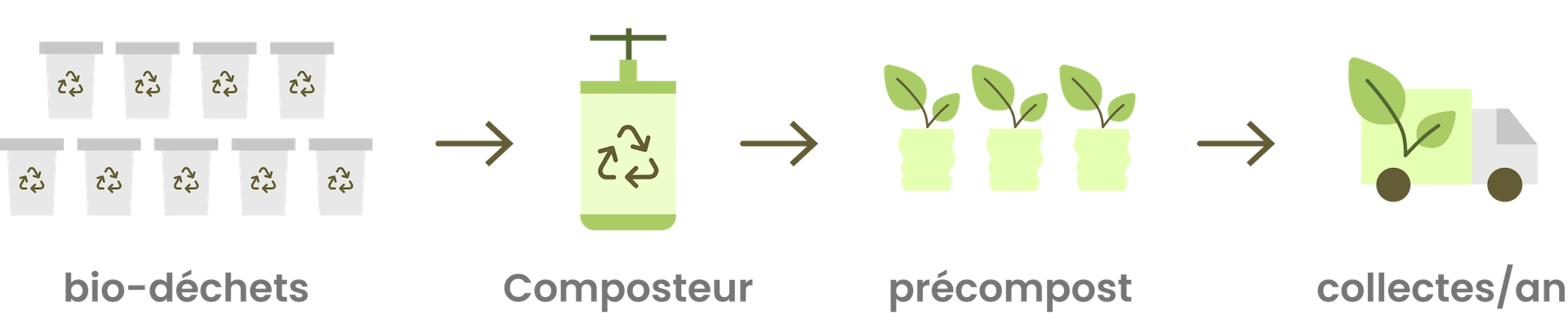
The calculation below isolates a single variable, frequency, keeping the same distance on both sides. Every assumption is stated so that you can replace it with your own.
The maths
- Volumes produced by the site, starting assumption 1,500 kg a year
- Distance from site to final destination, one way, identical in both scenarios 40 km
- Weekly collection to an anaerobic digestion plant 52 × 80 km = 4,160 km
- On-site composting, 12 collections a year 12 × 80 km = 960 km
Collection kilometres avoided over a year3,200 km, or 77 %
Three cautions before quoting that result. It counts dedicated journeys: a shared round spreads those kilometres and narrows the gap, in both scenarios. Real distances are rarely equal: if the digestion plant is 12 km away and the site receiving your pre-compost is 40, recalculate rather than copy. And do not convert those kilometres into CO2 with a single factor: a light van and a 19-tonne rigid do not have the same emission factor per kilometre, and that is precisely where LCAs diverge. The conversion is set out on our carbon footprint page, and the effect of frequency in our comparison of anaerobic digestion and on-site composting.
Energy, nitrogen, water: the three trade-offs
Energy is the only indicator anaerobic digestion wins by design: it is a net producer, whereas composting merely consumes nothing. But an energy credit only exists in a real balance sheet if the biogas is actually used. So ask for the availability rate measured over the last twelve months, maintenance shutdowns included, rather than the installed capacity: the gap between the credit claimed and the credit delivered sits between those two figures.
Nitrogen is the least understood trade-off and the most structural. Mature compost releases its own slowly, over several months, bound to a stable organic matter that also improves soil structure. Liquid digestate delivers a large share of ammoniacal nitrogen that is immediately available: an agronomic asset when spreading is synchronised with the crop's needs, a source of volatilisation and leaching when it is not. It is that release curve, and not the process itself, that explains the gap on eutrophication and acidification. It is also why the pre-compost has to be matured and sanitised before it goes back to land, and why the receiving site is worth identifying and contracting locally, in writing, rather than left to a generic destination.
Water, finally, is the item that consumer comparisons forget. Anaerobic digestion uses it to dilute the feedstock, wash the tanks and cool the cogeneration engines; on-site composting uses none. In an area under recurrent water stress, that indicator stops being anecdotal and becomes a condition of local acceptance.
The assumptions that tip an LCA
Here is the table to keep to hand. It does not say who wins: it says which assumption moves the result, and in which direction. It is the tool that lets you audit, in a meeting, any comparison put in front of you.
| Assumption | Favours on-site composting | Favours anaerobic digestion | Why |
|---|---|---|---|
| Functional unit | Treating 1 tonne of food waste | Producing 1 MWh of energy | The choice of unit names the winner before any calculation |
| Volumes produced by the site | A few hundred kilos a year | Several dozen tonnes concentrated in one place | Infrastructure and lorry load factor both obey economies of scale |
| Distance to the final destination | A spreading or maturation site close by | A plant in the immediate vicinity | Transport weighs in proportion to distance and to frequency |
| Reference electricity mix | A low-carbon mix, as in France | A carbon-intensive mix | The biogas credit is worth exactly what the energy it displaces is worth |
| Use made of the biogas | Measured availability rate | Theoretical rated capacity | A credit that is never realised does not exist in the real balance |
| Fertiliser substitution | Credit calculated on the carbon and organic matter returned to the soil | Credit calculated on the mineral nitrogen immediately substituted | Depending on whether the study values stored carbon or directly available nitrogen, the credit changes sides. And if the receiving farm was not fertilising in the first place, it disappears on both sides |
| Seasonality of the site | Activity spread across the year | A long seasonal closure | A shared round absorbs the quiet periods better than an idle composter |
Six questions are then enough to qualify a study. Ask them in order: as soon as one of them has no written answer in the document, what you are holding is not an LCA but a sales argument.
- Which functional unit, quoted word for word?
- Is the boundary symmetrical, manufacture of the equipment and return to the soil included?
- Which characterisation method, which database, which year?
- Which credits are deducted, and on what substitution assumption?
- Has a third-party critical review been carried out, as ISO 14044 requires?
- What becomes of the conclusion if the distance to the final destination doubles?
What the law requires, whichever route you choose
An LCA informs a choice; it creates no obligation. That comes from waste law, and it is written country by country. Across the European Union, Article 22 of the Waste Framework Directive 2008/98/EC has required food waste to be collected separately or recycled at source since 31 December 2023, each member state transposing it in its own way: that is the framework that applies in Ireland. The United Kingdom sits outside the directive and runs four distinct regimes, Simpler Recycling in England, the Waste (Scotland) Regulations 2012, Workplace Recycling in Wales since 2024, and a separate regime in Northern Ireland. None of them prescribes composting rather than anaerobic digestion: both are organic recovery, and both routes stay open. What each of them asks of your own establishment is set by the law of your country.
Penalties are set nationally. The amounts, the body that enforces them and the route of appeal differ from one regime to the next: what is a fixed penalty notice in one country is an administrative fine issued by the local authority in another. Rather than reciting figures that would not apply to your site, ask your regulator which text covers you and what it provides for. One thing holds everywhere: an inspection will never ask for your life-cycle assessment. It will ask for dated evidence of where each load of food waste went, and the annual summary of those records.
Which route for which site
The useful thresholds are physical, not regulatory. One ABC composter absorbs up to 1,500 kg a year; beyond that a second one is added, up to 3,000 kg a year. Those two figures are equipment capacities, not LCA results: above them, on-site composting can no longer be sized, and that is generally where economies of scale end up outweighing the transport advantage. To settle the question site by site, our article on anaerobic digestion or on-site composting works through the operational comparison. On the budget side, the composter is rented over a 48-month commitment, and it can be bought as well. For the 1,500 kg-a-year site used as an example above, the French grid gives 12 visits:
The matching price
- Composter delivered, bulking agent, maintenance, awareness kit and remote training 79 € excl. VAT a month
- Collection, 12 visits a year at 10 € excl. VAT per annual visit, French benchmark 120 € excl. VAT a month
Monthly total199 € excl. VAT
What happens to the compost is a separate decision, and it is taken locally: a site that spreads its own compost on its grounds needs nothing beyond the composter itself, while a site with no green space arranges removal with a local waste contractor. For a multi-site group the answer is not uniform: the large majority of premises come in under 3,000 kg a year and belong to on-site composting, while a few very concentrated sites stay on anaerobic digestion. That is the logic behind the rollout carried out with Decathlon across its network; how an installation actually unfolds is set out on the how it works page.
Common questions
Can an LCA say that one route is better than the other in absolute terms?
No. It compares two systems for a given functional unit, a given boundary and a given set of assumptions. Change the functional unit, the distance to the final destination or the reference electricity mix, and the conclusion can reverse without any calculation being wrong. That is why ISO 14044 requires a third-party critical review as soon as a comparison is made public.
Which indicators does an LCA of food waste measure?
The common methods, ReCiPe 2016 and the European Commission's Environmental Footprint reference, cover between 16 and 18 midpoint indicators: climate change, acidification, eutrophication, fine particulates, ecotoxicity, human toxicity, land occupation, water consumption and resource depletion, among others. Climate is only one of them, and it is not the one on which the two routes differ most.
Is on-site composting always more favourable than anaerobic digestion?
No. It is, for as long as the volumes stay modest and the final destination stays close, because the process consumes no energy and collection drops to a few visits a year. Above 3,000 kg a year on a single site, that is two composters at capacity, the comparison shifts ground: the industrial plant amortises its infrastructure over an enormous tonnage and its lorry travels full, and economies of scale most often outweigh the transport advantage.
Does the law require you to choose composting or anaerobic digestion?
Neither one. Waste law requires food waste to be separated at source and sent for organic recovery, in the European Union under Article 22 of Directive 2008/98/EC and in the United Kingdom under each nation's own rules. Both routes are acceptable; the choice is yours. And what an inspection asks for is not an LCA: it is dated evidence of where the waste went.
Where to start
An LCA is arguable; volumes are weighed. Start there: a week of weighing extrapolated over your opening days gives the one figure that drives everything else. Set it against the two thresholds, 1,500 and 3,000 kg a year, and you will know straight away whether on-site composting belongs in the discussion at all. If you come in below them, the sizing tool tells you in two minutes how many composters your site needs, with no sign-up. If it works out that you are above them, it says so: that is part of what it is for.
A free assessment, a quote within 24 h
Thirty minutes on a video call to go over the food waste separation duty that applies where you operate, size the solution and estimate your savings.
