
Resource
ABC composting: the technology, mechanism by mechanism
Three mechanisms, nothing to plug in. How the aeration chimney, the mixing auger and the low door work, what each of them solves, and where the machine stops.
The ABC composter comes down to three mechanisms and nothing to plug in: a perforated aeration chimney that runs the full height of the vessel and carries air to the core of the material, a crank-driven auger that buries the week's inputs in two or three turns, and a low door that pushes the composted material into a 120 L wheelie bin. No electricity, no water, no drainage, no groundworks. Here is what each mechanism solves, what it does not, and how to compare this technology with the others.
Key takeaways
ABC is three mechanisms: aeration, mixing, collection. Three years of development, and manufacturing in our own workshop in France.
Nothing to connect. Air circulates by natural draught and the mixing is done by hand. So this is not an electromechanical composter: that term covers the powered dehydrators sold alongside it.
1,500 kg a year per composter. Above that, a second one is added; above 3,000 kg a year, on-site composting is no longer the right answer.
Why ordinary composting fails in a business
A garden bin works in a garden, with someone looking after it. Moved to an office site, it fails for three reasons that compound each other. Air. Aerobic breakdown consumes oxygen continuously; when oxygen runs short, fermentation tips into anaerobic conditions and produces sulphur compounds. The smell appears, and people stop feeding the bin. Compaction. Catering food waste is mostly water: a wet mass that is never mixed compacts and the process stalls. Turning with a fork fixes that, but in a business nobody writes the task into a job description. The structure. A slatted bin standing on bare soil is an invitation to rodents, and a hygiene officer will say so.
There is a regulatory constraint on top of that. In the European Union, Article 22 of the Waste Framework Directive 2008/98/EC required food waste to be collected separately or recycled at source by 31 December 2023, and every member state has transposed it into its own law; Ireland falls under that framework. The United Kingdom sits outside the directive and runs four separate regimes: Simpler Recycling in England, the Waste (Scotland) Regulations 2012, Workplace Recycling in Wales since 2024, and its own rules in Northern Ireland. Whichever one applies to you, both routes are open and the question is no longer whether to separate food waste, but with what equipment. The ABC composter recycles at source: it treats the food waste on the site that produces it, removes 65% of the mass and runs without electricity and without any connection.
A is for aeration: the chimney that carries air to the core
Aeration governs everything else. A perforated steel chimney runs through the vessel from bottom to top: air enters at the base, rises along the chimney and spreads into the mass through the perforations, instead of merely brushing the surface of the heap. That is the difference between a composter that breathes only at the surface and a composter that breathes throughout.
What drives that circulation is the fermentation itself. In the thermophilic phase the core of the mass climbs to 45 to 65 °C: the hot, lighter air escapes at the top and draws fresh air in at the bottom. The draught stops only when the fermentation stops, and it keeps breakdown aerobic from the first day to the last, as our article on the composting cycle explains.
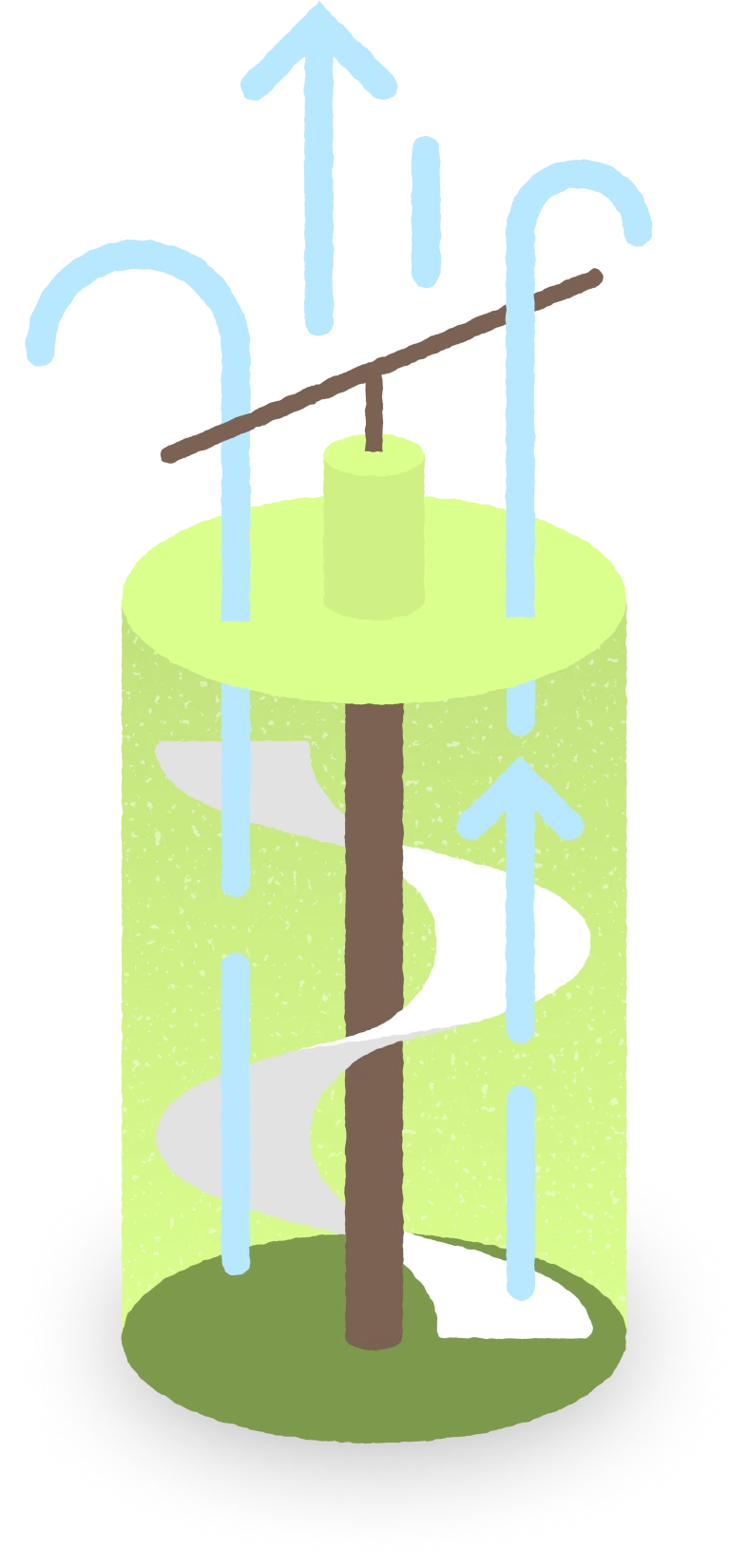
A point of vocabulary, because it changes everything in a technical file: this is not forced aeration. Forced aeration means fans, and therefore a power supply, a control cabinet, a consumption figure and servicing. Here a closed vessel and continuous aeration through the chimney are enough. That is the fundamental difference with electromechanical composters, which are usually grinder-dehydrators fed continuously. So the composter goes where it is useful, in a service yard, on a terrace or in a car park, rather than where a power supply happens to run.
B is for mixing: the crank-driven auger
Aerating is not enough if fresh inputs stay on the surface. The second mechanism is an auger housed inside the vessel and driven by a crank on the outside: two or three turns once a week, and the inputs that have built up are buried in the mass. The compost advances at the same rate everywhere, with no dead zones.
The mixing is mechanical but hand-operated: no motor, no programming, no electrical wearing parts. Allow two minutes a week. It is the only weekly task that falls to the site, and it calls for neither strength nor training, which is what separates it from a tumbler composter, where the whole loaded drum has to be turned. Add a visual check under the lid, ten minutes or so once a month. The rest is straightforward upkeep the site carries out itself, and our maintenance checklist sets out the detail.
The auger works with a second ingredient: the bulking agent, laid in a thick bed at the bottom of the vessel at start-up and topped up each time the composter is emptied. It absorbs excess moisture and supplies the carbon that balances the nitrogen in food waste. Your teams never add any day to day: they tip through the top hatch, they turn the crank, and that is it. The part-by-part detail is on the ABC composter page.
C is for collection: the low door, and what actually comes out
The third mechanism is the one nobody thinks to look at during a demonstration, and yet it is the one that decides how the machine lives day to day. You set a 120 L wheelie bin on the bin rest, open the low door, turn the crank, and the composted material is pushed into the bin: under five minutes, no tools, and a standard industry container rather than a proprietary cassette.
The second thing to know, and it is often put badly: what comes out after a few months is not a finished, standard-compliant compost, it is a pre-compost. It still has to be matured and sanitised before it can go to land. In the European Union the finished product falls under Regulation (EU) 2019/1009 on fertilising products, with national analysis requirements on top. Outside France that downstream stage is yours to arrange locally, with a licensed composting site, a green-waste platform or a farm. It is that stage, not the composter, that produces the evidence an inspection will ask for.
Third point: emptying and removal are separate from the machine. Outside France the composter is sold on its own and you contract locally for whatever leaves the site; some organisations handle removal in house, others put it out to a waste contractor. How often it goes out is not a matter of preference: it follows from the volumes produced, on the schedule set out further down, and runs from 1 to 12 times a year.
The vessel: 2 mm steel, closed base, and the pest question
Around the chimney and the screw there is a vessel, and that is what a hygiene department looks at. The M model offers 450 L of composting volume for 1,000 mm of height and 810 mm of diameter, 121 kg empty and around 330 kg loaded. The sheet is an S235 steel 2 mm thick, powder-coated in our workshop in Albert, in the Somme; the garden composter also receives a French Douglas fir cladding. The range comes in five lacquered colours, with no change to the mechanics inside.
Against rodents, what counts is not a promise but a geometry: a 2 mm steel vessel with a closed base, a solid lid, inputs through a top hatch that shuts again, never an open heap. It stands on a hard surface, a slab, tarmac or a terrace, which removes any way in from underneath. One clarification, because a photograph can mislead: some finishes carry an outer skin cut with decorative openings, and that is not the working enclosure. It is the inner vessel that is closed, not the cladding. The criteria worth checking are in our article on rodent-proof composters.
Fifteen minutes on the ground with two people, no groundworks and nothing to build: that is what makes the machine deployable in identical form across dozens of sites, as the Decathlon network case study shows. Nothing is fixed to the ground, nothing is connected, and the unit can be moved.
ABC against the other technologies
The word composter covers objects that share neither the same principle, nor the same running cost, nor the same output. The table sets the five answers you meet in a tender against each other.
| Solution | Where the air comes from | To connect | What the team has to do | What comes out | Main limitation |
|---|---|---|---|---|---|
| Garden bin, wood or plastic | Slatted walls and turning by hand | Nothing | Turning with a fork, regularly | Compost, if the routine is kept up | Compaction, odours, rodents getting in from underneath |
| Tumbler composter | Rotation of the whole drum | Nothing | Turning the loaded drum | A young compost | Effort rises with the load, limited usable volume |
| ABC composter | Perforated chimney running through the vessel, natural draught | Nothing | 2 to 3 turns of the crank a week | A pre-compost, matured and sanitised downstream | 1,500 kg a year per composter |
| Dehydrator, sold as electromechanical | Not applicable: this is not composting | Continuous mains power, often water and drainage | Loading, emptying, servicing the machine | A dried, ground material that is not compost | Power consumption and siting constraints |
| Weekly collection, no treatment on site | Not applicable | Nothing | Putting the bins out 1 to 2 times a week | Nothing on site | 52 to 104 lorry runs a year |
Two columns should be read together: to connect and what the team has to do. Nothing to connect but turning with a fork, and a technology fails on the task; no task but a dedicated power supply, and it fails on siting. The ABC trade-off is two minutes a week and nothing to connect. The comparison of tumbler, ABC and traditional bin goes into the first three rows.
What the ABC composter does not do
Volume. One composter absorbs up to 1,500 kg a year. Between 1,500 and 3,000 kg you install a second one and everything doubles, the equipment as much as the emptying. Above 3,000 kg a year on a single site, composting on the spot is no longer the right answer. Material. The composter does not transform what will not break down: large bones, shellfish in quantity, oils and liquids, so-called compostable packaging nobody can identify; the list is in our article on what goes into a commercial composter.
The output. The composter produces a pre-compost, not a compost that meets a fertilising-product standard: maturing and sanitising happen downstream. Sorting. No technology recovers from bad separation upstream: the caddy, the signage and the training weigh as much as the mechanics. If your first need is fitting into the landscape, the 2,000 L circular planter of the garden composter answers a different brief, on the same terms: to buy, or to rent over 48 months.
What the technology changes in your budget
Having nothing to connect shows up on the bill: no electricity line, no water line, no preparatory works, no servicing of a motorised appliance. The composter is rented at 79 € excl. VAT a month over 48 months, composter delivered, bulking agent, maintenance and training by video call, and it can be bought as well. In France, collection is an option at 10 € excl. VAT a month per annual visit, the number of visits following from your volumes: up to 250 kg a year, 1 visit; 450 kg, 2; 625 kg, 3; 750 kg, 4; 875 kg, 6; 1,125 kg, 9; 1,500 kg, 12. Elsewhere, the removal of the mature compost is arranged with a local operator of your choice, and we help you scope the brief.
The maths
- People on site on a normal day 120
- Working days used 220
- Office ratio, 0.015 kg per person per day 396 kg
- Coffee point or tea station, factor 1.5 594 kg
- Realistic capture rate used, 70 % 416 kg a year
- Emptying schedule for one composter, 450 kg band 2 collections a year
- Rent of the composter 79 € excl. VAT
- Collection, 2 visits at 10 €, French benchmark 20 € excl. VAT
Monthly for this site99 € excl. VAT a month
Two cautions. The 0.015 kg ratio is an estimate: a week of weighing is worth more, and the method is set out in our article on sizing a composter to your volumes. And the 70 % capture rate stands for what never reaches the composter, meals eaten out, absences, imperfect sorting, so it does not apply to kilos you have actually weighed. Run the calculation again with your own figures in the sizing tool.
Checking a composting technology before you sign
Product sheets all look alike. These nine questions separate the technologies in a few minutes, and they hold for any supplier, ourselves included.
- Ask where the air comes from: slatted walls, a chimney running right through, or a fan? A fan means a power supply and servicing.
- Have the annual consumption in kWh quantified. If the answer is zero, have it written into the contract.
- Ask what task falls to your teams, and how often. Have it done in front of you with the vessel loaded, not empty.
- Check the output container: a standard 120 L wheelie bin, or a proprietary cassette?
- Ask exactly what comes out, pre-compost or a standard-compliant soil improver, and who takes care of the maturing.
- Ask for the name of the final destination and how far it is from the site: that is what produces your evidence of recovery.
- Insist on capacity in kilos a year, not in litres: it is the kilo that saturates a composter.
- Ask what happens beyond capacity: a second machine, or a site too big for the solution.
- Have it spelled out what the price covers: bulking agent, servicing, awareness material, reporting, or options billed separately.
Our sequence, from the first conversation to the machine going into service, is set out on the how it works page.
Common questions
What does ABC stand for in the ABC composter?
ABC stands for the three mechanisms of the machine: aeration through a perforated chimney running the height of the vessel, mixing by an auger turned with a crank, and collection through a low door that pushes the material into a 120 L wheelie bin.
Does the ABC composter need electricity?
No. It plugs into nothing: no electricity, no water, no drainage, no groundworks. Air circulates through the composter by natural draught and the mixing is done by hand. That is what separates it from the machines sold as electromechanical composters, which are dehydrators fed by a continuous power supply.
Is the mixing automatic?
No, it is mechanical and hand-operated: two or three turns of the crank once a week, about two minutes. The auger buries fresh food waste in the mass, which takes the place of turning with a fork. No motor is involved.
How much food waste does an ABC composter absorb in a year?
Up to 1,500 kg a year. Between 1,500 and 3,000 kg a second composter is installed and everything doubles, the equipment as much as the emptying. Above 3,000 kg a year on one site, composting on the spot is no longer the right answer.
What does a business risk if it does not separate its food waste?
Separation at source is a legal duty on businesses, but the penalties are national. In the European Union the duty comes from Article 22 of the Waste Framework Directive 2008/98/EC, which set 31 December 2023 for separate collection or recycling at source, and each member state sets its own sanctions when transposing it; Ireland falls under that framework. The United Kingdom sits outside the directive and runs four regimes, Simpler Recycling in England, the Waste (Scotland) Regulations 2012, Workplace Recycling in Wales and separate rules in Northern Ireland, each with its own enforcing body and its own penalties. Figures published for one country say nothing about another: ask your local authority or environment regulator what applies to your site.
Where to start
Technology settles nothing until you know your volumes. Weigh for a sample week, scale it up over your opening days, then set the result against the two thresholds: 1,500 kg a year is one composter; 3,000 kg is the limit of on-site composting. Below that, the sizing tool gives you in two minutes the number of composters and how often each will need emptying, with no sign-up. Above it, it tells you that too.
Three things can be prepared in parallel, and none of them costs anything. Siting: a hard surface, reachable with a 120 L wheelie bin, close enough to where the waste is produced that nobody has to cross the site with a caddy. The lead person: whoever will turn the crank each week and open the lid once a month, plus a stand-in for holidays. The record: who in your organisation will file the evidence issued by whoever takes the material away, because that is the document an inspection asks for, not a photograph of the composter. Once those three are settled, installation itself takes a quarter of an hour.
A free assessment, a quote within 24 h
Thirty minutes on a video call to go over the food waste separation duty that applies where you operate, size the solution and estimate your savings.
