
Resource
Commercial composter: the 7 criteria that decide the choice
Volumes, capacity, steel, mixing, siting, service, traceability: the 7 criteria for a commercial composter, with the emptying schedule and the arithmetic.
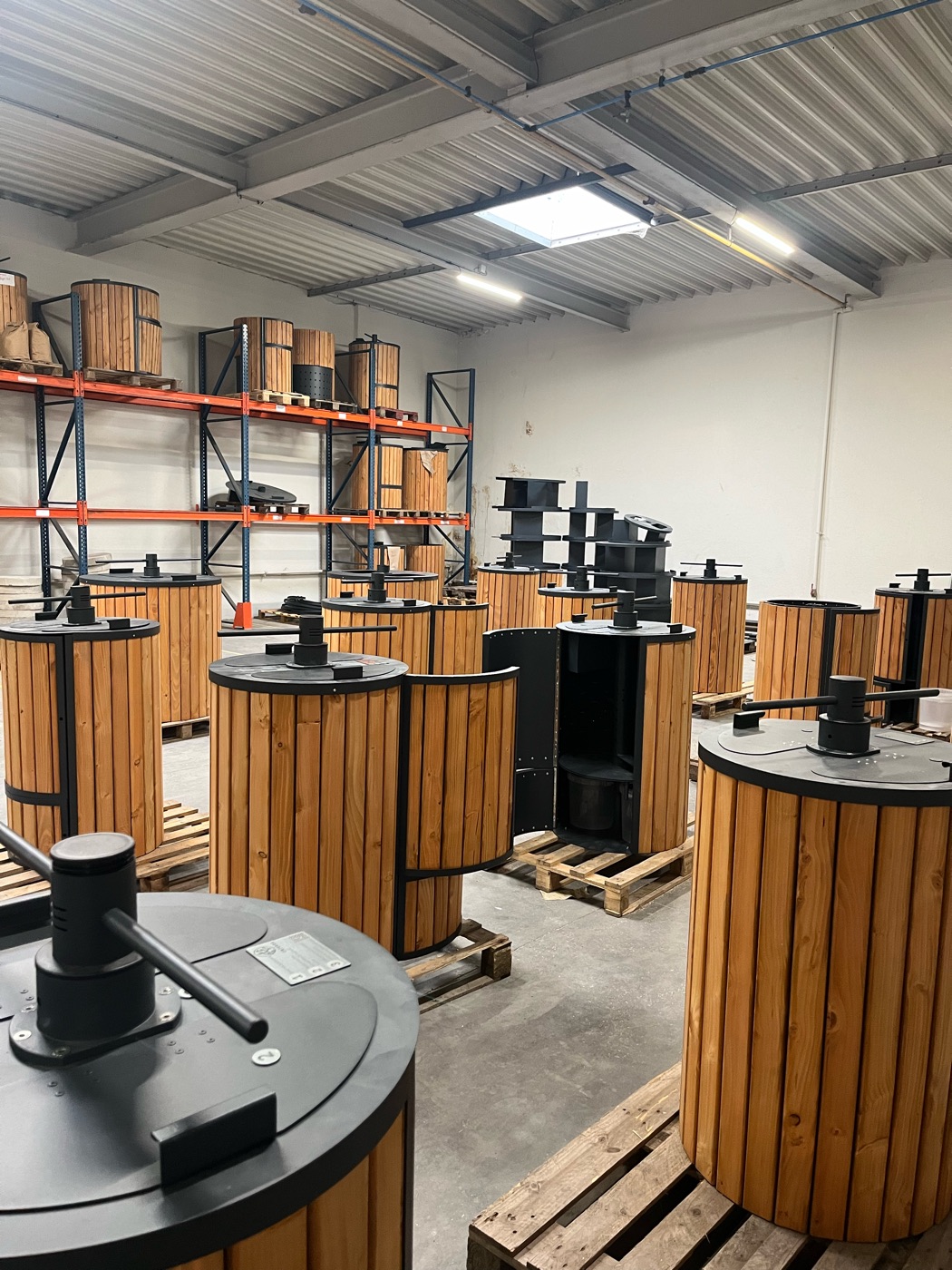
Seven criteria are enough to choose a commercial composter, and they are taken in this order: annual volumes in kilos, the real capacity of the container, the material and the closure, how aeration and mixing are done, the constraints of the location, the service that comes with the machine, and the traceability you will be able to produce if you are inspected. The first governs all the others: until you know how many kilos of food waste leave your site each year, no data sheet will move you forward.
Key takeaways
An ABC composter absorbs up to 1,500 kg of food waste a year. Above that you add a second, up to 3,000 kg a year; above 3,000 kg a year, on-site composting is no longer the right answer. The composter is available to buy or to rent over 48 months, and whatever leaves the site is contracted locally.
The seven criteria, in one table
Catalogues push what photographs well: volume in litres, the finish, sometimes a screen. What decides whether an installation succeeds is checked differently, through a closed question a serious supplier answers in writing.
| Criterion | The question that settles it | What should put you on alert |
|---|---|---|
| 1. Volumes | How many kilos of food waste a year actually leave the site? | A quote drawn up without that figure |
| 2. Capacity | How many kilos a year does the machine absorb, not just how many litres does it hold? | A capacity given in litres only |
| 3. Container | What sheet thickness in millimetres, what steel grade, what closure? | The word "reinforced" with no figure attached |
| 4. Aeration and mixing | Does anything have to be connected: electricity, water, drainage? | No power consumption anywhere on the data sheet |
| 5. Siting | What loaded weight, what floor area, what access for emptying? | No loaded weight given |
| 6. Service | Who supplies the bulking agent, who repairs it, who trains the teams? | A price for the machine alone, with service quoted separately |
| 7. Traceability | What do you produce on the day of an inspection? | No evidence provided for in the contract |
These seven points do not carry equal weight: the last six depend on the first. A site producing 300 kg a year and a site producing 2,800 do not face the same questions about load-bearing capacity, nor the same questions about cost.
Volumes govern everything else
There are two ways to establish your volumes: weighing, which is always better, or estimating from ratios where nothing has ever been weighed. The ratios we use come from ADEME (France) reference data cross-checked against readings from our own installed sites: 0.015 kg per person per office day, multiplied by 1.5 where there is a coffee point; 0.075 kg per meal served in contract catering; 0.140 kg per bed per day in healthcare; 0.025 kg per hotel breakfast. Our full method for sizing a composter to your volumes sets out each ratio and where it comes from.
One correction matters as much as the ratios: the capture rate. Part of the theoretical volume never reaches the composter, because some meals are eaten out, because separation is never perfect and because headcount varies. We use 70 % on estimates from ratios, and 100 % on kilos that have been weighed. Without that correction, you oversize.
The maths
- Headcount on site on a normal day, office head office 250 people
- Office ratio 0.015 kg per person per day
- Uplift for a coffee point × 1.5
- Working days used 220
- Theoretical volumes 1,238 kg/year
- Share actually captured 70 %
Volumes used866 kg/year
At 866 kg a year that is a single composter, since one vessel absorbs 1,500 kg a year. On the schedule set out below it is also 6 emptying operations a year. The same head office without a coffee point would drop to 577 kg and to 3 operations. So one figure governs the number of machines and how often each is emptied.
The container: thickness, grade, closure
Three materials share the market, and only one stands up to commercial outdoor use all year. Polyethylene is embrittled by UV and offers nothing against rodents. Wood requires a maintenance plan almost nobody keeps to. Steel settles both problems, provided it is the right thickness: sheet of 0.5 to 1 mm, the kind used in metal garden stores, dents at the first knock from a pallet truck and deforms under load, where 2 mm sheet takes both. The detail is in our comparison of steel, wood and plastic.
A data sheet has to carry figures, not adjectives. The one for the ABC composter states a vessel in S235 steel 2 mm thick, 450 L of composting volume, 1,000 mm high by 810 mm in diameter, 126.5 kg empty, for a loaded weight of 335.5 kg. The surface treatment is set out too: degreasing, primer, paint, all baked in our workshop in Albert.
On pests, be wary of absolute claims. What protects is the construction: a steel vessel with a closed base, a solid lid, drop-offs through a hatch and never into the open air, standing on a hard surface rather than on loose soil. Some finishes carry an outer skin cut with decorative openings: it dresses the vessel, it does not replace it. We have set out what makes a container genuinely out of reach of rats.
Aeration and mixing: what plugs in and what does not
Compost that smells bad is compost that is short of air: fermentation turns anaerobic and produces the sulphur compounds that drive the neighbours away. Everything follows from that. On the ABC composter, air arrives through an aeration chimney that runs through the vessel from bottom to top: aeration is continuous and consumes nothing. The mixing is mechanical and hand-operated: a crank-driven auger buries the fresh drop-offs, two minutes a week, with no turning by fork.
The practical consequence: the composter does not plug in. No electricity, no water supply, no drainage, no groundworks. That is what lets you put it on a car park, a service yard or a terrace without preparing a works application, and it is the criterion that separates two families of equipment fastest. Electromechanical solutions and powered dehydrators reduce volume by heat and assume a connection, a consumption figure and their own servicing: they are different machines, with different running costs.
Two questions are enough to settle it: how much does the machine consume in a year, and what happens when the power goes off? On a closed vessel with hand mixing, nothing: the process carries on, as the how it works page explains.
Siting: what the site dictates
The location is chosen before the finish. Three constraints can be checked on a plan in ten minutes. Load-bearing capacity first: 335.5 kg loaded on a circle 810 mm in diameter, that is 0.52 m² of footprint, works out at about 650 kg per m². A concrete slab or tarmac takes it; a terrace on pedestals, a roof slab or the top deck of a car park deserve a check with whoever manages the building.
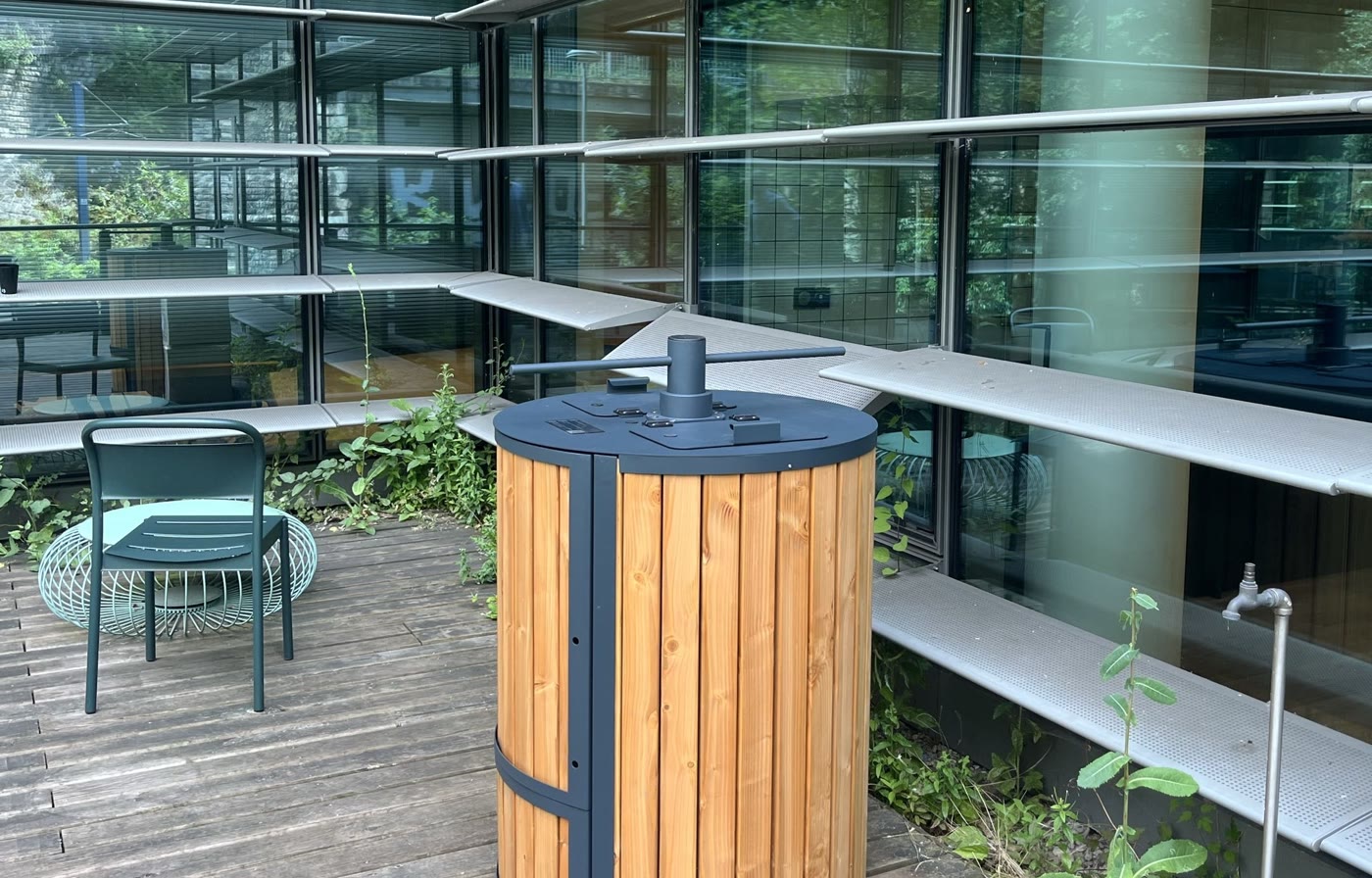
Then access. Emptying is done through a low door, into a standard 120 L wheelie bin: you have to be able to bring that bin up to the door and take it away full, which rules out corners with no wheelable route. Putting it in place initially is down to you: the composter arrives assembled, with its bulking agent inside, and is moved in 15 minutes by two people, with a screwdriver and a sack truck, and no lifting equipment.
Visibility, finally. In a service yard the composter is chosen on technical criteria; at a hotel entrance or in a public park it becomes street furniture. That is the use case for the garden composter: the same 450 L composter, ringed by a 2,000 L circular planter. The composting capacity does not change by a litre; the footprint does: 2 m in diameter with the planting bed, 5 to 6 m² on the ground against 0.52 m² for the bare vessel, and installation by three people in 30 minutes. It is the best illustration of the second criterion: the litres on the label say nothing about what the machine absorbs.
The service around the machine
This is the criterion most often pushed to the end of a tender, when it is the one that decides what the installation becomes once the novelty has worn off. A composter does not run on its own: it calls for carbon-rich bulking agent, teams trained to separate properly, mechanics that are looked after, and someone to call when the lead person leaves the site.
Outside France what we supply is the composter on its own: it leaves the workshop on a pallet with its first load of bulking agent already in the vessel, with the awareness kit (posters, stickers, caddies), and the training is held on a video call, which can be repeated as often as you need. Two things to know before you sign: moving it from the pallet into position is down to you, and topping up the bulking agent is sourced locally, as is the removal of what leaves the site and any weighing that goes with it. Our commercial composter maintenance checklist sets out what has to be checked, and how often.
A last point, often misunderstood: what comes out of the composter after a few months is not a compost ready to use, but a material at the end of its first phase, which still has to mature. In the European Union a finished product placed on the market falls under Regulation (EU) 2019/1009 on fertilising products, with national rules on top. Outside France its destination is yours to arrange: mature it on your own grounds, pass it to a neighbouring farm, or contract a licensed composting site or green-waste platform to take it. Ask any supplier what becomes of the material and who takes it back: the answer tells you a great deal about their downstream route.
How often it is emptied, and what that follows from
You can take the composter either way: buy it outright, or rent it over 48 months at 79 € excl. VAT a month. On the rental route there is no capital outlay to amortise and no maintenance line to provision, the parts are covered and shipped to you, and the durability of the machine is our industrial risk rather than your budget line. What is organised locally is the removal of what leaves the site, with an operator of your choosing; in France it is an option billed at 10 € excl. VAT a month per annual visit, from 1 to 12 visits.
How often it is emptied is not negotiable and not a matter of choice: it follows from the volumes produced, on the schedule below, taking the first band whose ceiling covers your annual volume.
| Annual volumes | Emptying operations a year | All-in monthly, French grid |
|---|---|---|
| Up to 250 kg | 1 | 89 € excl. VAT |
| Up to 450 kg | 2 | 99 € excl. VAT |
| Up to 625 kg | 3 | 109 € excl. VAT |
| Up to 750 kg | 4 | 119 € excl. VAT |
| Up to 875 kg | 6 | 139 € excl. VAT |
| Up to 1,125 kg | 9 | 169 € excl. VAT |
| Up to 1,500 kg | 12 | 199 € excl. VAT |
Above 1,500 kg a year you add a second composter and everything doubles, with its own set of bands for two vessels: a site at 2,000 kg falls on 9 emptying operations a year. Above 3,000 kg a year we no longer offer on-site composting: saying so in good time avoids an installation that will be saturated by the third month. The sizing tool applies exactly this schedule.
Compliance: what you will have to prove
Separating food waste at source is a duty on businesses, and where it comes from depends on where your site is. In the European Union it is Article 22 of the Waste Framework Directive 2008/98/EC, which set 31 December 2023 for separate collection or recycling at source; each member state has transposed it in its own law, and Ireland falls under that framework. The United Kingdom sits outside the directive and runs four regimes: Simpler Recycling in England, the Waste (Scotland) Regulations 2012, Workplace Recycling in Wales since 2024, and its own rules in Northern Ireland. Both routes are open in every one of them. The ABC composter takes the second: it treats the food waste on the site that produces it and removes 65% of the mass. A supplier who quotes you a threshold or a deadline without saying which country it applies to is working from the wrong text.
Penalties are national, and so is the body that imposes them. The amounts, the enforcing authority and the appeal route are set by each regime, and a figure published for one country tells you nothing about another. Note too that no regime prescribes a technology: what they require is that food waste is genuinely kept out of residual waste and recovered, and that you can show it. Ask your local authority or environment regulator what applies to your site.
Hence the seventh criterion: an inspection is not satisfied by a composter standing visibly in the yard, it asks for documents. A service contract, collection notes, dated tonnages, the final destination of the material. Check on the quote who produces them and how often; what becomes of the material, and who can take it, is set out in what to do with the compost you produce.
The checklist before you sign
Ten questions, put in writing. An honest data sheet answers most of them before you ask; an absence of an answer is already an answer.
- Does the quote state my annual volumes in kilos, and on what basis they were estimated?
- Is capacity expressed in kilos absorbed per year, and not only in litres?
- Is the sheet thickness given in millimetres and the steel grade named?
- Are the empty and loaded weights on the data sheet, so the load-bearing capacity of the ground can be checked?
- Does it need a power supply, a water supply or drainage to run?
- Is it emptied into a standard 120 L wheelie bin, with no proprietary container?
- Who supplies the bulking agent, and is topping it up included?
- Are maintenance parts and labour included, or billed per call-out?
- What becomes of the material that comes out of the composter, and who takes it?
- What traceability records am I given, and how often?
The last four sort fastest: they separate an equipment seller from a service provider.
Common questions
What size of commercial composter for 100 office staff?
One vessel is more than enough. With a coffee point and 220 working days, 100 people come to about 347 kg of food waste captured a year, less than a quarter of the annual capacity of an ABC composter, which absorbs up to 1,500 kg. Those volumes call for 2 emptying operations a year.
Does a commercial composter need electricity or water?
It depends on the family of equipment. The ABC composter plugs into nothing: no electricity, no water, no drainage, no groundworks. Air circulates through an aeration chimney and the mixing is turned by hand, with a crank. Powered dehydrators, on the other hand, need a connection and consume all year: it is the first criterion to clear up in a tender.
Is it better to buy or to rent a commercial composter?
Both are possible: you can buy the composter outright, or rent it over 48 months at 79 € excl. VAT a month. The rent covers the composter delivered, the bulking agent, the maintenance and the replacement parts, and the awareness work with your teams; the diagnosis, the training and the support are done remotely and the parts are shipped. In France, collection remains an option at 10 € excl. VAT a month per annual visit; elsewhere the removal of the mature compost is arranged with a local operator of your choice.
Above what volume does on-site composting stop being suitable?
Above 3,000 kg of food waste a year. Up to 1,500 kg one composter is enough; between 1,500 and 3,000 kg you install a second and everything doubles, the equipment as much as the emptying. Above that, the volumes belong with an industrial treatment route, and an on-site installation would be saturated within the first few months.
Where to start
Take the seven criteria in order, and refuse to skip the first. A representative week of weighing, or a few minutes of estimating from ratios, gives you the figure that settles the rest: the number of vessels, the emptying frequency, and an honest answer to the question of whether on-site composting suits you at all.
The sizing tool takes that path in that order: it estimates your volumes from your headcount, your covers or your beds, works out the sizing from there, and does so with no form to fill in first. Allow a few minutes. If you run several sites, the rollout at Decathlon across its national network shows the same decision replicated store by store.
A free assessment, a quote within 24 h
Thirty minutes on a video call to go over the food waste separation duty that applies where you operate, size the solution and estimate your savings.
