
Resource
How to make compost: a practical guide to getting started
The 4 conditions for compost that works, the right carbon to nitrogen ratio, the table of mistakes to correct and what the separation duty changes for a business.
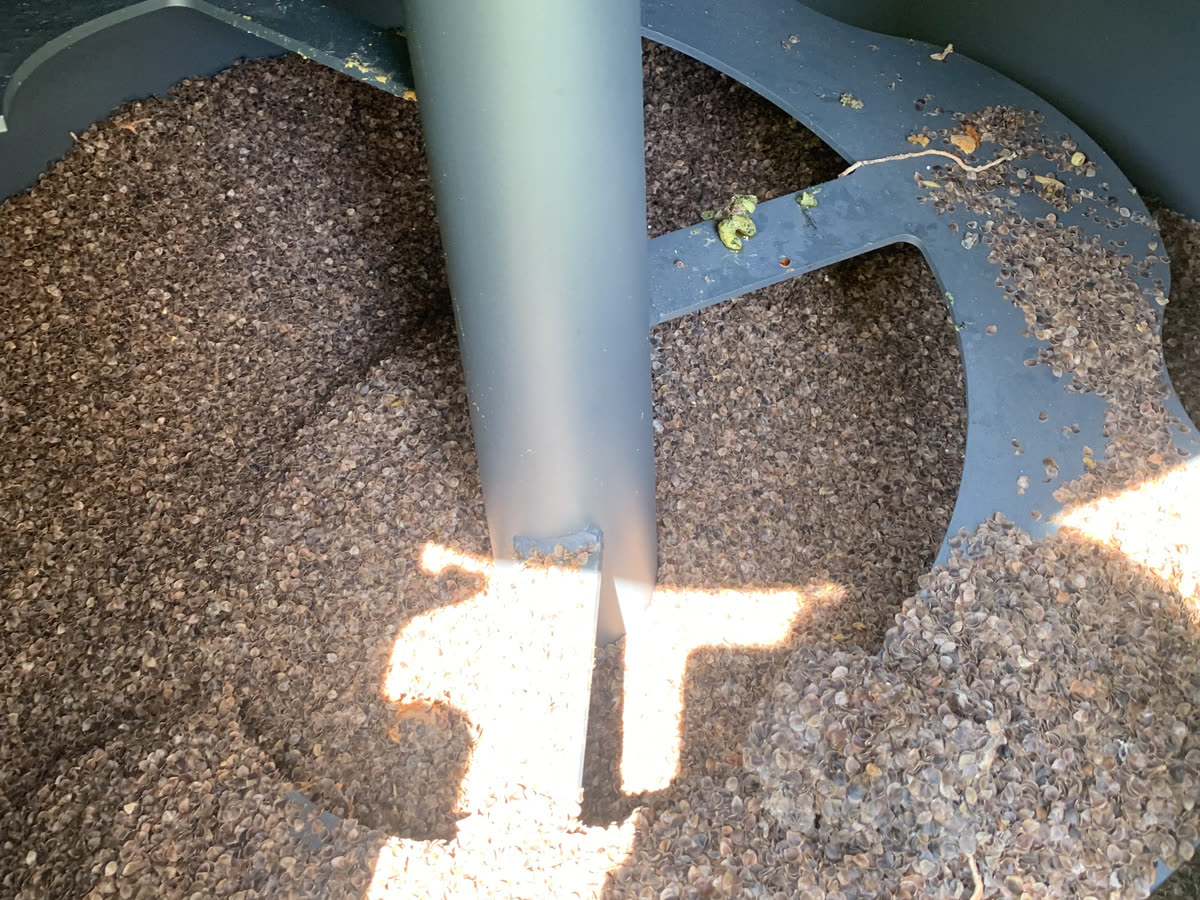
Making compost means bringing four conditions together and letting the micro-organisms work: a continuous supply of oxygen, the moisture of a wrung-out sponge, a balanced mix of green material rich in nitrogen and brown material rich in carbon, and time, 3 to 6 months. Everything else, the model of bin, the mixing frequency, the size of the pieces, only serves to hold those four conditions in place. A compost that smells, that stays cold or that leaks is never a fatality: one of the four is missing, and the diagnostic table further down says which one.
Key takeaways
The dosage: aim for a carbon to nitrogen ratio between 25 and 35 to 1, which in practice comes down to roughly as much brown volume as green volume. Field rule: 1 handful of bulking material for 1 bucket of food waste added.
Oxygen governs everything else: starved of air, the breakdown tips into anaerobic fermentation, which produces methane, sulphur compounds and liquor. It is behind 9 compost problems out of 10.
In a business: separation at source of food waste has been required across the European Union since 31 December 2023, under Article 22 of the Waste Framework Directive 2008/98/EC, and each country sets the terms in its own transposition.
What is compost?
Compost is the product of aerobic biological breakdown: bacteria, then fungi, then a macrofauna of worms and woodlice consume the organic matter in the presence of oxygen and turn it into a brown, crumbly, stable material rich in humus. It is neither a fertiliser nor a potting soil: it is a soil improver. It improves the structure of the soil first, its water-holding capacity and its microbial life, and it feeds the soil afterwards, slowly.
The process goes through four phases that can be read from the temperature at the core of the mass: mesophilic from 0 to 3 days, between 20 and 45 °C; thermophilic from 3 to 30 days, between 45 and 65 °C, which attacks the cellulose and sanitises the material by destroying pathogens and weed seeds; cooling from 30 to 60 days; maturation from 60 days to 6 months. During the thermophilic phase the volume can halve in two weeks: the water evaporates and the carbon leaves as CO2.
Those phases drive two concrete decisions: a compost that never climbs in temperature has not started, and a compost that is still hot is not to be used. The detail is in our article on the composting cycle and its four stages.
Air, water, carbon, nitrogen: the four conditions
Oxygen. Aerobic breakdown consumes it continuously. When it runs short, the fermentation turns anaerobic: smells, methane, slowdown. It is the condition most often at fault; it has its own section below.
Water. The target is the moisture of a wrung-out sponge, that is 50 to 60 %. Checking it needs no instrument: a handful squeezed in the hand should hold together in a ball without liquid running between the fingers, and fall apart when the hand opens. Too dry and the process stops; too wet and the water drives the air out.
The carbon to nitrogen ratio. Micro-organisms need nitrogen for their proteins and carbon for their energy, in a proportion of 25 to 35 to 1. Too much nitrogen, nothing but peelings and fresh grass, and the excess escapes as ammonia. Too much carbon, nothing but cardboard and wood chip, and nothing gets going.
Structure and mass. Air needs voids to move through: that is the role of wood chip, straw and torn cardboard. And below about 1 m3 in a free-standing heap, the mass does not hold its heat and the thermophilic phase never sets in; a closed vessel corrects that.
| Material | Family | Indicative C/N | What it brings |
|---|---|---|---|
| Coffee grounds and paper filters | Green | 20 to 1 | Nitrogen and fine structure, the most abundant material in offices |
| Fruit and vegetable peelings | Green | 15 to 25 | Nitrogen and a lot of water |
| Cooked meal leftovers | Green | 15 to 20 | Nitrogen, but also fat and salt to dilute in the mass |
| Fresh grass clippings | Green | 15 to 20 | Nitrogen; packs into a mat if it is not mixed in |
| Dead leaves | Brown | 40 to 60 | Carbon and an airy structure, free and seasonal |
| Straw, dry hay | Brown | 80 to 100 | Carbon; creates the voids where air moves |
| Shredded branches, untreated wood shavings | Brown | 100 to 500 | Slow carbon, structure that holds for several months |
| Unprinted brown cardboard, kitchen paper | Brown | 200 to 350 | Carbon; soaks up excess water, available everywhere |
What composts, and what does not compost
The starting rule fits in one sentence: anything that was once alive will compost, but not at the same speed, and not without consequences for smells and pests.
Without hesitation: peelings and fruit and vegetable leftovers, coffee grounds with their filter, paper tea bags with no staple, crushed eggshells, stale bread, kitchen paper soiled with food, spent flowers, dead leaves, torn brown cardboard.
In moderation, and always buried: cooked meal leftovers, meat and fish, dairy products, citrus, crushed nut shells. These go through well in a closed vessel where every input is buried; in an open slatted bin left uncovered they create smells and call in rodents.
Never: plastics, metals, glass, ceramics, cigarette butts, nappies and wipes, medicines, chemicals, animal droppings and litter, treated wood. And one trap: bags described as “compostable” and certified for industrial composting, which need a sustained temperature of 60 °C that an on-site composter does not hold. They come out intact. The full list is in our inventory of what composts.
Composting methods compared
Every method aims at the same four conditions; they differ in the volume they take, the space they occupy and the work they demand. Two of them do not produce compost at all: bokashi, which returns a fermented material to be buried afterwards, and the electric dehydrator, which returns a dry, inert residue.
| Method | Suitable volume | Duration | Main constraint | Setting |
|---|---|---|---|---|
| Heap on the ground or windrow | No limit | 6 to 12 months | Space, turning with a fork | Farm, rural garden |
| Static garden bin | 300 to 800 L | 6 to 12 months | Slatted walls, standing on soil, mixing is hard work | Detached house |
| Rotating drum composter | 200 to 500 L | 3 to 6 months | Limited capacity, drum heavy once loaded, bought outright | Regular home use |
| Worm composter | 20 to 100 L | 2 to 6 months | Sensitive to temperature; no citrus, no meat | Flat, small office |
| Bokashi (fermentation) | 15 to 20 L bucket | 2 to 4 weeks, then maturation is compulsory | Does not produce compost: the material has to be buried afterwards | Indoor kitchen |
| ABC composter | 450 L, up to 1,500 kg a year | 3 to 6 months | 2 minutes on the crank a week, nothing to plug in | Business site |
| So-called “electromechanical” dehydrator | Depends on the model | A few hours | Does not produce compost: a dry residue with no biological activity; it consumes electricity | Catering kitchen looking to cut volume |
Vermicomposting uses manure worms (Eisenia fetida): few smells, a concentrated liquor to dilute, but neither large quantities nor swings in temperature. Bokashi, for its part, needs maturing in soil or in a composter to finish the job.
Watch the vocabulary, because it sells: appliances marketed as “kitchen composters” or “electromechanical composters” heat and grind the food waste. They cut the volume, but their residue does not enrich soils with living organic matter: see our analysis of electromechanical and electric composters. The equipment designed for a business site is presented on our composters page.
Aeration: without oxygen, nothing happens
Composting is an aerobic process. Without air, anaerobic micro-organisms take over: methane, sulphur compounds smelling of rotten eggs, acid liquor. The process does not stop, it goes off the rails. And because it goes off the rails through smell, the bin stops being fed: that is how most composting projects die.
In manual composting, three moves keep the aeration going: mixing every 10 to 15 days during the active phase, to reopen the pores closed by settling; never piling up a thick layer of wet, fine material, fresh grass above all, which welds into an impermeable mat; alternating a green layer and a brown layer, the second acting as a framework for the first.
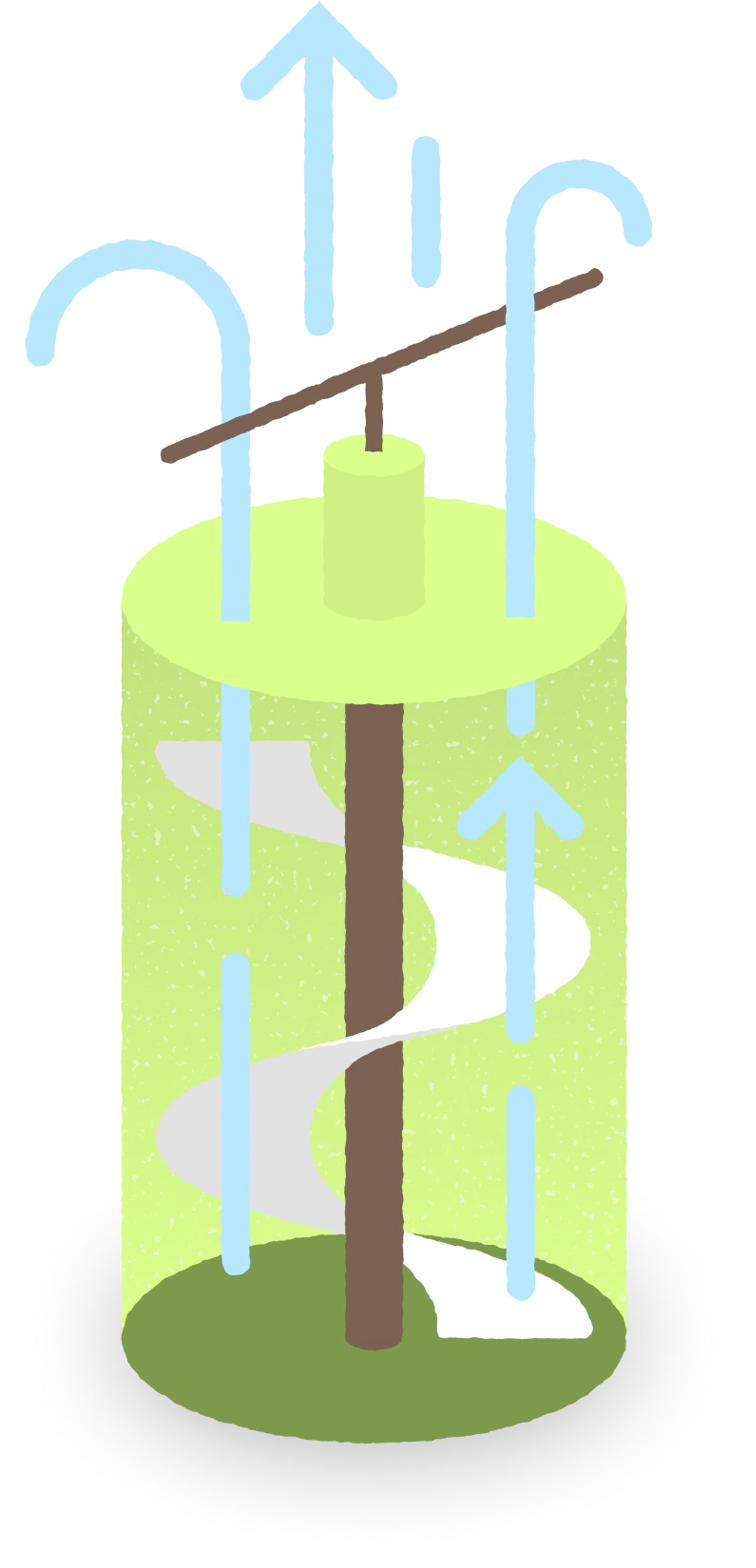
On a workplace site, nobody writes “turn the compost with a fork” into a job description. The ABC composter therefore settles aeration by mechanics rather than by discipline: a closed 2 mm steel vessel with a solid base, a perforated aeration chimney that spreads air into the heart of the mass, and a crank-driven screw that buries the week's loads in two or three turns. The mixing is mechanical but turned by hand: no electricity, no water, no drainage, no groundworks. So this is not powered ventilation, which implies fans and an electrical connection, but continuous aeration through the chimney. The three mechanisms are set out in detail in our article on ABC composter technology.
How long does it take, and when is it ready?
Allow 3 to 6 months for a mature compost, longer if winter slows the active phase. Particle size matters a great deal: pieces bigger than 10 cm offer little surface to attack and come out whole after six months.
Five signs say a compost is mature, and all five have to be there: an even dark brown colour, almost black; a smell of woodland floor, with no acid or ammonia note; a crumbly, granular texture with no recognisable waste; a temperature back to ambient. The cress test settles it: sown on the compost, the seeds should germinate in about 5 days; if they do not, the material is still maturing and would be phytotoxic.
One useful detail for a business: what comes out of the composter’s lower hatch after a few months is not a mature, standard-compliant compost, but a material at the end of active breakdown. It is taken away, sanitised at a facility permitted for it, then spread by an operator you contract locally. The other destinations, internal green spaces, planters, gifts to staff, are reviewed in our article on making use of the compost produced at work.
Common mistakes and how to correct them
A compost that is going wrong always sends a readable signal. The table links each symptom to its most likely cause and to its correction. In almost every case, correcting means restoring one of the four conditions.
| Symptom | Most likely cause | Correction |
|---|---|---|
| Smell of rotten eggs or of drains | Lack of oxygen: material packed down and waterlogged | Mix, and work in coarse brown material (wood chip, torn cardboard) |
| Smell of ammonia | Excess nitrogen, too much green | Add carbon, pause the fresh grass inputs |
| Liquor is running out | Excess moisture | Work in bulking material, keep the rain off |
| The mass stays cold, nothing moves | Volume too small, too dry, or too much carbon | Moisten, add green, gather the material together |
| Cloud of fruit flies on opening | Fresh inputs left on the surface | Bury every input and cover it with bulking material |
| Signs of rodents | Slatted walls, standing on soil, meat leftovers on the surface | Vessel with a closed base and a solid lid, on a hard surface, everything buried |
| Pieces intact after 6 months | Particle size too coarse | Cut to under 10 cm, shred the woody material |
These corrections apply to a domestic bin as much as to professional equipment. On a site open to the public, a single bad smell is enough to make people give up on sorting: the defences are gathered in our guide to composting at work without smells or pests.
Making compost at work: what changes
The biology does not change; the framework does. Across the European Union, Article 22 of the Waste Framework Directive 2008/98/EC has required since 31 December 2023 that food waste be either collected separately or recycled at source, and bio-waste itself is defined at Article 3(4) of the same text. Each country sets the terms in its own transposition, Ley 7/2022 in Spain, D.Lgs 152/2006 in Italy, KrWG and GewAbfV in Germany, AWG 2002 in Austria, while the United Kingdom sits outside the directive with 4 separate regimes. Two routes satisfy the duty: composting on site, or having the waste collected separately.
The penalties for failing to separate belong to national law and differ from one country to the next: the amounts in force in France carry no weight across a border, and the sliding scales that circulate online correspond to no provision at all. What applies to your own establishment is set by your national framework and by its authority; our guide to the French framework sets out the French case.
On the equipment side, the ABC composter is a 450 L vessel in 2 mm steel, designed and manufactured in our workshop in Albert. It absorbs up to 1,500 kg of food waste a year; beyond that you add a second composter, and beyond 3,000 kg a year on-site composting is no longer the right answer. Renting it costs 79 € excl. VAT a month, composter delivered, bulking material, maintenance and training by video call, on a 48-month agreement; buying one is possible too, talk to us and we will quote it. Compost collection is an option in France, charged at 10 € excl. VAT a month per annual visit, from 1 to 12 visits, and the number of visits is not a choice, it follows from the volumes. Elsewhere the removal is arranged with the local operator of your choice.
The maths
- Head office, people actually on site on a normal day 150
- Working days used by the method 220
- Base ratio, 0.015 kg per person per day 495 kg/year
- Coffee point and tea station, coefficient 1.5 742 kg/year in theory
- Share actually captured, 70 % 520 kg/year
- 520 kg stays under 1,500 kg, so a single composter 1
- Removals matching 520 kg (threshold 625) 3 a year
- Rent of the composter, everything included 79 € excl. VAT/month
- Collection, 3 annual visits at 10 €, French benchmark 30 € excl. VAT/month
Monthly budget for the set-up109 € excl. VAT
Assumptions, so the calculation can be reproduced: ADEME office ratios (France) as used by our online quote, 0.015 kg per person per day, uplifted by 50 % where there is a coffee point; 220 working days; captured share set at 70 %, since part of the theoretical volumes never reaches the composter (meals taken outside, imperfect sorting, absences). Change the headcount and the monthly figure follows the same grid: 750 kg a year gives 4 visits and 119 € excl. VAT a month, 1,200 kg gives 12 visits and 199 € excl. VAT a month. The office parameters are on our offices and workplaces page.
That leaves the organisation, which decides as much as the equipment does. Here is the start-up sequence applied on the sites we equip.
- Put a figure on the annual volumes before choosing any equipment, by weighing over a typical week or by sector ratio.
- Choose the siting: a hard, level surface, reachable during the week, close to the drop-off points and to a vehicle access.
- Keep the stock of bulking material next to the composter: 1 handful per bucket brought over, that is the only dosage to remember.
- Name a lead for each site and a deputy, otherwise the weekly gesture disappears with the first holiday.
- Put the “yes / no” signage at the drop-off point, break room or kitchen, and not only on the composter.
- Fix the mixing on one day of the week: 2 minutes on the crank, plus a monthly visual check of ten minutes or so.
- File the records of what becomes of the compost from the first removal onwards: that is the document an inspection asks for, and it cannot be reconstructed afterwards.
The full run-through, from delivery to team training, is described on the how it works page.
Common questions
Can you put meat and fish in a compost?
Yes in a closed professional composter, no in an open garden bin. In a closed steel vessel with a solid base, where every input is buried by the mixing, meat and fish break down without attracting pests. In a slatted bin standing on soil, they create smells and call in rodents.
How long does it take to make compost?
From 3 to 6 months for a mature compost in good conditions, longer in winter. The thermophilic phase, the one that climbs from 45 to 65 °C and sanitises the material, lasts 3 to 30 days. Then come cooling, from 30 to 60 days, and maturation, from 60 days to 6 months. A compost that is still hot is not ready.
Do you need an electric composter to compost at work?
No. The ABC composter does not plug in: no electricity, no water, no drain, no civil works. Air moves by natural draught through a perforated aeration chimney, and the mixing is done with the crank, 2 minutes a week. Electric appliances sold as composters are most often dehydrators: they produce a dry, inert residue, not compost.
Is on-site composting a requirement?
No, it is separation at source that is required, from every producer, since 31 December 2023 under Article 22 of the Waste Framework Directive 2008/98/EC. The business then chooses between composting on site and having its food waste collected separately. On-site composting removes the transport and makes the recycling visible to the teams.
How much does a composter cost for a business?
79 € excl. VAT a month to rent, composter delivered, bulking material, maintenance and training by video call; reporting comes with the collection option. Buying one is possible as well: talk to us and we will quote it. Collection is an option in France, charged at 10 € excl. VAT a month per annual visit, from 1 to 12 visits depending on the volumes. A head office at 520 kg a year needs 3 visits, that is 109 € excl. VAT a month.
Where to start
If the question is a domestic one, there is nothing to decide: put a bin on a level patch, alternate a green layer and a brown layer, mix every 10 to 15 days, watch for the moisture of a wrung-out sponge. The four conditions do the rest.
If the question is a professional one, the order reverses: you put figures down first and choose afterwards, because the annual volumes determine the number of composters, the number of removals and therefore the budget. The online quote takes two minutes, your sector and your headcount; it returns the estimated volumes, the sizing and the monthly figure, with no sign-up. You will then know whether your site calls for one composter, two, or an industrial route beyond 3,000 kg a year.
Read next
Composting at the University of Lille: case study
Making use of the compost produced at work: 5 possible routes
A free assessment, a quote within 24 h
Thirty minutes on a video call to go over the food waste separation duty that applies where you operate, size the solution and estimate your savings.
