
Resource
The list of what composts, and what does not
The full sorting table, family by family, the borderline cases settled and the legal framework that makes this list compulsory at work.
What composts, the short answer
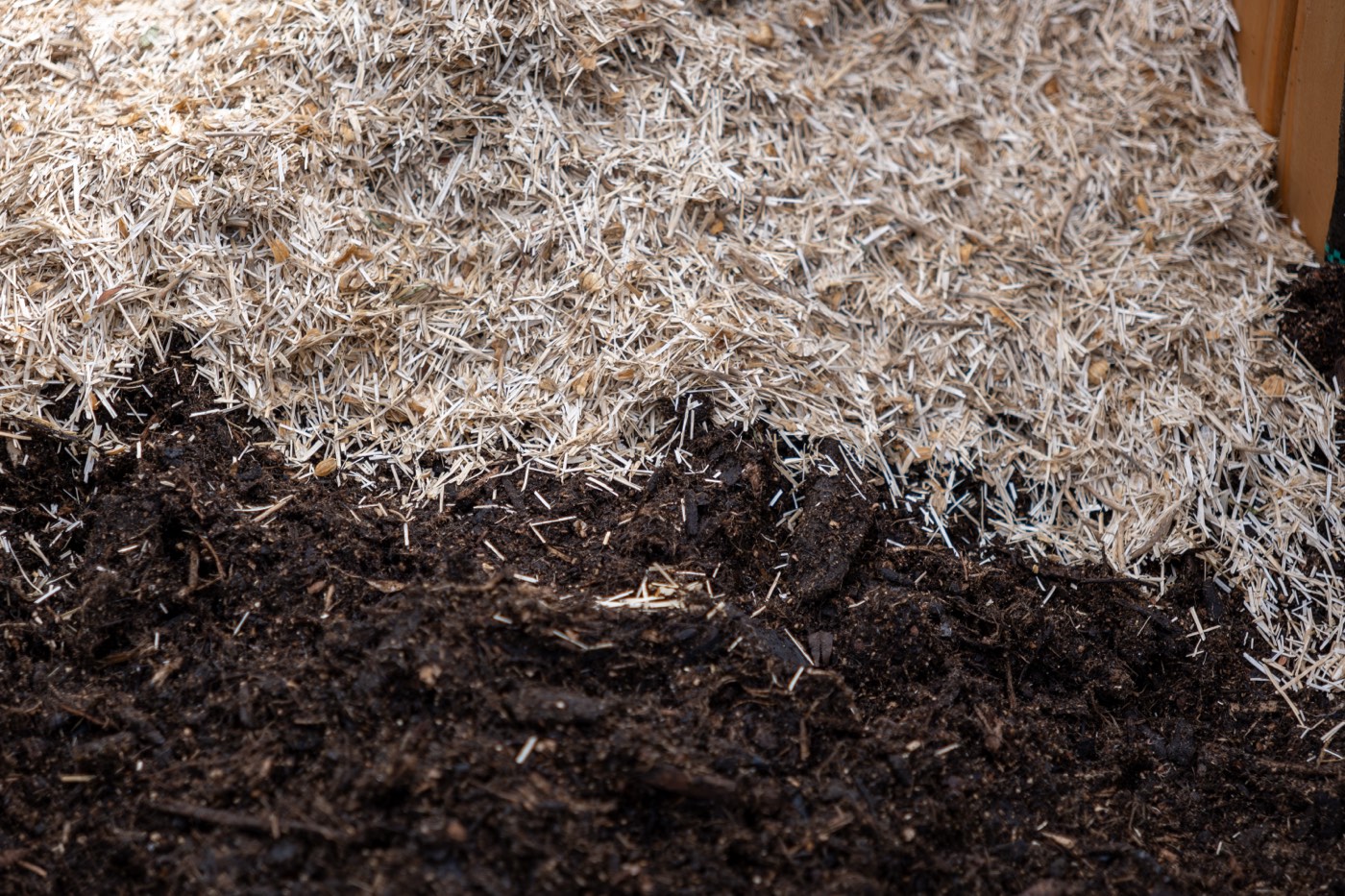
They compost: peelings and leftovers of raw or cooked fruit and vegetables, coffee grounds with their filter, paper tea bags, crushed eggshells, bread and starchy food, spent flowers, kitchen paper soiled with food, unprinted brown cardboard and wood chip. They never compost: plastics in every form, including bags and cutlery sold as “compostable”, glass, metal, ceramics, cigarette butts, nappies and wipes, pet litter and droppings, medicines and chemicals. Between the two sits a grey area that depends not on your goodwill but on your equipment: citrus, meat, fish, dairy products, nut shells. An open garden bin refuses them, a closed professional vessel takes most of them.
The reason is always the same. Composting is an aerobic process: bacteria, fungi and then worms consume the material while breathing oxygen. Three variables govern it. The carbon to nitrogen ratio, to be held around 25 to 30 to 1: peelings and meal leftovers bring the nitrogen, cardboard, wood chip and dead leaves bring the carbon. Oxygen, which mixing renews. Moisture, that of a wrung-out sponge. An item is refused when it breaks one of the three, when no micro-organism knows how to digest it, or when it carries a health risk. The detail of the phases and temperatures of the cycle explains why the rise in heat over the first weeks changes what the material can take.
Key takeaways
Three lists, not two. A green one, a red one, and between them an amber one that depends on the composter in use rather than on the waste itself.
Carbon is the missing link. An office site produces almost nothing but nitrogen. Without a regular dry input, the best green list ends up as liquor.
“Compostable” is not a sorting instruction. The label points to an industrial standard that assumes 60 °C continuously, never reached on site.
The sorting table, family by family
This table is what we build the signage of our sorting points from. It applies to a composter installed on site and fed by offices, a cafeteria or a hotel or restaurant kitchen, not to an industrial platform. The verdict reads on three levels: “Yes” with no condition, “With reservations” when the quantity or the equipment decides, “Never” with no exception. The right-hand column gives the reason: an instruction with no motive does not last three months in a break room.
| Waste or family | Verdict | Why, and on what condition |
|---|---|---|
| Peelings and leftovers of fruit and vegetables, raw or cooked | Yes | The base of the volumes on any site. Rich in nitrogen, broken down in a few weeks. |
| Coffee grounds and paper filter | Yes | Nitrogen and a fine particle size. The filter brings the carbon. Aluminium or plastic pods have to be taken out. |
| Tea and herbal tea bags | Yes | Paper only, staple removed. The bags described as “silk” are a polymer. |
| Eggshells | Yes | Crushed, otherwise they go through the cycle intact. A source of calcium and of structure. |
| Bread, pasta, rice, cooked starchy food | Yes | Spread through the flow, never in a compact lump that goes mouldy on the surface. |
| Spent flowers, house plants, planter compost | Yes | Diseased or recently treated plants excepted, as they carry pathogens or residues all the way to the field. |
| Kitchen paper and paper napkins | Yes | If they have been used for food. Soaked in cleaning product, they become a reject. |
| Unprinted brown cardboard, egg boxes | Yes | Torn into pieces. A free source of carbon, available in every building. |
| Wood chip, dead leaves, hedge trimmings | Yes | The carbon that is almost always missing on an office site. Supplied with the subscription. |
| Citrus | With reservations | Acidic and thick-skinned. The problem is the quantity in one go, not the citrus. |
| Meat, fish, small bones | With reservations | Refused in an open bin: smells and rodents. Accepted in a closed vessel with an aeration chimney. |
| Dairy products, cheese rinds | With reservations | Small quantities, always covered with bulking material. |
| Stones, nut shells, avocado and pineapple skins | With reservations | Lignified: 2 to 5 years without crushing, when the rest is processed in a few months. |
| Untreated wood ash | With reservations | Strongly alkaline. An occasional handful at most, never a bucket. |
| Bags, cutlery and trays certified “compostable” to EN 13432 | Never | A standard calibrated for industrial composting at 60 °C continuously, never reached on site. |
| Lined “cardboard” cups and boxes | Never | A polyethylene film invisible to the eye, which breaks into microplastics. |
| Plastics, glass, metal, ceramics | Never | No micro-organism breaks them down. They come out as they went in and are picked out by hand. |
| Cigarette butts, nappies, wipes, face masks | Never | Synthetic fibres and chemical residues, including heavy metals in cigarette butts. |
| Pet litter, animal droppings, excrement | Never | A health risk. Outside the remit of an on-site composter. |
| Frying oils, grease trap fats | Never | They coat the material and cut off the oxygen. |
| Treated wood, varnished sawdust, pallets, greenery treated with pesticides | Never | Treatment residues that follow the material all the way to the farm field. |
| Medicines, paints, solvents, cleaning products | Never | Biocides: they sterilise the very environment we are trying to keep alive. |
The “With reservations” rows are the only ones that move from one site to another. They are settled at installation, according to the composter chosen and the real volumes: the instructions specific to a professional composter are not those of a shared neighbourhood bin.
The four cases that cause hesitation
Citrus. It is compostable, contrary to what is often read. Its acidity and its essential oils only get in the way in bulk: a crate of squeezed oranges emptied in one go drops the local pH and blocks the breakdown for several days. Spread through the flow and covered with bulking material, it causes no problem at all. The useful instruction is not “no citrus” but “no citrus in bulk”.
Meat, fish and dairy products. Here the equipment decides on its own. Rich in protein and in fat, these materials attract rodents and flies and ferment anaerobically in an open bin standing on soil; in a closed vessel they break down normally. The comparison of composters against rodents shows that the variable is neither the brand nor the volume, but the build: wall thickness, closed base, how the lid holds, the nature of the ground.
“Compostable” packaging. Maize starch bags, PLA cutlery, EN 13432 trays: that standard targets industrial composting, at a sustained 60 °C and under permanent mixing. No on-site composter holds those conditions, and the object comes out whole months later or fragments without being digested. The same verdict applies to “cardboard” cups and boxes, most of which carry a polyethylene film invisible to the eye.
Stones, shells and tough skins. Avocado or peach stones, nut shells, pineapple skins: organic, and so compostable in the strict sense, but lignified. Allow 2 to 5 years for a whole stone when the rest of the vessel is processed in a few months. They come out visible at emptying and give the impression of a composter that has stopped working. Crush them or leave them out.
What a professional composter changes about the list
The gap between the green list of a garden bin and that of a business composter is not a matter of looser instructions: it is a matter of build. The ABC composter is a vessel in 2 mm steel, 450 litres, designed and manufactured in our workshop in Albert. A closed, continuous base, a solid lid, standing on a hard surface: that configuration takes away from rodents most of what they are after, which a slatted bin standing on soil does not.
The second difference is the aeration. An aeration chimney runs through the vessel and keeps the air moving continuously; a mixing screw turned by hand takes the material over. Nothing plugs in: no electricity, no water, no drain, no civil works. This is not an electromechanical composter, a term that describes the electric dehydrators sold by others. It is that continuous aeration that allows animal protein and that avoids the tip into fermentation behind the smells: the real causes of smells at work almost always come down to an excess of nitrogen that has not been balanced, not to one isolated item of waste.
The third difference is that the bulking material is supplied and delivered with the subscription. Lastly, what comes out of the vessel after a few months is not a mature, standard-compliant compost: it is a pre-compost, taken away at a collection, sanitised at a facility permitted for it, then spread by an operator you contract locally. The full journey of the outgoing material sets out that stage.
What the law requires you to separate
The law does not publish a list of foods. It requires a separation. Across the European Union, Article 22 of the Waste Framework Directive 2008/98/EC has required since 31 December 2023 that bio-waste be either recycled at source or collected separately, from every producer and holder. Bio-waste is defined at Article 3(4) of the same text: biodegradable non-hazardous garden or park waste, and food or kitchen waste from households, offices, restaurants, canteens, caterers and retail. Each country sets the terms in its own transposition, Ley 7/2022 in Spain, D.Lgs 152/2006 in Italy, KrWG and GewAbfV in Germany, AWG 2002 in Austria, while the United Kingdom sits outside the directive with 4 separate regimes.
In other words, the green list above is not a gardener’s preference: it is what a duty looks like in practice. The penalties themselves belong to national law and differ from one country to the next, so the amounts in force in France carry no weight across a border. The same goes for the permitting thresholds that apply to a composting installation, set nationally, an on-site composter sitting well below them wherever they exist. The full guide to the French framework sets out each French text with its article and its date.
The sorting point checklist
A sorting list is only worth something if it can be read from the place where people throw things away. Here is what gets checked at every installation, and what you can audit yourself on an existing sorting point.
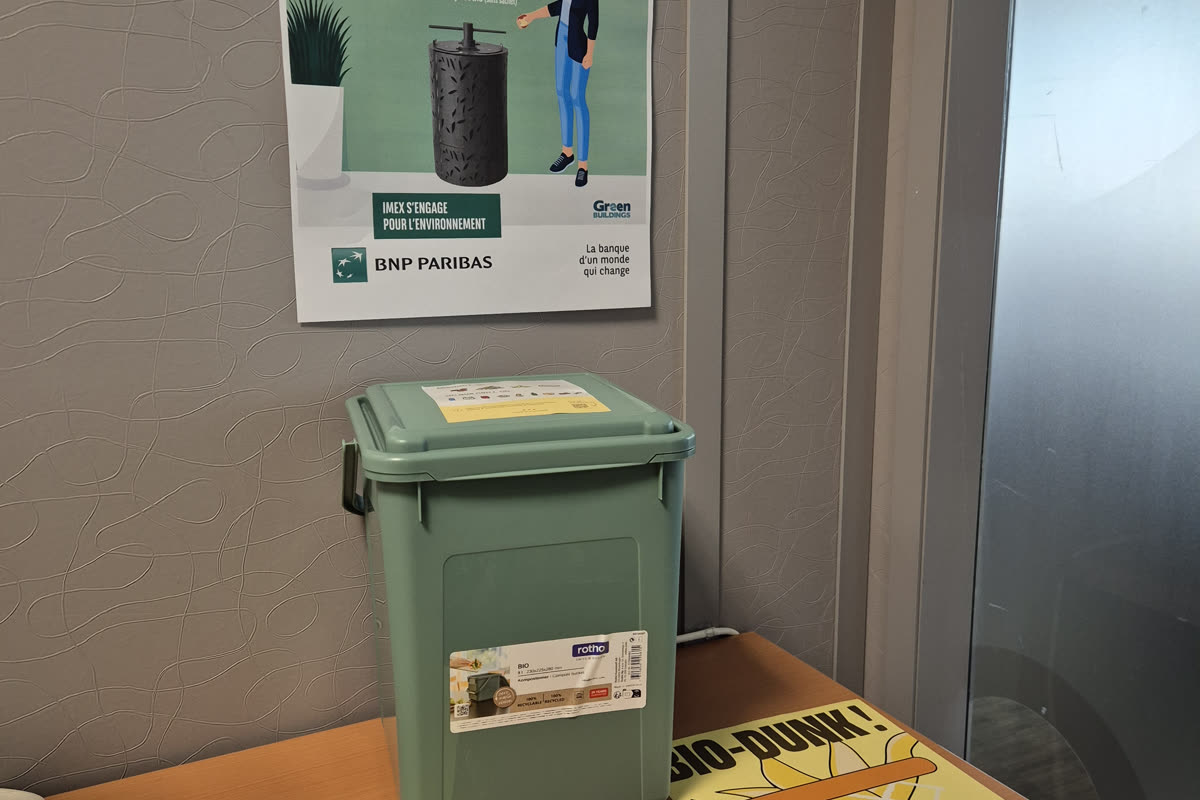
- A “yes / no” instruction posted at eye level, above the caddy and not on the composter, which is often 30 metres away.
- Pictograms rather than text alone, for the teams whose first language is not the one the poster is written in.
- One caddy per real point of production: coffee machine, dishwashing area, food preparation, break room. A single central bucket drops the capture rate.
- A stock of bulking material in the same place, with the rule on display: one handful per bucket emptied.
- No plastic bag, and no “compostable” bag either. The caddy is emptied, then rinsed.
- The three most frequent rejects named explicitly: lined cups, compostable bags, coffee pods.
- A named lead for each site, and a stand-in, rather than an instruction addressed to everyone.
- The instruction repeated in the induction of new starters and temporary staff.
- A visual check of the contents once a month, with a written record of the unwanted items found.
- The cleaning contractor informed and trained: they are the ones who empty the bins in the evening.
The last point is the one most often forgotten. Getting the teams on board fails more often on the cleaning subcontractor than on the employees themselves.
What the list changes on your bill
Sorting determines the tonnage actually captured, and the tonnage determines the price. An ABC composter is rented at 79 € excl. VAT a month: the equipment, the bulking material restocked, maintenance covering parts and labour, the kit of posters and stickers, and training for the teams by video call. Four things sit outside that rent, and they are worth knowing before you sign: setting it down on site, since the composter arrives ready to use and two people are enough to place it; awareness work in person; reporting on the tonnage diverted; and collection. Renting runs on a 48-month agreement, and buying one is possible: talk to us and we will quote it. The composter can stand on its own if you handle the outgoing material yourself. Collection is an option in France, charged at 10 € excl. VAT a month, per annual visit and per composter, from 1 to 12 visits a year; it is what brings the reporting, since the material is weighed at removal. The number of visits is not a choice: it follows from the volumes.
Take a head office with 250 people on site on a normal day, with a coffee point but no staff restaurant. The method for working out the volumes applies 0.015 kg per person per day, uplifted by half by the presence of the coffee point, over 220 working days, then keeps 70 % of that theoretical figure because some meals are eaten out and sorting is never perfect.
The maths
- People on site on a normal day 250
- Office ratio with a coffee point, 0.015 × 1.5 0.0225 kg/person/day
- Over 220 working days 1,237 kg/year in theory
- Share actually captured, 70 % 866 kg/year
- Collection visits, from the grid 6 a year
- Rent of the ABC composter 79 € excl. VAT/month
- Collection option, 6 × 10 €, French benchmark 60 € excl. VAT/month
Monthly figure, rent and collection139 € excl. VAT
That is 1,668 € excl. VAT over the year, collection included. Two side effects. If the lined cups from the coffee machine go into the caddy, they swell the volume without adding a gram of compostable material and they will have to be picked out by hand at emptying. Conversely, crossing 1,500 kg a year moves the site to two composters, and that is the most expensive step on the scale: the rent doubles, from 79 to 158 € excl. VAT a month, while collection is read on the two-composter grid, where the price per visit doubles but the number of visits falls back. In practice a site at 1,500 kg pays 199 € excl. VAT a month and a site at 1,600 kg pays 278: at the threshold the cost per kilo goes back up, it does not fall. There is a direct interest, then, in knowing your volumes before equipping yourself. Beyond 3,000 kg a year, on-site composting stops being the right answer.
Common questions
Do coffee grounds and filters compost?
Yes, with no restriction. The grounds are rich in nitrogen and their fine particle size breaks down quickly, and the paper filter brings the carbon that goes with it. Do take out aluminium or plastic pods: only the powder they contain is compostable.
Can you put meat and fish in the compost?
It depends on the composter. In an open garden bin, no: animal protein attracts rodents and ferments anaerobically. In a closed steel vessel with a solid base and a solid lid, crossed by an aeration chimney like the ABC composter, yes, in quantities spread out and covered with bulking material.
Do “compostable” bags and cups go in the composter?
No. The EN 13432 standard certifies breakdown in industrial composting, at a sustained 60 °C and under permanent mixing. An on-site composter does not hold those conditions: this packaging comes out whole at emptying, or fragments without being digested.
Should you crush eggshells and leave out stones?
Yes for the shells: whole, they go through the cycle intact and stay visible in the outgoing material. Stones and nut shells are lignified and take 2 to 5 years to disappear, so it is better to crush them or leave them out.
What becomes of the material once it leaves the composter?
After a few months it is taken away at a collection, sanitised at a facility permitted for it, then spread by an operator you contract locally. It is not a mature, standard-compliant compost: it is a pre-compost that finishes maturing along that route.
Where to start this week
Three moves, in this order. Print the table above and stick it over the caddy. Then open the ordinary bin on one floor and note what should have gone to the compost, and do the reverse in the caddy: that ten-minute survey beats any estimate. Finally, estimate your volumes, because they govern everything else, from the number of composters to the number of collections.
The online quote does that last calculation in two minutes, with no sign-up: you enter your sector and your headcount, it applies the same ratios used above and shows the monthly figure. To understand the run of an installation first, the page describing the service step by step answers in chronological order.
Read next
Professional composter maintenance: quarterly operations and support
Anaerobic digestion of food waste in France: 2026 overview
A free assessment, a quote within 24 h
Thirty minutes on a video call to go over the food waste separation duty that applies where you operate, size the solution and estimate your savings.
