
Resource
How to choose a compost bin
Size, material, ventilation, liners: the full method, with tables and calculations to back it up.
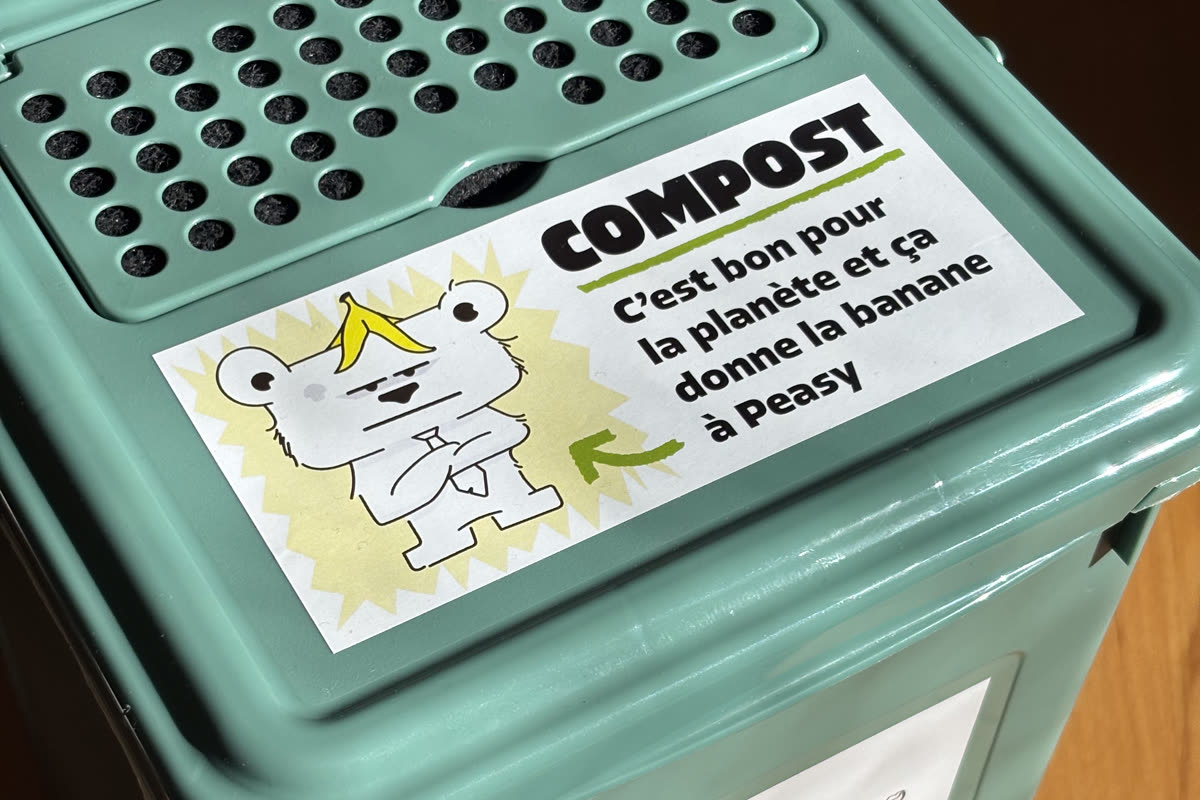
A compost caddy is chosen on three things: usable volume, material, and how the lid breathes. For a collection point in an office, allow 7 litres emptied every other day at a coffee point, 10 litres emptied daily in a break room, in stainless steel or smooth plastic, with a perforated lid and its charcoal filter: an airtight seal traps the moisture and manufactures the very odours it claims to prevent. What the container never settles is where its contents go next. Separating food waste at source is now a legal duty for businesses in the European Union and, under their own rules, across the United Kingdom.
Key takeaways
Two objects go by the same name. The caddy is the sorting container, 5 to 30 litres. The composter is the treatment container: at Easy to Compost, a 450 L cylinder in 2 mm steel that absorbs up to 1,500 kg a year.
Volume follows from what a site actually produces, not from an average. The conversion rule used throughout this site: a full 240 L wheeled bin weighs about 95 kg, that is 0.4 kg per litre.
Compost bins: two objects behind one word
The search term mixes up two pieces of equipment that do quite different jobs. The caddy, sitting on a worktop or in the break room, catches the peeling at the moment it appears, and that is all it does. The composter transforms the material. Confusing the two leads to the classic disappointment: a bucket filled over three weeks, then tipped into the general waste for want of anywhere else to send it. A third object comes in between at work, the 120 or 240 L wheeled bin: it stores between two lorries and therefore forces regular collection, because fresh food waste will not keep three weeks in a back store.
| Container | Role | Volume | What it settles | What it does not settle |
|---|---|---|---|---|
| Caddy | catching waste where it is produced | 5 to 30 L | the sorting habit, hygiene at the workstation | where the material goes next |
| Wheeled bin | storing before removal | 120 or 240 L | the volume between two lorries | how fast the material rots: up to 52 collections a year |
| On-site composter | transforming on the spot | 450 L of composting, ABC composter and garden composter alike | where the material goes, and how often: 1 to 12 collections a year | volumes above 3,000 kg a year |
The alternative processes read against the same grid: bokashi is a fermentation bucket, so a pre-treatment that still needs somewhere to send the result.
What size to choose, collection point by collection point
Product sheets announce a volume "ideal for an average household", which gets you wrong twice over: too small and the caddy overflows and sorting stops; too large and the material sits there for five days, and in summer that settles it. The calculation is one division: daily volumes in kilos, divided by 0.4 kg per litre, multiplied by the number of days between two emptyings. That is the density we use everywhere, including for sizing a composter. Then add headroom: a caddy is never filled to the brim, or the lid stops closing and the trip to the composter makes a mess.
| Collection point | Usable volume | Emptying |
|---|---|---|
| Coffee point, 10 to 20 people | 7 L | every 2 days |
| Break room, 30 to 60 people | 10 L, or two 7 L caddies | every day |
| Staff restaurant kitchen | 20 to 30 L on castors | every service |
| Tray return, dishwash | 60 L bin alongside the line | every service |
| Home kitchen, 2 to 4 people | 5 to 7 L | every 2 to 3 days |
Two habits come with it: add drop-off points rather than litres, because a caddy that is out of the way does not get used, and keep cardboard to hand to balance coffee grounds, which are very wet. Here is the full calculation, on an office floor with no staff restaurant, using the ratios that our guide to sizing a composter publishes and that the sizing tool applies.
The maths
- People on site on a normal day 120
- Office ratio with a coffee point, 0.015 × 1.5 0.0225 kg/person/day
- Working days used 220
- Theoretical annual volumes 594 kg
- Capture rate used 70 %
- Volumes actually captured 416 kg/year
- That is, per working day 1.9 kg
- Converted at 0.4 kg per litre 4.7 L/day
- Usable fill used, so that the lid still closes 50 %
- Container volume needed, 4.7 ÷ 0.5 9.4 L
Caddy to install10 L emptied every day, or 2 × 7 L at two points
Change one assumption and the result follows: a staff restaurant adds 0.075 kg per meal served, a care home counts 0.140 kg per bed per day over 365 days.
Which material to go for, and the real microplastic risk
Only one criterion counts: a smooth, non-porous surface that holds neither liquid nor smell and that goes in the dishwasher. Price and design change nothing there, and wood disqualifies itself: it drinks the liquid, stains, and cannot be disinfected.
| Material | Strengths | Limits | Verdict |
|---|---|---|---|
| Stainless steel | odour-neutral, non-porous, goes in the dishwasher | heavy, dearer to buy | the best choice in professional use |
| Food-grade plastic | light, inexpensive, unaffected by moisture | scratches, yellows, holds odours if the grade is poor | good value for the use as long as the wall is undamaged |
| Wood or bonded bamboo | pleasant to look at | absorbs moisture, stains, cannot be disinfected | to be ruled out in contact with food waste |
| Enamel, ceramic, glass | smooth, very good against odours | heavy, breakable | careful domestic use |
The case against plastic deserves a qualification: at ambient temperature the problem is not the acidity of the liquid but mechanical wear. An undamaged wall releases very little; a wall that has been scratched and scoured with harsh products sheds particles that do not disappear in composting and end up in the soil. Soft side of the sponge, no abrasives, replacement as soon as the wall is marked. The same trade-off applies to the treatment container, where we have compared steel, wood and plastic.
Ventilation, odours and liquid: it all happens in the lid
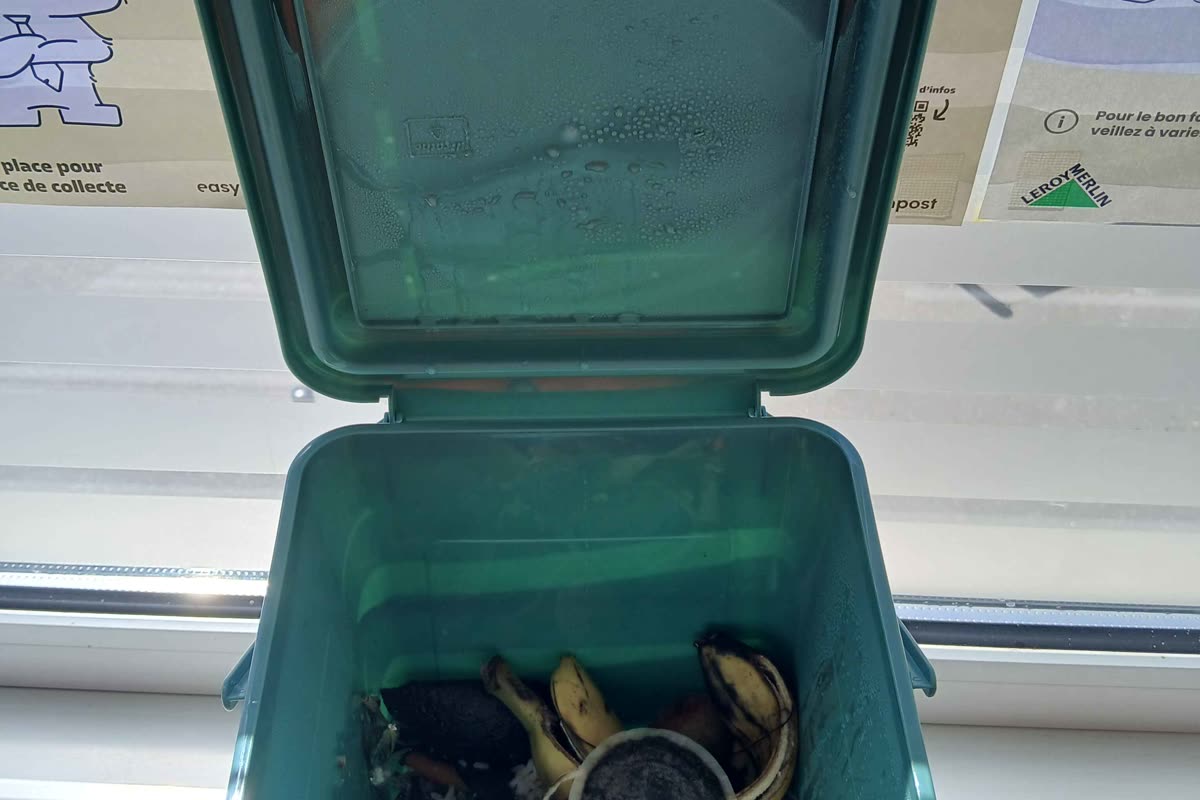
Intuition says airtight, practice says the opposite. A perfectly sealed container keeps the moisture inside: it condenses on the lid, falls back, saturates the material, and fermentation turns anaerobic, the kind that smells and that produces liquid. A perforated lid backed by an activated charcoal filter lets the moisture out and holds the odorous compounds in. Three days of storage then become realistic, even in August.
The rest comes down to use. Do not press the material down: the air between the peelings is what stops liquid forming. Balance the moisture with kraft paper or brown cardboard, and empty on the same day anything that degrades fast, fish and meat first of all. The smell from a caddy usually comes from the bottom of the container, not from what is in it: hot water and vinegar once a week. And insist on a lid that opens one-handed, a handle that does not give way under load, and a container with no awkward corners. What belongs in the caddy is set out in our guide to what can go into a commercial composter, and pests and odours are dealt with in composting at work without odour or pests.
Compostable liners: what the standard says, and what the label may claim
A liner is not compulsory, it is a comfort: it avoids splashes at the transfer and cuts down on cleaning. That comfort is a recurring cost to budget for, and it comes with two traps. The first is semantic. Biodegradable and compostable are not synonyms: the first word says nothing about the conditions or the time required. Regulators have caught up with common sense here, and unqualified green claims such as "biodegradable" or "environmentally friendly" are now restricted by consumer-protection rules in most European markets, with the detail set country by country. Check what your market allows before you print anything on a bag.
The second trap is technical. The European standard EN 13432 covers compostability in an industrial plant, at the high temperatures such plants reach. Home composting, at ambient temperature, is a different test altogether, and it is covered by certification schemes such as OK compost HOME rather than by that standard. A liner that meets EN 13432 alone can come out of a garden composter intact. Check the reference printed on the bag itself, not the sales copy on the packaging, and take the thickness above the one that looks sufficient: a liner gives way at precisely the moment it is full.
In a business, the caddy is not enough
Separating food waste at source is a duty on the business, not on the container. In the European Union it comes from Article 22 of the Waste Framework Directive 2008/98/EC, which required separate collection or recycling at source by 31 December 2023 and applies in Ireland; the United Kingdom sits outside the directive and runs four separate regimes, Simpler Recycling in England, the Waste (Scotland) Regulations 2012, Workplace Recycling in Wales since 2024, and its own regime in Northern Ireland. Buying caddies is therefore not enough to be in order: the duty covers a whole chain, from the sorting habit through to recovery, and it is proved with a document.
Penalties are set nationally and do not carry across borders: the amounts, the body that issues them and the appeal route differ in each regime, and what is a fixed penalty notice in one country is an administrative fine from the local authority in another. Ask your local authority or environmental regulator which text covers your site and what it provides for, rather than working from figures published for another market.
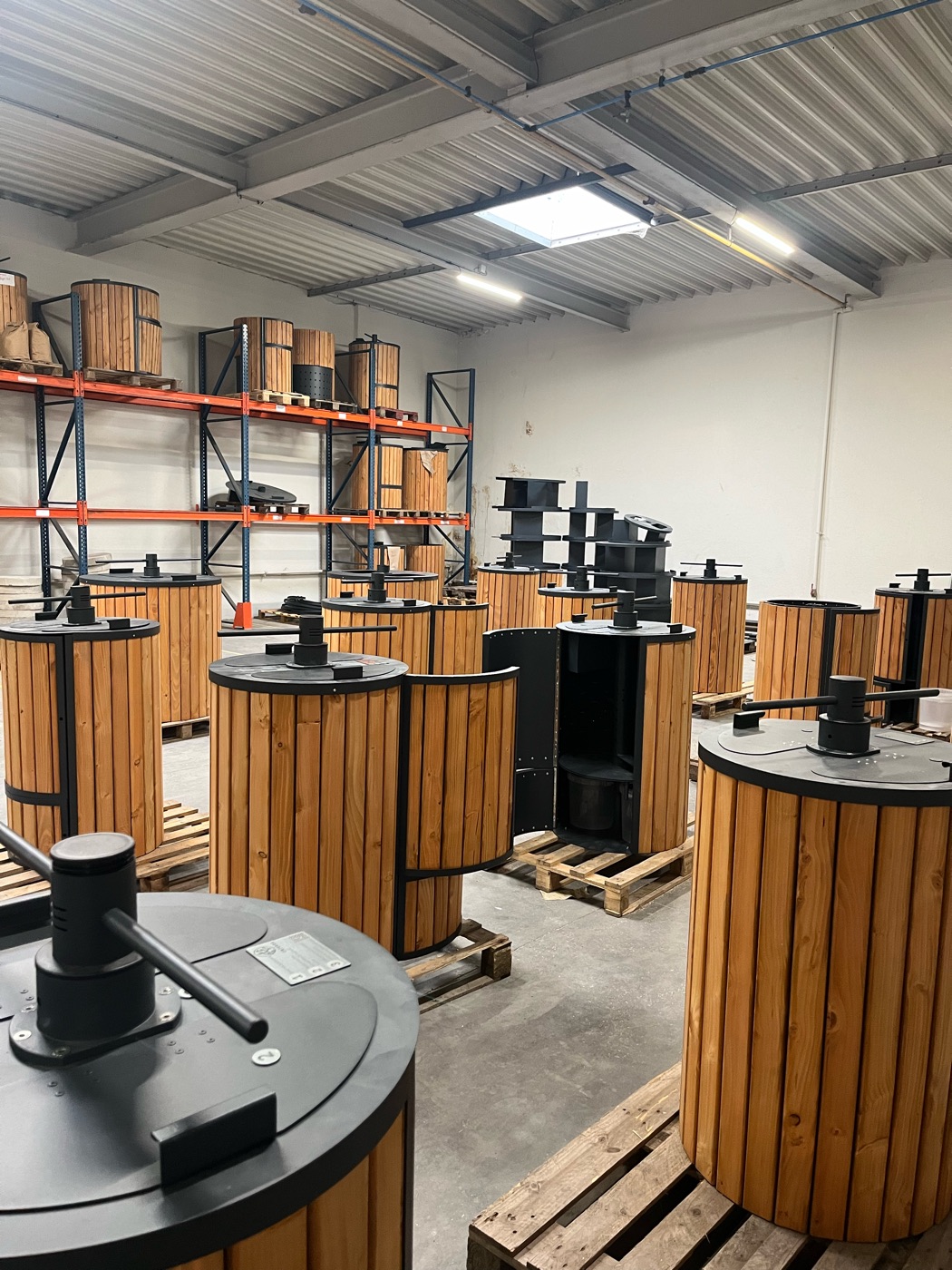
That leaves the destination. Either the material leaves fresh and the lorry comes back often, or it is treated on site and the lorry becomes rare: that is the principle behind the ABC composter, a 450 L cylinder in 2 mm steel built in our workshop in France, with its central aeration chimney and its mechanical mixing turned by hand. It plugs into nothing: no electricity, no water, no drainage, no groundworks. What comes out of it a few months later is a pre-compost, and where it goes from there is arranged locally, with a composting site or a landowner near you; the how it works page sets out the sequence.
How often the composter has to be emptied
The ABC composter is rented at 79 € excl. VAT a month: the unit, the bulking agent, the awareness kit, the training of your teams and the maintenance, on a 48-month commitment, and it can be bought outright as well. In France, collection is an option at 10 € excl. VAT a month per annual visit, from 1 to 12 visits, and it is what brings the weight record, since the material is weighed when it is taken away; elsewhere that removal is arranged with a local operator of your choice. The number of visits is not a matter of preference: it follows from your volumes, using the table below, the one the online quote applies.
| Volumes captured per year | Collections a year | Monthly, excl. VAT |
|---|---|---|
| up to 250 kg | 1 | 89 € |
| 251 to 450 kg | 2 | 99 € |
| 451 to 625 kg | 3 | 109 € |
| 626 to 750 kg | 4 | 119 € |
| 751 to 875 kg | 6 | 139 € |
| 876 to 1,125 kg | 9 | 169 € |
| from 1,126 to 1,500 kg | 12 | 199 € |
The maths
- Volumes captured per year, taken from above 416 kg
- First band of the table that covers it 450 kg
- Matching number of collections 2 a year
- Rent of the ABC composter 79 € excl. VAT/month
- Collection option, 2 × 10 €, French benchmark 20 € excl. VAT/month
Monthly, that is 1,188 € excl. VAT a year99 € excl. VAT
Three limits frame all of this. One composter absorbs up to 1,500 kg a year; beyond that a second one is added and everything doubles; above 3,000 kg a year, on-site composting is no longer the right answer. If your grounds can absorb the compost, nothing has to leave the site at all and the composter on its own is enough: you empty it yourself, and you give up the removal note, which means you need another way of evidencing what you sort. The garden composter composts the same 450 L, under a circular planter of 2,000 L, and comes on the same terms: to buy, or to rent over 48 months.
Common questions
What size of caddy should you choose?
Divide your daily volumes in kilos by 0.4 to get litres, then multiply by the number of days between two emptyings. A coffee point serving 10 to 20 people needs a 7 L caddy emptied every other day; a break room for 30 to 60 people needs 10 L emptied every day.
Should a caddy be airtight or ventilated?
Ventilated. A perfectly sealed container keeps the moisture inside, the material saturates and fermentation turns anaerobic, the kind that smells and that produces liquid. A perforated lid backed by an activated charcoal filter lets the moisture out and holds the odorous compounds in. An airtight caddy is only acceptable if it is emptied every day.
Are compostable liners compulsory?
No. They make the transfer easier and cut down on cleaning, but they are a recurring cost. Check the standard printed on the liner itself: EN 13432 covers compostability in an industrial plant, while home composting at ambient temperature is covered by certification schemes such as OK compost HOME.
Is a caddy enough to meet the legal duty on food waste?
No. Separating food waste at source is a duty on businesses in the European Union, under Article 22 of Directive 2008/98/EC, and under each nation's own rules in the United Kingdom, and it covers the whole chain through to recovery, not just the container. Buying caddies is a first step, not evidence. Penalties for failing to separate are set nationally and differ from one regime to the next: ask your local authority which text covers your site.
The checklist, then the number
Seven checks before you order: the first five cover the caddy and its consumables, the last two cover what comes after it.
- Work out the volume: daily volumes in kilos, divided by 0.4, multiplied by the number of days between two emptyings.
- Choose stainless steel or a smooth food-grade plastic, and rule out wood in contact with the material.
- Insist on a perforated lid with a charcoal filter, a solid handle and a container with no awkward corners.
- Check that it is dishwasher-safe, or plan for weekly cleaning by hand.
- For liners, check the reference printed on them: EN 13432 for industrial composting, an OK compost HOME certification for home composting.
- Name the destination of the material before you buy the first caddy, not after.
- Make sure you can produce evidence of what you sort on the day an inspector asks.
That leaves the number, which governs everything else. The sizing tool estimates your annual volumes from a few figures from your trade (people on site, meals served, covers, beds) and gives you the matching number of composters, with no sign-up. If several premises are involved, the Decathlon network case study shows how the same set-up is replicated site by site, and where we deliver sets out the countries we ship to.
A free assessment, a quote within 24 h
Thirty minutes on a video call to go over the food waste separation duty that applies where you operate, size the solution and estimate your savings.
