
Resource
Tumbler, ABC or traditional composter: an honest comparison
Tumbler, ABC in-vessel composter or traditional bin: the comparison table, the cost lines nobody budgets for, and the one criterion that really decides for a professional site.

For a professional site the answer takes three lines. The traditional wooden or plastic composter is a garden object: it stands up neither to rodents nor to the volumes a workplace produces. The tumbler composter speeds up the active breakdown phase, but it is mechanical, noisy, small in capacity, and it has to be bought. The ABC composter mixes by hand with no motorised part, holds aeration continuously, and is rented as a full service at 79 € excl. VAT a month. The criterion that decides is neither speed nor purchase price: it is the annual volumes to be absorbed, and what is left to do once the composter is in place.
Key takeaways
Traditional: 50 to 300 € to buy, no directed aeration, walls that do not keep rodents out, mixing with a fork. Fine for a private garden, beside the point for a professional site.
Tumbler: 1,000 to 4,000 € to buy depending on capacity, active phase cut to 3 to 6 weeks, but 200 to 500 L per drum, noise, and wearing parts.
ABC composter: 2 mm steel, 450 L, up to 1,500 kg absorbed a year, mechanical mixing turned by hand, no connection of any kind. To buy or to rent over 48 months, delivered on a pallet with its bulking agent and a remote handover for your team; collection is contracted locally.
The comparison, criterion by criterion
The three technologies are not in the same category. The table sets them against each other on the criteria that really decide in a business: capacity absorbed over a year, resistance to pests, siting constraints, and what is left to the site once the equipment has been delivered.
| Criterion | Traditional (wood, plastic) | Tumbler (drum) | ABC composter |
|---|---|---|---|
| Mixing | With a fork, inside the bin | Full rotation of the drum | Mechanical, turned by hand |
| Aeration | Passive, through the walls | Only at the moment of rotation | Continuous, through the central chimney |
| Material | Thin wood or plastic | Plastic or painted steel | 2 mm steel |
| Resistance to rodents | No | Reasonable: the drum is closed and raised, but most models have a plastic wall | Yes, closed steel enclosure |
| Usual volume per unit | 300 to 800 L | 200 to 500 L | 450 L |
| Volumes absorbed per year | A few hundred kg of garden waste, far less in plate waste | Limited by the drum volume and by batch operation | Up to 1,500 kg |
| Mechanical wearing parts | None | Shaft, bearings, gearbox | No motorised part |
| Electricity, water, drainage | None | Depending on the model | None, and no groundworks |
| Noise | None | Pronounced during rotation | Low |
| How it is acquired | Purchase | Purchase | Rent over 48 months, or buy |
| Typical price | 50 to 300 € to buy | 1,000 to 4,000 € to buy, observed catalogue prices | 79 € excl. VAT a month |
| What is left for you to cover | Bulking agent, upkeep, emptying, replacement | The same, plus mechanical maintenance | Sorting, a few turns of the crank, and topping up the bulking agent supplied with the machine |
The last line is the one people forget when they compare. A composter is a container: it supplies neither the carbon-rich bulking agent that has to be added all year, nor the upkeep, nor the training of the teams, nor the document you produce if an inspector asks. Those items do not disappear whichever machine you buy; they simply move to another budget line, and they are worth costing before you compare purchase prices.
The open traditional composter
This is the slatted wooden or injection-moulded plastic bin sold in garden centres, open at the top and often with no base. It was designed to take grass cuttings, leaves and peelings from a household, fed in very gradually. On that ground it does its job, and its value for money is hard to beat.
Moved to a professional site, it fails for three mechanical reasons. The first is the absence of directed aeration: pile up nitrogen-rich plate waste and the material compacts, oxygen no longer reaches the core of the heap, breakdown turns anaerobic and the odours follow within days. The second is the wall: a few millimetres of wood or plastic will not stop a rat, which will gnaw through it or come up through the open base, a point we set out in our article on rodent-proof composters. The third is human: mixing with a fork is physical work, it is nobody's job on the site, so it gets put off and then abandoned.
Then there is service life: 3 to 5 years for a plastic exposed to UV, 8 to 12 years for wood treated every year, where a powder-coated 2 mm steel body passes 20 years. The material is not a question of finish: it decides how pest-proof the unit is and over how long it is written down, as the comparison between steel, wood and plastic shows.
The tumbler composter (drum)
A tumbler is a drum mounted on a shaft, turned by a crank or by a motor. The idea is a good one: instead of working a compacted material with a tool, you turn the whole mass over in a single movement. The mix is even, oxygen reaches everywhere, and the active breakdown phase can fall to 3 to 6 weeks where a traditional bin takes several months.
The limits lie elsewhere. Capacity first: 200 to 500 L per drum, and batch operation. You have to stop feeding a drum to let the batch mature, which means installing two in alternation and doubling the outlay. Noise next: rotating a mass of several hundred kilos on a shaft is audible, which rules it out of a hotel courtyard, an office patio or the terrace of a care home. And the mechanics: shaft, bearings, seals and gearbox are wearing parts, and a breakdown stops the service until it is repaired.
A point of vocabulary, because the confusion is common: a tumbler composter is not an electromechanical composter. Those are powered machines that grind and dehydrate food waste in 24 hours and give back a dry material that is not mature compost. How the drum works in detail is covered in our article on tumbler composters.
The ABC composter
The ABC composter is designed and built in our workshop in France. It is a closed 450 L enclosure in 2 mm steel, built around a central aeration chimney. Fresh air enters at the bottom, passes through the material as it breaks down, picks up heat and moisture, and leaves at the top. That circulation does not depend on anyone doing anything: it is permanent, which prevents compaction and therefore the anaerobic conditions that are the first cause of odours.
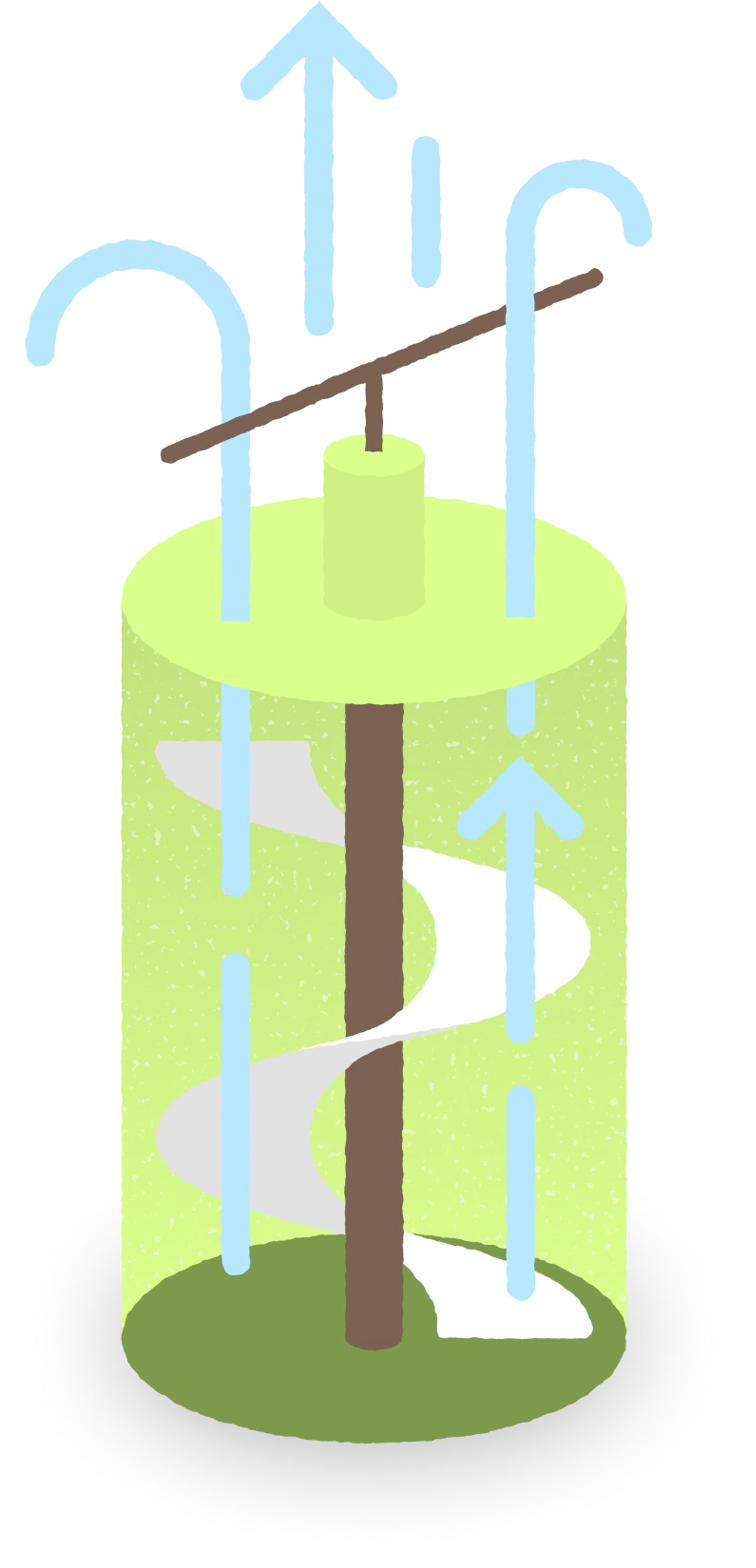
The mixing is mechanical and turned by hand: a few turns are enough, with no tool and none of the effort of a fork. So there is no motorised part to maintain, and no rotation noise. Above all, the ABC composter plugs into nothing: no power supply, no water, no drainage, no slab and no groundworks. Set on a flat surface, it is operational on the day it is delivered. The principle is set out in our article on ABC composting technology.
Capacity is thought of in kilos a year, not in litres: one composter absorbs up to 1,500 kg of food waste a year. Above that, a second one is added. Above 3,000 kg a year, on-site composting stops being the right answer and an off-site treatment route has to be looked at. And the equipment can be taken either way: the composter range is available to buy or to rent over 48 months, which moves the question away from a purchase price and on to what the machine costs to run once it is on site.
What each solution really costs you
Comparing a purchase price and a rental only makes sense over the same period and the same scope. Take the 48-month term, and a site whose volumes have been measured rather than estimated: weighing the caddy over 10 working days gives an average of 3.4 kg a day, that is about 750 kg over 220 working days.
The maths
- Measured annual volumes 750 kg
- Composters needed, 1,500 kg a year each 1
- Rent of the composter, everything included 79 € excl. VAT/month
- Emptying operations these volumes call for 4 a year
- Cost of collection, 10 € excl. VAT per annual visit, French benchmark 40 € excl. VAT/month
Monthly total, that is 5,712 € excl. VAT over 48 months119 € excl. VAT/month
How often the composter is emptied is not a matter of preference: it follows from the volumes the site produces. Each band in the table below is a threshold, and you take the first one whose ceiling covers your volumes.
| Annual volumes | Collections a year | Monthly, excl. VAT |
|---|---|---|
| Up to 250 kg | 1 | 89 € |
| 251 to 450 kg | 2 | 99 € |
| 451 to 625 kg | 3 | 109 € |
| 626 to 750 kg | 4 | 119 € |
| 751 to 875 kg | 6 | 139 € |
| 876 to 1,125 kg | 9 | 169 € |
| 1,126 to 1,500 kg | 12 | 199 € |
Above 1,500 kg a year a second composter comes into play and everything doubles. Conversely, if the mature compost is used on the spot, in the site's own grounds or by a neighbour who wants it, the composter on its own is all you need and nothing has to be taken away at all.
On the other side, the 1,000 to 4,000 € excl. VAT of a professional tumbler cover the container and nothing else. You still have to budget for the bulking agent added all year, the upkeep of the mechanics, removal of the mature compost, staff time and eventual replacement. Those are the lines the monthly rent absorbs. Like for like over 48 months, the tumbler is therefore not compared with 5,712 € excl. VAT, but with its purchase price plus those items: each site has to cost them with its own internal rates, and that is where the gap opens or closes.
Which technology for which use
Before choosing between the three families, six questions are enough to rule out the wrong tracks. None of them calls for particular expertise: only the first takes time, two weeks of weighing, and the other five can be answered within the hour.
- What are the real annual volumes, measured by weighing the caddy over two weeks rather than estimated by eye?
- Will the composter stand near an occupied area, a terrace or a space open to the public? If so, the noise of a drum and the opening of a bin are both disqualifying.
- Does the chosen spot have a power supply and drainage? If not, rule out any equipment that plugs in.
- Who brings the bulking agent, who mixes, who empties, and on whose identified working time?
- What becomes of the mature compost once it is produced: the site's own grounds, a neighbouring farm, or removal?
- What do you show an inspector to prove that your food waste is genuinely separated and recovered?
The answers almost always point to the same split. A private individual with a garden stays with a traditional wooden bin, which suits them. An office, healthcare, hotel, retail or industrial site goes to the steel ABC composter, which takes the volumes with no connection and produces the evidence. A local authority, a school or a site with green space will look instead at the garden composter, which houses the same 450 L of composting at the centre of a circular planter of 2,000 L: the same volumes absorbed, but it composts and flowers in the same place. The tumbler keeps its place on very small volumes, away from sensitive neighbours. Above 3,000 kg a year, none of the three will do and the question becomes one of an off-site route.
What the law requires, and what it does not
Separating food waste at source is a legal duty on businesses. In the European Union it comes from Article 22 of the Waste Framework Directive 2008/98/EC, which set 31 December 2023 as the date for separate collection or recycling at source and applies in Ireland. The United Kingdom sits outside the directive and runs four distinct regimes: Simpler Recycling in England, the Waste (Scotland) Regulations 2012, Workplace Recycling in Wales since 2024, and its own regime in Northern Ireland. Scope, thresholds and dates differ between them, but the two routes are open in all four. The ABC composter takes the second: it treats the food waste on the site that produces it, removes 65% of the mass and turns fifty-two collections a year into a handful.
No regime prescribes a technology. None of them bans the garden-centre bin or mandates a steel composter. What they require is that food waste is genuinely kept out of residual waste and recovered, and that the business can demonstrate it. That last point is what disqualifies equipment bought with no thought for the records: a bin produces no written trace, so whoever chooses one has to organise the weighing and the log themselves, and keep the notes from whoever takes the material away.
On penalties, one rule holds: they are national. The amounts, the enforcing body and the appeal route are set by each regime, and figures published for one country say nothing about another. Ask your local authority or environmental regulator which text covers your site and what it provides for.
Common questions
Is a tumbler composter faster than an ABC composter?
On the active breakdown phase, yes: mixing the whole mass at every rotation can bring that phase down to 3 to 6 weeks, against several months for a traditional bin. But speed is not what decides on a professional site. What decides is the number of kilos absorbed over a year, the space available, the noise that can be tolerated and the working time it takes up. A fast 300 L drum saturates long before a 450 L composter that absorbs up to 1,500 kg a year.
Does the ABC composter need electricity?
No. No electrical connection, no water supply, no drainage, no groundworks. The mixing is mechanical and turned by hand. That is what separates it from electromechanical composters, those powered machines that grind and dehydrate food waste and give back a dry material that is not mature compost.
Can you buy an ABC composter?
Yes. The composter is available either way: you can buy it outright, or rent it over 48 months at 79 euros excl. VAT a month, the rent covering the composter delivered, the bulking agent, the maintenance and the awareness work with your teams. It arrives on a pallet with its bulking agent, and the team is taken through it on a video call. Installation is done by the site itself, since the machine needs no electricity, no water and no groundworks. In France, collection is a separate option at 10 euros excl. VAT a month per annual visit, from 1 to 12 visits a year; elsewhere the removal of the mature compost is arranged with a local operator of your choice.
Can a traditional composter be enough for a business?
For a few kilos a week and with no public nearby, it can hold up. Beyond that, three things catch up with it: thin walls do not stop rodents, the absence of directed aeration tips the material into anaerobic conditions and therefore into odours, and mixing with a fork ends up being neglected. It also produces no evidence you could use if an inspector asked.
What does a site producing 750 kg of food waste a year need?
One composter. Those volumes fit inside a single 450 L ABC composter, which absorbs up to 1,500 kg a year, and they call for about 4 emptying operations over the year. How often it is emptied is not a matter of preference: it follows from the volumes the site produces.
Where to start
The choice turns on a figure few sites know: their annual volumes. Start there. Put a scale next to the caddy, note the weight every evening for two weeks, multiply the average by your number of working days. That figure alone rules out two of the three technologies in most cases.
With that figure in hand, the sizing tool gives you in a few minutes the number of composters your site needs and how often each will have to be emptied, with no vague ranges. If you would rather first understand how an installation unfolds, from delivery to the first batch of compost, the how it works page sets it out step by step.
A free assessment, a quote within 24 h
Thirty minutes on a video call to go over the food waste separation duty that applies where you operate, size the solution and estimate your savings.
