
Resource
Tumbler composters: pros and cons
How a rotating drum works, what its advantages really cost, and the volumes at which it stops being enough.
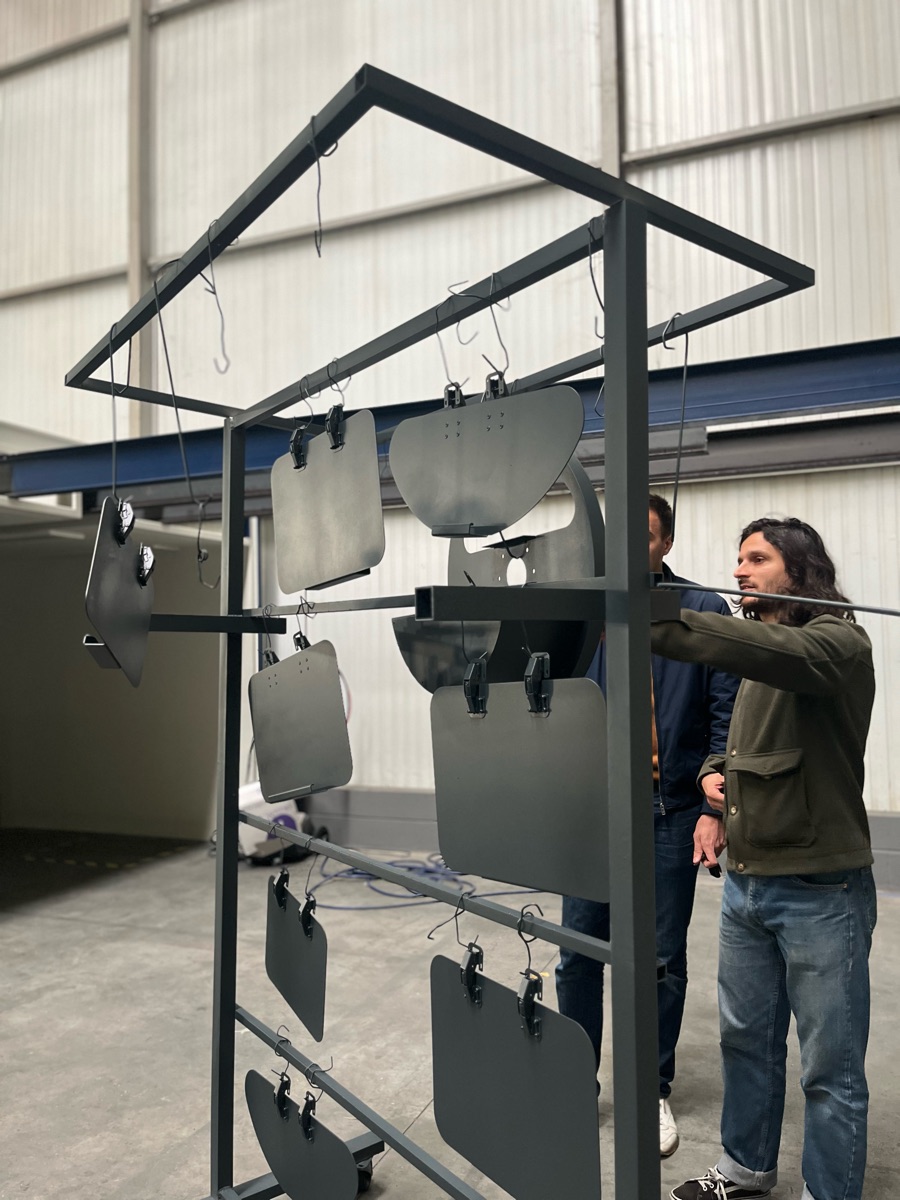
A tumbler composter is a drum on an axle that you turn by crank to mix the material without a fork. It shortens the active phase of composting to 3 or 6 weeks, keeps rodents out better than an open bin, and stands on a terrace. In return it works in batches, tops out between 200 and 500 L per drum, is bought rather than hired, and leaves you with the bulking agent, the wear parts and the final destination of what comes out. For a household or a seasonal run of garden waste, it is a good tool. For a working site that has to absorb several hundred kilos a year and show what becomes of them, it reaches its limit very quickly.
Key takeaways
What the drum does well: a shorter active phase, mixing without fork work, a closed raised tank, a footprint of around a square metre. What it does badly: 200 to 500 L per drum, batch working that does not sit with a daily flow, an axle and bearings to maintain, and an outright purchase of 1,000 to 4,000 € with no service behind it. What it does not do at all: supply carbon-rich bulking agent all year, train your teams, produce the record an inspector asks for, or take the material away at the end of the cycle.
How a tumbler composter works
The principle fits in a sentence: a cylindrical or hexagonal tank, mounted on a frame around a horizontal axle, that you turn a few revolutions every two or three days. You load through a hatch, close it, and turn. Each rotation turns the mass over, breaks up the anaerobic pockets that form in the heart of the heap, brings the nitrogen-rich material (peelings, meal leftovers) back into contact with the carbon-rich material (bulking agent, shavings, brown cardboard), and puts oxygen back in.
That oxygen is the real subject. Composting is an aerobic process. Starved of air, the bacteria and fungi that break the material down give way to fermenting micro-organisms that produce volatile fatty acids, and so odour, and the temperature drops back. Regular mixing does the opposite and restarts the thermophilic phase, the one in which the core of the heap climbs to between 45 and 65 °C, as our article on the composting cycle, its phases and its temperatures sets out.
First friction: heat is produced in the volume and lost through the walls. A small drum has a great deal of wall for very little volume, so it cools faster than it heats, especially from November to March, and the thermophilic phase is not always reached. Some models compensate with a twin chamber, one maturing while the other receives, at the cost of halving the working volume on each side.
The claimed advantages and what comes back
The sales arguments for a tumbler composter are not false. They are incomplete. The table takes each of them in turn, what is genuinely true, and what the argument leaves out.
| The argument | What is true | What comes back |
|---|---|---|
| Faster composting | Regular mixing shortens the active phase to 3 or 6 weeks, against several months in an open bin that is never turned. | Maturing, on the other hand, does not speed up. What comes out of the drum is young material, which still has to rest before any land spreading. |
| No more fork work | A few turns of the crank replace turning by hand, a heavy job that is rarely done properly. | A full drum weighs several tens of kilos and becomes hard to turn: the bigger the tank, the more the crank resists. Someone has to be named to turn it, holidays included. |
| Protected from rodents | The tank is closed and raised: rats cannot reach it from the ground, unlike an open-based bin. | Most consumer models are moulded plastic, which can be gnawed through. The decisive criterion is the material, not the rotation. |
| Fewer odours | Oxygenation avoids anaerobic fermentation, the main source of odour in a composter. | A drum that is too wet and too rich in nitrogen still smells. The carbon to nitrogen ratio still has to be held, so the bulking agent still has to be supplied. |
| Fits on a terrace | A footprint of around a square metre, no connections, nothing to fix down. | Working volume follows the footprint: 200 to 500 L per drum, the output of a few households, not of a site. |
| You buy it once | No subscription: the equipment goes on the balance sheet and the matter looks settled. | The purchase price climbs with capacity on commercial models, and on top of it come, every single year, the bulking agent, the wear parts and your teams' time. |
The last line is the one people forget. A composter you buy is a container: it delivers neither the bulking agent you have to bring in all year, nor the training of your teams, nor the record you produce if an inspector asks. Those items do not disappear, they simply move to another budget line. If the material is your main criterion, our comparison of steel, wood and plastic sets out the usual service life of each type of wall.
The limit that decides everything: batch working
A tumbler drum is a batch reactor. You fill it, close it, and wait. Adding fresh material halfway through the cycle resets the clock: the batch is never finished, and the most recent material has not had time to break down. That suits grouped, seasonal loads perfectly, a hedge trim or the end of a vegetable patch. It is structurally incompatible with a kitchen, a tea point or a canteen producing peelings every day of the week. Both workarounds are expensive: multiplying drums means buying the same object several times over, and moving to a twin chamber halves the volume on each side, which makes the heat problem described above worse.
An ABC composter takes the problem the other way round: it works as a continuous flow. You load from the top every day, the material travels down as it breaks down, and you draw off from the bottom what has made the journey. No batch to close, so never a period during which the caddy in the break room has nowhere to go. If you are weighing up the three families of equipment, our comparison of the tumbler, the traditional bin and the ABC composter puts them side by side against 12 criteria.
How much your site produces, and what that means
The technology argument is only settled once you have the figure. Take a 200-person head office with a coffee point and no staff restaurant. The assumptions are stated and checkable: they come from the ratios we set out in our article on sizing a composter to your food waste.
The maths
- People on site on a normal day 200
- Working days used 220 a year
- Office ratio, uplifted by 50 % for the coffee point 0.0225 kg per person per day
- Theoretical volumes 990 kg a year
- Capture rate used, meals taken outside and imperfect sorting 70 %
Volumes actually captured693 kg a year
About 700 kg a year, a little over 3 kg per working day. The problem is not the instantaneous capacity of the drum, it is the length of the cycle: during the six weeks a batch takes to mature, production does not stop. Some 95 kg of fresh food waste arrives over that period, and as much bulking agent has to be mixed in with it. A 400 L drum is therefore already tight for a single batch, and a second one is needed, receiving, while the first finishes. The equipment is bought twice over.
The maths
- Captured volumes used 700 kg a year
- One composter absorbs up to 1,500 kg a year 1 composter
- Rent of the composter, everything included 79 € excl. VAT/month
- Collection option, 4 × 10 €, French benchmark 40 € excl. VAT/month
- Monthly 119 € excl. VAT
Annual cost, everything included1,428 € excl. VAT
What matters here is the physical ceiling, not a negotiation line by line. One composter absorbs up to 1,500 kg a year; beyond that a second is added and the sizing is redone on two tanks. Above 3,000 kg a year, on-site composting is no longer the right answer and we say so: at that point you are looking at a food waste collection sized for the volume, which you contract locally. You can run the exercise for your own site with the online sizing tool.
What the rules require, and what they leave open
Separating food waste at source is now required of businesses across the markets we ship to, under regimes that differ nation by nation: Simpler Recycling in England, the Waste (Scotland) Regulations 2012 in Scotland, the Workplace Recycling rules of 2024 in Wales, a separate regime in Northern Ireland, and in Ireland the national food waste regulations that transpose the EU waste framework. Thresholds and start dates are not the same everywhere, and a fifteen-person office is not always caught on the same date as a logistics platform, so check which text applies to you.
None of these regimes prescribes a technology: a tumbler drum, an in-vessel composter, a wormery or a separate collection by a contractor can all have their place. What they require is that food waste does not end up in residual waste or down the drain, and that you can show it. A drum bought from a garden centre is not therefore outside the rules: it simply gives you nothing to show. The evidence is entirely yours to build, with a log of what goes in and a record of where the material ends up.
Penalties are set nation by nation, from a fixed penalty or a compliance notice up to prosecution, and the level that applies to you is the one your own regulator publishes. Carrying a figure across from another market tells you nothing useful, and the practical consequence is the same everywhere: a system that cannot be evidenced is treated as no system at all.
Eight questions to ask before buying a drum
This list takes half an hour to fill in, with the supplier's quote in front of you. If three answers are missing, the purchase is premature.
- What annual volumes do I have to absorb, in kilos? Without that figure, no drum size means anything.
- Are my loads daily or grouped? A daily flow sits badly with a reactor that works in batches.
- Where will I find carbon-rich bulking agent, all year round, and who places the order?
- Who turns the drum, how often, and what happens over the summer holidays?
- Does the wall stand up to rodents? Moulded plastic can be gnawed through, steel cannot.
- Which parts wear (axle, bearings, gearbox), under what warranty and with what lead time on spares?
- What becomes of the material once it is out? Spreading on site, removal, a local farm: settle that before the purchase, not after.
- What record will I produce to show that food waste is separated at source?
Questions 5 and 7 do the most damage when they go unanswered: our article on rodent-proof composters deals with the first.
The alternative on a working site: the ABC composter
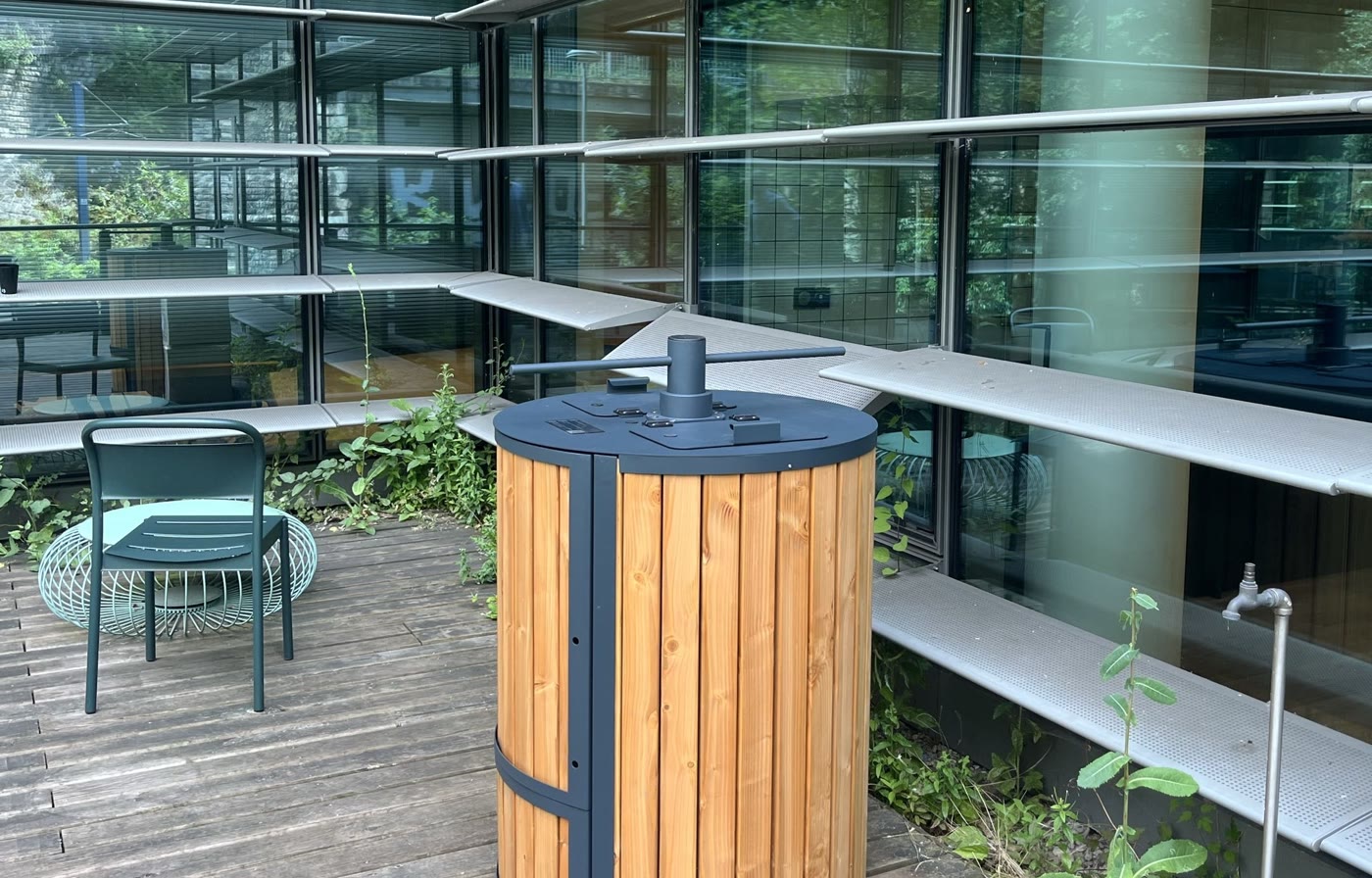
The ABC composter is a sealed 2 mm steel tank of 450 L, designed and built in our workshop in France. Its mechanical mixing is hand-cranked, and aeration is continuous through a central chimney. There is nothing to plug in: no electricity, no water, no drain, no groundworks. It should not be confused with the machines sold as electromechanical, which are powered grinder-dehydrators.
The composter is rented at 79 € excl. VAT a month on a 48-month commitment, and it can be bought as well. The rent covers the composter delivered, the bulking agent, the maintenance and the awareness work with your teams: that is what the page on the composter on its own sets out. For a site with grounds, the garden composter, a circular 2,000 L planter, is 129 € excl. VAT a month.
What comes out of the tank after a few months is not a mature, standard-compliant compost. The material has to be taken away and given a final destination, a licensed composting or sanitisation facility or land spreading, through an operator you contract locally: outside France that step is not part of what we supply. It is that journey, and not the composter itself, that produces the traceability an inspector will look for, and the page on how it works sets out each stage.
Outside France we ship the equipment, its bulking agent and its spare parts, and the handover is run remotely. What we do not provide beyond France is the collection of the mature material: that is contracted locally, with a waste contractor or a farm near the site. At network scale, the Decathlon case study tells the story of a national rollout.
Common questions
Is a tumbler composter enough for a business?
Rarely. A drum gives 200 to 500 L of working volume and runs in batches: during the 3 to 6 weeks of a cycle, the day's loads have nowhere left to go. Drums therefore have to be multiplied as soon as volumes pass a few tens of kilos a month, and you are still left to organise the bulking agent, the upkeep and the final destination of the material coming out.
How long does it take to get compost in a tumbler composter?
The active phase lasts 3 to 6 weeks with regular mixing, against several months in an open bin that is never turned. That is still not finished compost: the material out of the drum is young and has to mature for several weeks more before it can be spread.
Does a tumbler composter attract rats?
Less than an open bin, because the drum is closed and raised: rodents cannot reach it from the ground. The point to watch is what the wall is made of, because moulded plastic can be gnawed through whereas a 2 mm steel tank cannot.
Does a tumbler composter need electricity?
Not the hand-cranked models, which are turned by hand. Machines sold under the label "electromechanical" are something else: most of them are grinder-dehydrators, which need a power supply and produce a dried material, not compost.
Is the ABC composter a tumbler composter?
No. It is a 2 mm steel cylinder of 450 L with a sealed tank, whose mechanical mixing is hand-cranked and whose aeration is continuous thanks to a central chimney. It works as a continuous flow rather than in batches, and there is nothing to connect it to: no electricity, no water, no drain.
Where to start
Three steps, in this order. Put a figure on your annual volumes: until that number exists, every equipment comparison runs on empty. Set it against the rhythm of your loads, daily or grouped, because that is what rules the drum in or out. Then check the three items a purchase price never contains: the bulking agent, your teams' time and the removal of the material coming out.
The online sizing tool takes the first two steps in a few minutes: it estimates your volumes from headcount or covers served, then gives the number of composters the site needs. No sign-up, immediate result.
A free assessment, a quote within 24 h
Thirty minutes on a video call to go over the food waste separation duty that applies where you operate, size the solution and estimate your savings.
