
Resource
The composting cycle: mesophilic, thermophilic and maturation phases
Mesophilic, thermophilic, cooling, maturation: the four phases of composting, their core temperatures and how long they really take.
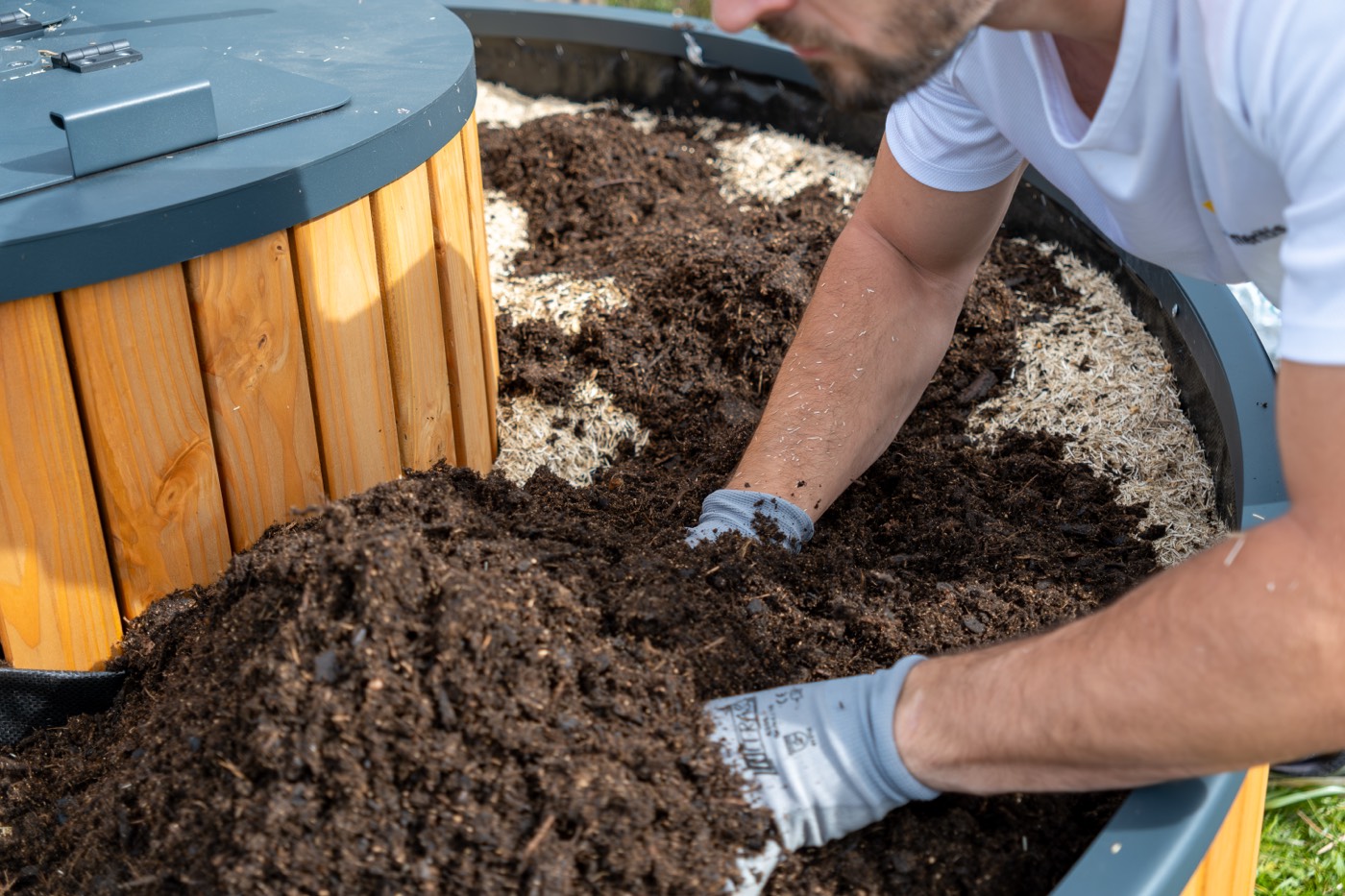
Composting runs through four phases, always in the same order: mesophilic (0 to 3 days, 20 to 45 °C), thermophilic (3 to 30 days, 45 to 65 °C in the core), cooling (30 to 60 days, back down to 20 to 30 °C) and then maturation (60 days to 6 months, ambient temperature). Temperature is not a side effect of the process: it is the only indicator that tells you, with no laboratory and in ten seconds, whether the cycle is running or has stopped.
Key takeaways
Always measure in the core, never at the surface: a gap of 20 to 30 °C between the centre and the edge is normal.
A composter fed every week does not run the four phases one after another: it runs them side by side, from the top of the tank to the bottom.
What comes out of the tank after a few months is a pre-compost, not a mature, standard-compliant compost. Maturation and sanitisation are finished downstream.
The four phases in one table
The engine of composting is a succession of microbial populations taking over from one another. Each works within a temperature band, produces heat as it breaks the material down, and ends up making the environment unliveable for itself: that is what triggers the move to the next phase.
| Phase | Duration | Core temperature | What breaks down | Recognisable sign |
|---|---|---|---|---|
| Mesophilic | 0 to 3 days | 20 to 45 °C | sugars, starches, simple proteins, light fats | the mass warms up, a faint sweet-sour smell |
| Thermophilic | 3 to 30 days | 45 to 65 °C (30 to 40 °C at the edge) | cellulose, hemicellulose, complex proteins | steam on opening, volume collapsing by around 50 % |
| Cooling | 30 to 60 days | 30 °C, then 20 to 25 °C | lignin, the difficult residual fractions | white fungal threads, a woodland-floor smell |
| Maturation | 60 days to 6 months | ambient temperature | humification, no more outright breakdown | worms and woodlice, a crumbly structure, no heating after mixing |
Mesophilic phase: the temperature climb
Mesophilic comes from the Greek: middle temperature. As soon as the food waste enters the tank, the bacteria already present on the material and in the bulking agent go for what is easiest to consume: sugars, starches, simple proteins, light fats. Those molecules make up a large share of a meal leftover, which is what explains how fast the reaction is.
Every breakdown releases heat. In a large enough volume it builds up faster than it dissipates and the temperature climbs, slowly at first, then by several degrees an hour. Below a certain quantity, though, the surface losing the heat wins out over the volume producing it: which is why a balcony bin stays lukewarm while a 450 L tank climbs properly.
This phase also produces organic acids that push the pH down for two or three days, hence the slightly sour smell of the first few days. If it lasts beyond a week, it is no longer the mesophilic phase talking, it is a lack of aeration: our article on composting at work without odour or pests sets out the corrections.
Thermophilic phase: the one that sanitises
Above 45 °C, the mesophilic bacteria can no longer cope. They give way to thermophiles, which work between 45 and 65 °C and attack what the previous population could not break down: cellulose, hemicellulose, complex proteins. Volume collapses by around 50 % in two weeks, because water evaporates and carbon leaves as CO2. Two ceilings frame the phase: below 45 °C the process is slow but works, above 70 °C microbial diversity collapses and the material sterilises the environment that breaks it down. The useful band sits between 50 and 65 °C.
This is where sanitisation happens, meaning the destruction of pathogens and weed seeds. The biological effect and the regulatory test are two different things: Regulation (EU) No 142/2011, which frames the treatment of animal by-products and therefore of catering waste, sets as its standard parameter 70 °C for at least 60 minutes on particles of no more than 12 mm, and the same figures are carried into United Kingdom law as assimilated legislation. That pairing is certified at a facility approved for the purpose, not measured in a site composter. What may then be done with the material is set by the animal by-products rules of your own country.
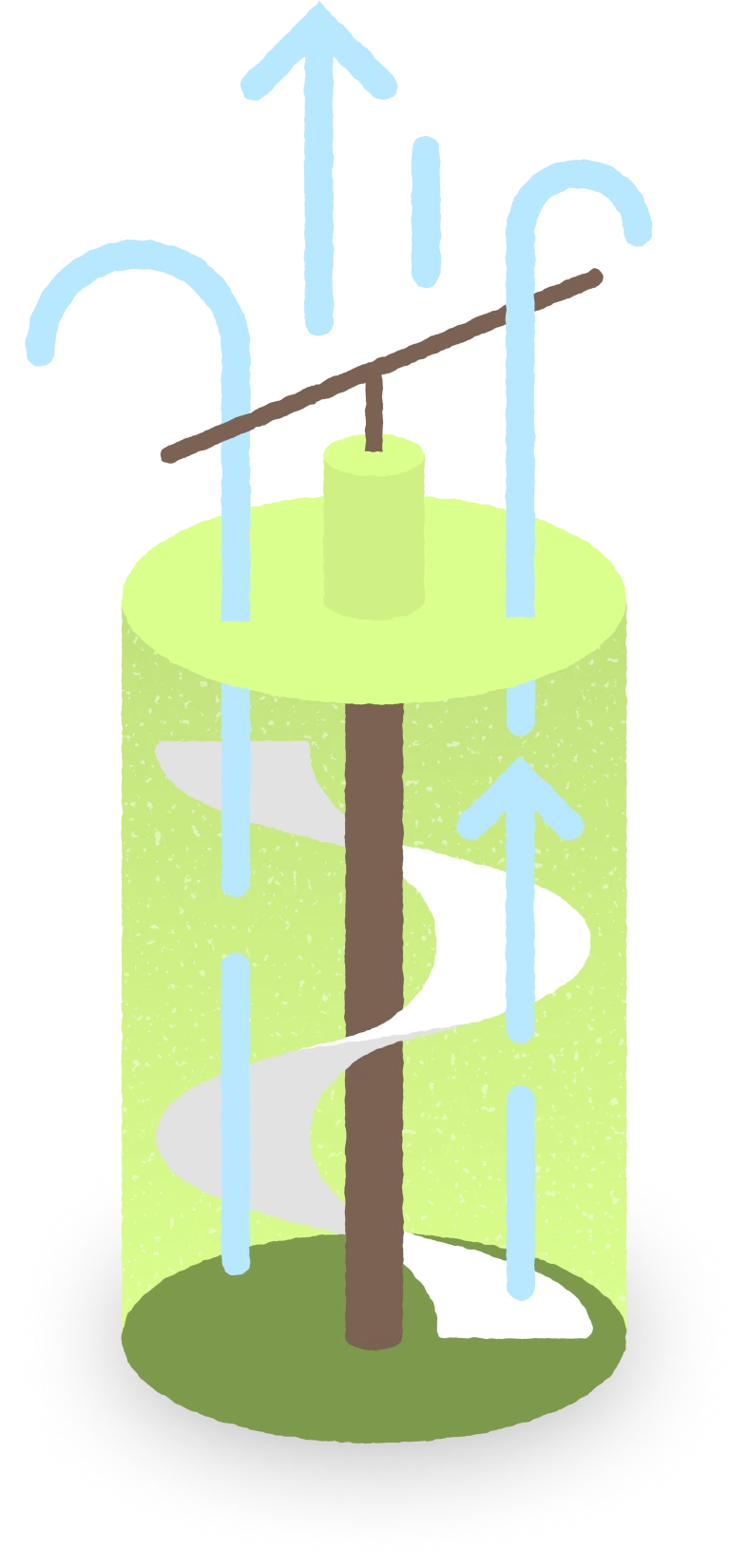
Temperature only holds if oxygen follows. A wet, compacted mass starves the aerobic micro-organisms of air: fermentation tips over into anaerobic, the temperature falls back and sulphur compounds appear. On the ABC composter, a 2 mm steel tank of 450 L, air circulates through a perforated aeration chimney that runs through the whole of the material, and the auger is driven by the crank: mixing is mechanical but hand-operated, with no fan and no power supply. The mechanism is set out in detail in our article on ABC composting technology. The machines described as electromechanical, by contrast, are most often grinder-dehydrators: they heat the material with an electric element instead of letting it heat on its own.
Cooling phase: the fungi take over
Once the easy material is used up, bacterial activity falls off and heat production with it. The temperature comes back down towards 30 °C, then towards 20 to 25 °C. This is not composting slowing down, it is a change of team: mesophilic fungi and actinomycetes colonise the mass and attack the lignin the bacteria leave alone. White-grey threads appear in a network, often mistaken for mould when they are exactly the sign you want, and the woodland-floor smell settles in.
A practical point: a sharp drop in temperature after only a week is not cooling, it is a stoppage. Cooling is recognised by how gradual it is, and by the fact that mixing restarts nothing lasting. If mixing brings the temperature back up by 15 or 20 °C, the thermophilic phase was not finished and it was short of air.
Maturation phase: from 60 days to several months
Maturation is no longer breakdown, it is transformation. The residual fractions recombine into stable humic substances, the ones that give compost its agronomic value: water retention, soil structure, slow nutrient release. The macrofauna, worms, woodlice, springtails, breaks up what is left. Its duration is the most variable in the cycle: fibre-rich volumes mature more slowly than plate waste, and in winter the macrofauna slows down below 10 °C.
It is also the phase most often skipped over in sales material. Equipment that advertises "compost in 24 hours" produces a ground, dehydrated material whose maturation is still entirely ahead of it. The question to ask at a demonstration is therefore not "how long?" but "where does maturation finish, and who keeps the record?".
Fed every week, a composter does not follow the cycle to the letter
Everything above describes a heap built in one go and then left alone. A workplace composter receives loads every day or every week: the four phases do not follow one another in time, they overlap in space. The top of the tank is in the mesophilic phase, the middle in the thermophilic phase, the bottom in cooling. That is the whole point of weekly mixing, which buries fresh loads in a mass that is already hot instead of letting them form a cold layer on the surface.
A direct consequence: the oldest material, the material that comes out of the bottom door, has not spent six months in the tank. It has spent the time between two removals, and that time can be calculated.
The maths
- Volumes used for the example 750 kg a year
- Weekly load, 750 divided by 52 14.4 kg
- Bulk density used for fresh food waste 0.40 kg per litre
- Fresh volume added each week 36 L
- Volume lost during the thermophilic phase around 50 %
- Average volume taken up by one week's load over its stay 27 L
- Volume of the ABC tank 450 L
- Weeks before theoretical saturation, 450 divided by 27 17 weeks
- Removals planned over the year in this example 4 a year
- Interval between two removals 13 weeks
Stay of the oldest material at removal13 weeks, tank about 80 % full
The assumptions need adapting to your own case: wetter volumes compact more, more fibrous volumes lose less bulk. The order of magnitude holds, and it explains why the material leaving the tank is a pre-compost: it has been through the thermophilic phase, not through full maturation. One composter absorbs up to 1,500 kg a year; beyond that you add a second, and above 3,000 kg a year on-site composting is no longer the right answer. Our article on sizing a composter to your food waste starts from data you already have.
The four parameters that drive temperature
When the heat does not come, the cause lies in one of these four parameters, rarely anywhere else.
The carbon to nitrogen ratio should be 25 to 30 parts carbon to one part nitrogen. Meal leftovers being very high in nitrogen, the carbon comes from the bulking agent, mixed in at start-up and then topped up at every emptying. Moisture should be 50 to 60 % water: a handful squeezed in a gloved hand should hold together as a ball without a trickle of water running out. Below 40 %, microbial activity stops for want of free water; above 65 %, water drives the air out of the gaps.
Oxygen arrives by two routes: air circulating through the mass, and the porosity created by the bulking agent. A compost short of it does not just smell bad, it loses 10 to 20 °C. Mass, finally: below about 1 m3, an open heap loses its heat faster than it produces it, and a sealed 2 mm steel tank limits those losses, which is what allows 450 L to work where a slotted bin of the same volume would stay lukewarm. What goes in matters too: see what can go in a commercial composter.
Diagnosing a cycle that stalls
Most incidents can be read with a thermometer and a nose.
| What you observe | Most likely cause | Correction |
|---|---|---|
| The temperature never goes above 30 °C | loads too small, or too much carbon-rich bulking agent | group the loads together, reduce the share of bulking agent at the next top-up |
| A sharp smell of ammonia | too much nitrogen, carbon to nitrogen ratio too low | add bulking agent and mix straight away |
| A rotten-egg smell, compacted and seeping material | lack of oxygen, anaerobic fermentation | mix, add bulking agent, check that the aeration chimney is not blocked |
| Dry, dusty material and no heating at all | moisture below 40 % | reduce the bulking agent, favour water-rich loads, without hosing it down |
| Heating stops after 3 or 4 days and does not come back | loads too far apart, or a cold layer left on the surface | go back to weekly mixing so that loads are buried in the hot mass |
| Fruit flies under the lid | fresh loads left on the surface | bury every load with one or two turns of the crank |
If the correction produces nothing in two weeks, the problem is no longer biological but mechanical or organisational: our commercial composter maintenance checklist lists the points to check.
Recognising mature compost, and what really comes out of the tank
Mature compost can be recognised without instruments: very dark brown and even, crumbly, a woodland-floor smell, no residual heating after mixing, nothing you put in still identifiable by eye. The cress test completes the examination: sow a few seeds in the neat compost and as many in a control potting compost. Comparable germination in 5 days indicates stable material; delayed or absent germination points to organic acids still present, and so to unfinished maturation.
- Push the thermometer in at least 30 cm, into the centre of the mass and not at the edge.
- Note the reading and the date: a series of readings explains an incident three months later, a single reading explains nothing.
- Smell it: woodland floor is good; ammonia or eggs is an imbalance to correct the same day.
- Squeeze a gloved handful: it should hold together as a ball without a trickle of water running out.
- Check that the crank turns without unusual effort.
- Compare the level in the tank with the removal schedule.
- Take out any foreign objects you can see: disposable cutlery, plastic-lined tea bags, oily kitchen paper.
For a regulated agricultural use, these signs are not enough: placing a compost on the market as a fertilising product is governed by Regulation (EU) 2019/1009 and, in the United Kingdom, by the national rules that replaced it, and both rest on laboratory analysis. That is why what comes out of the vessel is described as a young compost rather than a certified product: on your own grounds you use it as it is, and to pass it on you appoint a contractor locally, a route described in our article on what to do with the compost you produce. Which operator handles that step, and what evidence it can issue you, is settled with them.
Common questions
What temperature should a compost reach?
Between 45 and 65 °C in the core during the thermophilic phase, with a useful band of 50 to 65 °C. Below 45 °C, breakdown continues but more slowly. Above 70 °C, microbial diversity collapses and the process slows. The edge is always cooler, between 30 and 40 °C.
How long does a full composting cycle take?
From 3 to 6 months for the four phases, of which about 1 month for the mesophilic and thermophilic phases together. Maturation is the most variable part, from 60 days to 6 months depending on the season and on what goes in. In a composter fed every week, the material removed has not been through that whole cycle: it has stayed for the time between two removals, around 13 weeks on a site producing 750 kg a year.
Do you need a thermometer to monitor a composter?
It is not compulsory, but it is the check that pays for itself fastest: a long-stem probe gives you in ten seconds information that nothing else gives. A monthly reading, noted with its date, is enough. Without a thermometer, you only detect a stalled cycle by the smell, which is to say too late.
What happens if the temperature never climbs?
The cause lies in one of the four parameters: carbon to nitrogen ratio, moisture, oxygen, mass. The two most common are too much bulking agent, which brings in too much carbon, and loads too small or too far apart for heat to build up. The material still breaks down, but slowly, and sanitisation by heat does not take place.
Can the compost that comes out of the composter be used straight away?
No. What comes out of the tank after a few months is a pre-compost: it has been through the thermophilic phase, not through full maturation. It is taken away, sanitised at a facility permitted for it, then spread by an operator you contract locally. A mature compost intended for a regulated agricultural use falls under the fertilising products rules that apply in your country, which call for laboratory analysis.
Where to start
If you already have a composter, start with three temperature readings a month apart: you will know whether your cycle reaches the thermophilic phase or stalls in the mesophilic one, and the diagnostic table above will give you the correction to try first.
If you are still at the study stage, the useful question is not how long the cycle takes but how the unit is sized, because mass is what decides temperature. The online quote estimates your volumes from a few reference points for your line of work, applies the grid and shows the number of visits it keeps: in France, 750 kg a year gives 4 visits, that is 119 € excl. VAT a month; 1,200 kg a year gives 12 visits, 199 € excl. VAT a month. It all runs in the browser, with no sign-up. The operational sequence is set out on the how it works page, and collection remains an option: some sites handle the removal themselves and take the composter on its own, rented over 48 months or bought.
A free assessment, a quote within 24 h
Thirty minutes on a video call to go over the food waste separation duty that applies where you operate, size the solution and estimate your savings.
