
Resource
Composting in hospitality: a guide for hotels, brasserie-style restaurants and resorts
What a hotel really produces, how to size an on-site composter, where to put it and what waste law asks of you. Ratios and worked examples throughout.
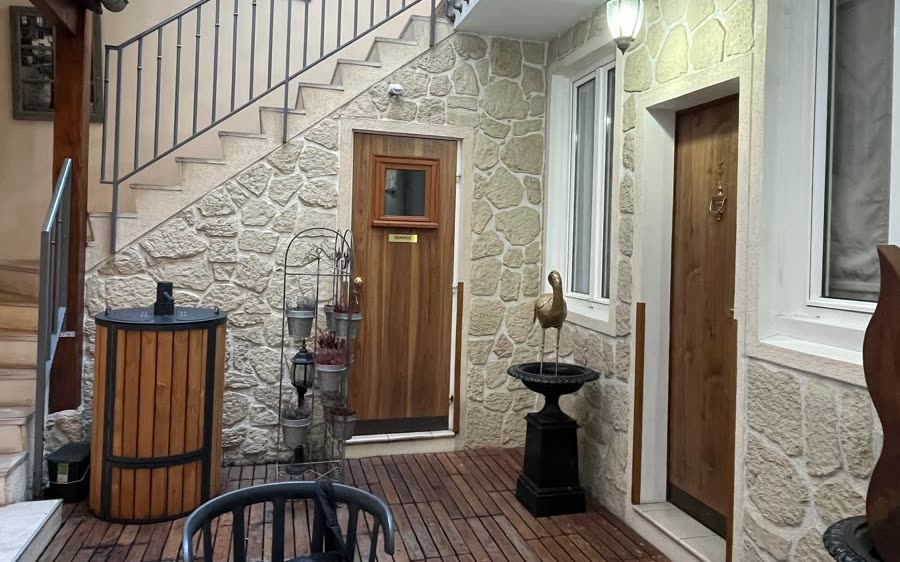
A three-star, 80-room hotel with a brasserie-style restaurant captures around 1,100 kg of food waste a year: the volume a single ABC composter absorbs, standing in the service yard. Separating that food waste is no longer optional, businesses across the European Union and the United Kingdom have to separate it at source, under rules written country by country. This guide is here to help you check that figure on your own site: where the material comes from, how to count it, where to put the composter without a guest ever seeing it, and at what point on-site composting stops being the right answer.
Key takeaways
The restaurant weighs far more than the breakfast buffet. A brasserie-style cover leaves 0.10 kg of food waste, a breakfast 0.025 kg. As soon as there is a menu, the kitchen accounts for three quarters of the volumes: that is where the caddy goes first.
Collection is an option in France, at 10 € excl. VAT a month per annual visit, on top of the 79 € excl. VAT of the composter; elsewhere the removal of the mature compost is arranged with a local operator of your choice, and we help you scope the brief. How often the material has to leave is not something you choose: it follows from your volumes, using the table further down.
Where the material comes from in a hotel
Four streams feed the volumes. Breakfast gives clean, uniform material, coffee grounds, tea bags, peelings, bread: concentrated into two hours and handled by one team, it is the easiest to separate. The restaurant kitchen produces two of them, preparation trimmings, which are predictable, and plate returns, mixed with napkins and stirrers. Room service arrives on trays, often late, and is the stream that most escapes separation. Grounds and gardens follow a different logic: cuttings and prunings belong in a garden composter, a circular planter that composts 450 L.
Two ratios are enough to turn those streams into kilos: the ones behind our online sizing tool, drawn from published catering benchmarks (ADEME, France) and checked against readings from the sites we have equipped.
| What is served | Food waste per unit | Example over 300 days |
|---|---|---|
| Breakfast | 0.025 kg | 50 a morning: 375 kg/year |
| Cover, fast food | 0.05 kg | 40 a day: 600 kg/year |
| Cover, brasserie-style or traditional | 0.10 kg | 40 a day: 1,200 kg/year |
| Cover, fine dining | 0.15 kg | 40 a day: 1,800 kg/year |
These ratios give a theoretical figure. What actually reaches the composter is lower: trays that end up in general waste, separation that slips at the height of service, an agency cook who arrived that morning. We therefore take 70% of the theoretical figure as the share captured, and it is that number that drives the sizing; the alternative is a weighing exercise over a representative week, which the page on sizing a composter sets out. One result deserves to be put on the table in a meeting: in a hotel with a restaurant, the buffet is only a quarter of the volumes. Separation plans that start with the buffet, because it is the visible part, are tackling the smallest share of the problem.
Working out your volumes, then your sizing
Take the most common case: a three-star hotel with 80 rooms, 50 breakfasts on an average morning, a brasserie-style restaurant serving 40 covers a day, open 300 days a year. The same calculation runs step by step in the online sizing tool.
The maths
- Breakfasts, 50 × 300 × 0.025 kg 375 kg
- Brasserie-style covers, 40 × 300 × 0.10 kg 1,200 kg
- Theoretical volumes 1,575 kg/year
- Share actually captured, 70% 1,102 kg/year
- Collections needed, from the table 9 a year
- Rent of the ABC composter 79 € excl. VAT/month
- Collection option, 9 × 10 €, French benchmark 90 € excl. VAT/month
Monthly, everything included169 € excl. VAT
The number of collections is not a commercial variable: you read it off a table, on the first row whose threshold covers the volumes captured. What we supply is the composter, its bulking agent, the awareness kit and a remote handover for your team; the material leaves your site through a contractor you appoint locally, or it does not leave at all if your grounds can take the compost.
| Annual volumes captured | Collections a year | Monthly, excl. VAT | Annual cost, excl. VAT |
|---|---|---|---|
| up to 250 kg | 1 | 89 € | 1 068 € |
| 251 to 450 kg | 2 | 99 € | 1 188 € |
| 451 to 625 kg | 3 | 109 € | 1 308 € |
| 626 to 750 kg | 4 | 119 € | 1 428 € |
| 751 to 875 kg | 6 | 139 € | 1 668 € |
| 876 to 1,125 kg | 9 | 169 € | 2 028 € |
| from 1,126 to 1,500 kg | 12 | 199 € | 2 388 € |
Above 1,500 kg a year a second composter is added and everything doubles, capacity and emptyings alike. The next table applies the method to four profiles.
| Profile | Volumes captured | Composters | Collections a year | Monthly |
|---|---|---|---|---|
| 30 rooms, 20 breakfasts, no restaurant, 300 days | 105 kg | 1 | 1 | 89 € |
| 60 rooms, 45 breakfasts, no restaurant, 365 days | 287 kg | 1 | 2 | 99 € |
| 80 rooms, 50 breakfasts + brasserie-style restaurant, 40 covers, 300 days | 1,102 kg | 1 | 9 | 169 € |
| 100 rooms, 65 breakfasts + brasserie-style restaurant, 70 covers, 365 days | 2,204 kg | 2 | 9 | 338 € |
The fourth profile shows the threshold effect: at 2,204 kg the site moves to two composters, and the nine collections are needed twice over. If the compost finds a use on site, in beds or planters, nothing has to leave at all and you are left with the composter on its own. Against a conventional weekly round, the page on arranging food waste collection is where the switch is set out.
Seasonality: what it actually changes
A seaside hotel can multiply its volumes by four between January and August. Two things do not move with the season: the number of collections, which follows the volumes of the whole year rather than the peak, and the sizing table itself, which knows nothing of high season.
Three things do change. First, how you enter the figures. The online quote offers only three lengths of season, 250, 300 or 365 days: a hotel open five months falls outside that and should do the sum by hand, with its real days and its average over those days. A hotel serving 120 breakfasts a morning for 150 days captures 315 kg (120 × 150 × 0.025 kg, then 70%). The same hotel declaring the diluted annual average, 49 breakfasts a morning, without correcting for its opening days, would show 129 kg: one band lower, 1 collection instead of 2. Then the calendar: dates are agreed with the operator you appoint, and nothing prevents you concentrating 9 collections between May and October, the last one just before you close.
Then the physical limit. A composter absorbs 1,500 kg a year, roughly 4 kg a day in steady operation: a very seasonal site can stay under that annual ceiling while going well over it in July. The answer is a second composter, not a commercial arrangement. Settle it before you order, using the peak flow and not the average: the page on sizing your composter works through the same reasoning stream by stream.
Where to put the composter without a guest seeing it
It is the first objection any general manager raises, and it is settled up front. The ABC composter needs about 1 m² outdoors, on a flat, load-bearing surface, within thirty metres or so of where the waste is produced and on a route your team already walks every day: the service yard, the delivery bay, the bin area.
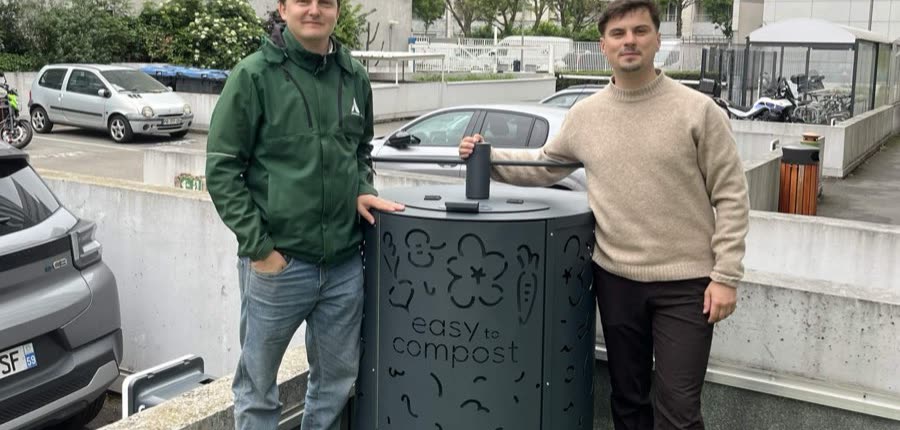
What makes those locations possible is that the composter does not plug into anything: no electricity, no water, no drainage, no groundworks. No trenching, no drilling, no waterproofing to reinstate: on an older or listed building, where the smallest connection triggers a procedure, that argument carries weight. Mixing is done by hand, with a crank, a few minutes a week, which is what separates the ABC from the electric dehydrators sold as electromechanical composters.
That leaves two worries. Odour does not come from composting but from putrefaction, that is, from material too wet and starved of air: the central aeration chimney, the bulking agent added at every drop and regular mixing settle the question without powered ventilation, as the guide to composting at work without odour or rodents explains. Rodents next: a 2 mm steel vessel, closed, with no way in, a subject covered in the article on rodent-proof composters. And if the spot stays visible from a guest area, the vessel can be finished in your own colours and branding.
Hygiene, HACCP and audits
Regulation (EC) No 852/2004 of 29 April 2004 on the hygiene of foodstuffs deals with food waste in Annex II, Chapter VI. It applies across the European Union and has been kept in United Kingdom law as assimilated legislation. It requires food waste to be removed as quickly as possible from rooms where food is present, to be put in containers that close, and to be stored so that it does not attract pests. Those three requirements shape the arrangement: a closed caddy in the kitchen, emptied every service, and the composter away from any food handling area.
So the composter does not go in the kitchen but at the end of the trip the caddy already makes, from the worktop to the waste area. It adds no critical control point to your food safety plan: the destination of a stream changes, and the stream was leaving anyway. What can and cannot be composted does, on the other hand, call for a written instruction above the caddy.
On environmental audits, whatever standard your group works to, the document asked for is the same: proof that the separated material went to an identified destination. Weigh each load out and keep the dated paperwork your contractor issues. The article on what to do with the compost you produce covers the routes out.
What waste law requires of you
Separating food waste at source is a legal duty on the business. In the European Union it comes from Article 22 of the Waste Framework Directive 2008/98/EC, which required separate collection or recycling at source by 31 December 2023 and is the framework that applies in Ireland, each member state transposing it in its own way. The United Kingdom sits outside the directive and runs four separate regimes: Simpler Recycling in England, the Waste (Scotland) Regulations 2012, the Workplace Recycling rules of 2024 in Wales, and Northern Ireland's own arrangements. The wording, the thresholds and the dates differ from one to the next, and the one that binds your hotel is set by where it stands. Both routes are open in all of them: the ABC composter takes the second, treating the food waste in the service yard and removing 65% of the mass.
On penalties, one rule holds: they are national. The amounts, the body that enforces them and the route of appeal are set by each regime, and figures published for one country say nothing about another, what is a fixed penalty notice in one is an administrative fine issued by the local authority in another. Ask your local authority or environmental regulator which text covers your site and what it provides for, rather than working from amounts quoted for another market.
One worry comes up often: does composting on the premises turn the hotel into a permitted waste installation? Permitting thresholds are national and differ from one country to the next, but they are almost always expressed in tonnes handled per day rather than per year, and the hotel in our example handles 3.7 kg per opening day. Which regime covers a composter of this size, an exemption, a registration or a permit, is set by your own environmental regulator.
Making the habit stick in a brigade that turns over
This is the real difficulty in the sector, more than space or budget: a brigade takes on agency staff, seasonal workers and apprentices, sometimes several languages, and summer turnover can replace half the team. Training given in April does not survive July if nothing keeps it alive.
Three things make the difference on the sites we equip. The instruction is visual rather than written: a poster in pictures stays readable whatever the language. The action is shorter than the alternative: if the caddy is two steps from the worktop and the bin is six, separation happens by itself; the other way round, no campaign will hold. And one person owns the subject, head chef or maintenance manager, with a slot in the pre-season briefing. An awareness kit comes with the composter, and establishments that also feed their own staff will find useful markers in the article on food waste in contract catering.
When this is not the right answer
Four situations rule the solution out, and it is better to look at them before losing three months.
Volumes above 3,000 kg a year. One composter absorbs up to 1,500 kg, two up to 3,000. Beyond that it is no longer a question of equipment but of route: a 200-room resort serving 130 breakfasts and 150 fine-dining covers a day, 365 days a year, captures close to 6.6 tonnes, more than double the ceiling, and we say so rather than stacking composters.
There is no 1 m² available outdoors. A city-centre hotel with no yard and no bay, whose bins go out on the pavement at set hours, has nowhere to put it: conventional food waste collection remains the fallback.
There is no local route for the material. Our own collection service covers mainland France only; elsewhere the composter is deployed without it, which assumes the compost is used on site, plausible for a resort with grounds, less so for a city-centre hotel. Where the material does have to leave, its removal is arranged with a local operator of your choice, and we help you scope the brief. Where we deliver is set out on our delivery page.
Nobody will own the subject. A composter takes food waste, not packaging or coffee pods. Without someone inside the business to carry it, the material gets contaminated and whoever takes it away will turn it down. That factor, more than any other, separates the installations still running after three years from those that stop at the end of a season; the hotels and resorts page gathers what we see across the sector.
The checklist before you sign
Eight checks, about thirty minutes, and the question is settled.
- Count breakfasts served on an average morning and covers served on an average day, lunch and dinner together, as two separate figures.
- Write down the days you are actually open, not 365 out of habit.
- Apply the ratios, then take 70% of the result as the volumes captured.
- Check that it stays under 3,000 kg a year: above that, change route rather than equipment.
- Estimate the flow in your peak month, not just the average: above 4 kg a day over a long spell, ask the question of a second composter.
- Find 1 m² outdoors, flat and load-bearing, within 30 metres of the kitchen and out of sight of guests.
- Name the person responsible in the kitchen and schedule the training before the season starts, not after.
- Divide the annual cost of your current collection contract by the number of collections it includes, and compare.
Common questions
How much food waste does an 80-room hotel produce?
Around 1,100 kg a year with 50 breakfasts a morning and 40 brasserie-style covers a day over 300 days: 1,575 kg in theory, brought down to 70% for what escapes separation. Without a restaurant, the same hotel falls back to 262 kg captured, which is 2 collections a year.
Where can a composter go in a hotel without guests seeing it?
In the service yard, on the delivery bay or in the bin area: about 1 m² outdoors, flat and load-bearing, within thirty metres or so of the kitchen. The composter needs no electricity, no water, no drainage and no groundworks.
How do you handle seasonality in a seaside hotel?
The number of collections follows the volumes over the year, but the calendar is agreed with the waste contractor you appoint: 9 collections can be concentrated between May and October. The point to watch is the peak flow, since a composter absorbs 1,500 kg a year, roughly 4 kg a day.
Is a composter compatible with kitchen hygiene rules?
Yes, provided it is kept away from the areas where food is handled. Regulation (EC) No 852/2004, Annex II Chapter VI, which applies across the European Union and is retained in United Kingdom law as assimilated legislation, requires food waste to leave those rooms as quickly as possible, in containers that close: a closed caddy in the kitchen, the composter outside.
Does composting on site require a waste permit?
Permitting thresholds are national, and they are almost always expressed in tonnes handled per day rather than per year, a hotel handling 3.7 kg a day is a very long way from any of them. Which regime applies to you, and whether it calls for an exemption, a registration or a permit, is set by your own environmental regulator.
Where to start
In this order: the volumes, the sizing, the location. The first two steps are automated. The online sizing tool asks four questions specific to hotels, breakfasts, covers, type of kitchen, days open, applies exactly the ratios and the emptying schedule in this article, and shows the result in your browser, with no sign-up.
What the calculation does not settle is the rest: going out to measure 1 m² in the service yard, and checking that a trolley can reach it in all weathers, at night and mid-delivery. For how it runs day to day, the page on how it works sets out the steps; the hotels and resorts page gathers the sector's cases; and if you run several addresses, the Decathlon network case study shows a multi-site rollout. The rest is in the We also recycle your cigarette buttsFAQ.
A free assessment, a quote within 24 h
Thirty minutes on a video call to go over the food waste separation duty that applies where you operate, size the solution and estimate your savings.
