
Resource
Bokashi vs aerobic composting: which method for food waste?
Bokashi or aerobic composting: 13 criteria compared, the real workload on a 120-person site, and the food waste volumes each method can actually take.
Bokashi and aerobic composting do not produce the same thing. Bokashi ferments food waste without oxygen and gives back an acidic material that still has to be buried; aerobic composting breaks it down with oxygen and gives back a mature compost that can go straight onto the ground. For a professional site the dividing line is clear: bokashi is a kitchen method, sized for a few kilos a week. Above 50 kg of food waste a month it is the logistics of the buckets that break down, and on-site aerobic composting takes over.
Key takeaways
Bokashi: anaerobic fermentation in an airtight bucket, 2 to 3 weeks, then 2 to 6 weeks buried in soil. What comes out of the bucket is an acidic pre-compost, not compost. Realistic ceiling: 20 to 50 kg a month.
Aerobic composting: breakdown with oxygen, a rise in temperature, 3 to 6 months with no further handling of the material. The result is a mature compost ready to spread. One 450 L ABC composter absorbs up to 1,500 kg a year.
Bokashi: fermenting, not composting
Bokashi, a Japanese word for fermented organic matter, was developed in the 1980s by Teruo Higa, professor of horticulture at the University of the Ryukyus in Okinawa. The principle is not decomposition but preservation through fermentation, exactly as with sauerkraut or kimchi.
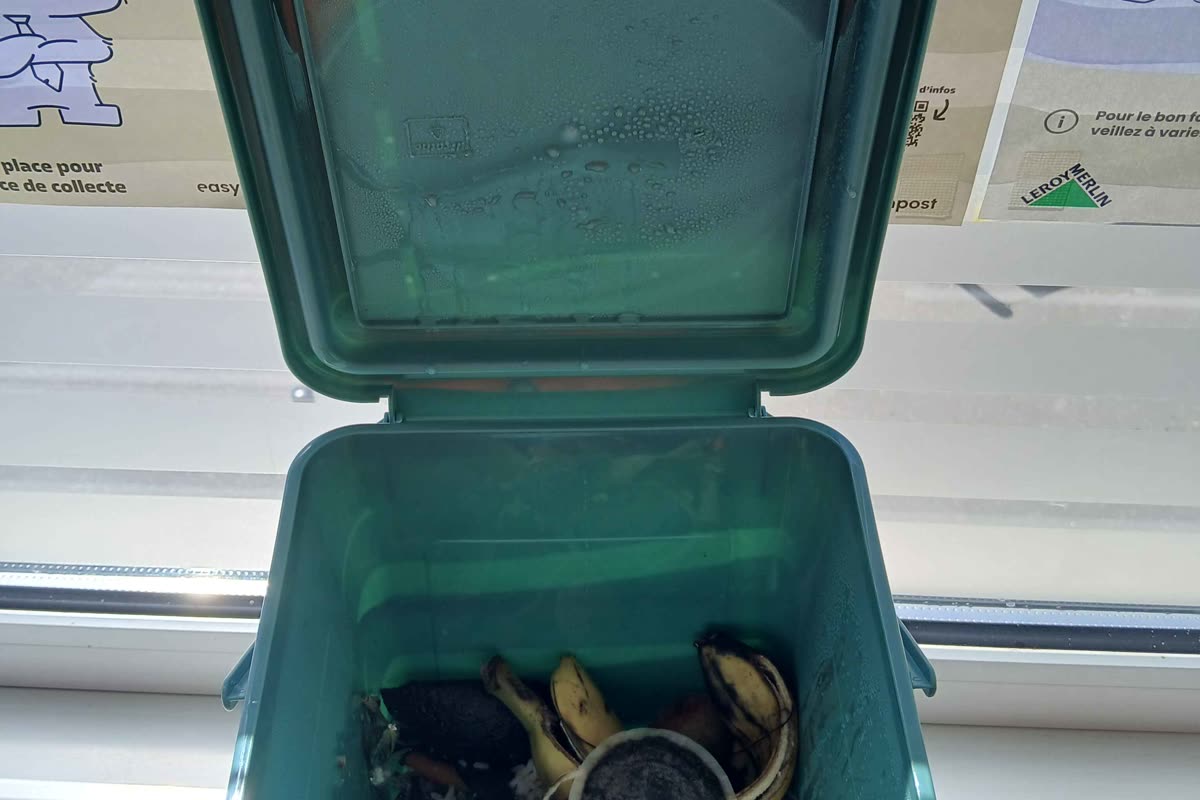
The routine comes down to a few actions. Food waste is laid in layers in an airtight bucket fitted with a tap at the bottom. Each layer is sprinkled with an EM activator (Effective Microorganisms): wheat bran inoculated with lactic acid bacteria, yeasts and phototrophic bacteria. You press it down to drive out the air, close the lid, and open it again only to add more. Every 2 to 3 days the fermentation liquid has to be drawn off through the tap, or the bucket turns.
After 2 to 3 weeks the material is fermented. Its smell is unrecognisable and its shape unchanged: a potato peeling that comes out of a bokashi bucket is still a potato peeling, simply acidified, with a pH down around 3.5 to 4.5. It cannot be used as it is: applied straight to the base of a plant, it burns it. It has to be buried in living soil, or added to a composter, and left another 2 to 6 weeks for soil organisms to finish the job.
Two consequences follow, and they weigh heavily on a professional site. First, fermentation takes place at ambient temperature: there is no thermophilic phase, therefore no sanitisation, and weed seeds and pathogens alike come through the cycle intact. Second, and this is bokashi's real advantage, the absence of oxygen means meat, fish and dairy can go in, and those are precisely what you keep out of a commercial composter.
Aerobic composting: breaking down with oxygen
Aerobic composting needs no bought-in starter. The bacteria that do the work are already on the food waste. What they need is oxygen, a little moisture and carbon: peelings and plate waste are rich in nitrogen, and they have to be balanced with a carbon-rich bulking agent (wood chip, shavings) to hold a carbon-to-nitrogen ratio of around 25 to 30.
When that balance holds, the material heats up. It moves from a mesophilic phase to a thermophilic one in which the core of the heap climbs to between 50 and 70 °C, which sanitises the material; the temperature then falls back and maturation sets in. Allow 3 to 6 months before you have a mature compost, but those months pass with no handling of the material at all: it stays in the same place from beginning to end. That is the fundamental difference with bokashi, where every batch has to be taken out, carried and buried. The detail of the phases and temperatures of the composting cycle is worth reading on its own.
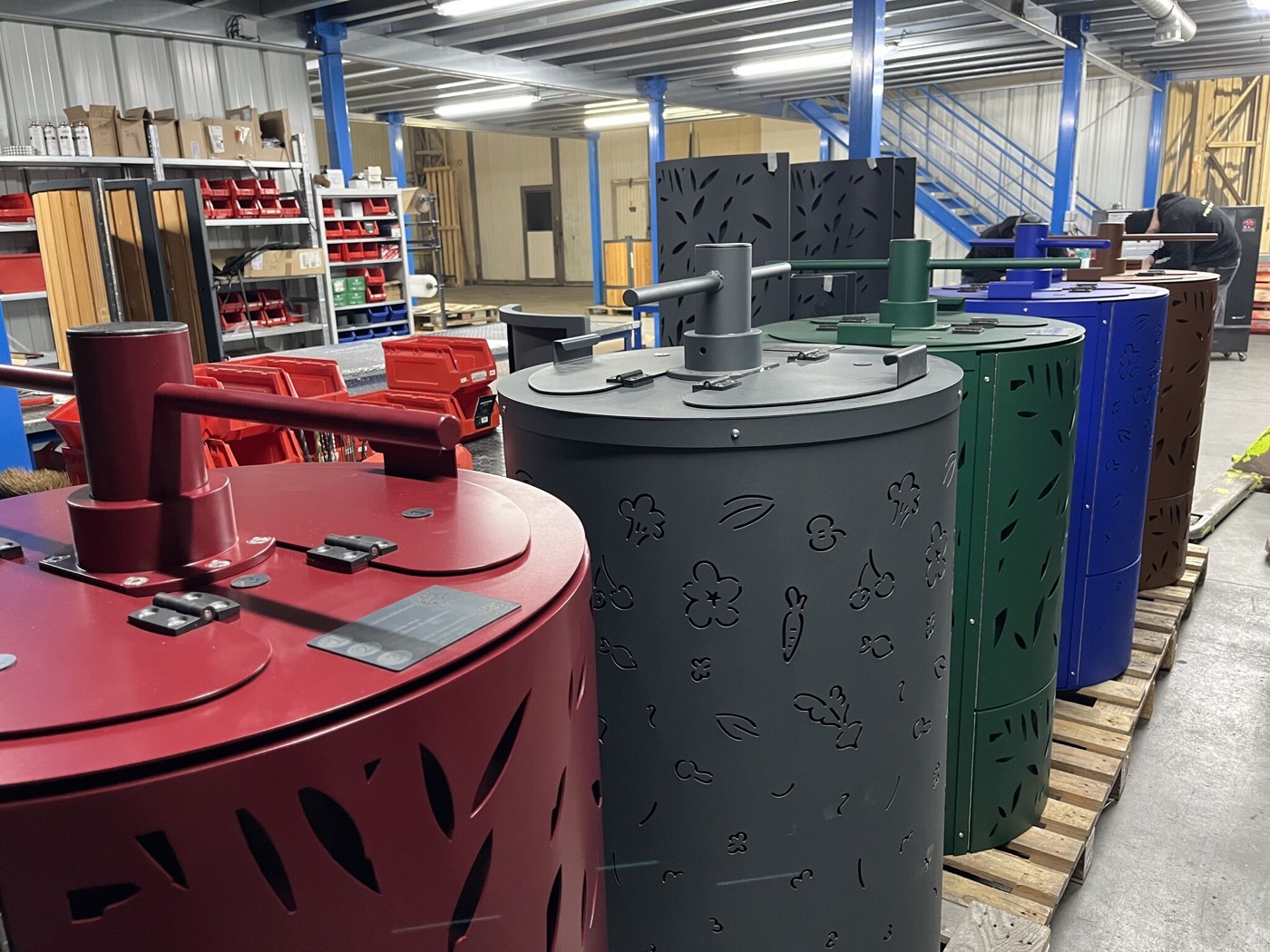
The limiting factor is therefore aeration. On the ABC composter it is handled by a central aeration chimney and by mechanical mixing turned by hand: a crank, a few turns, and the material is folded over. The unit is made of 2 mm steel, it holds 450 L, and it is designed and built in our workshop in France. It plugs into nothing: no electricity, no water, no drainage, no groundworks. That is what separates it from electromechanical composters and electric dehydrators, which cut volume by heating and drawing current, without producing a mature compost.
The comparison, criterion by criterion
The two methods are often presented as interchangeable. They are not, on any of the criteria that matter when you are equipping a site.
| Criterion | Bokashi | Aerobic composting (ABC composter) |
|---|---|---|
| Biological principle | Lactic fermentation | Microbial breakdown |
| Oxygen | Excluded, airtight container | Essential, aeration chimney and mixing |
| Activator to buy | Yes, EM-inoculated wheat bran, continuously | No, the micro-organisms are already there |
| Temperature reached | Ambient | Thermophilic phase, 50 to 70 °C |
| Sanitisation | No | Yes, through the rise in temperature |
| pH of the material produced | Acidic, around 3.5 to 4.5 | Close to neutral |
| Material obtained | Fermented pre-compost, to be buried | Mature compost, ready to spread |
| Time to a usable material | 2 to 3 weeks, then 2 to 6 weeks buried | 3 to 6 months, with no further handling |
| Meat, fish, dairy | Accepted | Best avoided |
| Capacity per unit | 8 to 10 kg per cycle per 16 L bucket | Up to 1,500 kg a year |
| Recurring actions | Fill, press down, draw off the liquid, carry, bury | Tip in, add the bulking agent, mix |
| Space required | The buckets, plus an area of soil to bury in | A few square metres of stable ground, no connections |
| Evidence for an inspection | No record generated | A dated log of each emptying, kept on site |
Volumes each method can take, and the real workload
The limit on bokashi is not biological, it is logistical. A standard 16 L bucket takes 8 to 10 kg of food waste per cycle. Since each bucket stays shut for 2 to 3 weeks, you need several in rotation to absorb a continuous flow, and every end of cycle means carrying a batch out and burying it. Let us set out the calculation on a common case, a head office that serves breakfast: this is where the ADEME office ratio (France) moves from 0.015 to 0.025 kg per person per day on site.
The maths
- Headcount on site 120 people
- Days on site per year 220
- ADEME office ratio (France), breakfast served 0.025 kg/person/day
- Annual volumes (120 × 220 × 0.025) 660 kg
- Capacity of a 16 L bokashi bucket 9 kg
- Fermentation cycles to run (660 / 9) 74 a year
- Buckets permanently tied up (21 days of fermentation) 5
- Draining off the liquid (every 3 days, so 7 per 21-day cycle) about 520 a year
- Burials at the end of each cycle 74 a year
Handling operations a yearabout 600
Six hundred handling operations a year, around ten a week, plus 5 airtight buckets permanently taking up room somewhere, plus soil available to bury 74 batches. A city-centre head office has neither the room nor the soil. On the same 660 kg, a single ABC composter is more than enough, since it absorbs up to 1,500 kg a year, and the daily gesture comes down to emptying the caddy and giving the crank a few turns. If you do not yet know your volumes, our guide to sizing a composter against the food waste you produce sets out the ratios sector by sector.
The thresholds on our side are simple: up to 1,500 kg a year, one composter; between 1,500 and 3,000 kg, a second one is added; above 3,000 kg a year, on-site composting is no longer the right answer and separate food waste collection, arranged with a contractor local to you, takes over. Sizing the composter turns entirely on those two figures.
Which method for which profile
Bokashi has genuine uses. It makes sense when all of the following conditions are met.
- Volumes stay under 50 kg a month, roughly 600 kg a year.
- One named person accepts the routine: drawing off the liquid, closing the lid, carrying the buckets.
- A garden, a vegetable plot or a back-up composter is available for burying the batches.
- The waste stream contains meat, fish or dairy that no other route will take.
- The sweet-sour smell of fermentation bothers nobody in the storage room.
In practice, that describes a flat, a chef's kitchen looking to make use of a few specific peelings, or an office of 10 to 20 people with no outdoor space. As soon as you move up to a floor of 50 staff, a restaurant, a hotel, a care home or a shop floor, the number of handling operations makes the method unworkable: that is also why it never appears in the schemes rolled out in offices or in hotels and catering.
For those profiles, on-site aerobic composting comes in two formats. The composter on its own is 79 € excl. VAT a month and includes the composter delivered, the bulking agent, the maintenance and the awareness work with your teams; it can be bought as well. In France, collection remains an option at 10 € excl. VAT a month per annual visit and per composter, from 1 to 12 collections a year: that is what removes the mature compost when a site has no green space to absorb it, and elsewhere that removal is arranged with a local operator of your choice. The rental runs over a 48-month commitment. For sites that would rather plant up an outdoor area, the garden composter, a circular planter of 2,000 L, is 129 € excl. VAT a month. What actually happens, step by step, is set out on the how it works page.
What that gives for a site with no green space, which therefore has to have its mature compost taken away. The number of collections is not a matter of choice: it follows from how fast the composter fills.
The maths
- Volumes captured, working assumption 750 kg/year
- Capacity of one ABC composter 1,500 kg/year
- Number of composters (750 < 1,500) 1
- Emptying operations over the year 4
- Rent of the composter, everything included 79 € excl. VAT/month
- Collection, 4 visits × 10 €, French benchmark 40 € excl. VAT/month
Monthly119 € excl. VAT
On volumes of that order, the bokashi route costs almost nothing in equipment but consumes staff time and assumes soil is available to bury every batch. That is where the real trade-off lies: not in the price of a bucket, but in the number of hours somebody will have to give it every week, and in what written evidence is left if an inspector asks.
Two other methods come up in the same comparison: vermicomposting at work, which shares bokashi's small-volume constraint, and anaerobic digestion against on-site composting, which becomes relevant exactly where on-site composting stops.
What the law changes in this choice
The choice of method is no longer purely technical. Across the European Union, Article 22 of the Waste Framework Directive 2008/98/EC has required food waste to be collected separately or recycled at source since 31 December 2023, and that is the framework that applies in Ireland. The United Kingdom sits outside the directive and runs four separate regimes: Simpler Recycling in England, the Waste (Scotland) Regulations 2012, Workplace Recycling in Wales since 2024, and its own regime in Northern Ireland. Both routes are open in every one of them: the scope, the exemptions and the dates are what differ, and they are set by the law of the country your site is in.
Penalties are set nationally, and they do not translate from one country to another: the amounts, the enforcing body and the appeal route are different in each regime, and what is a fixed penalty notice in one is an administrative fine issued by the local authority in another. Ask your regulator which text covers you and what it provides for, rather than working from figures quoted for another market.
That legal point settles the choice between the two methods indirectly. Domestic bokashi generates no document at all: no collection note, no weighing, no log. What an inspection asks for is evidence, not intent, and that is the whole subject of what you do with the compost you produce and of the records that go with it. An on-site composter makes those records straightforward: each emptying is dated and weighed, and what leaves the site is documented by whoever takes it.
One frequent worry is worth addressing directly: does composting on your own premises bring the site into a waste-permitting regime? Permitting thresholds are national and usually expressed in tonnes treated per day or per year, and a 450 L composter sits a long way below the levels those thresholds are written for. Which regime covers a unit of this size, an exemption, a registration or a permit, is set by your own environmental regulator.
Common questions
Does bokashi produce compost?
No. It produces a fermented, acidic pre-compost in which the waste has kept its shape. It has to be buried in soil or added to a composter for another 2 to 6 weeks before it becomes a usable soil improver. Aerobic composting, by contrast, gives back a mature compost that can be used straight away, and that a business can then use on site or place locally.
Does bokashi smell?
It does not smell of rot, but it does smell. Lactic fermentation gives off a sweet-sour, vinegary odour, very pronounced when the bucket is opened and when the liquid is drawn off. That smell is incompatible with a shared room, a break room or an area open to the public. A well-run aerobic composter gives off no odour: what makes it drift and how to correct it are set out in our article on composting at work without odour or pests.
Can meat and fish go into a bokashi bucket?
Yes, and that is its main technical advantage. The absence of oxygen prevents the usual putrefaction. One caution, though: without a rise in temperature there is no sanitisation, and the buried material still needs watching.
Is bokashi enough to meet the legal duty on food waste?
Separating food waste at source is a legal duty for businesses across the European Union, under Article 22 of Directive 2008/98/EC, and under each nation's own rules in the United Kingdom. Bokashi is indeed a form of separation followed by recovery. The difficulty lies elsewhere: it leaves no usable written trace for an inspection, and its capacity rarely covers what a professional site actually produces. Whether it satisfies the duty on your site is for your local authority to confirm.
How many buckets does an office of 50 people need?
At the ADEME ratio (France) of 0.025 kg per person per day on site, the figure for an office that serves breakfast, and 220 working days, an office of 50 people produces around 275 kg a year, or 23 kg a month. At 9 kg per bucket that is about 31 cycles a year, so one cycle every 12 days for 21 days of fermentation: 2 to 3 buckets permanently in rotation, plus burying every batch. That is still within the range where bokashi holds up, provided you have the room for the buckets and the soil to bury 31 batches a year.
Where to start
The question is not which of the two methods is better in absolute terms, but which one absorbs your volumes without tying up a member of staff full time. So the starting point is always the same: estimate what you produce in a year, compare it against the 1,500 and 3,000 kg marks, and you will know straight away whether you are in bucket territory, on-site composter territory or separate collection territory.
Our sizing tool covers that ground in a few minutes: you enter your sector and your headcount, it estimates the volumes and proposes the matching number of composters. The where we deliver page sets out the countries we ship to and how the machine reaches you.
A free assessment, a quote within 24 h
Thirty minutes on a video call to go over the food waste separation duty that applies where you operate, size the solution and estimate your savings.
