
Resource
Vermicomposting at work: what a worm composter really handles
The principle, the conditions the worms need to survive, the real volume ceiling, how to calculate the stock, and a worked comparison with a commercial composter.
Vermicomposting at work, the short answer
Vermicomposting holds up on a professional site up to 300 to 500 kg of food waste a year, in a room held between 15 and 25 °C, with no meat and no fish, and only if a named person opens the bed every week. Below that ceiling it is an excellent tool, silent and instructive. Above it, or as soon as the installation has to live outdoors, the worms die and the sorting stops with them.
That ceiling is not an opinion, it can be calculated. A composting worm eats about half its own weight a day, and the bed of a worm composter will not carry more than 5 kg of worms per square metre. An office of 150 people with a coffee point already captures 520 kg of food waste a year: the full calculation is set out below, and it puts that site out of range.
Key takeaways
Vermicomposting is not forbidden, it is small. Since 31 December 2023, Article 22 of the Waste Framework Directive 2008/98/EC has required food waste across the EU to be collected separately or recycled at source, and the United Kingdom runs four separate regimes of its own: a worm composter answers that as long as it absorbs the volumes actually produced. So the useful question is not is it allowed
, but how many kilos a year, and who opens the bin on a Friday evening
.
The principle: worms, and above all no heat
Vermicomposting, or worm composting, is carried out by two species of composting worm stocked in a worm composter, the wormery of British usage: Eisenia fetida, the tiger or brandling worm, and Eisenia andrei. These are not the earthworms of a garden. Lumbricus terrestris, the classic deep-burrowing lobworm, digs vertical tunnels and refuses to live in a bin: putting one in a worm composter amounts to killing it.
The epigeic species, on the other hand, live in the top 30 centimetres of litter, tolerate high densities (up to 5 kg of worms per square metre) and eat something like half their own weight in organic matter every day. Under stable conditions the population settles itself against the food available. But a stock that has been lost does not come back in a week.
The decisive difference with conventional composting is thermal. A well-run aerobic composter goes through a thermophilic phase where the material climbs to between 50 and 70 °C, which destroys pathogens and weed seeds. A worm bed has to stay mesophilic: above 30 °C the worms die. There is therefore never any sanitisation in a worm composter, and that is where most of its food restrictions come from.
The system gives you worm castings, fine and granular, and a liquid that percolates to the bottom of the bin. That leachate is not worm tea
in the strict sense, which means an aerated extract made from the castings: raw, it can be acidic, it is diluted before any use, and heavy percolation is a sign of a bed that is too wet.
The six parameters to hold, and what happens when they drift
A professional worm composter has no settings. It has thresholds, and the living stock enforces them. Here are the parameters to hold and the direct consequence of each drift.
| Parameter | Target | What happens when it drifts |
|---|---|---|
| Bed temperature | 15 to 25 °C | Below 10 °C feeding stops, below 0 °C the bed freezes, above 30 °C mortality is rapid |
| Moisture | 70 to 85 %, material that beads under pressure without running | Too dry and the worms migrate then die; too wet and the bed turns anaerobic, acidifies and smells |
| pH | 6.5 to 7.5 | Below 6, acidosis: the worms flee to the walls, refuse food, then disappear |
| Oxygen | A loose bed, never packed down, in perforated trays | An anaerobic zone, local putrefaction, the batch concerned is lost |
| Light | Permanent darkness | The worms go to the bottom and stop working the material at the surface |
| Feeding rhythm | Split into small loads, never more than a day's consumption | The material ferments before it is eaten: heat, acidity, fruit flies |
None of these thresholds is hard to hold on its own. What breaks installations is their accumulation over time, and the fact that one drift is enough. A heatwave weekend in a room with no cooling, a three-week summer shutdown with no watering, a massive load after a conference: in all three cases the stock either takes it or dies, and there is no quick fix. Restarting a bed takes 2 to 3 months.
On an aerobic site composter, the same drift is corrected with a handful of bulking agent and two turns of the crank: the remedies are set out in our article on odours and pests at work.
The volumes it can take: the stock calculation, set out
The capacity of a worm composter cannot be read off a product sheet, it follows from the volumes the site produces. Here is the full calculation for a 150-person head office with a coffee point, with all its assumptions.
The maths
- People on site on a normal day 150
- Working days used 220
- Office ratio, ADEME (France), cross-checked against our own site readings 0.015 kg/person/day
- Uplift for coffee point and breakfasts × 1.5
- Theoretical volumes 742 kg a year
- Real capture rate used 70 %
- Volumes actually captured 520 kg a year
- Average load per working day 2.4 kg
- Stock needed (a worm eats 50 % of its weight a day) 4.7 kg of worms
- Which, on a mixed population of adults and juveniles averaging 0.25 g, so 4,000 individuals per kilo about 19,000 worms
- Bed area at the maximum density of 5 kg/m² 1 m² minimum
Volumes to be treated520 kg a year
The 70 % capture rate is not a device: meals eaten out, sorting mistakes and holidays mean part of the theoretical volumes never reaches the bin. It is the assumption used by our sizing tool, and the full method, ratio by ratio, is set out separately.
One square metre of active bed at maximum density is the ceiling of the process, not its comfortable operating point. Nobody sizes a livestock operation at the top of its permissible density. In practice, then, you take a capacity of the order of 300 to 500 kg a year for an installation run in-house by somebody who has other things to do. Above that you have to multiply the modules, and therefore the heated floor area, and therefore the weekly monitoring time: the workload curve turns against you well before a tonne.
Vermicomposting and the commercial composter: the comparison
The right comparison is not worms against bacteria
, it is which process absorbs my volumes, outdoors, all year round, without anyone having to think about it
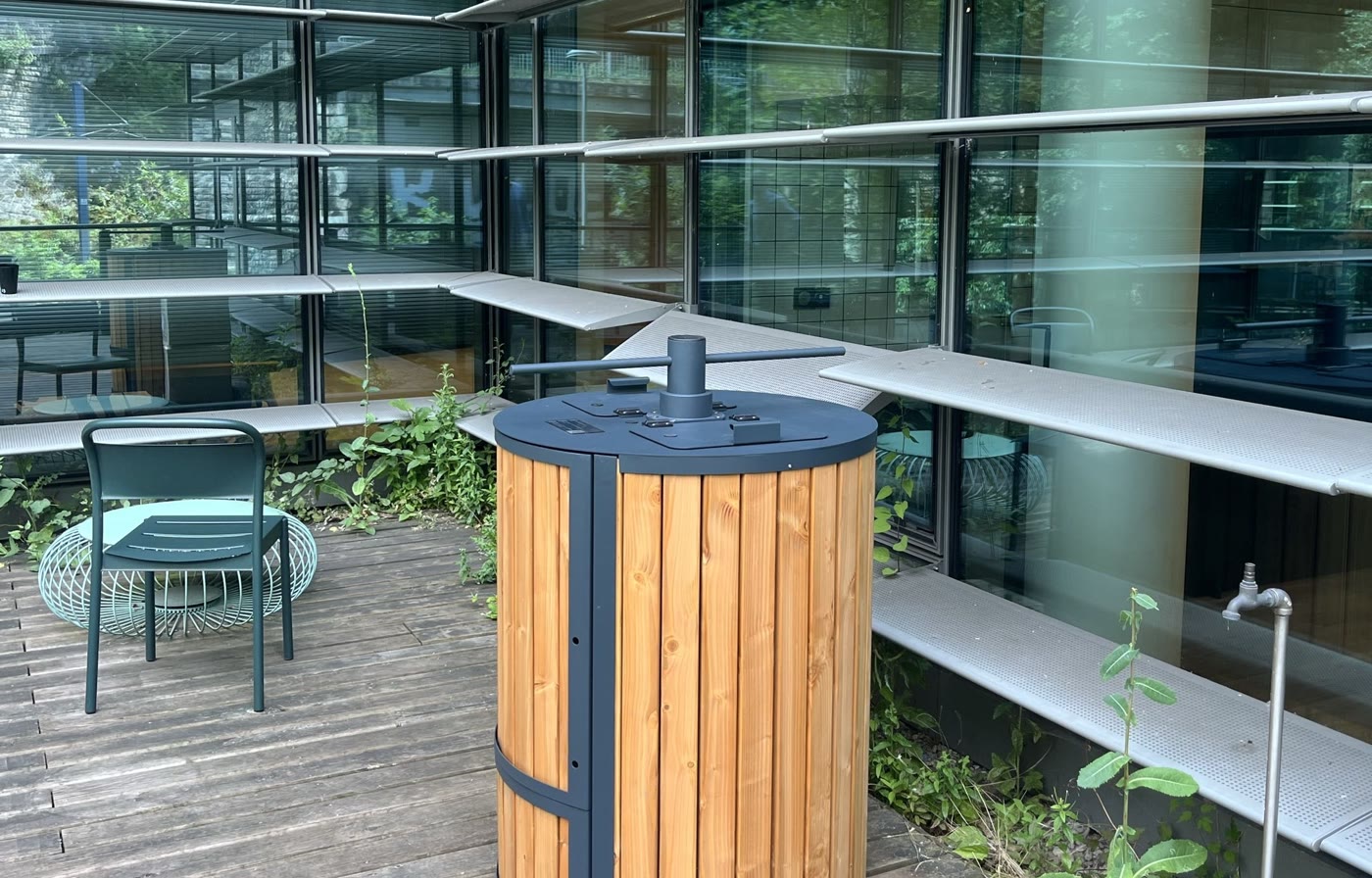
. Here are the two systems line by line, the worm composter on one side and the ABC composter on the other.
| Criterion | Vermicomposting | ABC composter |
|---|---|---|
| Biological agent | Eisenia worms and the micro-organisms of the bed | Bacteria and fungi, aerobically |
| Temperature range | 15 to 25 °C, non-negotiable | A thermophilic rise is wanted, no range to hold |
| Sanitisation | No, a mesophilic process | Yes, through the temperature rise inside the vessel |
| Meat, fish, dairy | Excluded | Accepted, closed vessel |
| Siting | A heated indoor room, in darkness | Outdoors, on a hard surface |
| Connections | None | None: no electricity, no water, no drainage, no groundworks |
| Annual capacity | 300 to 500 kg for about 1 m² of bed | 1,500 kg per composter, 3,000 kg with two |
| Mechanism | Stacked perforated trays, the worms migrate upwards | Perforated aeration chimney, mixing on the crank, lower door |
| Weekly monitoring | Moisture, pH, temperature, density, state of the stock | Load it, two turns of the crank, bulking agent |
| Effect of a mistake | The stock dies, 2 to 3 months out of action | Drift corrected with bulking agent and mixing |
| Output | Worm castings and leachate, to be used up on site | Stabilised material, used on your own grounds or sent out by a local route you arrange |
| Commercial model | Buy the bin and the stock of worms, carry both on the balance sheet, monitor in-house | Rental at 79 € excl. VAT a month, bulking agent, team training and maintenance included, or bought outright; delivered on a pallet and run by your own team after a remote handover |
On the worked example above, the translation is direct. The 520 kg a year of a 150-person head office fit inside a single ABC composter. At those volumes the scale gives 3 emptyings a year, done by your own team in under five minutes each; arranging collection for whatever you cannot use on site is a separate contract, with a waste contractor in your own country. The composter can equally be taken on its own, if the site uses up its own material.
A point of vocabulary, because it comes up in every tender: an ABC composter is not an electromechanical machine. Mixing is done by hand, air moves through the composter by natural draught, and the word "electromechanical" describes the electric dehydrators sold against it, which draw power and do not compost. The three mechanisms are set out in our article on ABC composting technology.
Which sites it holds up on, and which it breaks on
Vermicomposting has real qualities. It is silent, it has no moving parts, it has no smell when it is well run, it goes into an existing room, and it teaches: opening the bin in front of a team does something no dashboard does. For a school, a head office of under 60 people or a charity, it is often the right answer. Its limits are the mirror image: a low volume ceiling, high sensitivity, weekly monitoring that rests on one person, a long restart after any incident, and the exclusion of animal protein, which rules out every kitchen and every hotel from the start.
- The volumes you actually capture stay under 500 kg a year, verified by calculation and not estimated by eye.
- You have an indoor room that never drops below 12 °C and never goes above 28 °C, weekends and holidays included.
- No kitchen, no staff restaurant and no hot meal service feeds the stream.
- A named person, with a stand-in, opens the bed every week and knows what to look for.
- You have a real use on site for the castings and the leachate produced, in grounds or in planters.
- Your peaks (conferences, shutdowns) are anticipated, with somewhere for the material to go in the meantime.
- You accept carrying the investment and the cost of restocking the worms yourself.
If a single one of these lines fails, vermicomposting is not the right tool for that site. Offices and workplaces generally cross the volume ceiling at 120 to 150 people on site; restaurants and hotels are ruled out by the very nature of their waste. That leaves the choice between a site composter and a waste contractor, or, for sites that also want to plant something, the garden composter. If it is fermentation that interests you, bokashi answers a different logic, with limits of its own.
What the law requires, whichever process you choose
The technical choice changes nothing about the obligation. Since 31 December 2023, Article 22 of the Waste Framework Directive 2008/98/EC has required every EU member state to have food waste either collected separately or recycled at source, and each has transposed it in its own way: Ley 7/2022 in Spain, D.Lgs 152/2006 in Italy, the GewAbfV and the KrWG in Germany. Ireland sits inside that framework; the United Kingdom sits outside it and runs four separate regimes. The tonnage thresholds that shaped the previous decade have largely gone, but the text that binds you is the one written for your own market.
A worm composter is a form of recycling at source, one of the two routes on offer, for as long as it absorbs the volumes produced. The problem appears when it no longer does, or when an inspection asks to see the evidence. Penalties are national and are not comparable from one country to the next, so ask your local authority, or your own legal adviser, what applies to your site rather than carrying over a figure from another market.
A word on permits, often brandished to frighten people: thresholds for composting are set nationally and are expressed in tonnes handled per day, not per year. No office site, hotel or shop comes anywhere near them, but confirm the figure that applies where you are. Traceability, on the other hand, is a genuine issue, and it is exactly where an in-house worm composter disappoints: it produces no document on its own. Keep a dated record of what you treat and an annual summary, and check with your local authority what form it expects.
Common questions
How many worms do you need for an office of 50 people?
An office of 50 people with a coffee point captures about 173 kg of food waste a year, or 0.8 kg per working day. Since a worm eats half its own weight a day, you need about 1.6 kg of worms, in the order of 6,400 individuals. Vermicomposting handles that volume. The same office at 150 people captures 520 kg and falls outside the range.
Does vermicomposting satisfy my legal obligations?
In principle yes, in practice no as soon as the volumes exceed what the bed can take. Article 22 of the Waste Framework Directive 2008/98/EC requires food waste across the EU to be collected separately or recycled at source, and worm composting is a form of organic recycling. What is missing is the proof: a worm bed produces no document you can put in front of an inspector, whereas an inspection asks for a written record. Keep a dated log of what you treat, and confirm with your local authority what it expects to see.
Can meat and fish go into a worm composter?
No. Vermicomposting is a mesophilic process: the bed stays between 15 and 25 °C, so there is no sanitisation at all. Animal protein and dairy ferment there, attract pests and acidify the medium. A closed commercial vessel accepts them, because the temperature rise treats them: the detail is in our list of what goes into a commercial composter.
Can a worm composter be installed outdoors?
In the United Kingdom, Ireland and anywhere with a temperate or cold winter, no: it needs a heated room. Below 10 °C the worms stop feeding, below 0 °C the bed freezes, above 30 °C mortality is rapid. A garden shed or an unheated plant room spends several months a year outside the range. That is the most structural difference with a steel composter installed outdoors, on a hard surface, with no connections at all.
Are worm castings better than compost?
They are two different products. Worm castings are fine and rich in directly available nutrients: they are used in small quantities, for potting or planting. Compost from an aerobic process is coarser and richer in stable organic matter: it improves soil structure over time and is spread by the hectare. The first feeds a planter, the second feeds a field.
Where to start
Start with the one figure that separates the options: the volumes you actually capture over a year. Redo the calculation set out above with your own headcount, your opening days and the way you feed people. Under 300 kg a year, with a heated room and a willing lead, the worm composter is a good decision and you need nobody's help. Between 300 and 500 kg it is doable but tight, and it will only hold if the monitoring holds. Above that, the question is no longer the process, it is the capacity.
If your volumes are over the ceiling, our sizing tool gives you, in a few questions and without signing up, the estimated annual volume for your sector, the number of composters needed and how often the machine will have to be emptied. You can also start by seeing how it works, from delivery to the first emptying.
A free assessment, a quote within 24 h
Thirty minutes on a video call to go over the food waste separation duty that applies where you operate, size the solution and estimate your savings.
