
Resource
What can you put in your compost? The complete list, item by item
What goes into your compost, what does not, and why. With the reference table, the carbon to nitrogen ratio and the rules that apply on a business site.
The short answer
Anything that was once alive will compost, but not everywhere and not at the same speed. In a home composter you can add peelings, coffee grounds, cooked vegetable leftovers, bread, crushed eggshells, dead leaves and unprinted paper without a second thought. Left outside are meat, fish, dairy, oils, animal droppings, diseased plants and every packaging described as “compostable”. In a closed professional composter the list widens considerably: meat, fish and plate leftovers go through without difficulty. The difference is not in the waste, it is in the equipment.
The confusion starts there. A chicken bone is a perfectly compostable piece of food waste under the European definition, Article 3(4) of the Waste Framework Directive 2008/98/EC, and it is still a very bad idea at the bottom of an open heap. 3 parameters decide everything: the balance between carbon and nitrogen, the presence of oxygen and the moisture level. The waste that causes trouble is not “dirty”, it pushes one of those sliders out of balance, or it attracts what has no business being there.
Key takeaways
The right question is not “is it compostable?” but “is it compostable in my equipment?”. The same plate leftover is out of the question in an open garden bin and becomes an ordinary input in a closed vessel ventilated by an aeration chimney.
The reference table, item by item
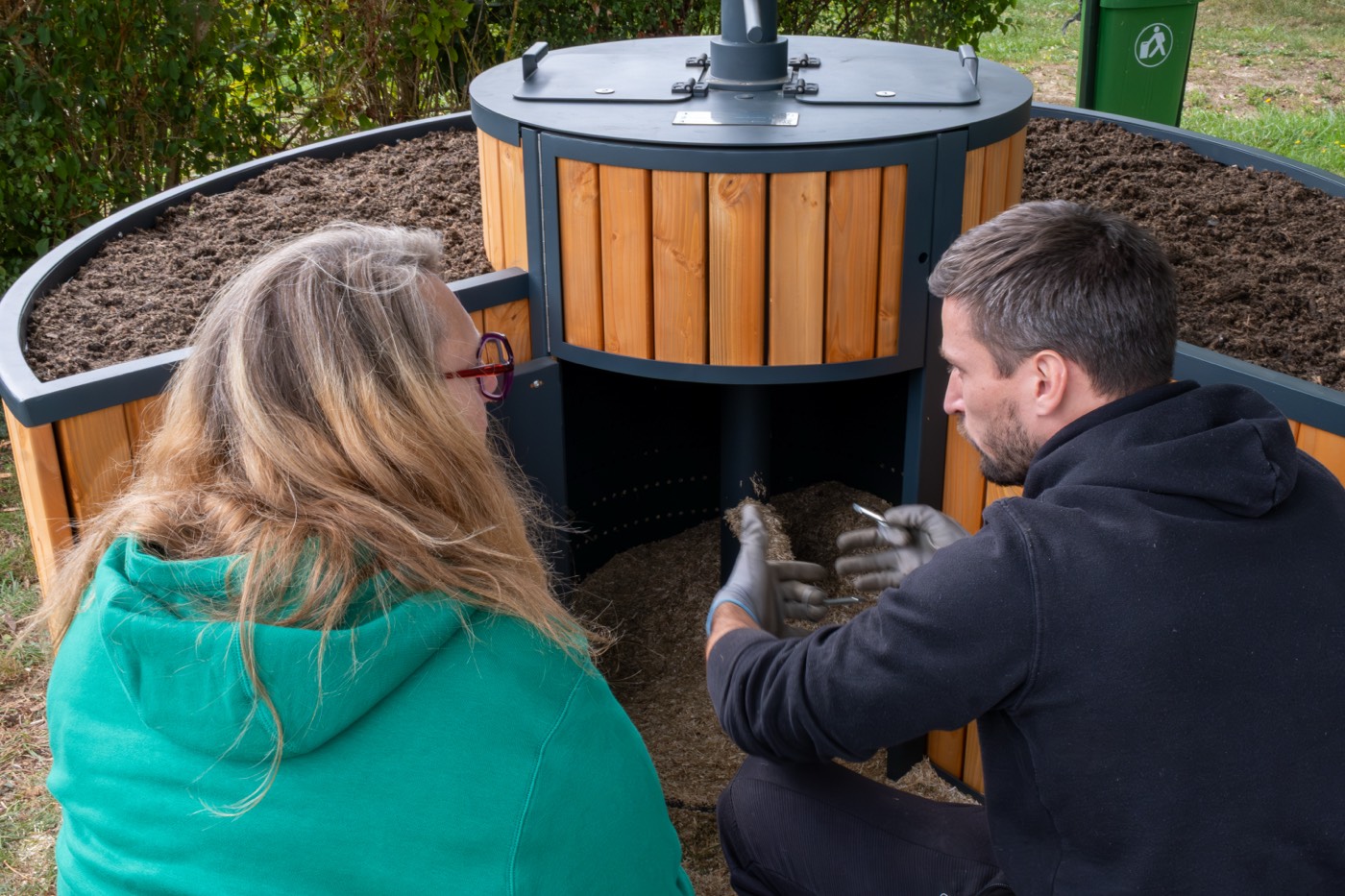
The “home composter” column covers the ordinary heap or bin, open or simply covered, with no lasting rise in temperature. The “closed professional composter” column covers a closed unit, a vessel with mixing and continuous air flow, such as the ABC composter in 2 mm steel installed on the sites we equip.
| Waste | Home composter | Closed professional composter | What is at stake |
|---|---|---|---|
| Fruit and vegetable peelings | Yes | Yes | The nitrogen base of the compost, broken down in a few weeks |
| Coffee grounds and paper filter | Yes | Yes | Nitrogen and fine structure, nothing against it |
| Tea bag with no staple and no mesh | Yes | Yes | Unbleached paper only, the staple goes in the bin |
| Crushed eggshells | Yes | Yes | A calcium input, all but everlasting if left whole |
| Cooked leftovers, rice, pasta, vegetables | In moderation | Yes | In an open heap they attract fruit flies and rodents |
| Bread, biscuits, dry cakes | In moderation | Yes | Crumble them, otherwise they go mouldy in a compact lump |
| Meat, fish, bones | No | Yes | Protein and fat, so sulphurous smells and pests in the open air |
| Dairy products, cheese rinds | No | Yes, in small amounts | Fats slow down microbial colonisation |
| Citrus, garlic, onion | In moderation | Yes | Acidity and antibacterial compounds, dilute them in the rest |
| Kitchen paper and unprinted napkins | Yes | Yes | A free carbon input, already there on site |
| Dead leaves, spent flowers | Yes | Yes | Carbon and structure, crumble them if the leaves are thick |
| Fresh grass clippings | In a thin layer | In measured amounts | Very high in nitrogen and very wet, it packs down and suffocates |
| Stones, nut shells, avocado skin | No | No | 2 to 5 years for a stone, it comes out of the cycle intact |
| Frying oil, fatty sauces | No | No | They coat the material and cut off the oxygen |
| Pet litter and animal droppings | No | No | A health risk, out of place in a shared compost |
| Diseased or recently treated plants | No | No | Pathogens and pesticide residues passed on to the compost |
| Bags and cutlery certified to EN 13432 | No | No | A standard written for industrial composting |
| Cigarette butts, coal ash, vacuum cleaner bags | No | No | Plastics, heavy metals and combustion additives |
The detailed version for a business site, signage included, is set out in our guide to what to put in a professional composter.
The carbon to nitrogen ratio, the rule that lets you decide on your own
Behind the words “greens” and “browns” sits a number: the proportion between the carbon (C) and the nitrogen (N) of what you add. Carbon is the energy of the micro-organisms, nitrogen their building material. A mix works well around 25:1 to 30:1, that is far more carbon than nitrogen by mass. Yet kitchen waste, which makes up most of the daily inputs, sits entirely on the nitrogen side.
| Material | Indicative C/N ratio | Role in the mix |
|---|---|---|
| Fresh grass clippings | 15 to 25 | Nitrogen |
| Fruit and vegetable peelings | 15 to 25 | Nitrogen |
| Coffee grounds | around 20 | Nitrogen, despite its brown colour |
| Dead leaves | 40 to 80 | Carbon |
| Straw | 80 to 100 | Carbon and structure |
| Brown cardboard, unprinted paper | 150 to 400 | Carbon |
| Wood chip, untreated sawdust | 200 to 500 | Carbon and structure |
These values are agronomic orders of magnitude: species, season and moisture shift them by a third. What matters is the direction of the correction, not the decimal. Too much nitrogen and the heap turns wet and packed, it smells of ammonia. Too much carbon and it sets solid, nothing happens for months.
The field rule fits in one sentence: a caddy of fresh food waste, a handful of bulking material on top. That is what is delivered and restocked with the composter subscription, because running short of bulking material is the leading cause of failure on the sites we take over.
Oxygen and moisture, the conditions everyone forgets
Composting is an aerobic process. Without oxygen, anaerobic bacteria take over and produce methane, sulphur compounds and a blackish liquor: that is not slow compost, it is fermentation. Hence 3 moves that cost nothing: mixing every 10 to 15 days in a garden bin, never dropping a thick layer of wet material in one go, and alternating fresh inputs with dry ones.
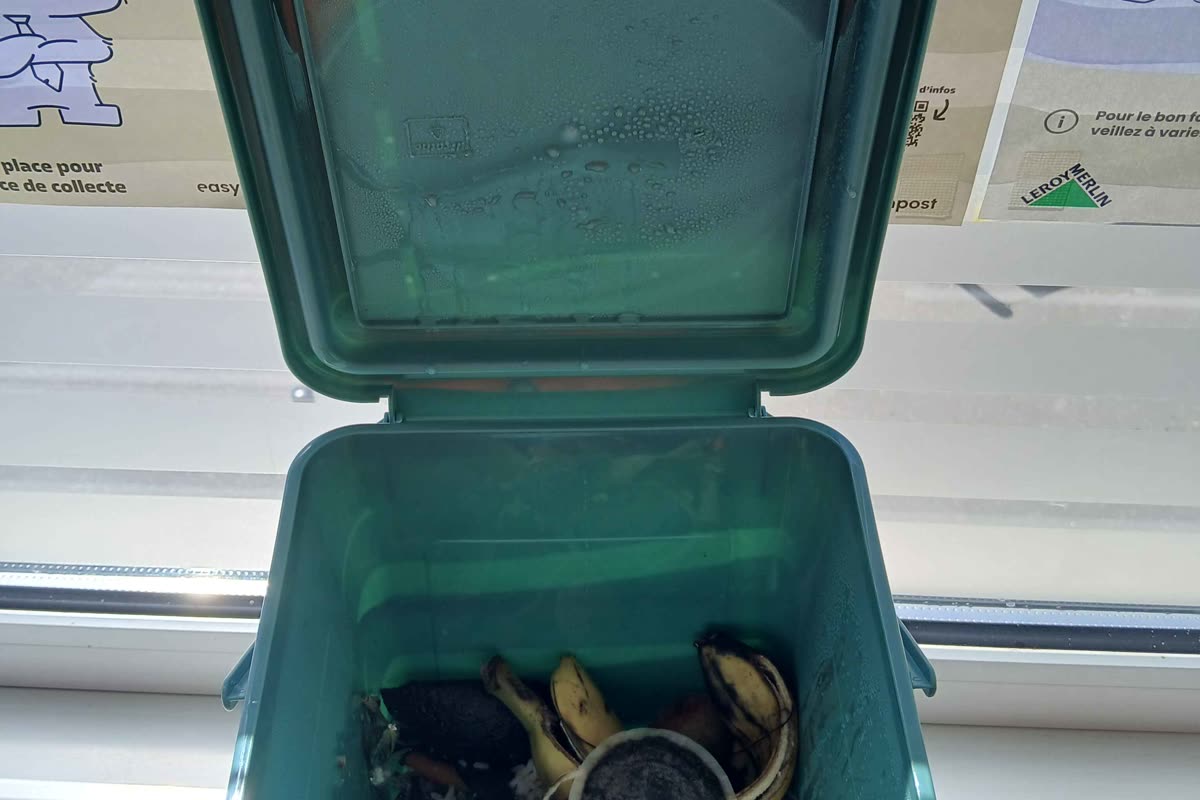
The target moisture is that of a wrung-out sponge: the material clings when you press it, without a drop escaping. Too dry and it stops; too wet and it drives the air out. The causes of excess are always the same: too much fruit and vegetable without bulking material, no absorbent cardboard, rainwater getting in through a badly designed lid.
That is what a closed unit settles. The ABC composter is a 2 mm steel vessel with a closed base and a solid lid, standing on a hard surface: the rain does not get in, and the liquor does not go into the ground. Air circulates continuously through an aeration chimney and the mixing is done by hand, with no electricity, no water, no drainage and no groundworks. The mechanism is set out in our article on ABC composting, and its effect on odours in the one on composting without odour or pests.
Meat, citrus, oil: what really causes trouble
4 families account for most of the refusals, each for a different reason.
Animal matter (meat, fish, dairy) is rich in protein and fat. It breaks down through bacteria that produce sulphur compounds, and the smell carries a long way: in an open heap it brings rats and crows within days. The problem is not the material, it is access, as our article on rodent-proof composters explains.
Liquid fats (frying oil, sauces in quantity) pose a mechanical problem, not a biological one: they form a film around the particles that blocks water and oxygen. An oily plate changes nothing, the bottom of a fryer suffocates a whole zone.
Acidic or antibacterial matter (citrus in excess, garlic, onion) is not banned, it needs diluting: a compost whose pH drops too low slows down. A crate of orange peel in one go breaks the rhythm, the peelings from one lunch do not.
Matter carrying a health or chemical risk (diseased plants, treated greenery, pet litter, cigarette butts, coal ash) is the only category excluded whatever the equipment. A home compost does not hold 40 to 50 °C for long and therefore does not destroy pathogens: that is the job of the thermophilic phase, described in our article on the phases and temperatures of the composting cycle.
Bioplastics and “compostable” packaging, the grey area
This is the question that comes up most often, and the one where the intuitive answer is wrong: packaging marked “compostable” is almost never compostable at home. The EN 13432 standard qualifies a material for industrial composting, a process that holds a temperature of around 60 °C for several weeks, with intense mixing and controlled moisture. Neither a home composter nor an on-site composter reproduces those conditions.
| Packaging | Home composter | On-site composter | Why |
|---|---|---|---|
| Tea bag in unbleached paper | Yes | Yes | Fibre alone, no film and no glue |
| Tea bag with a staple or a mesh | No | No | Metal or polymer that stays intact |
| Cardboard hot drink cup | No | No | Plastic lining inside |
| Kraft fast food box | Check first | Check first | Often lined, often greasy |
| Untreated, ungreasy kraft bag | Yes | Yes | A good source of carbon |
| Bag or cutlery certified to EN 13432 | No | No | Needs a hot industrial process |
| Marked “OK compost HOME” | Worth testing | Not recommended | Slow, uneven breakdown, and a muddled instruction |
| Film based on maize or cassava starch | No | No | It fragments without being digested |
The most reliable test takes one gesture: tear the cardboard. If the torn edge shows a shiny film that stretches instead of breaking, it is a plastic lining. That film does not disappear, it breaks down into microplastics that stay in the compost, then in the soil. On a business site this rule deserves to be posted as pictograms rather than as text, as our method for getting your teams to adopt food waste separation explains.
Plants, leaves and flowers, the garden exceptions
Garden waste is the most available and the most poorly used source of carbon. Dead leaves, spent flowers, fine prunings and house plants at the end of their life are all welcome. 3 categories are the exception. Thick, waxy leaves, laurel, oak, magnolia, hold out for whole seasons because their cuticle protects the fibre: they have to be shredded. Diseased plants spread their pathogens. Recently treated greenery carries its residues right into the soil.
That leaves the special cases. Stones and nut shells take 2 to 5 years to break down: they are not harmful, they are simply outside the cycle. Wood ash, strongly alkaline, is tolerated in occasional handfuls, never by the bucket; coal ash never. Untreated wood chip is an excellent bulking material. Textiles in natural fibres compost in theory, in years in practice, and only once cut up.
When the volume of greenery outstrips the kitchen waste, composting changes scale: this is the ground of the garden composter, a circular planter of 2,000 L that takes clippings and prunings along with food waste.
Home, industrial, on site: 3 settings, 3 lists
The same material does not meet the same fate depending on the route that receives it: that is why the instructions found online contradict each other. Home composting, in a garden bin, a worm composter or a bokashi bucket, works at low volume and variable temperature, between 15 and 50 °C depending on the season. Effective, free, fragile: its list of accepted items is the most restrictive.
Industrial composting, on a dedicated platform, climbs to 70 °C with heavy mixing. It destroys pathogens, breaks down certified packaging and takes almost everything, but it assumes the material is collected, transported and massed together.
On-site composting sits in an in-between position that is often misunderstood. The closed vessel, ventilated by its aeration chimney and mixed by hand, takes all food waste, including what a garden heap refuses. It does not, however, replace the industrial stage: after a few months, what comes out of the composter is not a mature, standard-compliant compost. It is taken away, sanitised at a facility permitted for it, then spread by an operator you contract locally, alongside the full run-through of the service. 2 variants are worth knowing before you decide: vermicomposting, suited to very small volumes, and bokashi, which is a fermentation rather than a composting process.
In a business, the question changes nature
For a household, sorting badly means a failed compost. In a business it opens a compliance gap. Across the European Union, Article 22 of the Waste Framework Directive 2008/98/EC has required since 31 December 2023 that food waste be either collected separately or recycled at source, whoever produces it. Which of the two routes applies to your establishment, and on what terms, follows from the national transposition of that article.
The penalties themselves belong to national law and differ from one country to the next: the amounts in force in France carry no weight across a border. In the European Union the duty comes from Article 22 of the Waste Framework Directive 2008/98/EC and from its transposition, Ley 7/2022 in Spain, D.Lgs 152/2006 in Italy, KrWG and GewAbfV in Germany, AWG 2002 in Austria; the United Kingdom sits outside the directive and runs 4 separate regimes. What your own establishment faces is a matter for your national authority, and our guide to the French framework sets out the French case.
A site’s list of accepted items is therefore not a preference, it is an instruction that has to fit inside a pictogram above a caddy. It follows from the volumes, which also drive the sizing: a 450 L ABC composter takes up to 1,500 kg a year, beyond that you install a second one, and beyond 3,000 kg a year on-site composting is no longer the right answer. Here is the calculation for an office building with a coffee point, following the method behind our online quote.
The maths
- People on site on a normal day 120
- Working days used 220 a year
- ADEME office ratio (France), uplifted for the coffee point 0.015 kg × 1.5 per person per day
- Theoretical volumes 594 kg a year
- Realistic capture rate used 70 %
- Volumes actually captured 416 kg a year
- Compost removals over the year 2
- Rent of the ABC composter, everything included 79 € excl. VAT per month
- Collection, 10 € excl. VAT a month per annual visit, French benchmark 20 € excl. VAT per month
Total99 € excl. VAT per month
The 79 € cover the composter delivered, the bulking material, maintenance and training for the teams by video call; reporting comes with the collection option. The equipment is rented over 48 months at that rate, and buying one is possible: talk to us and we will quote it. Collection is an option in France, from 1 to 12 visits a year, a number that follows from the volumes rather than from a choice; elsewhere the removal of the mature compost is arranged with the local operator of your choice. To put in your own figures, see our method for working out food waste volumes and the offices and workplaces page.
- Was the waste once alive? If not, it has no place in a composter.
- Is it fatty, oily or drowned in sauce? Fats cut off the oxygen.
- Is it printed, shiny or plastic-coated? Shiny cardboard is lined cardboard.
- Is it bigger than an apple? Cut it up: the exposed surface sets the speed.
- Has a handful of bulking material been added on top of the fresh input?
- Is the instruction posted as pictograms, right next to the caddy?
- Still in doubt? Leave it out. A compost is hard to repair, a bin is easy to empty.
Common questions
Can you put coffee grounds and tea bags in the compost?
Yes. Coffee grounds are rich in nitrogen and break down quickly, paper filter included. Tea bags compost if they are unbleached paper, with the staple and the tag removed. Bags in so-called “silk” mesh are polymer and have no place in a composter.
Do meat and fish compost?
It depends on the equipment. In an open heap or garden bin, no: the smells carry and the pests arrive. In a closed professional composter, a steel vessel with a solid lid and an aeration chimney, yes, provided you balance it with bulking material.
Do “compostable” bags go in the compost?
No, unless they state home composting explicitly, and even then with caution. The EN 13432 standard targets industrial composting, around 60 °C for several weeks. Neither a garden bin nor an on-site composter reaches those conditions: the bag stays visible for months, or breaks into microplastics.
Why does my compost smell bad?
A smell of ammonia or of rot almost always signals an excess of nitrogen and moisture, and so a lack of oxygen. The reflex is to add bulking material, unprinted cardboard, dead leaves or wood chip, then to mix. A smell of woodland floor, on the contrary, is the sign that all is well.
Should you cut waste up before putting it in the compost?
Yes, as soon as an item is bigger than an apple. Micro-organisms attack from the surface: dividing a piece by 2 speeds up its breakdown noticeably. That is why a crushed eggshell disappears within months while a whole shell goes through several cycles.
What comes next depends on your situation. At home there is nothing more to decide: the table above is enough, add a handful of bulking material with every fresh input and mix every 15 days. On a business site, the list of accepted items only settles once the volumes are known, since they set the number of composters and the rhythm of removal. Allow 2 minutes to get the full figures with the online quote, and We also recycle your cigarette buttsthe site FAQ for the rest.
A free assessment, a quote within 24 h
Thirty minutes on a video call to go over the food waste separation duty that applies where you operate, size the solution and estimate your savings.
